


If you searched “45Q tax credit” hoping to find a way to cut your tax bill through energy investing, you’re closer to the right answer than the label suggests. In this article, that phrase refers to something specific: the front-loaded deductions accredited investors capture through direct working-interest positions in U.S. oil and gas wells, not the federal carbon-capture credit that shares the same numeric name in the tax code.
Here’s the headline number. Investors who structure a working interest correctly can often see 60 to 80 percent of their capital classified as intangible drilling costs, deductible against ordinary income in the very first year. After that, percentage depletion, roughly 15 percent of gross income under IRC §613A, keeps sheltering income for as long as the well produces.
That’s the opportunity. It comes with real strings attached:
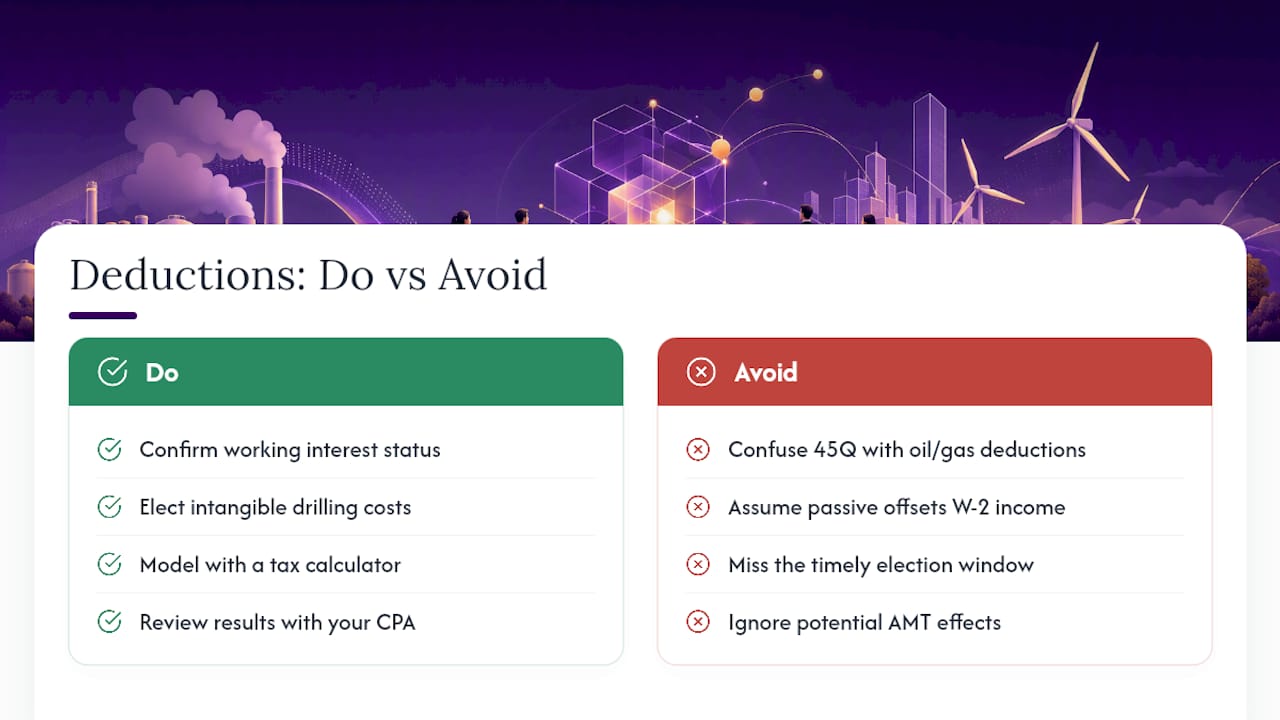
- Your ownership structure has to qualify as a working interest, not a passive limited interest.
- The election to expense IDCs is binding and time-sensitive.
- The Alternative Minimum Tax can claw back part of the benefit.
- None of this matters if the operator running the well isn’t competent.
Key Takeaways
Working-interest oil and gas investments can convert 60 to 80 percent of invested capital into a first-year ordinary-income deduction through the IDC election, followed by ongoing percentage depletion during production.
| Point | Details |
|---|---|
| IDCs drive the first-year number | Labor, fluids, and site prep typically make up 60 to 80 percent of a well’s cost and are deductible in year one under a binding election. |
| Depletion shelters income after that | Percentage depletion allows a 15% deduction on gross income, even after basis is fully recovered. |
| Ownership form decides everything | Only a true working interest gets nonpassive treatment under Section 469©(3); limited interests often trap losses as passive. |
| Timing and AMT can erode the benefit | Confirm the spud date in writing, and watch for AMT preference treatment on excess IDCs. |
| Fieldvest supports the process end to end | Fieldvest sources vetted operators, provides deal documentation, and offers a free tax deduction calculator to model your own scenario before you fund. |
Table of Contents
- How Intangible Drilling Costs Generate Large First-Year Deductions
- Percentage Depletion: How Post-Production Income Gets Sheltered
- Who Qualifies: Working Interest vs. Limited Interest
- Timing, Elections, and the Traps That Erode the Benefit
- Due Diligence: What to Verify Before You Fund
- Estimating Your Tax Impact: A Worked Example
- What Section 45Q Actually Covers (And Why It’s a Different Credit)
- Who Qualifies for Section 45Q Credits
- Claiming the Credit: Forms and Documentation
- How 45Q Interacts With Other Energy Tax Incentives
- Recent Legislative Changes Affecting Section 45Q
- Fieldvest: Turning IDC and Depletion Strategy Into an Actual Investment
- Why Deal Quality Beats Tax Engineering Every Time
- Frequently Asked Questions
- Sources
How Intangible Drilling Costs Generate Large First-Year Deductions
Intangible drilling costs, IDCs for short, cover the portion of drilling spend that has no salvage value once the well is finished. Labor, drilling fluids and mud, site preparation, hauling, and fuel all qualify. You can’t resell a bulldozed access road or recover the diesel burned running a rig, so the tax code treats these costs as fully expendable, and Treas. Reg. §1.612-4 allows them to be deducted rather than depreciated.
Statistic: Industry data consistently shows that 60 to 80 percent of a well’s initial cost lands in the intangible bucket, with the remaining share going toward tangible equipment like casing, wellheads, and tanks, which gets depreciated instead under standard MACRS schedules.
The mechanics matter as much as the math. Here’s the sequence that actually determines whether you get the deduction:
- The operator or fund allocates costs between intangible and tangible categories, ideally documented in writing before you fund.
- You (or the entity you invest through) make an election under IRC §263© to expense IDCs in the year incurred, rather than capitalize and amortize them over 60 months.
- That election is binding going forward for future wells under the same election, so it isn’t a decision to make casually each year.
Before wiring money, confirm three things in writing: how the sponsor allocates IDCs, whether their accounting has held up under audit before, and the actual drilling schedule for your specific well.
Percentage Depletion: How Post-Production Income Gets Sheltered
Once a well starts producing, the tax benefit shifts from IDCs to percentage depletion. Under IRC §613A, independent producers and royalty owners can deduct 15% of gross income from the property, and unlike cost depletion, this deduction can continue even after you’ve recovered your full basis in the investment.
That’s the feature most first-time investors miss. Cost depletion caps out once your basis hits zero. Percentage depletion doesn’t care about basis at all, it’s calculated straight off gross income, which means a well that keeps producing keeps generating a deduction indefinitely.
It isn’t unlimited, though. Watch for these caps:
- The deduction generally can’t exceed 100% of the taxable income from the property before depletion.
- Independent producers face a daily production cap tied to barrels of oil equivalent.
- Depletion in excess of basis can itself become an AMT preference item in certain situations.
The realistic tax arc looks like this: a large ordinary-income deduction from IDCs in year one, modest depreciation on tangible equipment over the following several years, then a smaller but recurring depletion shelter for as long as the well produces at commercial volumes.
Who Qualifies: Working Interest vs. Limited Interest
This is the detail that separates investors who actually use these deductions from investors who watch them evaporate. A working interest gives you a direct operating stake in the well, along with direct exposure to costs and liability. Under the Section 469©(3) working-interest exception, losses from that interest are treated as nonpassive, meaning they can offset your W-2 income, business income, or capital gains.
Limited partnership units and many LLC structures work differently. If your liability is limited, the IRS generally treats your losses as passive, which means they can only offset passive income, not your salary or your medical practice’s earnings. That’s the tradeoff: more liability protection almost always means less usable deduction.
Before committing capital, confirm:
- Whether the offering document explicitly structures your position as a working interest.
- How liability is allocated among partners under the joint operating agreement.
- Whether your K-1 reports losses as passive or nonpassive.
Pro Tip: Read the K-1 language before you read the pitch deck. A sponsor can call something a “working interest” in marketing copy while the actual tax treatment on your K-1 says otherwise. The document that matters is the one the IRS sees.
Timing, Elections, and the Traps That Erode the Benefit
Getting the deduction into the right tax year depends on when the well is actually spudded, meaning when drilling physically begins, not when you wire funds. Fund in December for a well that doesn’t spud until February, and you likely push the deduction into the following year.
Four issues trip up otherwise sound investments:
- Timing mismatch. Confirm the spud date in writing before funding late in the year; verbal assurances from a sponsor don’t hold up under audit.
- AMT exposure. Excess IDCs beyond 65% of net oil and gas income can become an AMT preference item, reducing your realized benefit.
- Dry-hole elections. If a well comes up dry, you need a specific, timely election to deduct those costs as an ordinary loss. Miss it, and you may be forced into a far less favorable recovery method.
- K-1 timing. Entity-level elections made by the operator flow through to your K-1, sometimes later than your own filing deadline wants.
Statistic: Financial press coverage has noted that year-one write-offs can top 80% of invested capital in well-structured working interests, alongside a clear warning about unlimited liability exposure that comes with that structure.
Due Diligence: What to Verify Before You Fund
Tax treatment is only valuable if the underlying well produces. A large deduction attached to a dry hole from an incompetent operator is still a loss, just a partially subsidized one.
Start with the operator. Ask for a documented track record across prior wells, audited historical drilling costs, and evidence of adequate bonding and insurance. Review the joint operating agreement for how costs, liability, and decision-making authority are split among working interest holders.
Then look at the economics independent of tax benefits. Commodity price volatility affects your revenue regardless of what you deducted. Dry-hole probability varies enormously by basin and formation, and reputable operators will disclose their historical success rate rather than dodge the question. Capital calls for additional development work are common in multi-well programs, and liquidity is limited. You’re not going to sell a working interest on a Tuesday afternoon the way you’d sell a stock.
Documents worth requesting before you wire a dollar:
- A written IDC allocation schedule specific to your well or program.
- The projected spud date and drilling timeline.
- The operating agreement governing your working interest.
- Proof of insurance and bonding for the operator.
Vague drilling schedules, missing IDC detail, or fuzzy overhead allocation language are red flags worth walking away from.
Estimating Your Tax Impact: A Worked Example
Numbers make this concrete. Say you commit $100,000 to a working interest, and 75% of that gets classified as IDCs, a fairly typical split within the 60 to 80 percent range reported industry-wide.
- Year one: $75,000 in IDCs deducted against ordinary income. At a 37% marginal federal rate, that’s roughly $27,750 in tax savings, bringing your effective net cost down to about $72,250.
- Years two through five: The remaining $25,000 in tangible costs depreciates on a MACRS schedule, providing smaller annual deductions.
- Ongoing production years: Percentage depletion shelters roughly 15% of gross income from the well, continuing even after you’ve recovered your basis.
These figures are illustrative, not a projection for any specific deal. Real outcomes depend on your marginal rate, AMT exposure, and passive-loss rules tied to your ownership structure. Run your own numbers on Fieldvest’s Free Oil & Gas Tax Deduction Calculator and walk the output through with your CPA before committing capital.
What Section 45Q Actually Covers (And Why It’s a Different Credit)
Because the phrase “45Q tax credit” also surfaces search results for an entirely separate program, it’s worth being precise about what that other credit is, so you don’t confuse it with the working-interest deductions covered above.
Section 45Q of the Internal Revenue Code is a federal tax credit for capturing and permanently storing carbon dioxide or other qualifying carbon oxides, typically from industrial facilities, power plants, or direct air capture projects. It rewards facilities that either sequester carbon in secure geologic storage or use it for enhanced oil recovery and other qualifying utilization.
The credit amount is calculated on a per-metric-ton basis, and it scales up over a defined period after a facility is placed in service, with higher rates generally available for direct air capture projects and secure geologic storage compared to enhanced oil recovery or other utilization pathways. Eligible facilities have to meet minimum annual capture thresholds that vary depending on the type of facility, industrial source, or direct air capture unit involved.
This credit is administered separately from the working-interest oil and gas deductions this article focuses on, and it targets a different taxpayer profile entirely, typically the industrial facility or capture project developer, not a passive accredited investor buying into a drilling program. If your interest is specifically in carbon capture infrastructure investment, that’s a distinct asset class from the direct working-interest oil and gas positions discussed here.
Who Qualifies for Section 45Q Credits
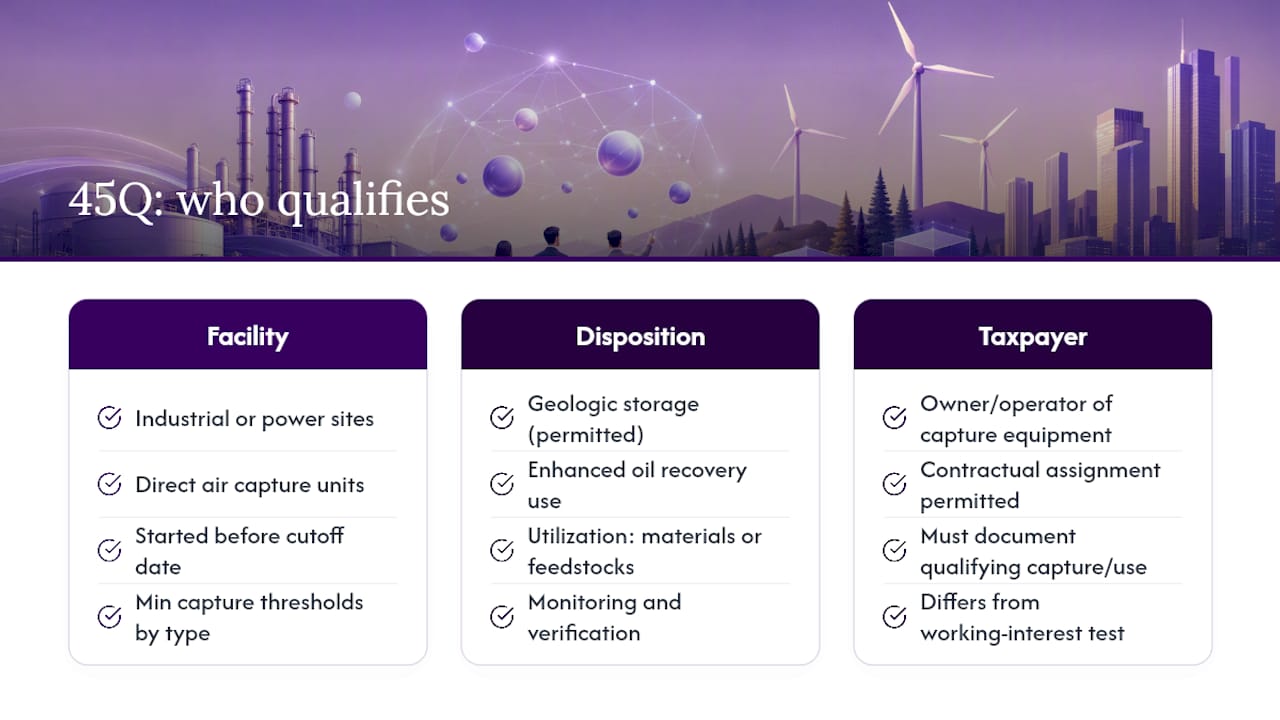
Eligibility for the carbon capture credit hinges on three things: the facility, the carbon handling, and the taxpayer claiming it.
Qualified facilities are industrial or power generation sites, or direct air capture equipment, that began construction before a statutory cutoff date and meet minimum capture volume thresholds set by facility type. A coal or natural gas power plant faces a different minimum threshold than a direct air capture unit, and the rules distinguish between new construction and retrofits of existing equipment.
The captured carbon then has to go somewhere specific to count. Secure geologic storage, meaning injection into a permitted underground formation with monitoring and verification requirements, qualifies. So does use in enhanced oil recovery operations or other approved utilization pathways, such as converting captured carbon into building materials or chemical feedstocks, though utilization pathways carry their own documentation standards to prove the carbon was actually put to a qualifying use rather than released.
Qualified taxpayers are generally the entities that own the capture equipment and physically capture the qualifying carbon oxide, though the credit can be contractually assigned to a party that disposes of, injects, or utilizes the carbon under specific agreements. This is a fundamentally different qualification pathway than the working-interest ownership test that determines whether an oil and gas investor gets nonpassive tax treatment on IDCs. One is about who owns and operates capture infrastructure; the other is about how an energy investment is legally structured for a passive investor.
Claiming the Credit: Forms and Documentation
Claiming Section 45Q generally runs through Form 8933, Carbon Oxide Sequestration Credit, filed with the taxpayer’s annual federal return. The form requires detailed reporting on the volume of carbon oxide captured, how it was disposed of or utilized, and certification tied to monitoring, reporting, and verification plans required under EPA and Treasury guidance.
Documentation demands are substantial because the credit is volume-based and audited against physical measurement, not a percentage of investment. Facility operators need metering records, third-party verification of injection or utilization volumes, and, for geologic storage, compliance records tied to the applicable underground injection permit. For utilization pathways, additional life-cycle analysis documentation is often required to substantiate that the carbon was converted into a qualifying product rather than simply vented.
Deadlines follow the normal federal tax filing calendar for the entity claiming the credit, though the credit itself can generally be claimed for a defined number of years following the facility’s placed-in-service date, provided capture and disposal continue to meet the qualifying thresholds annually. Missing a year’s documentation doesn’t necessarily disqualify future years, but it does create an audit gap that’s hard to reconstruct after the fact.
None of this documentation burden applies to the working-interest deductions covered elsewhere in this piece. IDC elections and percentage depletion run through your individual or entity tax return using standard Schedule C or K-1 reporting, not a specialized volume-verification form.
How 45Q Interacts With Other Energy Tax Incentives
Carbon capture projects frequently stack Section 45Q with other federal incentives, and the interaction rules matter because double-dipping on the same expenditure isn’t generally permitted. A facility claiming 45Q for captured carbon typically can’t simultaneously claim certain other credits for the same capture equipment if those credits were calculated against the same qualifying costs.
Facilities also need to coordinate 45Q with any state-level carbon capture or clean energy incentives, since state programs sometimes require the facility to forgo or reduce the federal credit claim, or vice versa, depending on how the state statute is written. This is a jurisdiction-specific determination that varies significantly from one state to the next.
For direct air capture projects specifically, there’s often overlap consideration with broader clean energy tax credit categories, since a facility might technically qualify for multiple pathways depending on its ownership structure and how it monetizes the captured carbon. Transferability provisions, meaning the ability to sell the credit to an unrelated taxpayer for cash, have also become a significant factor in how project developers structure financing, since it allows a capture facility without sufficient tax liability of its own to still monetize the credit rather than losing its value.
This is a specialized area of tax and energy law that typically requires dedicated legal and accounting counsel with carbon capture project experience, distinct from the tax advisory needed for a working-interest oil and gas investment.
Recent Legislative Changes Affecting Section 45Q
Section 45Q has been amended multiple times since its original enactment, generally in the direction of higher credit values per ton and expanded eligibility for direct air capture and smaller-scale facilities. Legislative changes have also adjusted construction start deadlines, meaning the window during which a facility needs to begin construction to qualify under a given rate structure.
Transferability rules represent one of the more significant recent structural changes, allowing eligible taxpayers to sell 45Q credits to unrelated parties, which has materially changed how carbon capture projects raise capital compared to earlier years when the credit could only be used by the entity that earned it.
Given how frequently the construction deadlines, credit rates, and transferability mechanics get revisited in federal energy legislation, anyone evaluating a carbon capture project for its own sake needs to confirm current statutory language and effective dates directly with a tax professional or the IRS rather than relying on older summaries. That volatility is another reason this credit belongs in a different risk and planning category than the working-interest deductions accredited investors use for direct oil and gas positions.
Fieldvest: Turning IDC and Depletion Strategy Into an Actual Investment
Understanding IDCs and depletion is one thing. Finding a well-run project where the paperwork actually supports the deduction is the harder part, and it’s the part most investors underestimate.

Fieldvest connects accredited investors with vetted U.S. oil and gas operators, and every deal on the platform comes with the documentation that actually matters for your tax position: IDC allocation schedules, drilling timelines, and operating agreements you can hand directly to your CPA. Fieldvest also publishes educational guides on structuring these investments correctly, because the tax benefit only holds up if the ownership form and election timing are right from day one.
Before you commit capital anywhere, run your numbers on the Free Oil & Gas Tax Deduction Calculator, then bring the output to your tax advisor alongside the offering documents. If the math and the deal both check out, explore current vetted opportunities on Fieldvest to see what’s available this quarter.
Why Deal Quality Beats Tax Engineering Every Time
The tax mechanics in this article are real, and they’re powerful when used correctly. But I’ve watched too many smart investors get seduced by the deduction number and skip the harder question: is this actually a good well, run by an operator who knows what they’re doing?
The deduction just means the government subsidized part of that loss, it didn’t turn a bad investment into a good one. Vet the operator first. Confirm the tax structure second.
Pro Tip: If you’re funding late in the year to catch a current-year deduction, get written confirmation of the spud date before you wire money. A verbal promise that drilling “will start any day” isn’t documentation the IRS will accept if your timing gets questioned.
Frequently Asked Questions
Is the “45Q tax credit” the same thing as oil and gas tax deductions? No. Section 45Q is a separate federal credit for carbon capture and storage projects. The large first-year tax benefits accredited investors pursue through direct oil and gas investing come from IDC deductions and percentage depletion, an entirely different part of the tax code.
How much of my investment can actually be deducted in year one? Industry data commonly points to 60 to 80 percent of a well’s cost qualifying as intangible drilling costs, deductible against ordinary income in the year the well is drilled, provided you hold a qualifying working interest and make the proper election.
Can I use these deductions against my W-2 income? Only if your ownership qualifies as a working interest under the Section 469©(3) exception. Limited partnership interests and many LLC structures generate passive losses instead, which can’t offset salary or business income.
What happens if the well I invested in turns out to be dry? You need a timely, specific election to deduct those costs as an ordinary loss. Miss that election window, and you may be forced into less favorable recovery treatment for the same expense.
Does the Alternative Minimum Tax affect these deductions? It can. Excess intangible drilling costs beyond certain thresholds can become an AMT preference item, which reduces the real-world value of the deduction for some investors depending on their overall tax position.
Where can I estimate what my own deduction might look like? Fieldvest’s Free Oil & Gas Tax Deduction Calculator lets you model a hypothetical commitment and see the first-year and ongoing tax impact, which you can then review with your CPA before committing capital.
Sources
- IRS Written Determination excerpts (example guidance on IDC and related rules)
- U.S. Department of the Treasury press release (topic: energy tax guidance)
Recommended

Get the Fieldvest Energy Brief
and AI-driven demand shifts — curated for accredited investors. Smart. Strategic. Tax-advantaged.