

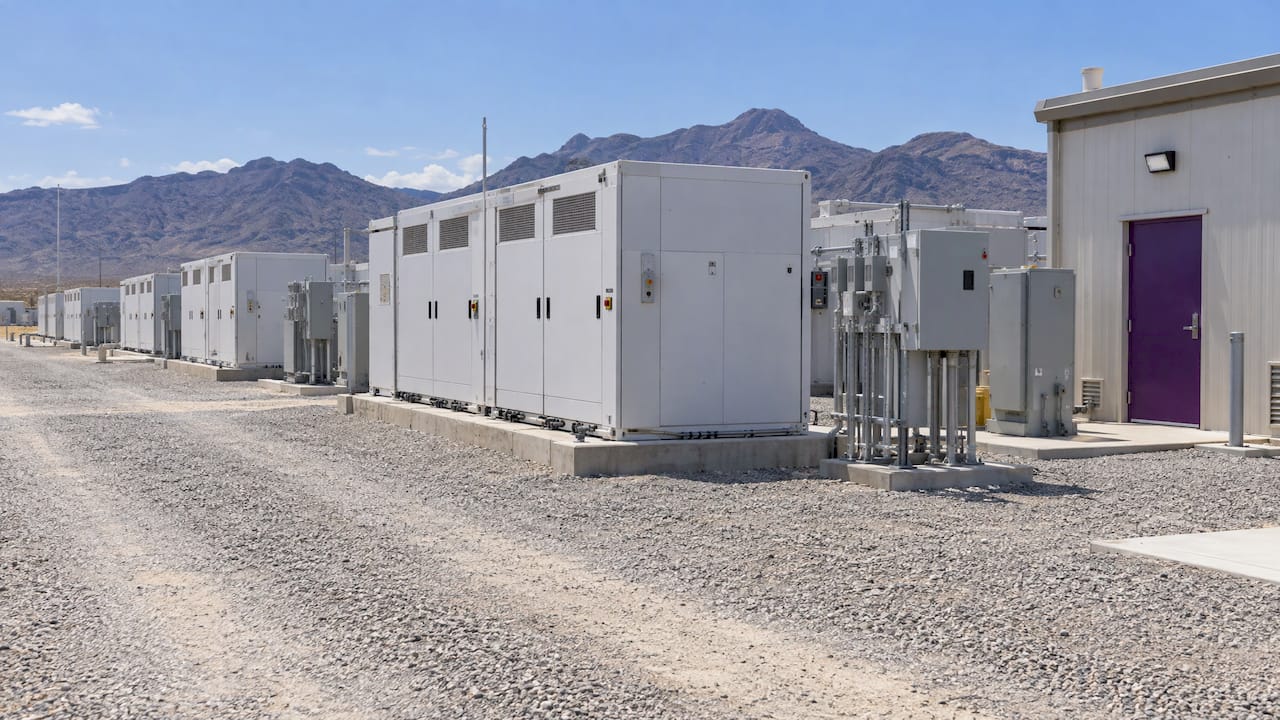
Battery storage carries real federal tax benefits: an investment tax credit of 6% to 30% of a project’s cost, plus accelerated depreciation. But those benefits attach to the owner of the project and depend on construction rules, supply-chain rules and deal structure. For a high earner, the practical question is which structure turns tax benefits into deductions you can use. We built Fieldvest around that question for accredited investors, with vetted U.S. energy projects that include producing assets, development projects and energy infrastructure.
This guide walks through the rules that apply to battery storage in 2026, what they mean for an individual investor with a large tax bill, and how to compare structures before you commit capital.
TL;DR
- Standalone battery storage can qualify for the Section 48E investment tax credit: a 6% base rate, rising to 30% when prevailing wage and apprenticeship rules are met or the system is under 1 MW.
- Two 10-point adders (domestic content and energy communities) can raise the credit further, but foreign-entity sourcing rules can disallow it entirely.
- Depreciation, including 100% bonus depreciation for qualifying property, is a separate benefit that reduces your basis-adjusted deductions and timing.
- Credits flow to the project owner. Individuals usually reach them through tax equity or transfer markets, which are complex and built for large institutions.
- If your goal is a large first-year deduction and long-term energy income, compare direct energy project ownership alongside storage. Confirm any plan with your CPA.
Table of Contents
- How battery storage gets its tax benefits
- Is the 30% credit still available for storage?
- The adders that raise the credit
- Foreign-entity rules: the new compliance risk
- Depreciation: the second benefit
- How an individual actually reaches these benefits
- What this means for a high earner
- A practical checklist before you commit capital
- Where Fieldvest fits
- Our perspective
- FAQ
- Sources
How battery storage gets its tax benefits
Two mechanisms do most of the work, and they behave differently.
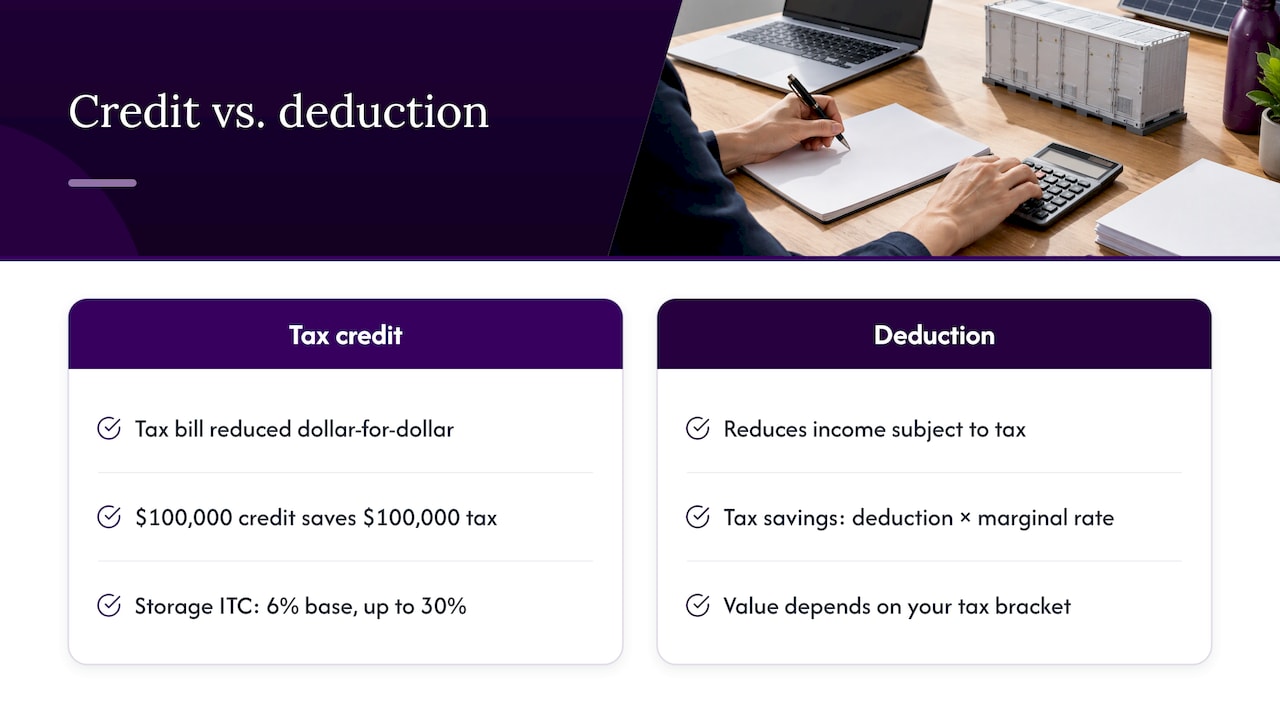
A tax credit reduces your tax bill dollar for dollar. A deduction (depreciation is the main one here) reduces the income your tax is calculated on, so its value depends on your bracket. A $100,000 credit saves $100,000 of tax. A $100,000 deduction saves roughly $100,000 multiplied by your marginal rate.
For storage, the credit is the investment tax credit (ITC) under Section 48E, the clean electricity provision that covers energy storage technology placed in service after December 31, 2024. The IRS Clean Electricity Investment Credit page sets a base rate of 6% of qualified investment, up to 30% (five times the base) for projects meeting prevailing wage and registered apprenticeship requirements.
The credit is calculated by multiplying the applicable percentage by the project’s tax basis, the capitalized cost of the qualifying equipment. IRS Publication 6045 adds that certain interconnection property can be included for systems up to 5 MW.
Is the 30% credit still available for storage?
Yes, for standalone storage that meets the conditions. People searching this often confuse the storage credit with the residential solar credit, which is a different provision. Under Section 48E the 30% rate applies in two cases, according to the Plante Moran analysis published October 20, 2026:
- The project meets prevailing wage and apprenticeship requirements, meaning construction, alteration and repair work is paid at locally prevailing wages and uses registered apprentices.
- The battery system has a maximum electrical output under 1 MW, which exempts it from those labor requirements.
A project that is 1 MW or larger and misses the labor rules falls back to 6%. That fivefold gap is why labor compliance is the first thing to understand about any storage deal.
Standalone storage also kept its position after the 2025 federal budget law. A Minnesota Commerce Department memo from August 15, 2025 concluded that storage projects under Section 48E were not affected by Public Law 119-21 (enacted July 4, 2025), apart from new foreign-entity requirements.
The adders that raise the credit
Bonus credits stack on top of the base rate. Per Publication 6045:
| Adder | Added credit | Core requirement |
|---|---|---|
| Domestic content | 2 or 10 points | U.S.-produced structural steel and iron, plus threshold shares of manufactured product costs |
| Energy community | 2 or 10 points | Project sits in a qualifying area |
| Low-income community | 10 points, or 20 for affordable housing or low-income household projects | Prior allocation from the program |
The energy community adder covers three kinds of area: coal closure communities, brownfield sites and fossil fuel employment areas, as LegalClarity’s April 2026 summary explains. Domestic content thresholds for battery cells, racks, power electronics and cabling rise on a schedule tied to when construction begins.
A project can’t claim both the ITC and the production tax credit on the same property. You choose one. For storage, the ITC is the usual route.
Foreign-entity rules: the new compliance risk
The biggest change in recent rules is the prohibited foreign entity (FEOC) restriction. The Minnesota memo states that for storage projects the material-assistance cost thresholds are 45% for construction beginning in 2026 and 40% for 2027. The prohibited foreign entities are China, Iran, Russia and North Korea. A waiver exists for projects that did significant physical work, or spent at least 5% of final tax cost basis, before December 31, 2025.

Plante Moran’s Josh Bemis stresses that these rules can disallow credits entirely, which makes supply-chain documentation a central risk for storage investors. In practice that means serial numbers, supplier declarations and component origin records that survive an IRS review. Teams that handle batteries at end of life face a related paperwork burden, and battery storage safety and handling rules show how much documentation lithium systems demand across their life.
For you as an investor, the lesson is simple: the headline credit rate means little until you’ve seen the sponsor’s evidence of labor compliance and sourcing.
Depreciation: the second benefit
The IRS cost recovery page says energy storage technology placed in service after December 31, 2024 is five-year MACRS property, with the deduction claimed on Form 4562. MACRS is the standard schedule the tax code uses to recover the cost of equipment over a set number of years.
Bonus depreciation can pull those deductions forward. The IRS announced in Notice 2026-11 on January 14, 2026 guidance on the permanent 100% first-year deduction as amended by the One, Big, Beautiful Bill. According to Blue Flag Solar’s 2026 incentives page, 100% bonus depreciation is restored for qualifying property placed in service on or after January 19, 2025, and the depreciable basis is reduced by 50% of the claimed ITC percentage.
That last point is a worked example worth keeping in mind. On a $1,000,000 system claiming a 30% credit:
- Credit: 30% × $1,000,000 = $300,000 off tax owed.
- Basis reduction: 50% × 30% = 15%, so depreciable basis is $850,000.
- First-year deduction under 100% bonus depreciation: up to $850,000, which at a 37% federal marginal rate would be worth about $314,500.
The example is illustrative arithmetic, not a forecast. Your rate, state taxes and eligibility will differ.
How an individual actually reaches these benefits
This is where most searchers get stuck. The credit belongs to whoever owns the project and has tax liability to use it. There are three common routes, as REGlobal’s August 2026 overview lays out:
- Tax equity. An investor joins a partnership and receives credits, cash flow and depreciation under pre-negotiated terms. ACORE’s 2026 risk profile notes these structures are complex and expensive to set up, and that domestic banks have historically supplied most of the capital. It also says accelerated depreciation typically adds value equal to 10% to 20% of project value.
- Transferability. The project owner sells credits for cash to an unrelated taxpayer. Holland & Knight’s summary of Treasury guidance says the buyer takes the credit and the cash paid is not deductible to the buyer, while the seller does not count it as income.
- Direct pay. Tax-exempt and governmental entities receive the credit value as a payment from the IRS. It requires pre-filing registration, per IRS Publication 5817, so it does not apply to a private individual.
For a W2 professional, founder or physician, each route has the same shape: documentation-heavy, built around institutions, and dependent on how your income is classified. Before putting money into any structure, ask your CPA whether the benefits would offset your type of income, since limits on passive losses and credits can change the outcome.
What this means for a high earner
Treat battery storage tax benefits as one tool among several, not as a free-standing strategy. Four questions sort the options:
- Which benefit do you want? A credit reduces tax directly. A deduction reduces taxable income. Many high earners want deductions in the year of a large income event, such as a stock sale, an exit or a crypto gain.
- Can you use it? A benefit you can’t absorb in the year you invest is worth less to you than its headline figure.
- Who carries the compliance risk? Labor rules, sourcing rules and placed-in-service dates all sit with the sponsor. You need clear evidence the sponsor has met them.
- Does the investment also produce income? A tax benefit is a bonus on top of an asset, not a substitute for one.
Founders facing a large tax bill from a liquidity event can see how this reasoning plays out in our guide on tax-saving energy investments for startup founders. For the broader menu of federal incentives, essential energy tax breaks for investors in 2026 covers more ground, and our piece on what a qualified energy project is defines the terms you will meet in offering documents.
A practical checklist before you commit capital
Whatever energy structure you consider, request and read these items:
- The sponsor’s description of the tax benefit you would receive and in which year.
- The placed-in-service or construction-start date, since rate steps and sourcing thresholds hinge on it.
- For storage: evidence of prevailing wage and apprenticeship compliance, or that the system is under 1 MW.
- For storage: component origin records supporting the foreign-entity thresholds.
- Who files and who holds documentation if the IRS asks.
- How cash flow is distributed and what happens at the end of the project’s life.
Then take the package to your CPA. Tax outcomes depend on your return, and a professional who knows your full picture should confirm them. Our walkthrough on how to qualify for energy tax incentives gives you questions to bring.
Where Fieldvest fits
Fieldvest is a platform where accredited, high-earning professionals invest directly in vetted U.S. energy projects. Deals fall into three categories: producing assets, development projects and energy infrastructure. Our focus is large first-year tax deductions, direct real asset ownership and long-term energy income, supported by portfolio management tools and ongoing investment support.
If you are comparing tax strategies for a high-income year, you can browse the project categories on Fieldvest and see how each is presented. To estimate how deductions could change your compounding, the after-tax wealth projection tool models growth for high earners.

Our guide to depreciation in energy projects explains how those deductions are timed and why that timing matters for a large tax bill.
Our perspective
Battery storage is an exciting part of the energy system, and its tax rules show how much Washington wants private capital in energy. But the rules reward the party that builds, sources and documents a project, and they reward large taxpayers who can absorb credits.
Most high earners we talk to want something simpler: a real asset they can own directly, a meaningful deduction in the year their income spikes, and cash flow after that. That is why we built Fieldvest around vetted U.S. energy projects, with deeper due diligence on operators and key project materials presented in one place so deals are easy to compare.
Our view is that tax benefits should follow a sound asset, not lead the decision. Compare structures on who owns the asset, how the deduction reaches your return and what income the project produces. Then let your CPA confirm the numbers.
Sharif
FAQ
Is the 30% tax credit available for battery storage?
Yes, under Section 48E, for standalone storage placed in service after 2024. The credit is 30% when the project meets prevailing wage and apprenticeship requirements or has an output below 1 MW. Otherwise the base rate is 6%, per the IRS.
Can I deduct a battery storage investment against my W2 income?
It depends on how the investment is structured and how the tax code classifies your participation. Credits and depreciation generally belong to the project owner, and passive-activity limits can restrict an individual’s use of them. Your CPA should confirm this before you invest.
Does bonus depreciation apply to battery storage?
Qualifying property can use 100% bonus depreciation, which the IRS addressed in Notice 2026-11 in January 2026. Energy storage placed in service after 2024 is also five-year MACRS property. If you claim the ITC, depreciable basis is reduced by half of the credit percentage.
What are the foreign entity rules for storage credits?
For storage projects, the thresholds are 45% for construction beginning in 2026 and 40% for 2027, with China, Iran, Russia and North Korea named as prohibited foreign entities. Credits can be disallowed if sourcing rules are not met, so supply-chain records matter.
Can tax credits from storage be sold?
Yes. Eligible credits can be transferred to an unrelated taxpayer for cash under Section 6418, and tax-exempt owners can use direct pay under Section 6417. Cash from a credit sale is not taxable income to the seller.
Sources
- IRS: Clean Electricity Investment Credit
- IRS Publication 6045
- IRS Publication 5817
- IRS: Cost recovery for qualified clean energy facilities
- IRS: Guidance on additional first year depreciation (Notice 2026-11)
- Plante Moran: Battery energy storage systems and the ITC
- Minnesota Commerce memo on P.L. 119-21
- ACORE: Risk Profile of Tax Equity Investments, 2026 Edition
- REGlobal: Role of Tax Equity Investments
- Holland & Knight: Direct pay and transferability guidance
- LegalClarity: Federal Tax Incentives for Battery Storage Systems
- Blue Flag Solar: Federal incentives 2026
- Lithium battery storage safety
Recommended

Get the Fieldvest Energy Brief
and AI-driven demand shifts — curated for accredited investors. Smart. Strategic. Tax-advantaged.