


People I speak with in tech ask a practical question: can an oil and gas investment help with a large tax bill?
They also see how much electricity AI needs. Those are reasonable reasons to take a look. Before committing money, though, I’d want a much more specific conversation about the project, the operator and what previous investors actually received.
Why is this coming up in conversations with people in tech?
The tax question is personal. Someone has had a strong year and wants to understand what they can do before it ends. The energy question is familiar because they work around technology businesses that need more computing capacity.
That combination makes oil and gas worth investigating. It also makes it easy to accept a broad story too quickly.
I’d start by asking what I’m actually buying: an interest in a well, a fund, a pipeline business or a public company. Those are different investments with different economics and tax treatment.
How strong is the connection between AI and natural gas?
The electricity demand is substantial. The International Energy Agency projects global data-center electricity use rising from about 485 terawatt-hours in 2025 to 950 in 2030. That includes all data centers and is a global forecast. IEA
Gas is part of the U.S. response. But equipment and infrastructure still matter. The IEA identifies turbine supply constraints and cautions that onsite gas is not necessarily a faster solution at scale. IEA
For a particular gas project, I’d follow the route to the buyer. Is there pipeline access? What processing is required? Where is the gas priced?
If someone says a project benefits from AI, I want to understand the commercial connection. Being near a proposed data center is a reason to ask more questions.
Does rising demand mean gas prices and investment returns will rise?
I wouldn’t build the investment around that assumption.
EIA’s November 10 outlook forecasts Henry Hub gas prices averaging $3.37 per million British thermal units in 2026 and $2.88 in 2027. It expects production growth to outpace growth in domestic demand and exports. Those are forecasts, but they show why demand and price need separate attention. U.S. Energy Information Administration (EIA)
My next question would be: show me what this project earns at a lower selling price. Then show me the same calculation with less production and higher costs.
I want to see how much room there is for something to go wrong.
How does this fit with making energy more affordable?
I want an investment that can earn money while delivering energy at a price customers can afford. That puts the focus on productive assets, sensible costs and a workable route to market.
Household electricity bills also depend on who pays for new infrastructure. The IEA explains that spreading the cost of a data center’s grid needs across other customers can raise their bills. Using existing capacity efficiently and allocating costs appropriately can change that outcome. IEA
Gas supply is only one factor. Utility contracts and grid investment costs also affect what customers pay.
What would you ask an operator first?
Show me what previous investors put in, what they have received and how long it took. Then explain how those results compare with the original projections.
I’d ask for a defined group of comparable projects, including the disappointing ones. I’d also separate actual cash distributions from an estimate of what an unsold asset might be worth.
If the operator presents an average, I want to know which projects are included and whether fees have been deducted.
Production records help answer whether wells produced as expected. Investor statements and financial records help answer what reached the people who supplied the capital. I’d want someone qualified to reconcile the two.
The SEC’s guidance on private oil and gas offerings also recommends checking promoter experience, well history, use of proceeds, compensation and conflicts. Investor.gov
What does useful due diligence actually look like?
I’d expect documents that let me check the pitch.
That means the ownership terms, project budget, available production history, supporting engineering work, sales arrangements and a complete explanation of fees. For a new drilling project, I’d ask how the geological and engineering assumptions were tested.
I want to know who gets paid at closing, who earns fees during operations and who benefits when the asset is sold. I’d also ask how much additional money I could be required to contribute and what happens if I can’t contribute it.
The word vetted needs an explanation. Who reviewed the project? Which records did they inspect? When? What came directly from the operator, and what was independently checked?
Those details make the review useful.
What does a large first-year deduction actually save?
Qualifying intangible drilling and development costs can be deducted under an election. They include certain costs of drilling and preparing a well for production. Equipment and acquisition costs require separate treatment. There is no universal percentage of every investment that qualifies. ecfr.gov
Take a hypothetical $100,000 investment with an $80,000 deduction that can be fully used in the current year. If every dollar offsets income otherwise taxed at a 37% regular federal marginal rate, the reduction in regular federal income tax is $29,600.
That is the arithmetic under those assumptions. The investor still commits $100,000.
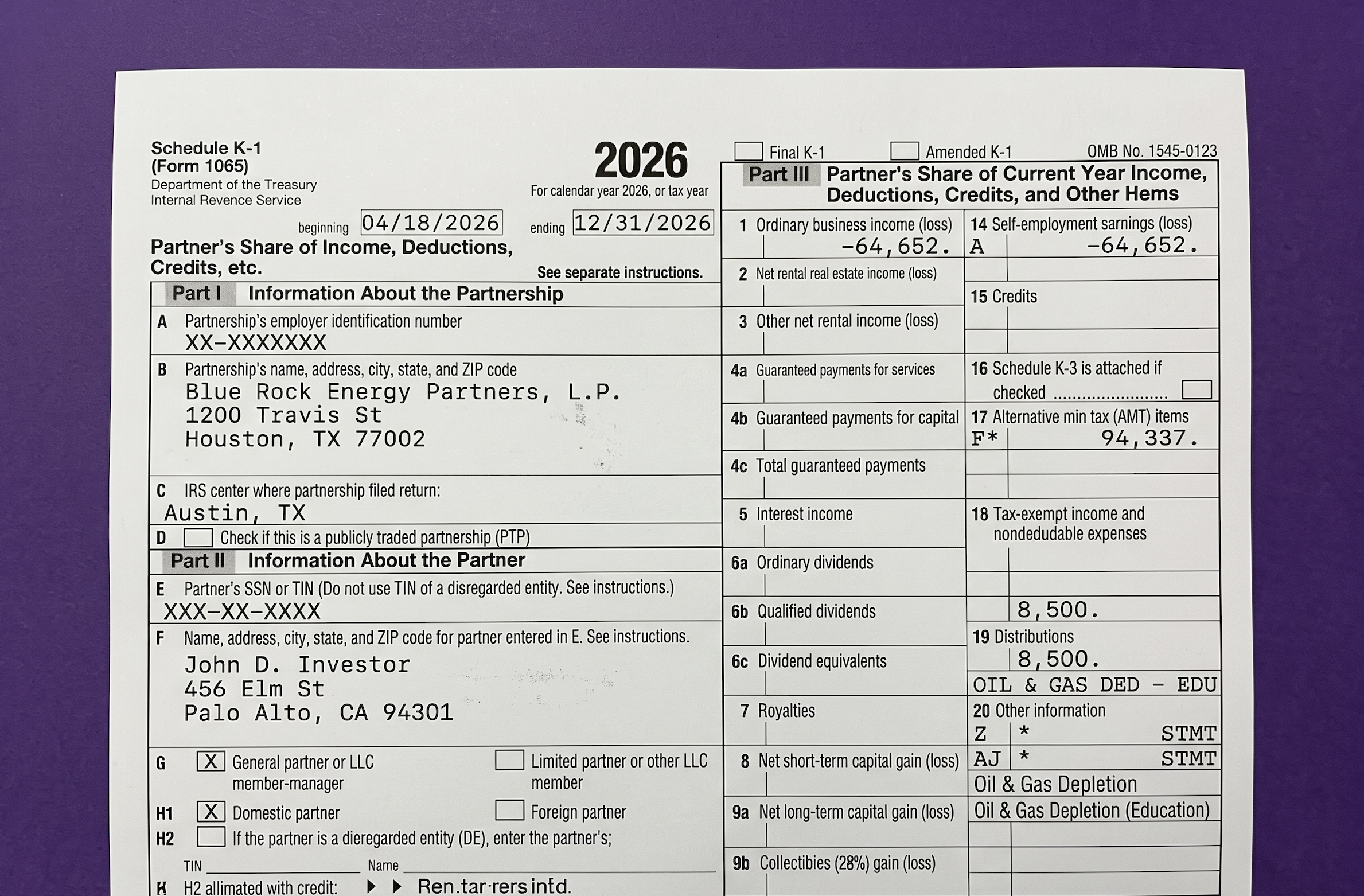
Actual savings depend on eligibility, limitations and the rest of the return. State taxes and alternative minimum tax can change the result. A later sale at a gain can also trigger recapture of earlier deductions. Internal Revenue Service
Can those deductions reduce tax on a salary or a stock sale?
Potentially, but the structure matters.
The working-interest exception to the passive-activity rules generally applies to an interest held directly or through an entity that does not limit the investor’s liability. It can apply without material participation. Other limits, including basis, at-risk and excess-business-loss rules, still apply. Internal Revenue Service
That liability condition deserves a real conversation. I wouldn’t assume that every LLC, limited-partner interest or oil and gas fund receives the same treatment.
A salary and a long-term stock gain can have different tax treatment. A usable deduction may reduce taxable income, but the salary example does not establish the savings on a particular stock sale. I’d have my own CPA model the investment against my actual return. Internal Revenue Service
Is wiring the money before December 31 enough?
A contribution date alone does not establish a deduction. The proper year depends on qualifying costs, the accounting method, applicable timing rules and elections. Some prepaid drilling arrangements have specific rules; they should not be treated as a blanket deadline extension. ecfr.gov
Before sending money, I’d ask the operator for the cost allocation and expected expenditure schedule. Then I’d have my tax adviser confirm what supports the deduction and its timing.
That needs to happen while there is still time to read the documents.
What would make you pause?
I’d pause if the operator could explain the deduction in detail but couldn’t give me a clear account of prior investor results.
I’d also pause if the projected return depended on prices staying high, or if the paperwork didn’t match the sales conversation.
Pressure to commit before an independent review would concern me. The SEC identifies unusually high promised returns and pressure tactics among the warning signs investors should investigate. Investor.gov
A project may have a reasonable explanation for an unanswered question. I still want that answer before I invest.
What do you want Fieldvest to contribute to this market?
I run Fieldvest, so I have a commercial interest in this market. The standard I want us held to is straightforward: help investors understand the project well enough to make an informed decision, including a decision to pass.
The useful work is organizing the evidence, explaining the assumptions and making the open questions visible.
If someone wants to understand a tax benefit, they should also be able to understand the fees, the operator’s record and the circumstances in which they could lose money.
General investor education. Private oil and gas investments can be illiquid and can lose capital. Tax treatment depends on the investment and the taxpayer.

Get the Fieldvest Energy Brief
and AI-driven demand shifts — curated for accredited investors. Smart. Strategic. Tax-advantaged.