


A carried working interest exists when one party (the carrying party) pays another party’s (the carried party’s) share of drilling and completion costs, letting the carried party hold an ownership stake in a well without writing a check upfront. The SLB Energy Glossary defines it in essentially those terms, and that definition matters because it draws a hard line most retail investors miss.
- The carrying party bears 100% of near-term cash risk and typically claims the tax deductions.
- The carried party gets a free ride on cost, but usually collects little or no revenue until “payout.”
- Tax treatment hinges on who actually bears the economic risk, not on what the contract calls the arrangement.
Key Takeaways
A carried working interest shifts near-term cost and tax risk to the carrying party while deferring the carried party’s revenue until a multiplier-based payout is reached.
| Point | Details |
|---|---|
| Definition matters | The carrying party funds costs; the carried party owns a stake but gets little revenue until payout. |
| Multiplier drives timing | Carrying parties often target more than 100% of advanced costs before payout, per deal terms. |
| Tax follows economic risk | The party bearing real financial risk generally claims IDC deductions, not the carried party. |
| Contract language is everything | Carry caps, payout formulas, and BIAPO clauses decide the deal’s real economics. |
| Fieldvest supports diligence | Fieldvest’s tax deduction calculator helps investors model payout timing and tax outcomes before committing capital. |
Table of Contents
- Carried Working Interest Definition and Contract Mechanics
- The Carried Interest Multiplier and Its Three Phases
- Tax and Accounting Implications of a Carried Working Interest
- Negotiating a Carried Working Interest: Contract Checklist
- A Worked Example: How Carry Payout Math Plays Out
- Risks and Legal Exposure in Carried Working Interest Deals
- Modeling Carried Working Interest Deals Before You Invest
- Why Carry Structure Deserves More Scrutiny Than It Gets
- Invest in Vetted Carried Working Interest Opportunities
- Sources
Carried Working Interest Definition and Contract Mechanics
Not every carry looks the same on paper. A full carry covers all of the carried party’s costs through a defined milestone. A partial carry covers only a portion, say IDCs but not completion costs, leaving the carried party to fund the rest. A promoted carry goes further: the carrying party fronts costs and also receives a premium above simple cost recovery, which is where the multiplier discussed below comes into play.
The trigger point for these arrangements is rarely arbitrary. Joint operating agreements typically define the carry period around a specific operational milestone, most commonly:
- Casing point — the moment a well is cased and ready for completion, often the switch from “carry” to “carried party pays its own way.”
- Through tanks — carry extends past completion until oil or gas actually reaches sales-quality storage, a longer and more generous carry for the carried party.
- Cost recovery threshold — carry ends once the carrying party has recouped a defined dollar amount or percentage of costs, independent of any physical milestone.
Recoverable costs named in the JOA usually include intangible drilling costs (IDCs), completion costs, and specific capital items, per typical Practical Law glossary language.
Pro Tip: Before signing anything, find the exact clause defining “payout.” A vague trigger, like “upon reasonable completion,” is a red flag. Payout should be tied to a specific, auditable event or number.
The Carried Interest Multiplier and Its Three Phases
The multiplier is the mechanism that decides when the carried party finally starts collecting real revenue. Most modern carries are not “recover 100% of costs, then split evenly.” Instead, the carrying party recovers more than 100% of what it advanced, using a carried interest multiplier as the recovery target.
That multiplier plays out across three distinct phases:
- Pre-payout — the carrying party receives most or all revenue attributable to the carried interest, applying it against the multiplier target.
- Payout moment — cumulative revenue allocated to the carrying party hits the multiplier threshold; the carry officially ends.
- Post-payout — the carried party begins receiving its full proportional share of revenue going forward, and often assumes its proportional share of ongoing costs too.
Exact multiplier figures are always deal-specific. A carry on a wildcat exploration well justifies a higher multiplier than a carry on a proven, low-risk infill location.
Tax and Accounting Implications of a Carried Working Interest
The party bearing economic risk generally claims the deductions, and that principle drives most of the tax analysis around carried arrangements. During the carry, the carrying party typically deducts intangible drilling costs (IDCs) as it incurs them, since it is the one with capital genuinely at risk. The carried party, having advanced nothing, usually cannot claim those same deductions until it starts bearing its own costs post-payout.
IDCs and tangible equipment costs get different treatment. IDCs, labor, fuel, and materials with no salvage value, are often currently deductible. Tangible drilling and completion equipment generally must be capitalized and depreciated over time rather than expensed immediately.
Economic substance, not contract labels, controls how the IRS and courts ultimately view a carried arrangement. If the deal functions more like a loan than a genuine reallocation of ownership and risk, recharacterization is on the table.
That principle traces back to case law such as the Weinert-Lehman decision, where courts scrutinized whether a transaction’s substance matched its form.
- Keep detailed records of who paid what, when, and under what contractual authority.
- Don’t assume standard carry treatment applies to your deal. Confirm structure with tax counsel before you file.
- Revisit treatment annually if the carry period spans multiple tax years.
Negotiating a Carried Working Interest: Contract Checklist
The clauses buried in a JOA determine whether a carry is a fair trade or a slow-motion giveaway. Before signing, confirm these six points:
- Carry amount cap — is there a dollar ceiling, or does the carry run indefinitely until the multiplier is satisfied?
- Carry period length — many agreements cap the carry at a fixed number of months (78 months is a commonly seen benchmark in drafted carry clauses) regardless of payout status.
- Payout formula — is it multiplier-based, revenue-share based, or a hybrid?
- Recoverable cost definition — get an itemized list, not a vague reference to “all costs.”
- Back-in after payout (BIAPO) provisions — these dictate how ownership shifts once the carry ends, and can quietly dilute the carried party’s long-term stake.
- Liability for abandonment and reclamation — confirm who’s on the hook for plugging costs if the well underperforms.
Audit rights and operator reporting obligations belong in this same review, since they determine whether you can actually verify the multiplier calculation later.
A Worked Example: How Carry Payout Math Plays Out
Assume an operator (the carrying party) drills a well for a carried investor holding a 20% working interest, and the well costs $2,000,000 to drill and complete.

At current production rates, payout arrives around month 40. If production declines faster than projected or operating costs rise, that timeline stretches, sometimes by years, since the multiplier target doesn’t shrink just because revenue slows down.
Pro Tip: Run your own sensitivity check with a tax deduction calculator before you commit. A 20% drop in projected production can push payout back well past the deal’s advertised timeline.
Risks and Legal Exposure in Carried Working Interest Deals
The biggest legal risk in any carry is recharacterization. If a court or the IRS decides the arrangement functions like a disguised loan rather than a genuine shift in economic ownership, the tax benefits both parties expected can unravel. Economic substance tests, the same ones referenced in the Weinert-Lehman line of cases, look at who really bears the risk of loss.
Operational risk compounds this. A dry hole or early abandonment can leave the carrying party out its full investment with no revenue stream to recover from, and abandonment or plugging obligations don’t disappear just because a well underperformed.
Well-drafted agreements protect both sides with capped carry amounts, escrow arrangements for disputed costs, and independent audit rights, reducing the odds of a dispute turning into litigation years later.
- Define recoverable costs with precision, not broad language.
- Push for periodic third-party audits of the payout calculation.
- Negotiate a cap on total carry exposure whenever leverage allows it.
Modeling Carried Working Interest Deals Before You Invest
Reading a JOA clause is one thing. Knowing whether the numbers actually work for you is another. Fieldvest’s tax deduction calculator lets you model how IDC deductions and payout timing interact with your own tax situation before you commit capital.
- Use the calculator to test multiplier and production scenarios against your expected tax position.
- Review operator track records and typical carry terms before evaluating a specific deal.
- Read Fieldvest’s guide on oil and gas joint ventures for how carries fit inside broader partnership structures.
Pro Tip: Ask any operator presenting a carried deal for their historical payout timelines on comparable wells. If they can’t produce that data, treat the projected multiplier timeline with skepticism.
Why Carry Structure Deserves More Scrutiny Than It Gets
Most explanations of carried working interest stop at the definition and skip the part that actually matters to an investor’s return: the multiplier is a negotiated risk price, not a fixed industry number, and too many carried parties accept whatever figure an operator proposes without pushing back. That is a mistake.
The conventional advice, “make sure you understand the payout trigger,” is fine as far as it goes, but it undersells the real leverage point: recoverable cost definitions. Vague cost language is where carrying parties quietly pad the recovery target, stretching payout timelines well past what an investor modeled going in.
If you’re evaluating one of these deals, prioritize verifying the operator’s historical payout accuracy over admiring the projected multiplier. A track record of hitting projections tells you more than any contract clause.
Invest in Vetted Carried Working Interest Opportunities
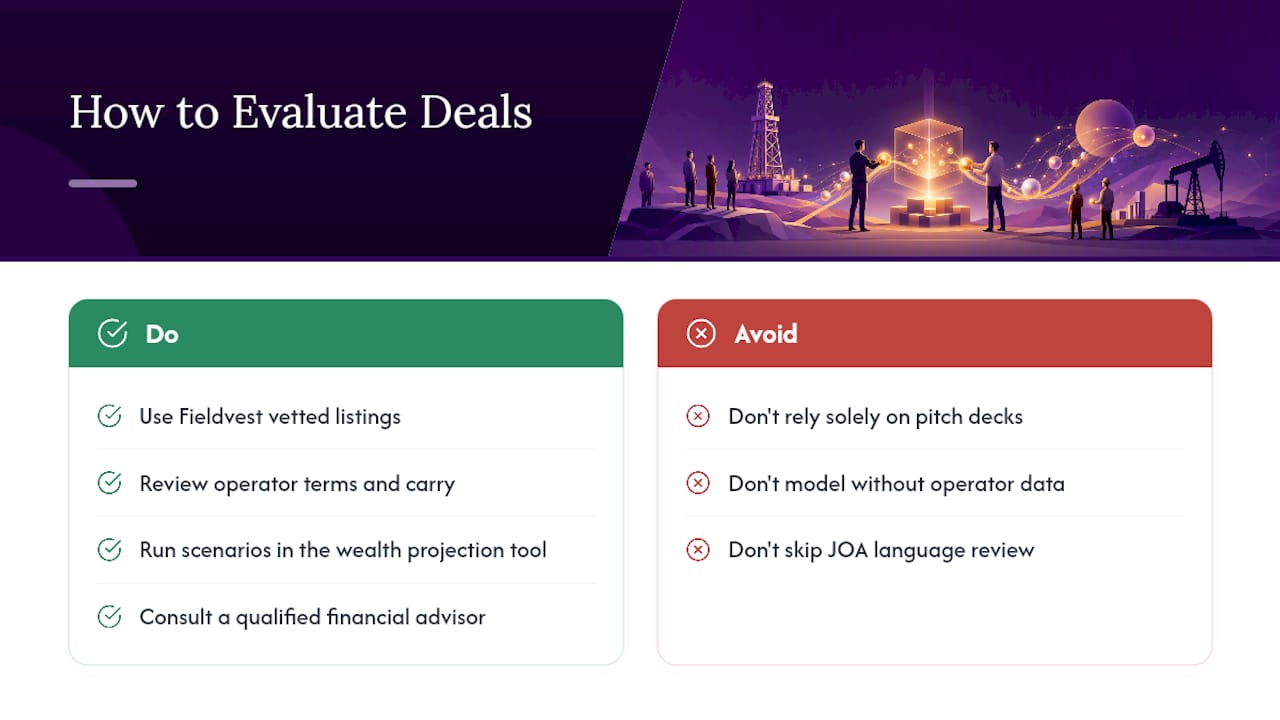
Evaluating a carried working interest deal on your own means chasing down operator track records, cross-checking JOA language, and modeling payout scenarios with limited visibility into how the deal was underwritten. Fieldvest gives accredited investors a shortcut: a marketplace of vetted U.S. energy projects where operator terms, including carry structures, have already been reviewed before the deal reaches you.

Fieldvest connects high-earning professionals with operators offering large first-year tax deductions alongside long-term production income, and every listing comes with the context you need to evaluate the carry terms yourself rather than taking a pitch deck at face value. If you want to see how a specific deduction or payout timeline would affect your after-tax position, run it through the wealth projection tool before you commit capital. Start by reviewing current opportunities on Fieldvest.
This article is general information, not a substitute for advice from a qualified financial advisor. Consult a qualified financial professional about your own circumstances before acting on anything here.
Sources
These references anchor the legal and financial definitions used throughout this guide:
- carried working interest | Energy Glossary
- What Is a Carried Working Interest in Oil and Gas? - LegalClarity
- Carried Interest (Oil and Gas) (US) - Westlaw
- Law
Recommended
- Oil Depletion Effects on Deal Value: An Investor’s Model | Oil & Gas Investing
- Analyzing Projected ROI for Oil Investments: Investor Guide | Oil & Gas Investing
- Joint Ventures in Oil and Gas: How Do These Partnerships Really Work? | Oil & Gas Investing
- How to Read an Oil Project Prospectus: Investor’s Guide | Oil & Gas Investing

Get the Fieldvest Energy Brief
and AI-driven demand shifts — curated for accredited investors. Smart. Strategic. Tax-advantaged.