


When an oil or gas project changes operators, the company that drills, produces, pays the bills and reports to regulators is replaced, while you keep your working interest. The risk is real but manageable. It lives in the new operator’s finances, bonding, systems and track record, and you can check all four before you commit capital. We built Fieldvest around that kind of screening: accredited investors access vetted U.S. energy projects, with the key project materials presented side by side so operator questions get asked early.
This guide is for high-income professionals who invest as non-operators, often for first-year tax deductions and long-term income. It explains what an operator change is, what the rules require, how it can affect production and distributions, and what to review first.
TL;DR
- The operator runs the wells, bills you for costs and files with regulators. A change of operator swaps that company out, and the swap is not automatic when interests are sold.
- Regulators review the new operator’s qualifications and bonding. In the Pacific offshore region, the federal procedure can take several months.
- In a McKinsey study of 50 North Sea assets, 60 to 70% of operator transitions saw production decline, so the new operator’s plan matters as much as its name.
- Check the operator’s financial strength, bonding, systems and billing history before you invest, and keep watching after.
Table of Contents
- What a change of operator means for a non-operator investor
- What the rules require of a new operator
- How an operator change can affect production and cash flow
- Warning signs before and after a change
- Vetting operator-change risk before you invest
- What a strong transition looks like
- Browse vetted projects on Fieldvest
- FAQ
- Sources
What a change of operator means for a non-operator investor
Most individual investors in oil and gas hold a non-operated working interest. You own a share of the project and its costs and revenue. A separate company, the operator, makes day-to-day decisions: drilling, maintenance, safety, regulatory filings, and the monthly invoices that pass your share of costs to you. Our guide to operator roles in U.S. oil and gas projects covers the basics.
An operator change happens for several reasons: the operator sells its position, resigns, is acquired, or is replaced by the partners. Two points trip up newcomers.
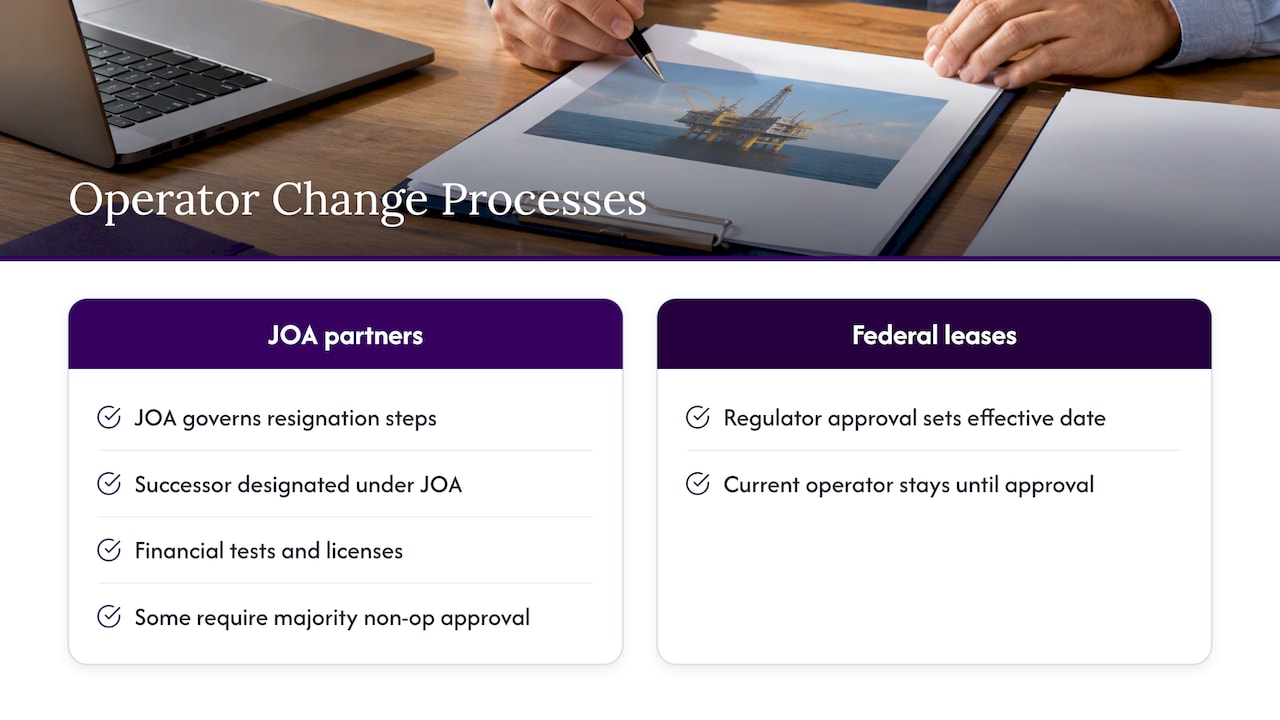
First, selling a working interest does not by itself change the operator. The joint operating agreement (JOA), the contract among the project’s owners, has its own steps for the operator to resign and a successor to be designated. Many JOAs also require the incoming operator to meet financial tests and hold the right licenses, and some call for approval from a majority of non-operators.
Second, the regulator, not the partners, decides when the change takes effect on public land and offshore leases. On the federal Pacific offshore side, the change is effective on the date of the approval letter. Until then, the existing operator stays in place.
What the rules require of a new operator
You do not need to memorize regulations, but knowing what a regulator asks for tells you what a serious operator has already prepared.
Federal offshore leases
For the Pacific region, the Bureau of Ocean Energy Management (BOEM) and the Bureau of Safety and Environmental Enforcement (BSEE) list the steps in a March 2026 procedure. The new operator must submit audited financial statements and a decommissioning cost estimate, and BOEM may require additional financial assurance. The procedure also covers pipeline rights-of-way, oil-spill-response certification and responsibility for pending corrective actions.
Liability follows the change. Under the offshore leasing rules, an assignee of operating rights is liable for obligations accruing after the assignment takes effect. That includes fixing existing environmental and operational problems, plugging wells properly and reclaiming the site.
Federal onshore leases
On Bureau of Land Management (BLM) leases, a new operator must file a change-of-operator request and a statement accepting responsibility for lease operations. When a unit operator is approved, it assumes full liability for compliance with the unit agreement, lease terms and BLM orders, including plugging wells and reclamation of earlier facilities (jointly with the former operator), royalties and environmental remediation.
Bonding is the financial backstop. BLM’s minimum bond amounts are $150,000 for an individual lease bond and $500,000 for a statewide bond, and the on-the-ground operator must be covered by its own bond or by a lessee’s bond that extends to its operations. Assignments of operating rights are filed with a $115 nonrefundable fee, within 90 days of the transferor’s signature.
State rules vary
Most drilling in the U.S. happens on private and state land under state rules. A few examples show the pattern: a notice, a financial guarantee and sign-off before the change counts.
| State | What the rule requires | Why it matters to you |
|---|---|---|
| Alabama | The new operator files Form OGB-1E within 60 days of the effective date, with a bond and an organization report. Until the Supervisor approves, the current operator stays responsible. | You can tell whose compliance record applies at any date. |
| Louisiana | An application to amend a permit for a change of operator must come with financial security, such as a performance bond, letter of credit or certificate of deposit. | Security is in place before the change, not after. |
| Oklahoma | Changing the operator in certain increased-density and location-exception orders needs application, notice and hearing, with mailed notice to working interest owners at least 15 days before the hearing. | Working interest owners get a formal chance to be heard. |
| New Mexico (state trust land units) | The resigning operator must document open surface releases, environmental liabilities and wells needing plugging, all resolved to the State Land Office’s satisfaction before approval. | Legacy issues are surfaced before the new operator takes over. |
The rules differ by state and by who owns the minerals, so the first question about any project is which regulator governs it. Check the state agency’s current rules and forms before relying on any summary, ours included.
How an operator change can affect production and cash flow
The regulatory handover is the easy part. The harder part is the operating handover: people, data, procedures and field knowledge move from one company to another.

McKinsey studied 50 upstream assets in Norway and the U.K. between 2013 and 2017. About 20% of transitions held or improved production, 15 to 20% stagnated, and 60 to 70% saw a decline, and transitions typically took 12 to 18 months. That is an offshore, non-U.S. sample, so read it as a pattern rather than a forecast for a Permian or Oklahoma project. The pattern is useful because it shows where value is lost: not at the signing, but in the months after.
For you as an investor, the effects show up in four places:
- Production volumes. Lost field knowledge or delayed maintenance can reduce output, and revenue follows.
- Operating costs. New systems, new contractors and catch-up maintenance can raise the costs billed to you.
- Billing and reporting. Joint interest billing (JIB), the monthly statement of costs the operator charges working interest owners, can be misallocated when records change hands. Practitioners commonly describe a reconciliation window after closing of roughly 90 to 180 days.
- Distribution timing. Revenue payments can slip while division orders, the instructions that tell purchasers who gets paid, are updated.
If you invested for tax deductions, remember that the deduction comes from your original investment in the project’s drilling costs, while cash flow depends on what the wells produce afterward. Your tax adviser can tell you how your own return treats it. The operator is what keeps the second part going.
Warning signs before and after a change
McKinsey points to several causes of failed transitions: too little collaboration between outgoing and incoming teams, too much change from day one, loss of essential capabilities, unaddressed cultural differences, and failing to keep the regulator engaged. Translated into what you can observe as a non-operator:
- Vague timelines. A handover with no stated effective date, no named transition lead and no plan for the first 90 days.
- Thin financials. An incoming operator that cannot show audited statements or a funded decommissioning estimate.
- Bonding gaps. No clear answer on whose bond covers the wells on the effective date.
- Staff exodus. Field personnel and engineers leaving at the same moment the operator changes.
- Late or inconsistent statements. Cost billings that suddenly change format, arrive late or do not reconcile.
- Silence on regulators. No mention of agency filings or approvals in investor updates.
Any one of these is a prompt to ask questions, not a verdict. A well-prepared operator answers them quickly and in writing.
Vetting operator-change risk before you invest
The cheapest time to assess this risk is before you wire funds. Here is a practical order of work.
1. Identify the operator and its record
Who operates today, for how long, and how many wells does it run? Has the operator changed on this asset before? A long, stable operating history on the specific asset is the best case. Our overview of how accredited investors vet private oil and gas deals lists the questions to put to any sponsor.
2. Read the operating agreement’s operator provisions
Look for how the operator can resign or be removed, who votes on a successor, and what financial and licensing tests a successor must pass. Confirm what happens if the operator becomes insolvent. An agreement that spells this out reduces surprises.
3. Confirm bonding and insurance
Ask which bond covers the wells and whether it moves with an operator change. Review the operator’s coverage too: our checklist on operator insurance coverage in oil deals explains what to look for.
4. Check your audit and information rights
If billing is disputed after a handover, audit rights decide how much you can verify and for how long. See the audit clauses accredited investors should check before signing.
5. Review the data room
Production history, well files, lease and title records, plugging obligations and the operator’s financials belong in the project materials. Our guide to what to check in an oil and gas data room walks through them. In an acquisition, buyers do this work to validate the valuation and to find issues that should change deal terms, and the same logic applies to you as an investor.
6. Understand how the deal handles a transfer
In a sale, the purchase agreement should say who is responsible for obtaining non-operator consents and what happens if consent is withheld, and should address in-transit costs and post-closing reconciliation. Our walk-through of the oil asset transfer process shows how those pieces fit together.
7. Plan how you will track updates and exit
Decide in advance how you will follow operator news, using our guide to tracking oil project updates, and what your options are if the situation changes, covered in our exit strategy tips for investors. For the broader frame, see our risk mitigation steps for oil projects.
What a strong transition looks like
McKinsey advises incoming operators to begin with an operational baseline: a structured review of asset integrity, capabilities and operating policies that lists the risk items to fix before and after day one. It also recommends dedicated capability in transition management, IT and systems integration, organization design and change management. For ambitious redevelopments, peak transition teams reached 200 full-time staff.
You will not see a 200-person team on a typical non-operated project, but the questions carry over: has the incoming operator reviewed the wells and facilities, who handles systems and billing, and who is accountable for the first months?
Our view on operator change
The operator is the single most important counterparty in a non-operated energy investment, so we treat operator screening as the center of the work, not a line item. Our approach is built on vetted and screened operators and on presenting each project’s key materials in a form investors can compare side by side.
For a busy professional who is investing for tax deductions and long-term income, that matters. You are not going to read a joint operating agreement at midnight, and you should not have to. Comparing operators, bonding, financial statements and project terms in one place makes the right questions easier to ask before capital is committed.
We also think diversification across producing assets, development projects and energy infrastructure is a sound way to hold energy exposure, and it is part of how we think about the operator question: a portfolio that is spread across projects is less tied to any single operating company’s decisions.
Our platform includes portfolio management tools and ongoing investment support so that you can keep following what happens after you invest.
Sharif
Browse vetted projects on Fieldvest
Fieldvest is a platform for accredited investors to invest directly in vetted U.S. energy projects across three categories: producing assets, development projects and energy infrastructure. Each listing is from an operator we have screened, with the project’s key materials laid out so you can compare them. If you are weighing a tax-advantaged energy allocation, you can see the available energy projects and review the operator details for each.

For a look at how we think about spreading exposure, read oil diversification through Fieldvest.
FAQ
Does a sale of working interest automatically change the operator?
No. Under a standard joint operating agreement, the operator has to resign and a successor has to be designated through the agreement’s own procedure. On government-leased land the regulator must also approve the change before it takes effect. Always confirm both steps in writing.
Who is liable for old wells when the operator changes?
It depends on the lease type and the regulator. On federal unit agreements, the new operator assumes liability for plugging earlier unplugged wells, jointly with the former operator. Bonding is what funds those obligations, which is why the bond question belongs in every review.
How long does an operator change take?
The regulatory step alone can take months on offshore leases, according to BOEM’s Pacific region procedure. The operational handover can run longer: McKinsey found 12 to 18 months was typical in its North Sea sample. Ask for the specific timeline for your project.
Can I vote on or block a new operator?
Sometimes. Some operating agreements require approval from a majority of non-operators, and some states, such as Oklahoma for certain orders, require notice and a hearing before the operator designation changes. Your rights are set by your agreement, so read that section first.
What should I read first if I get a notice of operator change?
Start with the effective date, the incoming operator’s identity, and which bond covers the wells. Then compare the next few billing statements with prior ones. Your tax adviser should review anything that affects your return.
Sources
- BOEM and BSEE: Procedure for Change of Existing and New Operator, March 2026
- McKinsey: Ten principles for successful oil and gas operator transitions
- eCFR: 30 CFR 556.807
- 43 CFR 3137.63: Liabilities after BLM approves a new unit operator
- BLM: Information and Procedures for Transferring Oil and Gas Lease Interests, 2026
- BLM: Bond Information Packet for Oil and Gas Bonds
- BLM: Assignments Handout, September 2025
- Alabama Administrative Code 400-1-2-.05
- Louisiana Administrative Code, Title 43, XIX-104
- Oklahoma Administrative Code 165:5-7-11
- New Mexico State Land Office: Unitization Change of Operator Checklist, August 2024
Recommended

Get the Fieldvest Energy Brief
and AI-driven demand shifts — curated for accredited investors. Smart. Strategic. Tax-advantaged.