

COPAS accounting is the standard rulebook for how an oil and gas operator bills its partners. COPAS stands for the Council of Petroleum Accountants Societies. It publishes the model accounting procedures that most Joint Operating Agreements (JOAs) attach as an exhibit. The exhibit decides which costs the operator passes through at actual cost and which it recovers through a negotiated overhead charge. If you put capital into a working interest, those two buckets decide how much of your money reaches the wellhead and how much stays with the operator.
This guide is written for accredited investors, not for petroleum accountants. It covers what COPAS is, how the cost split works, what the overhead adjustment factor is, where disputes start, and what to check before you commit.
TL;DR
- COPAS procedures are the accounting exhibit in many JOAs. They split operator charges into direct charges (actual cost) and overhead (negotiated fixed rates).
- COPAS does not publish or recommend overhead rates. Rates are negotiated deal by deal, so you must read the exhibit for each project.
- The annual overhead adjustment factor was negative 0.3% effective April 1, 2026. It applies to the base rates in your agreement, not to a number COPAS sets for you.
- Most billing disputes sit on the line between direct charges and overhead. Double charging is the classic finding.
- Before investing, ask which accounting procedure is attached, what the rates are, and what your audit rights look like.
Table of Contents
- What COPAS is and why it matters to you
- Direct charges versus overhead: the core of the system
- How COPAS overhead rates actually work
- Where the JIB meets COPAS
- Reading the exhibit before you invest
- Why contract language beats boilerplate
- Our perspective
- Browse vetted energy projects
- Common mistakes to avoid
- FAQ
- Sources
What COPAS is and why it matters to you
COPAS is a non-profit professional association founded in 1961. It has more than 3,500 members across 24 societies in the United States and Canada. Its job is to develop model form accounting procedures, publications and education for the industry.
You will never sign a COPAS document directly. But if you own a non-operated working interest, the operator’s accounting almost certainly follows a COPAS form attached to the JOA. The COPAS publications catalog describes these Accounting Procedures as standardized exhibits that set how costs are shared between operators and non-operating owners, including whether a cost is a direct charge or overhead.
That standardization is useful. Operators and non-operators across the country use the same vocabulary, the same categories and the same logic. When a statement arrives, you are not decoding a one-off invention.
It is also limited. The forms are templates. The numbers that matter most to your returns, such as the overhead rate, are filled in by the parties to each agreement.
Direct charges versus overhead: the core of the system
COPAS splits operator compensation into two categories. Valor’s JOA and COPAS basics guide describes direct charges as actual costs passed through at cost, such as field labor and burdens, materials priced under the exhibit’s rules, contract services, transportation, insurance and taxes. Overhead is the negotiated, fixed monthly rate that compensates the operator for indirect work.
Here is how that plays out in practice.
| Direct charges | Overhead | |
|---|---|---|
| What it covers | Costs tied to your wells: field labor, materials, contract services, insurance | Management, accounting and general administration |
| How it is priced | Actual cost, under the exhibit’s pricing rules | Fixed monthly rate per well, set by negotiation |
| What you verify | Invoices and allocation to the right wells | That the rate matches the exhibit and the adjustment was applied correctly |
| Typical risk | Charging items to the joint account that belong elsewhere | Charging a cost directly that overhead already covers |
The split matters for non-operators because it is the way to verify fair billing. LegalClarity’s explanation of joint interest billing frames it the same way: direct charges flow through at cost, while overhead pays for indirect support, and knowing the difference lets you spot administrative expenses billed in the wrong place.
The double-dipping rule
The cardinal rule is simple. An operator cannot bill a cost directly if the negotiated overhead rate already covers it, and cannot treat a directly billable cost as overhead. In its JOA and COPAS guide, Valor notes that this seam is the most common source of disputes and audit exceptions.
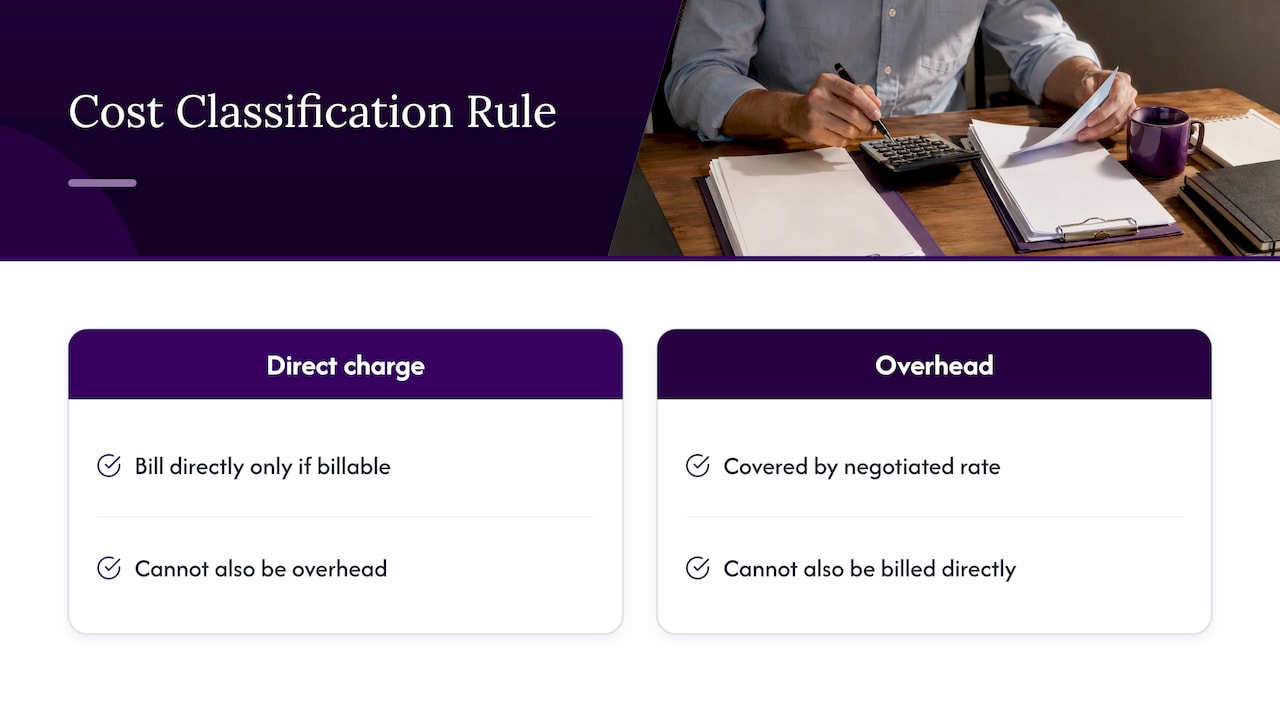
The practical consequence: the exhibit attached to your JOA is the final word. Two projects can both say “COPAS” and still treat the same expense differently.
Field offices: a typical gray area
Field offices show how fuzzy the line can be. Weaver’s guidance on joint interest audits points out that a field office is a staging area for field employees and is often directly chargeable. But it can also house administrative staff and non-field technical personnel whose costs overhead is meant to cover. There is no universal list of chargeable expenses, so auditors apply judgment against the JOA’s wording.
How COPAS overhead rates actually work
Searches for “COPAS overhead rates” usually hope for a table of what operators charge. There isn’t one, and that is by design.
COPAS says plainly that it does not publish or recommend any specific overhead rates. The base rates are written into the Accounting Procedure attached to each JOA and are a matter of agreement among the parties. COPAS provides guidance on how to establish rates, but the final figure is commercial. It is often traded against other terms in the deal, as the COPAS economic factors FAQ explains.
That FAQ also notes that, starting with the 1974 Accounting Procedure, COPAS dropped overhead structures based on well depth.
So when someone quotes you “the COPAS rate,” ask which agreement they mean. A fixed rate for a drilling well and a fixed rate for a producing well are both set in the exhibit. Two operators in the same basin can have very different numbers.
The annual adjustment factor
What COPAS does publish is the escalation. Its Accounting Procedures provide for an annual adjustment of the fixed overhead rates for drilling and producing wells, and COPAS offers an interactive calculator for it.
The adjustment factor was negative 0.3% effective April 1, 2026. That means, under agreements that follow the standard escalation mechanism, the fixed rates adjust slightly downward this cycle. Notice the wording: the factor applies to the base rates in the exhibit. It does not replace them.
A worked example makes the mechanics clear. Suppose a JOA sets a producing-well overhead rate of $1,000 per month (an illustration, not a market figure). Applying a negative 0.3% adjustment gives a rate of $997 per month. The change is small, but across many wells and many years, escalation errors add up. Cumulative escalation tables are available on the COPAS site.
As a non-operator, check two things:
- Whether the operator applied the adjustment on the date the exhibit calls for.
- Whether it applied the right direction and size. Weaver reports that an operator failing to escalate rates as permitted is a common audit finding, so errors do run both ways.
Where the JIB meets COPAS
The Joint Interest Billing (JIB) statement is where COPAS rules show up in your mailbox or inbox. Each month the operator bills non-operators for their share of costs. Each line should trace to a direct charge category or to the overhead rate.
Two related ideas are worth separating. A project budget is usually presented as an Authorization for Expenditure (AFE), and the JIB then reports actual spending against it. Our piece on AFE versus JIB and the 24-month adjustment window walks through how those two documents interact and why timing matters when costs are revised.
Operating costs are another part of the picture. Our guide to lease operating expenses explains how operators manage the per-barrel cost gap, which is where many direct charges show up.
Some costs are not about classification at all. The McGinnis law paper on COPAS accounting procedures observes that certain agreement provisions address who pays rather than how a cost is classified. Non-consent operations and abandonment liability are examples. Those live in the JOA body, not in the accounting exhibit.

Reading the exhibit before you invest
You do not need to become a petroleum accountant. You need a short checklist and the willingness to ask for documents.
- Identify the accounting procedure. Ask which COPAS form and which year of the form is attached to the JOA.
- Find the overhead rates. Look for the fixed monthly rates for drilling and producing wells, and see how they are adjusted each year.
- Check the thresholds. Exhibits typically set limits on what the operator can charge without approval. Know where those limits sit.
- Read the definitions. Field offices, camps, technical employees and district expenses are the items most likely to be argued over.
- Confirm your audit rights. Find the window to audit, the notice required and who bears the cost. Our checklist of audit clauses accredited U.S. investors must check covers this in detail.
- Understand the structure. If you are investing through a partnership or joint venture, see how costs flow. Our explainer on joint ventures in oil and gas is a good starting point.
What an audit really takes
Be realistic about audits. Weaver notes that joint interest audits are substantial undertakings that typically require at least 80 hours of effort. For a small position, a full audit may not be cost effective. That is why the contract language up front, and the operator’s transparency, matter more than audit rights you may never use.
The same Weaver piece recommends focusing on the operator’s treatment of annual overhead escalation, because that is a recurring and checkable item.
Why contract language beats boilerplate
COPAS documents give general categories, not an exhaustive list of every possible expense. The McGinnis paper makes the point that the practitioners who do best understand both the specific contract language and the practical realities of field operations, rather than relying on the form text alone.
For an investor, the lesson is straightforward. “COPAS compliant” is not a quality stamp. It says an operator uses a recognized framework. It does not say the negotiated rates are low, the definitions are clear, or the operator is careful with allocations. Those are questions of diligence.
Our perspective
We talk with accredited investors who are surprised that a single line on a JIB can matter as much as the geology. Our view is that accounting terms are part of due diligence, not an afterthought for the back office.
Three things guide how we think about it.
First, overhead is a negotiated price, and it deserves the same attention as any other price in the deal. Because COPAS does not set rates, comparing two projects means comparing their exhibits, not their labels.
Second, transparency is the real product. We favor operators who present key project materials in a form you can compare side by side, and who are comfortable explaining how costs are allocated. A clear answer to “what is billed directly and what is covered by overhead?” tells you a lot about an operator.
Third, taxes and accounting are linked. The way costs are classified affects what you can expect to deduct and when. If you are weighing energy investments for tax reasons, our free oil and gas tax deduction calculator and our overview of oil and gas depreciation methods help you frame the numbers. Confirm the specifics for your situation with your CPA before you act.
— Sharif
Browse vetted energy projects
If you are an accredited investor and want to see how these accounting questions play out in real deals, Fieldvest lists producing assets, development projects and energy infrastructure from screened operators. You can compare project materials in one place and review the terms before you decide. Start at Fieldvest, or read how oil and gas investments can lower your taxes first.
Common mistakes to avoid
- Treating overhead as a fixed industry number. It is negotiated, and COPAS does not endorse specific rates.
- Ignoring the annual adjustment. The factor changes every April, and it can be negative, as it is for 2026.
- Assuming the form text answers every question. Definitions in the specific JOA control.
- Skipping the exhibit because the operator is well known. Reputation is not a substitute for reading the rates.
- Waiting for an audit to learn the rules. Learn the classification rules before you invest, when you can still negotiate or walk away.
FAQ
What does COPAS stand for?
COPAS stands for the Council of Petroleum Accountants Societies, Inc. It is a non-profit professional association founded in 1961 that develops model accounting procedures and education for the oil and gas industry in the United States and Canada.
What is COPAS accounting in oil and gas?
It is the cost allocation framework in COPAS model form Accounting Procedures, which are attached to JOAs. It sets how an operator bills non-operating owners, separating direct charges at actual cost from negotiated overhead.
Does COPAS set overhead rates?
No. COPAS states that it does not publish or recommend specific overhead rates, because they are negotiated among the parties to each agreement. It does publish the annual adjustment factor, which was negative 0.3% effective April 1, 2026.
What is the difference between direct charges and overhead?
Direct charges are actual costs tied to the joint property, such as field labor, materials and contract services. Overhead is a fixed monthly rate covering indirect costs such as management and general administration. An operator should not bill a cost in both categories.
Can a non-operator challenge an operator’s billing?
Usually yes, if the JOA grants audit rights, which most do within a stated window. Check the notice requirements and time limits in your agreement, and talk to an oil and gas attorney or auditor before disputing charges.
Sources
- Council of Petroleum Accountants Societies
- COPAS publications reference catalog
- COPAS economic factors
- COPAS economic factors and accounting procedures FAQ
- JOA and COPAS accounting basics
- Joint interest billing: how JIB works
- Considering a joint interest audit
- COPAS accounting procedures paper (McGinnis)
Recommended

Get the Fieldvest Energy Brief
and AI-driven demand shifts — curated for accredited investors. Smart. Strategic. Tax-advantaged.