


An oil well reaches its economic limit when the cash it earns no longer covers the direct cost of keeping it running. Past that point, every barrel produced loses money, and a rational operator shuts the well in, plugs it, or sells it. If you own an interest in a well, or you are thinking about buying one, this number sets how long your income can last.
The textbook definition is simple. The practical version is not, because the limit moves with oil prices, water production, taxes and abandonment costs. This guide covers the formula, a worked example, the factors that shift the limit, and the questions to ask before you commit capital.
TL;DR
- The economic limit is the production rate at which a well’s revenue minus its direct operating costs falls to zero. Below that rate, the well loses money month to month.
- It is not fixed. Oil price, operating costs, royalties and taxes all feed the equation, and a well can cross the line more than once in its life.
- The basic calculation ignores sunk capital, depreciation and income taxes. Sophisticated operators add abandonment costs and the time value of money, and investors should too.
- Most U.S. wells are small. 78% of producing wells make 15 BOE/d or less, so the economic limit is a daily reality for much of the industry.
- Before investing, ask for lease operating expenses, the decline curve and the plugging liability, not just headline production.
Table of Contents
- What the economic limit actually means
- The formula and a worked example
- What moves the economic limit
- Why small wells dominate the picture
- The textbook limit versus the real one
- How the economic limit connects to taxes
- Our perspective
- A checklist before you invest
- Where Fieldvest fits
- FAQ
- Sources
What the economic limit actually means
Every producing well has two lines moving against each other. Revenue falls as the reservoir depletes. Operating costs, such as pumping, water handling, field labor and repairs, stay stubborn or even rise. The economic limit is where the lines cross.
An academic study of Louisiana fields puts it plainly: when operating costs equal the net revenue of production, the well has reached its economic limit. The same research notes that production, revenue and costs all change over time, so a well may hit the limit several times before better conditions restart commercial operation.
The Oil & Gas Journal frames the same idea from the owner’s side: the time to stop is when value is at its maximum, before continued operation destroys it.
Why it differs from “running out of oil”
A well rarely runs dry. It becomes uneconomic first. Oil is still in the ground, but lifting it costs more than it sells for. That is why the economic limit, not geology, usually decides how much of a field’s oil is ever recovered. A higher oil price pushes the limit down and extends the well’s life. Higher taxes or costs pull it up and shorten that life.
The formula and a worked example
The basic version uses direct, incremental costs only:
Economic limit (BOE/d) = daily operating costs ÷ net revenue per BOE
Net revenue per BOE is the price you receive after royalties, severance and production taxes, and any transportation deductions.
Here is a hypothetical well, with round numbers chosen for illustration and not drawn from any real property:
| Input | Value |
|---|---|
| Daily operating costs | $400 |
| Oil price | $70 per barrel |
| Royalty (burdened by landowner share) | 20% |
| Production taxes and deductions | 6% of gross |
| Net revenue per barrel | $70 × (1 − 0.20 − 0.06) = $51.80 |
| Economic limit | $400 ÷ $51.80 = about 7.7 BOE/d |
This well makes money above roughly 7.7 barrels a day. If the oil price drops to $50, net revenue falls to $37 a barrel and the limit rises to about 10.8 BOE/d. The same well, with the same equipment, is suddenly a loser at 9 barrels a day.
That sensitivity is the point. A well that looks safe at one price can be a shut-in candidate at another, which is why you should stress-test any deal at several price decks.
What moves the economic limit
Oil and gas prices
Price is the most visible driver. A swing in the price per barrel changes net revenue per barrel across every well in the field at once.
Lease operating expenses
Lease operating expenses (LOE) are the recurring costs of keeping a well producing. They include electricity, chemicals, workovers and field staff. Our own piece on how operators close the gap in lease operating expenses goes deeper on what separates efficient operators from the rest. For the economic limit, the key point is that LOE is largely fixed per well per day, so low-rate wells carry a heavy cost per barrel.
Water production
As a reservoir matures, wells tend to produce more water relative to oil. Separating, trucking or injecting that water is a cost without revenue. The Louisiana study cited above points to the cost of water separation as a central feature of oil-well economic limits.

Royalties and taxes
Royalty burdens and production taxes reduce net revenue before costs are even counted. The oilfield glossary notes that raising taxes on oil raises the economic limit and shortens well life.
Abandonment costs
The simple formula leaves out the bill for plugging the well and restoring the site. That is the largest blind spot, and we return to it below.
Why small wells dominate the picture
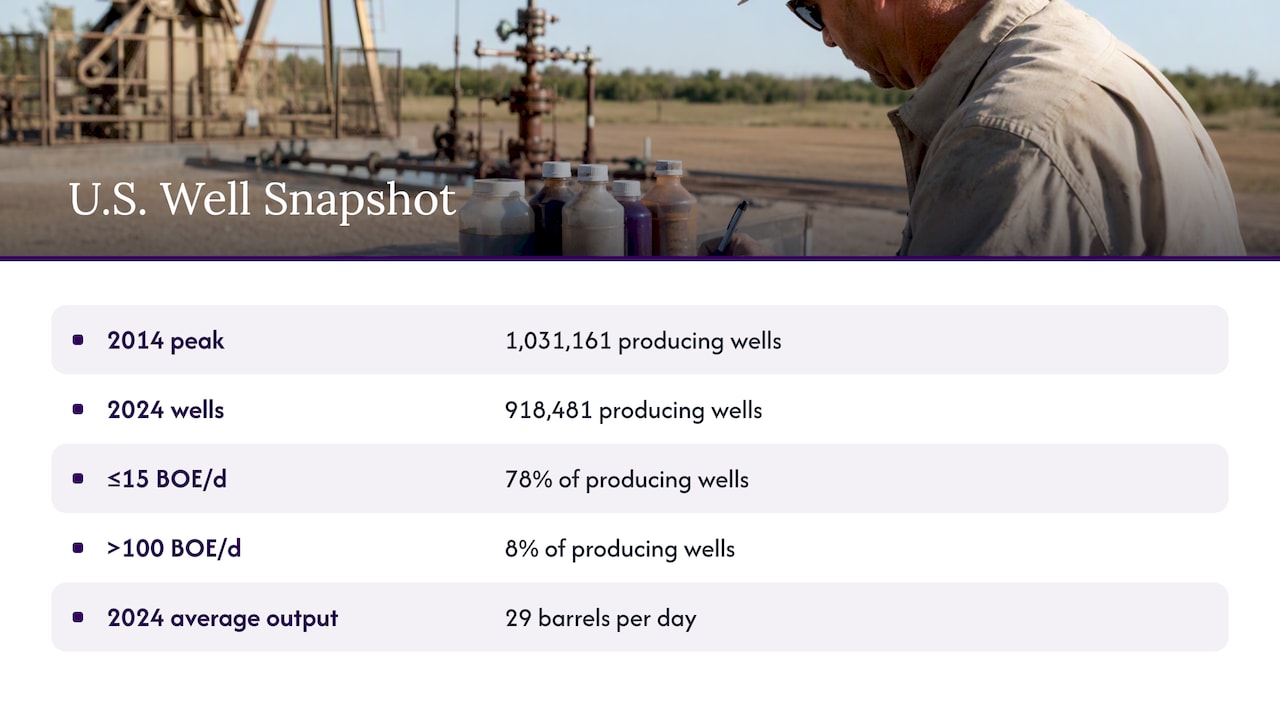
The U.S. oil patch is mostly made of low-rate wells. According to the EIA’s 2025 well distribution report, the country had 918,481 producing wells in 2024, down from a 2014 high of 1,031,161. Of those, 78% produced 15 BOE/d or less, while only 8% produced more than 100 BOE/d. Average oil well output in 2024 was 29 barrels a day.
Wells producing 15 barrels a day or less are known as marginal or stripper wells. The EPA notes that they made up a small share of U.S. production in 2021 (7%) but a disproportionate share of methane emissions from oil production. It also flags the risk that they become orphaned when operators lack the money to plug them properly.
For an investor, this means two things. First, many wells sit close to their limit, so small changes in cost or price matter. Second, the operator’s financial strength matters as much as the well’s geology.
The textbook limit versus the real one
The basic calculation is a snapshot of cash flow. Standard industry practice, as described by Oil & Gas Journal, leaves out sunk capital, depreciation and income taxes. That is fine for the operator’s day-to-day decision to keep pumping. It is not enough to value an investment.
More sophisticated operators include abandonment costs, income tax effects and the time value of money. Skip those and you can end up with a “zombie well”: cash flow is still positive, but the return on the capital tied up in it is badly degraded. You are earning something every month, yet you would have been better off elsewhere.
Reserves are not the same as production
One more trap is worth knowing. Under the Petroleum Resources Management System, producing quantities that are sub-economic does not turn them into reserves. Treating them as reserves is a classic valuation error. If a deal’s projected volumes depend on production below the economic limit, those barrels should not be in the base case.
Shutting in is not free
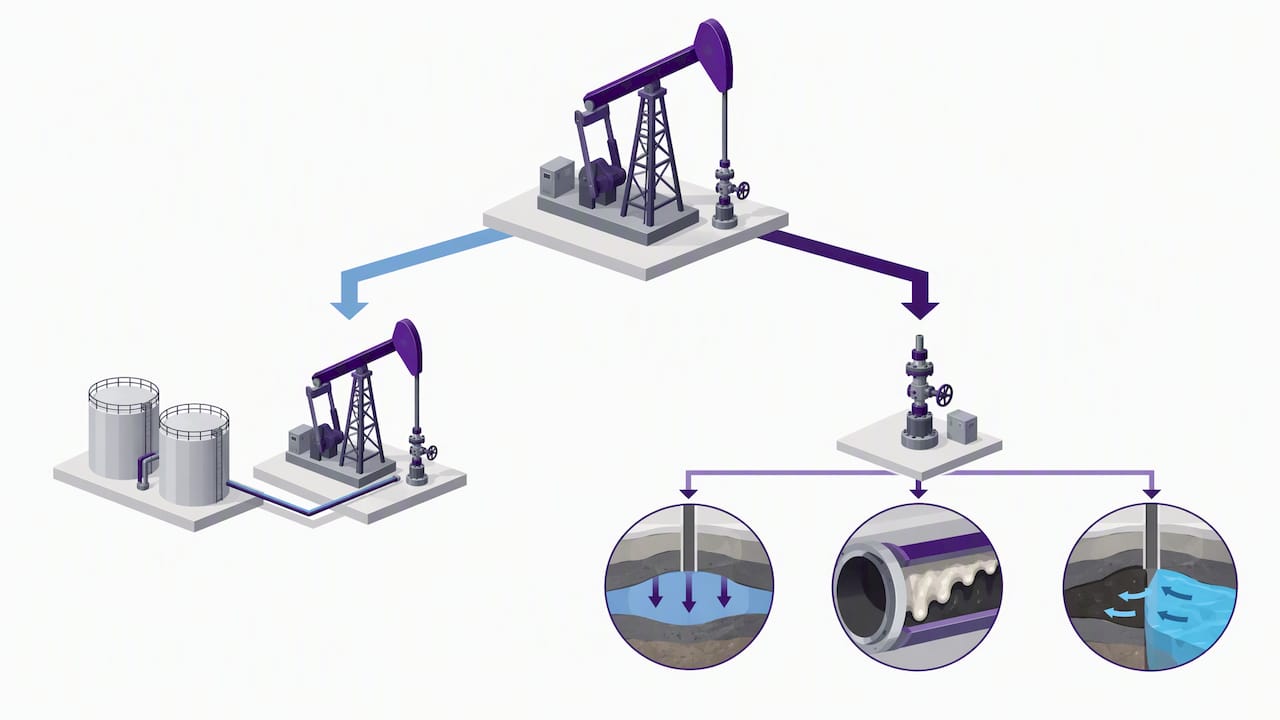
It is tempting to think an operator can simply switch off a loss-making well and wait for better prices. In practice, shutting in can damage a reservoir through pressure loss, paraffin buildup and water encroachment, especially in mature fields. This reporting concerned a large foreign field, so the scale differs from a small U.S. lease, but the mechanics are why many operators keep marginal wells running or rotate production instead of idling them. The cost of that choice is easy for outsiders to underestimate.
How the economic limit connects to taxes
Many of our readers come to oil and gas through the tax code, so the link deserves care. The tax treatment of a well and its economic life are separate questions, and one does not rescue the other.
The IRS explains in Publication 925 that a working interest held directly, or through an entity that does not limit liability, is generally not treated as a passive activity. That can allow losses to offset other active income, while future net income from that property is also treated as non-passive. We cover the mechanics in our guide to passive loss rules and the energy tax twist and in how to lower your taxes with oil and gas investments.
Depletion is the other piece that bears on marginal wells. The National Stripper Well Association describes percentage depletion as a 15% reduction of a property’s taxable gross income, limited to a taxpayer’s first 1,000 barrels a day of oil. Eligibility depends on the taxpayer’s status, and the Joint Committee on Taxation notes that only independent producers and royalty owners can claim it, not integrated oil companies. Whether any of this applies to you depends on how your interest is structured, so confirm it with a CPA who handles oil and gas.
Two cautions belong here. A deduction does not make an uneconomic well economic: a tax saving on a project that loses cash only reduces the loss. And the IRS pays attention to how costs are split. IRS Publication 5652 is the agency’s depletion guide for oil and gas examiners, and reviewing the operator’s overhead charges on intangible drilling costs in the Joint Operating Agreement is a sensible step before signing.
Our perspective
We talk with high-income professionals every week who come in asking about first-year deductions. The better question comes second: how long will this asset keep paying me, and what happens when it stops?
Our view is that the economic limit should be the first number you ask about, not the last. A project’s deduction is a one-time event. Its cash flow is a decade-long story, and the economic limit decides how that story ends. That is why we put weight on operator screening and on presenting key project materials in a form that makes projects easy to compare side by side.
When you review any deal, ask for the lease operating expense per BOE, the projected decline, the oil price at which the project crosses its limit, and who pays for plugging. If an operator cannot answer those four clearly, the tax benefit is not enough reason to proceed. We would rather you walk away from a weak deal than hold a zombie well.
Our analysis of depletion effects on deal value shows how we think about modeling decline.
— Sharif
A checklist before you invest
Use these steps on any producing asset, whether you find it with us or elsewhere.
- Get the last 12 months of lease operating expenses, broken down per well and per BOE. Compare them with current net revenue per BOE.
- Calculate the break-even rate using the formula above, at today’s price and at a price 25% lower.
- Compare the break-even rate with current output and the decline curve. If the well will cross the line within a few years, the payback has to happen before then.
- Find the plugging and abandonment estimate and who is responsible. Ask whether a bond or reserve is in place.
- Read the Joint Operating Agreement for overhead charges, especially on intangible drilling costs.
- Separate the tax benefit from the economics. Judge the project on cash flow first, then add the tax effect with your CPA.
- Check the operator’s balance sheet. The EPA’s orphan-well warning exists because operators sometimes cannot afford to plug what they drill.
Where Fieldvest fits
Fieldvest is a platform where accredited investors can invest directly in vetted U.S. energy projects across three categories: producing assets, development projects and energy infrastructure. We screen operators and present the key project materials in a way that lets you compare deals on the numbers above. You can also run a first estimate of your own numbers with our free oil and gas tax deduction calculator.
Oil and gas investing carries real risk, including loss of capital. Check any specific project’s structure with your CPA and attorney.
FAQ
What does “economic limit” mean for an oil well?
It is the point where the revenue from a well, after royalties and taxes, no longer covers its direct operating costs. Beyond it, continued production loses money. It is usually expressed as a minimum daily rate in barrels of oil equivalent.
Does the economic limit change over time?
Yes. It rises when costs or taxes go up or when oil prices fall, and it drops when prices recover. A well can cross the limit, be shut in, and return to production later if conditions improve.
How much does a typical U.S. oil well produce?
Not much. The EIA reports average oil well production of 29 barrels a day in 2024, and 78% of wells produce 15 BOE/d or less. Output varies sharply by basin and well type, so any single figure is only an average.
Is the economic limit the same as reserves?
No. Reserves are quantities expected to be recoverable economically. Sub-economic production does not count as reserves under SPE’s resource management system. A valuation that treats those barrels as reserves overstates what an investor will receive.
Do tax deductions change the economic limit?
The basic calculation excludes income taxes, so deductions do not move it. They can improve your after-tax return on a project, but they do not turn a cash-losing well into a profitable one. Talk to a CPA experienced in oil and gas about your specific position.
Sources
- Economic limit of field production in Louisiana, ScienceDirect
- Economic limit definition, Oilfield Glossary
- Method helps operators determine best times to shut down projects, Oil & Gas Journal
- Oil & Gas Journal
- The Distribution of U.S. Oil and Natural Gas Wells by Production Rate, EIA
- Marginal conventional wells, EPA
- Petroleum Resources Management System, SPE
- Iran faces forced shut-ins, Kpler
- IRS Publication 925
- Percentage depletion, National Stripper Well Association
- Present-law tax rules relating to domestic oil and gas, Joint Committee on Taxation
- IRS Publication 5652
Recommended

Get the Fieldvest Energy Brief
and AI-driven demand shifts — curated for accredited investors. Smart. Strategic. Tax-advantaged.