


Onboarding into a private U.S. energy investment is a sequence of eligibility checks, document signing, identity verification and funding. Most of the delay comes from paperwork that is incomplete or inconsistent, not from the deal itself. If you gather your accreditation proof, tax forms, entity papers and bank details before you start, the process usually moves quickly.
This guide walks through each stage in the order you will meet it, what you will be asked for, and what each confirmation actually means.
TL;DR
- Onboarding runs in roughly eight stages: eligibility, document delivery, subscription, review, AML and KYC, acceptance, funding, and register entry.
- Private energy offerings are generally open to accredited investors. The SEC sets the income, net worth and license tests.
- Expect to provide ID, proof of address, a tax form (W-9 for U.S. persons), bank details in your name and accreditation support.
- Incomplete packages are the most common cause of delay, so check every page before you sign.
- “Funded” and “accepted” are different events. Your investment is final only after the issuer accepts it.
Table of Contents
- The stages of energy investor onboarding
- Step 1: Confirm you are eligible
- Step 2: Gather your documents before you start
- Step 3: Read the offering documents before you sign
- Step 4: KYC and anti-money-laundering checks
- Step 5: Funding and what “accepted” means
- After onboarding: tax forms and communications
- Choosing the type of project
- Start with vetted deals on Fieldvest
- Our perspective on onboarding
- FAQ
- Sources
The stages of energy investor onboarding
One private fund onboarding guide breaks the process into eight steps: eligibility, document delivery, subscription, review for good order, AML and KYC, acceptance, funding, and entry on the investor register with confirmation. Direct oil and gas programs and project-level deals follow the same logic, even when the names of the documents differ.
Here is how those stages look from your side of the table.
| Stage | What you do | What the sponsor does |
|---|---|---|
| 1. Eligibility | Confirm you meet accredited investor tests | Forms a reasonable belief, or verifies, that you qualify |
| 2. Document delivery | Read the offering materials | Sends the offering memorandum, subscription package and project data |
| 3. Subscription | Complete and sign the subscription documents | Receives your offer to invest |
| 4. Review | Fix anything flagged | Checks the package for completeness and consistency |
| 5. AML and KYC | Provide identity and source-of-funds information | Screens and verifies identity |
| 6. Acceptance | Wait for confirmation | Accepts or rejects the subscription |
| 7. Funding | Send funds by the instructed method | Confirms receipt |
| 8. Register entry | Keep your confirmation | Records you as an investor |
The review step matters more than it looks. The same guide notes that an administrator checks completeness and internal consistency, and that submissions returned as “not in good order” are the largest single cause of delay. A missing initial, a mismatched name or a signature on the wrong page sends you back to the start of that step.
Step 1: Confirm you are eligible
Private energy offerings are usually sold under Regulation D, which limits who can take part. Under Rule 506(b), an issuer may sell to an unlimited number of accredited investors and no more than 35 non-accredited investors in any 90-day period, and those non-accredited buyers must be financially sophisticated, according to investor.gov. In practice, most energy sponsors, including the deals on Fieldvest, are built for accredited investors.
The accredited investor tests for individuals
The SEC’s guidance on assessing accredited investors says an individual can qualify in any of three ways:
- Net worth over $1 million, not counting your primary residence.
- Income over $200,000 individually, or $300,000 together with a spouse, in each of the prior two years, with a reasonable expectation of the same this year.
- A Series 7, 65 or 82 license in good standing.
The Legal Information Institute’s summary of Rule 501(a) gives the same income and net worth thresholds in plain language. For many W-2 professionals, the income test is the relevant one, which is why a household earning $300,000 or more often qualifies as a couple even when neither spouse reaches $200,000 alone.
Entities and trusts
If you invest through a company or trust, the tests change. According to the SEC’s accredited investor page, an entity can qualify if it owns investments above $5 million, if it is one of several listed entity types with assets above $5 million, or if all its equity owners are accredited. If you plan to invest through an LLC, read our practical guide to investment entity setup for energy projects before you sign anything, because the entity’s structure determines which documents you will need.
506(b) versus 506©: why it changes your paperwork
The offering type decides how much proof you must show.
- Under Rule 506(b), the issuer needs a reasonable belief that you are accredited. Often that means a questionnaire and a signed representation.
- Under Rule 506©, the issuer must take reasonable steps to verify. You will be asked for actual documents.
If the deal is a 506© offering, plan for extra time at the start. We explain the practical differences in 506© energy offerings: what accredited investors should know.
How verification works for 506©
The SEC’s non-exclusive list of verification methods includes:
- IRS income forms such as a W-2, 1099, Schedule K-1 or Form 1040.
- Net worth documents dated within the prior three months, such as bank, brokerage or credit statements, plus a written representation from you.
- A written confirmation, dated within the last three months, from a registered broker-dealer, SEC-registered investment adviser, licensed attorney or CPA.
- For investors verified before, a written representation at the time of sale that satisfies the obligation for five years.
All four are listed on the SEC’s assessing accredited investors page. If your CPA already prepares your return, a confirmation letter from them is often the fastest route, since it replaces handing over full tax returns. Ask your CPA or attorney which method fits your situation.
If you are still working out whether you qualify, our guide to what accredited investors are covers the definitions in more depth.
Step 2: Gather your documents before you start
The exact list depends on the sponsor and your investor type, but the core set is consistent. A subscription booklet checklist from a fundraising data room provider says to expect:
- Government-issued ID and proof of address.
- Form W-9 for U.S. persons, or the appropriate Form W-8 for non-U.S. persons.
- Tax-exempt status documentation where it applies.
- A source-of-funds statement.
- Bank details in your own name, often confirmed by phone.
- Supporting accreditation documents such as tax returns or financial statements.
- For entities, formation documents and beneficial-owner information.
The same source describes a typical subscription booklet as containing instructions, a subscription agreement, an investor questionnaire, tax forms, KYC and AML documents, wire and distribution details, signature pages and any supplements or side-letter forms.
Individuals versus entities
Individuals submit relatively little. Trusts, corporate entities, partnerships and retirement accounts must also prove they exist and show that the person signing has authority, as the private fund onboarding guide explains. For a trust that means the trust agreement or a certification of trust. For an LLC it means articles of organization, the operating agreement and a list of owners.
A pre-flight checklist
Before you open the subscription package:
- Check that the name on your ID, tax form, bank account and signature page matches exactly.
- Pull your last two years of tax returns and your most recent statements, dated within the past three months.
- Ask your CPA or attorney whether they will provide a written accreditation confirmation.
- Confirm the funding account is in the same name as the investing party.
- Decide in advance whether you are investing personally or through an entity.
That last item is the one people get wrong most often, because changing it midstream means redoing the whole package.
Step 3: Read the offering documents before you sign
The documents differ between a drilling program, a producing asset and an infrastructure project, but the core structure is similar. For a private placement equity investment, one securities services firm lists the closing documents as:
- A private placement memorandum (PPM), which describes the offering terms and the issuer. It is informational and you do not sign it.
- An operating agreement or articles of incorporation, signed by the investor and issuer.
- A subscription or purchase agreement, stating your investment and amount.
Read the PPM in full. It is where the project economics, the operator’s background, the use of proceeds, the fees and the risk factors live. We cover how to read private deal materials in how U.S. accredited investors vet private oil and gas deals before paying.
What you are representing when you sign
The investor representations section of a subscription agreement is the part with legal weight. According to a 2026 guide to subscription agreements, you typically represent that you are accredited and on what basis, that you are buying for investment rather than resale, that you can bear the economic risk of a total loss, and that you have reviewed the PPM and related documents. Treat those as statements you are making under your own name. Answer from your actual records, not from memory.
The same guide points out that your subscription is an offer that the company must affirmatively accept. It is not binding until accepted.
Step 4: KYC and anti-money-laundering checks
Expect an identity check even though the deal is private. Which rules apply depends on who is regulated in the chain. When a broker-dealer is involved, its Customer Identification Program must collect at minimum your name, date of birth, address and an identification number before opening an account, and it must verify your identity using risk-based procedures, per 31 CFR 1023.220. For a U.S. person, the identification number is a taxpayer identification number.
If you invest through an entity, FinCEN’s customer due diligence rule requires covered financial institutions to identify and verify the beneficial owners of legal entity customers when a new account is opened, according to FinCEN’s CDD rule FAQs. That is why entity investors are asked for owner names and ownership percentages.
Other checks you may see, described in the private fund onboarding guide, include screening against sanctions and politically exposed person lists and, where circumstances warrant, questions about the source of your funds. A clear one-paragraph source-of-funds explanation (salary, sale of a business, liquidation of crypto holdings, sale of property) saves a round of follow-up. Keep the supporting statements handy in case they ask.

Step 5: Funding and what “accepted” means
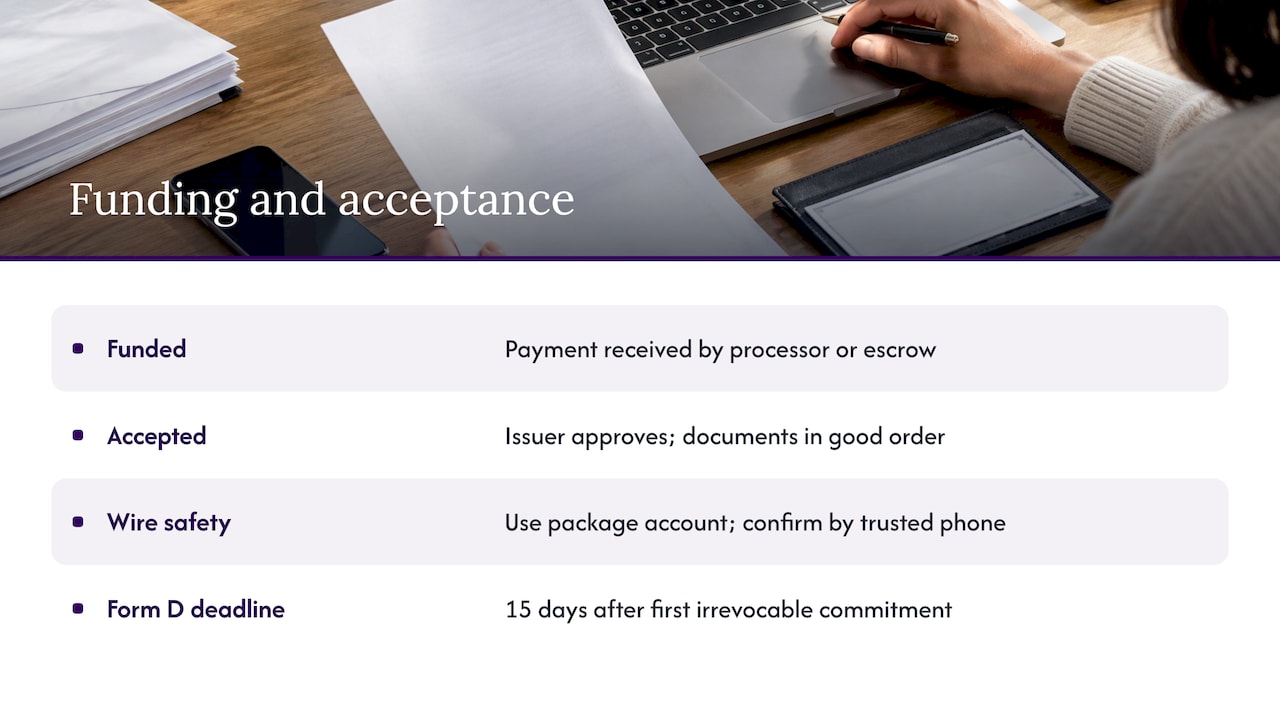
Two words get confused at the end of onboarding. One platform’s help center defines “funded” and “accepted” as separate events. Funded means your payment has been submitted and received by the processor or escrow account. Accepted means the issuer has reviewed and approved the subscription, found the documents in good order and chosen to accept the investment.
That has a practical consequence. Send funds only by the method and to the account named in the wire instructions in your package, and confirm those instructions by phone with a number you already trust, since wire fraud targets large transfers. Then wait for the written acceptance and keep it with your records.
After the first sale in an offering, the issuer files a Form D notice with the SEC. The Form D deadline is 15 days from the date the first investor becomes irrevocably committed, not the date funds arrive. This is the issuer’s job, not yours, but it explains why sponsors push for clean, timely signature pages.
After onboarding: tax forms and communications
Once you are on the register, expect regular reporting from the sponsor or operator: project updates, production or construction reports where relevant, and annual tax documents. Partnership structures typically issue a Schedule K-1 reporting your share of income, losses and deductions, one of the same IRS forms the SEC lists among accepted accreditation evidence.
The tax benefit is usually the reason high earners look at energy in the first place. Domestic oil and gas drilling programs can generate significant first-year deductions, and what you can actually use depends on your own tax position. Run the numbers with our free oil and gas tax deduction calculator, then take the results to your CPA before you commit. For a closer look at one common structure, see our piece on tax-first family office oil investing with IDC. To understand your exposure after you invest, our liability playbook for accredited oil investors covers the EPA, IRS and SEC angles.
Choosing the type of project
Onboarding looks similar across project types, but the documents you review change with what you buy. Our marketplace organizes deals into three categories:
- Producing assets: wells already in production, with operating history you can review.
- Development projects: drilling or build-out stages, where the tax treatment and timeline are the main questions.
- Energy infrastructure: midstream and supporting assets.
For background on each category, see our guides to oil and petroleum investments, gas investments, and oil and gas investments for accredited investors. Our overview of eight types of accredited investor opportunities shows how energy fits next to other private deals. If you also want to compare renewables, you can look at the top wind energy companies active in that segment.
Start with vetted deals on Fieldvest
Fieldvest connects accredited investors with U.S. energy projects across producing assets, development projects and energy infrastructure. Our approach is designed to put the key project materials side by side, so you can compare deals before you move into subscription documents, and we work with operators we have vetted and screened.
If you are ready to see what is available, browse Fieldvest’s energy investment opportunities. If you want to size the tax side first, start with the deduction calculator.
Our perspective on onboarding
Most investors we talk to expect the hard part of an energy investment to be choosing the project. In our experience the harder part is arriving at the subscription stage with clean paperwork and a clear picture of what you are signing.
That is why we built Fieldvest around transparency. We present key project materials in a format designed for comparison, and we focus on operators we have vetted and screened, so that by the time you start onboarding you already know what you are investing in and why.
Our advice is simple. Decide how you will hold the investment before you begin, collect your accreditation proof early, and read the offering memorandum before the subscription agreement. Done in that order, onboarding is a short administrative step toward direct ownership of a real energy asset and the tax and cash flow opportunities that come with it.
Sharif
FAQ
How long does energy investor onboarding take?
It depends on the sponsor, whether the offering is 506(b) or 506©, and how complete your package is. Incomplete submissions returned as not in good order are the largest single cause of delay, so a complete first submission is the best way to move quickly. Ask the sponsor for their current timeline before you start.
Do I need to be an accredited investor?
For most private energy offerings, yes. You qualify with income over $200,000 (or $300,000 with a spouse) in each of the past two years, a net worth over $1 million excluding your primary residence, or a Series 7, 65 or 82 license, per the SEC. Some 506(b) offerings allow a limited number of sophisticated non-accredited investors.
What documents will I need to provide?
Typically government ID, proof of address, a W-9, bank details in your name, a source-of-funds statement and accreditation support such as tax returns or a CPA or attorney letter. Entities add formation documents and beneficial-owner information. Your sponsor’s subscription package lists the exact set.
Is my investment final once I wire the money?
No. Funded means the payment was received, while accepted means the issuer reviewed the subscription, found the documents in good order and approved it. Keep the written acceptance for your records.
Can I invest through an LLC or trust?
Yes, in many cases. Entities have their own accreditation tests and must provide formation documents and owner information. Speak with your attorney or CPA about structure before you subscribe.
Sources
- Investor Onboarding in Private Funds
- SEC: Assessing Accredited Investors under Regulation D
- SEC: Accredited Investors
- Investor.gov: Private Placements under Regulation D
- Legal Information Institute: Investor
- Subscription Booklet Checklist
- Closing Documentation for Private Placement Investment Opportunities
- Subscription Agreement: Legal Guide for Private Offerings
- eCFR: 31 CFR 1023.220
- FinCEN: CDD Rule FAQs
- Is my Investment Fully Funded?
- How to Draft an Oil and Gas Private Placement Memorandum
- Top Wind Energy Companies for Investors and Partners
Recommended

Get the Fieldvest Energy Brief
and AI-driven demand shifts — curated for accredited investors. Smart. Strategic. Tax-advantaged.