


If you’re screening a private energy deal for first-year tax deductions, apply this rule before anything else: reject any opportunity that can’t produce audit-ready evidence of tax eligibility and doesn’t show the operator investing alongside you on the same terms. That single filter eliminates most of the deals that later trigger IRS scrutiny or recapture headaches under the final transfer regulations.
Before you spend a dollar on legal or engineering review, request three things: start-of-construction evidence or safe-harbor proof, placed-in-service substantiation with commissioning records, and prevailing wage/apprenticeship compliance logs. These documents matter because gaps in any one of them can lead to disallowed credits, clawback, or recapture penalties years after you’ve already filed.
- Start-of-construction proof (dated invoices, photos, safe-harbor documentation)
- Placed-in-service substantiation (commissioning reports, interconnection approval)
- Prevailing wage/apprenticeship logs (certified payroll, apprenticeship affidavits)
Key Takeaways
Tax-first energy investing succeeds when audit-ready documentation, verified operator co-investment, and modeled recapture exposure all clear the bar before capital moves.
| Point | Details |
|---|---|
| Demand documents first | Request start-of-construction evidence, placed-in-service records, and prevailing wage logs before deeper diligence begins. |
| Screen fast, verify slow | Use a 20 minute checklist to reject weak deals, then spend counsel fees only on survivors. |
| Model recapture explicitly | Run base, downside, and full-recapture scenarios to see how a claw back flips your after-tax return. |
| Structure protections, not promises | Size escrows and indemnities to your modeled recapture exposure, not a generic percentage. |
| Fieldvest pre-screens the document gap | Fieldvest verifies audit-ready evidence and operator co-investment before listing a deal, shortening your own diligence path. |
Table of Contents
- Energy Project Evaluation Checklist You Can Run in 20 Minutes
- Tax and Audit Documentation You Must Verify Before Committing
- What Operator and Contract Checks Reveal About Long-Term Risk
- How Do You Model Recapture Risk Into Your Return Expectations?
- Deal Protections Worth Negotiating Before You Wire Funds
- Warning Signs That Should End Diligence Immediately
- How Independent Engineers Validate Asset-Level Performance
- What Compliance Monitoring Looks Like After You Invest
- Exit Timing and Its Effect on Returns and Taxes
- Managing Geopolitical, Environmental, and Regulatory Risk
- How Fieldvest Vets Deals Before They Reach Investors
- Ready to Review Vetted, Tax-First Energy Deals?
- Sources
Energy Project Evaluation Checklist You Can Run in 20 Minutes
Before a deal earns a deeper look, run it through a fast screen. This isn’t a substitute for full diligence. It’s a filter that saves you from wasting counsel fees on deals that were never going to clear the bar.
- Tax eligibility: Does the operator have documented proof of credit eligibility tied to a specific tax code section, not just a verbal claim?
- Documentation completeness: Can they produce start-of-construction and placed-in-service evidence on request, within 48 hours?
- Operator alignment: Is the sponsor investing real capital on the same terms as outside investors, or are they collecting fees with none of their own money at risk?
- Insurance and indemnities: Is there a policy or indemnity structure covering recapture risk, not just general liability?
- Basic economics: Does the estimated first-year tax benefit justify the capital at risk once you subtract diligence and carrying costs?
Red-line items that should end the conversation immediately: no timestamped evidence of construction start, an operator with zero co-investment, or a purchase-option structure that lets a third party buy out the asset inside the recapture window.
Budget for this stage: expect preliminary diligence to run one to two weeks and cost relatively little if you’re doing it yourself. Full diligence, including an independent engineer review, tax opinion, and legal review of contracts, typically runs several weeks and involves real professional fees, which is why the quick screen exists in the first place.
Tax and Audit Documentation You Must Verify Before Committing
The IRS transfer rules under Notice N-22-61 put the compliance burden squarely on the buyer’s shoulders, even when the seller originated the credit. That means your due diligence file needs to survive an examination years after closing, not just satisfy a broker at signing.
| Document | What it proves | Weak version to watch for |
|---|---|---|
| Start-of-construction evidence | Project began before a statutory deadline or met safe-harbor thresholds | Undated vendor invoices with no chain of custody |
| Placed-in-service substantiation | Asset was operational by the claimed tax year | Commissioning report missing interconnection sign-off |
| Cost segregation report | Depreciation schedule matches asset classification | Generic template with no site-specific engineering |
| Certified payroll / apprenticeship logs | Prevailing wage and apprenticeship rules were met | Payroll summaries without contractor-level detail |
Market practitioners have converged on a fairly standard diligence roadmap for these transfers: cost segregation, placed-in-service substantiation, prevailing wage checks, insurance review, and seller credit analysis, according to TaxNotes. Ask for AFEs (authorization for expenditure documents), depreciation schedules, and any insurance policy language specifically addressing recapture, not just general property coverage.
The strongest files use immutable, timestamped records, sometimes called digital asset passports, rather than a folder of scanned PDFs with no metadata. Realizse’s analysis of the post-OB3 market makes the point directly: without persistent, verifiable compliance records, buyers can’t price bonus-credit-dependent deals safely, and insurers won’t touch the recapture exposure. If everything you’re handed is a static PDF bundle with no dates or version history, treat that as a documentation failure, not a formatting quirk.
Pro Tip: Ask counsel for a written tax opinion that specifically addresses the credit’s eligibility mechanics, not just a general summary letter. If no opinion exists, confirm the seller carries recapture insurance or an indemnity broad enough to cover the full credit amount, plus penalties and interest, for the entire recapture period.
What Operator and Contract Checks Reveal About Long-Term Risk
Documentation tells you whether a credit is defensible. Operator and contract quality tells you whether the cash flow behind it actually shows up. Both matter, and skipping either one is how investors end up with a technically eligible project that still loses money.
- Track record: How many similar projects has this operator completed, and can they show a distribution history, not just a pitch deck projection?
- Balance sheet: Does the sponsor have liquidity to cover cost overruns, or are they one bad quarter from default?
- Co-investment: Is the operator’s capital in the deal on the same terms as yours? Sponsor quality, not geology alone, tends to determine oil and gas program outcomes, and the same logic holds for renewables.
- Litigation history: Any pending disputes with prior investors, contractors, or regulators?
- EPC/O&M warranties: Are performance guarantees backed by a creditworthy counterparty, or a shell entity with no assets?
- PPA and interconnection alignment: Does the delivery point in the power purchase agreement match the interconnection agreement, and are metering and remote monitoring rights clearly assigned to you or your operator? Foley & Lardner’s diligence guidance flags mismatches here as a recurring source of both cash-flow and tax risk.
- Purchase options and title: Are there multiple parties with purchase-option rights inside the recapture window, and is the land title clean of competing liens?
Sort these into two buckets. Contract ambiguities around warranties or escalation clauses are usually fixable through indemnity or escrow. A structural issue, like a host purchase option that could trigger a change of ownership before the recapture period ends, is not fixable and should kill the deal outright. Legal diligence scope varies by project stage and offtaker type, so Lexology’s overview of renewable energy legal diligence is worth reading in full before you finalize a document request list.
How Do You Model Recapture Risk Into Your Return Expectations?
A tax-first energy deal lives or dies on one number most investors underweight: the probability-adjusted cost of recapture. Model it explicitly, not as an afterthought.
- Stress the placed-in-service timeline first. A six-month delay can push an asset into a different tax year, changing your entire first-year deduction assumption.
- Test bonus-credit eligibility assumptions separately. Domestic content and prevailing wage bonus adders are the parts of the credit most likely to be challenged, so model the deal both with and without them.
- Run three recapture scenarios. Full disallowance in year one is the worst case; partial recapture in year three or year six (common recapture windows for several credit types) shows a milder but still material hit.
- Calculate the after-tax cash impact of each scenario, including penalties, interest, and the realistic probability that a seller indemnity actually pays out rather than sitting in litigation for two years.
- Layer in a base case, a downside case (revenue down 25%), and the recapture case together. This is where the true tax-adjusted yield of a deal becomes visible, since a project that looks strong on paper can flip to a negative IRR once you price in even a modest recapture probability.
The point isn’t to avoid every deal with recapture exposure. It’s to know exactly what you’re pricing before you commit capital, because a first-year deduction that gets clawed back in year three is worse than never having claimed it.
Deal Protections Worth Negotiating Before You Wire Funds
Documentation and modeling tell you the risk. These terms tell you who absorbs it if something goes wrong.
- Seller indemnity for recapture, sized to the full potential clawback amount plus penalties and interest, not just a token percentage.
- Escrow holdbacks calculated against your modeled recapture exposure from the prior section, released on a schedule tied to the recapture window closing.
- Audit participation rights, giving you or your counsel access to respond if the IRS challenges the credit.
- Access to seller records in the event of an examination, written into the purchase agreement, not promised informally.
- Insurance covering recapture or representational breaches, distinct from standard property and liability coverage.
Independent engineer reports, tax opinions, and cost-segregation studies are usually paid for by the seller in a transfer transaction, though buyers sometimes split the cost of a second opinion when the stakes are high enough to warrant it.
Warning Signs That Should End Diligence Immediately
Some issues are worth negotiating around. Others mean you walk. If you see any of the following, stop the process rather than trying to reprice it:
- No immutable start-of-construction evidence, only vendor invoices with no chain of custody.
- Operator has zero co-investment under the same terms as outside investors, a structural signal researchers at Harvard Law School’s corporate governance forum associate with elevated moral-hazard risk.
- Multiple purchase-option holders inside the recapture window, or a PPA delivery point that doesn’t match the interconnection agreement.
- Missing certified payroll or prevailing wage records for a project claiming wage-dependent bonus credits.
How Independent Engineers Validate Asset-Level Performance
A tax opinion tells you the credit is theoretically eligible. It says nothing about whether the physical asset will actually generate the production numbers behind your cash flow projections. That’s what independent engineer (IE) review is for.

A competent IE report validates equipment specifications against manufacturer datasheets, confirms the resource assessment (wind, solar irradiance, or well production estimates) against independent modeling, and checks that the O&M plan matches the asset’s actual maintenance needs rather than a generic template. For oil and gas specifically, this extends to reserve reports validating recoverable volumes against geological data, not just operator projections. Robust technical due diligence in this space is often built around long, granular checklists, sometimes exceeding a hundred distinct line items, according to WRM’s guidance on minimizing renewable investment risk, precisely because a single missed technical assumption can undermine an otherwise sound financial model.
Ask specifically whether the IE report is stamped by a licensed professional engineer and whether it includes site-specific data or reused boilerplate from a similar project. A report that reads like it was written before the site was finalized is a red flag on its own. Cross-reference the IE’s production assumptions against the financial model you were handed. If the numbers don’t match, someone updated one document and not the other, and you need to know which one is wrong before you commit capital.
What Compliance Monitoring Looks Like After You Invest
Closing the deal doesn’t end your compliance exposure. It starts a new phase of it. The transfer regulations make clear that the buyer, meaning you, remains on the hook if underlying compliance requirements aren’t maintained through the credit’s full recapture period, which can run several years past the tax year you claimed the deduction.
Insist on a written reporting cadence from the operator before you fund: quarterly or annual compliance certificates confirming continued prevailing wage adherence where applicable, ongoing placed-in-service status, and any material changes to ownership or use that could trigger recapture. Market participants increasingly recommend buyers demand seller-run compliance monitoring programs specifically because the buyer’s exposure doesn’t end at closing, a point TaxNotes has flagged as a recurring gap in early-market transfer deals.
Beyond tax compliance, ask for annual production or performance reports, insurance renewal confirmations, and notice of any litigation or regulatory action involving the operator or asset. If you’re invested through a fund structure, your K-1 timing depends heavily on the operator’s own reporting discipline, so a sponsor who is slow or sloppy with compliance paperwork will make your own tax filing harder every single year, not just once.
Exit Timing and Its Effect on Returns and Taxes
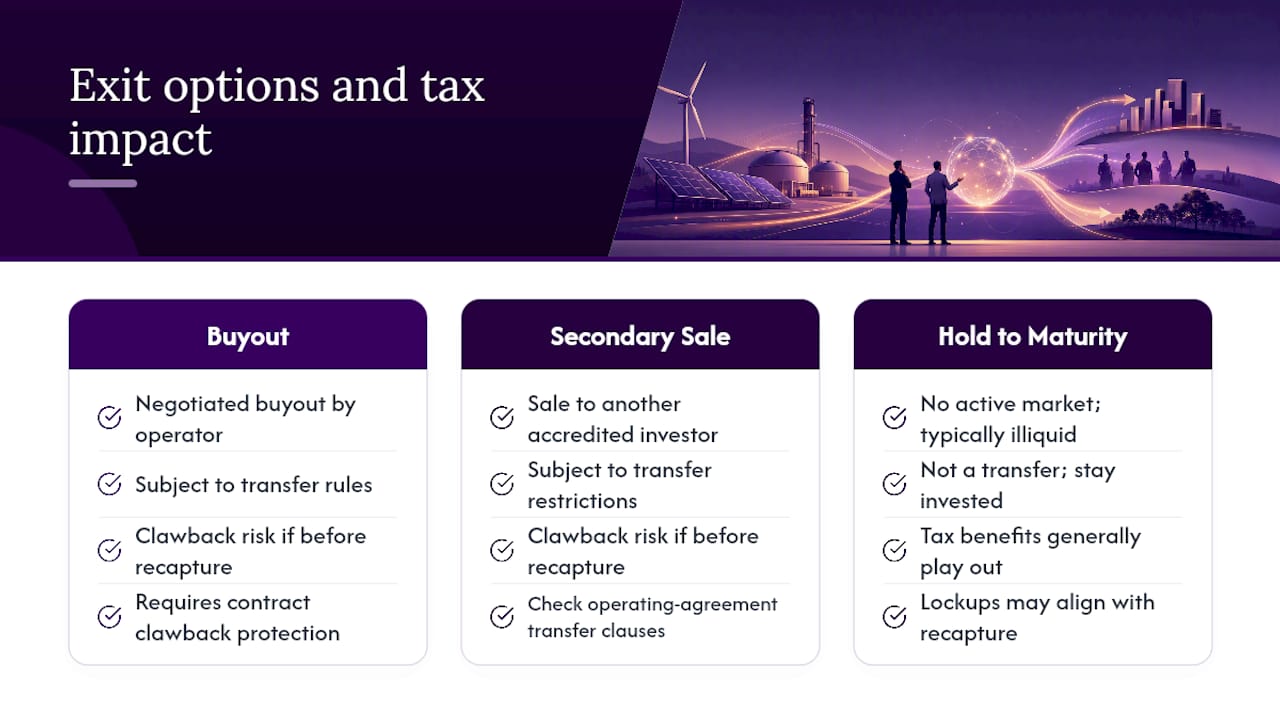
When and how you exit a private energy investment changes both your realized return and your tax exposure, sometimes dramatically. Selling or transferring your interest before the recapture period closes can trigger clawback of credits you already claimed, even if the sale itself has nothing to do with the project’s operational performance.
Most private energy deals aren’t liquid. There’s no public market to sell into, so your practical exit options are usually a negotiated buyout by the operator, a secondary sale to another accredited investor (subject to transfer restrictions in the operating agreement), or simply holding through the project’s full income-generating life and letting depreciation and cash distributions run their course. Each path has different tax consequences: a buyout during the recapture window needs specific contract language protecting you from clawback liability, while a full hold to project maturity generally lets the tax benefits play out as originally modeled.
Before you invest, ask what exit mechanisms exist and at what cost. Some agreements include a right of first refusal for the operator, others include lockup periods tied directly to the recapture schedule. If the operating agreement is silent on exit mechanics, treat that as a gap to negotiate before funding, not an issue to sort out later when you actually want out.
Managing Geopolitical, Environmental, and Regulatory Risk
Tax and contract diligence protect you from paperwork failures. A separate category of risk sits outside the deal documents entirely: the ground the project sits on, literally and figuratively.
Geopolitical risk shows up mostly through supply chains. Domestic content bonus credits depend on sourcing rules that can shift with trade policy, and a project relying on imported components for a domestic content adder carries real exposure if tariff or sourcing rules change mid-construction. Environmental risk includes permitting delays, resource variability (a solar or wind site underperforming its modeled output), and physical risks like extreme weather affecting uptime. Regulatory risk is the broadest category: tax credit eligibility rules, prevailing wage requirements, and interconnection standards are all subject to legislative and administrative change, and a project structured around today’s rules can face a materially different landscape by the time credits are actually claimed or recaptured.
Diversifying across project types and vintages helps, as does favoring operators with a demonstrated history of navigating permitting and regulatory changes rather than ones betting entirely on current rules staying static. None of this eliminates risk. It just means you’re pricing it deliberately instead of discovering it after the fact.
How Fieldvest Vets Deals Before They Reach Investors
I’ve watched enough deals fall apart in diligence to know the pattern: it’s almost never the tax code that trips people up, it’s incomplete records. That’s why Fieldvest runs every listed project through the same sequence: an initial screen for tax eligibility and operator quality, a full document review against the standards outlined above, technical validation through independent engineering where applicable, and a legal and insurance check before anything reaches an investor.
We require audit-ready start-of-construction evidence, cost segregation reports, placed-in-service substantiation, and certified payroll records where prevailing wage rules apply, before a deal goes live on the platform. What we certify is document completeness and baseline underwriting, not a substitute for your own tax counsel. Investors should still engage independent counsel for anything material, but they shouldn’t have to start diligence from zero.
Ready to Review Vetted, Tax-First Energy Deals?
Fieldvest exists for accredited, high-earning investors who want first-year tax deductions and ongoing energy income without building an in-house diligence team from scratch.

Every project listed on the platform has already cleared the document review and operator checks laid out in this guide, so what you’re screening is a shorter list of deals that already passed the hard filter. Fieldvest confirms document completeness, baseline underwriting, and access to the full deal file before anything reaches you, which means your own review starts from a stronger position than diligence on an unvetted deal ever would. Start by running the numbers on your own situation with the free oil and gas tax deduction calculator, then review current vetted opportunities and see how oil and gas investments can lower your taxes this year.
Sources
- Due Diligence and How to Prepare for Tax Credit Transfer Audits — TaxNotes
- Legal due diligence considerations for RE project investments — Lexology
- Diligence manual and PPA checklist — Foley & Lardner LLP
- Clean energy investors & the due diligence dilemma — Realizse
Recommended
- What Is a Qualified Energy Project? Investor Guide | Oil & Gas Investing
- What Are Accredited Investors? Your 2026 Guide | Oil & Gas Investing
- Safe Energy Investing Platform: How to Evaluate Risk, Access, and Protection | Oil & Gas Investing
- Oil and Gas Investments: A Guide for Accredited Investors | Oil & Gas Investing

Get the Fieldvest Energy Brief
and AI-driven demand shifts — curated for accredited investors. Smart. Strategic. Tax-advantaged.