


TL;DR:
- A Qualified Opportunity Fund is an investment vehicle that defers and potentially eliminates capital gains tax by investing in Opportunity Zone properties. Investors must reinvest only the capital gain portion within 180 days and comply with strict rules, including annual reporting, to maintain benefits. OZ 2.0 introduces a rolling five-year deferral for gains after 2027, adding planning complexity and emphasizing thorough vetting of fund sponsors.
A Qualified Opportunity Fund (QOF) is an investment vehicle organized as a corporation or partnership that defers and potentially eliminates capital gains tax by deploying at least 90% of its assets into designated Opportunity Zone properties. Explaining qualified opportunity funds clearly matters because the rules are specific, the deadlines are strict, and the 2025 One Big Beautiful Budget Act (OBBBA) introduced OZ 2.0 updates that change the planning timeline for gains realized after january 1, 2027. The core tax structure rests on three pillars: deferral of the original gain, a partial step-up in basis, and permanent exclusion of appreciation after a 10-year hold. Investors who understand all three pillars can build a tax plan that outperforms most conventional alternatives.
How does the Qualified Opportunity Fund investment process work?
The QOF investment process starts with a capital gain event. You sell an asset, stock, real estate, or a business interest, and you have 180 days to reinvest the gain portion into a QOF. A critical point most investors miss: only the capital gain portion, not the entire sale proceeds, must be reinvested to qualify for deferral. That distinction frees up the cost-basis cash for other uses immediately.

The fund itself self-certifies by filing Form 8996 with its annual tax return. There is no IRS pre-approval process. That means a fund can begin operating quickly, but it also means errors surface only after penalties are triggered, not before.
The investor’s side of the paperwork involves Form 8949 to make the deferral election and annual reporting on Form 8997 to track deferred gains. The fund reports its 90% asset compliance on Form 8996 each year. Both the fund and the investor carry ongoing reporting obligations for the life of the investment.
Under the original OZ 1.0 rules, deferred gains were recognized on december 31, 2026, regardless of when you invested. OZ 2.0 changes that. Capital gains reinvested after January 1, 2027 receive a rolling 5-year deferral window. That creates a continuous entry point for newly realized gains rather than a single fixed deadline.
- Realize a capital gain from any qualifying asset sale.
- Identify a compliant QOF within 180 days of the gain event.
- Invest the gain amount as equity (not debt) into the QOF.
- File Form 8949 with your tax return to elect deferral.
- Hold the investment and monitor annual compliance reporting.
Pro Tip: If your gain comes from a pass-through entity like a partnership, the 180-day clock may start from the end of the entity’s tax year, not the actual transaction date. Confirm the exact start date with a CPA before you invest.
What are the compliance requirements governing Qualified Opportunity Funds?
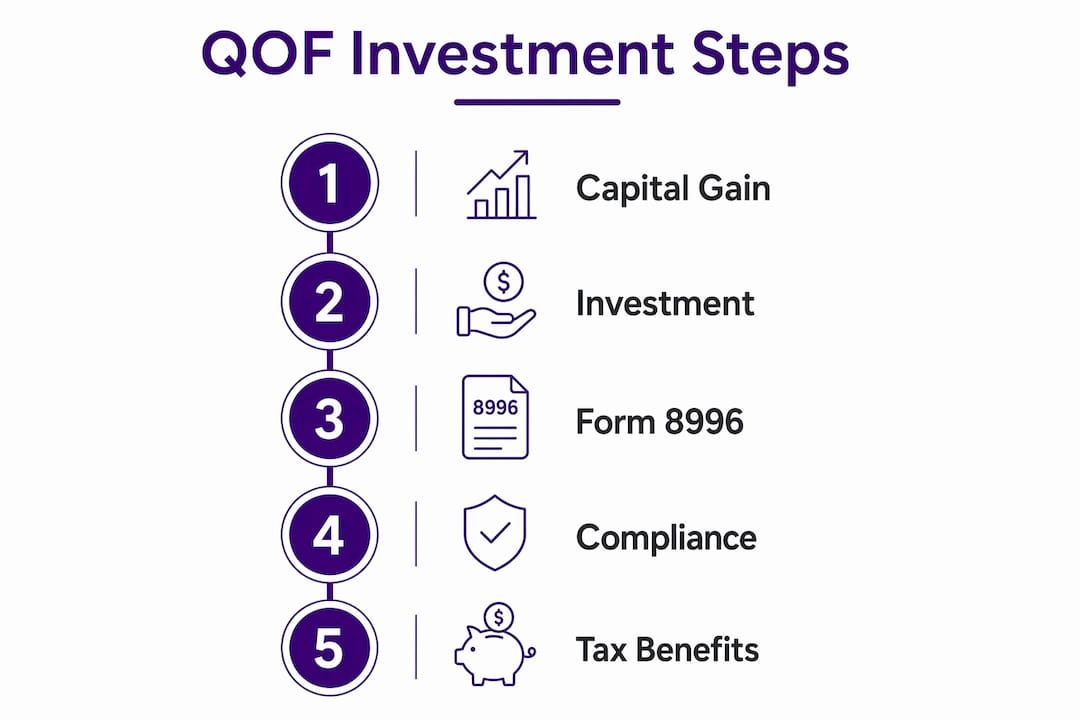
The 90% asset test is the central compliance rule every QOF must pass. The IRS tests compliance twice per year, at the midpoint and at year-end. A fund that falls short of the 90% threshold on either test date owes a monthly penalty calculated using the IRC Section 6621 underpayment rate applied to the shortfall amount. That penalty compounds, so a sustained compliance failure becomes expensive fast.
Qualified Opportunity Zone Property covers three categories: stock in a qualified opportunity zone business, partnership interests in such a business, and qualified opportunity zone business property (tangible property used in the zone). For real estate, the substantial improvement rule requires the fund to invest an amount equal to the original purchase price of the building within 30 months. Raw land is exempt from the substantial improvement requirement.
| Compliance Rule | Requirement | Consequence of Failure |
|---|---|---|
| 90% asset test | 90% of assets in QOZ property, tested twice annually | Monthly penalty per IRC Section 6621 |
| Substantial improvement | Improvements must equal original building cost within 30 months | Loss of qualified property status |
| Working-capital safe harbor | Business may hold cash for up to 31 months with a written plan | Protects against 90% test failure during deployment |
| Annual Form 8996 filing | Fund certifies compliance each tax year | Non-filing triggers penalties and potential disqualification |
The working-capital safe harbor is one of the most useful tools in QOF structuring. A fund can hold cash or cash equivalents for up to 31 months without violating the 90% test, provided there is a written plan for deployment into qualified property. That window gives fund managers time to identify and close on assets without rushing into bad deals.
QOFs self-certify without IRS pre-approval, so investors carry the burden of due diligence. Reviewing a fund’s private placement memorandum, audited financials, and compliance history is not optional. It is the only way to know whether the fund you are entering is actually following the rules.
Pro Tip: Ask the fund sponsor for their Form 8996 filings from prior years. A sponsor who hesitates to share those documents is a red flag.
What are the core tax benefits and timelines of a QOF investment?
The three-tiered tax benefit structure is what separates QOFs from nearly every other investment vehicle available to accredited investors.
- Deferral: The original capital gain is deferred until the earlier of the date you sell your QOF interest or the end of the applicable deferral window. Under OZ 2.0, gains invested after january 1, 2027, defer for a rolling 5-year period rather than a fixed 2026 date.
- Step-up in basis: Under OZ 1.0, holding for 5 years increases your basis by 10%, and holding for 7 years adds another 5% for a total 15% reduction in the deferred gain. These step-ups are limited for gains invested after 2021 due to the 2026 deadline, but OZ 2.0 restores rolling step-up eligibility for new investments.
- Permanent exclusion: Holding a QOF investment for at least 10 years allows you to step up your basis to fair market value at sale, eliminating federal capital gains tax on all appreciation earned inside the fund. This exclusion is available for investments through december 31, 2047.
“OZ 2.0 rules distinguish deferred gain pools from new appreciation gains that are permanently tax-exempt after 10 years, highlighting planning complexity.” — The Arca Labs, 2026
That distinction matters for tax planning. The gain you deferred when you entered the fund and the new appreciation you earn inside the fund are tracked separately. The deferred gain eventually gets recognized and taxed. The appreciation does not, provided you hold for 10 years. A CPA who understands both pools can model the net tax outcome before you commit capital.
The 10-year exclusion is the most powerful benefit in the program. An investor who puts $500,000 of capital gains into a QOF and watches that investment grow to $1,200,000 over a decade owes no federal capital gains tax on the $700,000 of appreciation. That outcome is not available through a 1031 exchange, a Roth IRA, or any standard private equity structure.
How do QOFs compare to other investment vehicles?
QOFs occupy a specific niche that does not overlap cleanly with direct real estate, traditional private equity, or 1031 exchanges. Understanding where they fit helps you decide whether they belong in your portfolio.
| Feature | QOF Investment | Direct Real Estate | Traditional Private Equity |
|---|---|---|---|
| Capital gains deferral | Yes, on reinvested gains | No (1031 defers, not eliminates) | No |
| 10-year appreciation exclusion | Yes, federal level | No | No |
| Liquidity | Low, 10-year hold for full benefit | Moderate | Low |
| IRS pre-approval | None, self-certified | N/A | N/A |
| Minimum investment | Typically $50,000–$250,000 | Varies | Varies |
| Mandated return rate | None required | N/A | Often required by LPA |
Most institutional-grade QOFs require minimum investments from $50,000 up to $250,000 and typically demand accredited investor status. That threshold excludes many retail investors and concentrates the market among high-income professionals and family offices.
QOF equity does not require a mandated rate of return, which allows fund sponsors to structure concessionary capital programs. That flexibility makes QOFs attractive to states and municipalities seeking long-term economic development capital, not just profit-seeking investors. QOF structures often incorporate preferred equity, fixed returns, or senior waterfalls, making them behave more like long-duration infrastructure capital than typical private equity.
The risks are real and specific. Compliance failures can strip the tax benefits retroactively. Opportunity Zone markets, often in economically distressed areas, carry higher development risk than prime real estate. And the 10-year hold requirement creates genuine illiquidity. You should not invest capital you may need before the decade is up.
Key Takeaways
A QOF delivers its full tax benefit only when the investor holds for 10 years, maintains compliance, and invests the right capital within the 180-day window.
| Point | Details |
|---|---|
| Invest only the gain | Only the capital gain portion, not total sale proceeds, must go into the QOF to qualify for deferral. |
| 90% asset test applies | The fund must hold 90% of assets in qualified OZ property, tested twice per year, or face monthly penalties. |
| 10-year hold eliminates appreciation tax | Selling after 10 years steps up basis to fair market value, removing federal capital gains tax on all growth. |
| OZ 2.0 creates rolling deferral | Gains invested after january 1, 2027, receive a 5-year rolling deferral window instead of a fixed deadline. |
| Self-certification means investor risk | No IRS pre-approval exists, so investors must vet fund sponsors and review Form 8996 filings independently. |
My take on navigating QOF investments
I have watched investors get excited about the 10-year exclusion and completely underestimate the compliance burden. The tax benefit is real. The execution risk is also real, and the two are inseparable.
The biggest mistake I see is treating QOF selection like a passive decision. Investors compare projected returns, pick the fund with the best pitch deck, and wire money. They never ask to see the fund’s compliance documentation, the sponsor’s track record in Opportunity Zones specifically, or the legal opinion supporting the fund’s structure. That is how you end up in a fund that fails the 90% asset test in year three and triggers penalties that eat into the tax savings you were counting on.
OZ 2.0 adds real planning value, but it also adds complexity. The rolling deferral window is genuinely useful for investors who realize large gains after 2026. But the distinction between the deferred gain pool and the new appreciation pool requires a CPA who has actually worked with QOF structures, not just read about them. Generic tax advice does not cut it here.
My honest recommendation: pair your QOF investment with a broader tax reduction strategy. QOFs address capital gains specifically. Other vehicles, including energy investments with large first-year deductions, address ordinary income. Using both in the same tax year can produce a materially better outcome than either alone. Align the investment with your liquidity timeline, vet the sponsor thoroughly, and do not let the tax tail wag the investment dog.
— Sharif
Tax-advantaged investing beyond Opportunity Zones
Qualified Opportunity Funds are one of the most powerful capital gains tools available to accredited investors. But they address one type of income. High-earning professionals often carry significant ordinary income tax exposure that QOFs do not touch.
Fieldvest connects accredited investors with vetted U.S. oil and gas projects that generate large first-year tax deductions, often offsetting 70–100% of the invested amount against ordinary income in year one. If you want to model what that looks like for your specific tax situation, Fieldvest’s free tax deduction calculator gives you a concrete estimate in minutes. For investors building a full tax reduction strategy, Fieldvest’s energy investment platform offers a direct path to operators with proven track records and transparent deal structures.
FAQ
What is a Qualified Opportunity Fund?
A Qualified Opportunity Fund is a corporation or partnership that self-certifies by filing Form 8996 and holds at least 90% of its assets in qualified Opportunity Zone property. It enables investors to defer and potentially eliminate capital gains tax through a structured holding period.
Do I have to invest all my sale proceeds into a QOF?
No. Only the capital gain portion of the sale proceeds must be invested within 180 days to qualify for tax deferral. You keep the cost-basis cash free to use elsewhere.
What happens if I sell my QOF investment before 10 years?
Selling before 10 years triggers recognition of the deferred gain and forfeits the permanent exclusion on appreciation. The partial step-up benefits may still apply depending on your holding period, but the most valuable benefit requires the full decade.
What is the minimum investment for a QOF?
Most institutional-grade QOFs require minimum investments between $50,000 and $250,000 and typically require accredited investor status. Minimums vary by fund sponsor and structure.
How does OZ 2.0 change the tax deferral deadline?
Under OZ 2.0, gains reinvested after january 1, 2027, receive a rolling 5-year deferral window rather than a fixed recognition date. This removes the original 2026 deadline and creates a continuous entry point for new capital gains.
Recommended

Get the Fieldvest Energy Brief
and AI-driven demand shifts — curated for accredited investors. Smart. Strategic. Tax-advantaged.