


Force majeure is a contract clause that pauses an obligation when an event outside anyone’s control makes performance impossible or impracticable. In an oil and gas investment, it can delay drilling, interrupt production and push back distributions, but it does not cover a falling oil price, and it does not erase payment duties. For an accredited investor, the practical task is to read how each project’s documents define the clause, how long relief can last and who bears the loss. This guide shows you how.
We built Fieldvest for high-income professionals who want energy exposure and a tax deduction without becoming oilfield lawyers. Fieldvest claims deeper due diligence on vetted and screened operators and a streamlined presentation of key project materials, so the force majeure terms of different deals can be compared side by side.
TL;DR
- Force majeure is a risk-allocation clause: it temporarily suspends performance that an unforeseeable, uncontrollable event has made impossible or impracticable. It is not a general excuse for a bad market.
- Low commodity prices and ordinary market swings generally do not qualify. Physical events, severe weather, government action and similar listed events can.
- The terms that matter most are the list of covered events, the exclusions, notice deadlines, mitigation duties, the maximum length of relief and the termination right.
- Payment obligations usually survive force majeure, but your distributions still depend on production and sales, so a long disruption can pause your cash flow.
- Compare operators on insurance, response planning and document clarity before you commit, not after an event.
Table of Contents
- What force majeure means in an oil and gas deal
- Which events qualify, and which never do
- What a force majeure event does to your investment
- The clock: notice, mitigation and termination
- What courts have said recently
- How to read a project’s force majeure terms
- Worked example: two projects, one hurricane
- Perspective
- Find projects with the documents in front of you
- FAQ
- Sources
What force majeure means in an oil and gas deal
The Supreme Court of Texas, in a 2023 decision, described a force majeure clause as a contractual provision allocating the risk of loss if performance becomes impossible or impracticable, especially because of an event the parties could not have anticipated or controlled. In that case, the clause did not save a drilling deadline, because the delay was a scheduling error that would have missed the deadline even without the event.
Two points follow for you as an investor.
First, the clause is temporary by design. Practitioners at Akin Gump describe it as a risk allocation that suspends performance while an event beyond the parties’ control lasts, and it does not release them from long-term obligations. A hurricane that shuts a platform for weeks is a force majeure story. A project that stops making sense at current prices is not.
Second, it is not the same thing as ordinary investment risk. Ordinary risk is price, reservoir performance, cost overruns and operator execution. Those risks are yours as an owner and are priced into the deal. Force majeure is a narrow, contract-defined category on top of them, and its wording decides who absorbs a specific disruption: the operator, the buyer of the oil or gas, the landowner or you.
If you want the structure underneath, our guide to joint ventures in oil and gas explains how owners and operators share costs and decisions, which is the setting in which these clauses operate.
Which events qualify, and which never do
There is no universal list. An Oklahoma law review article on the subject notes that force majeure is rooted in common law, but qualifying events depend largely on the express events written into each contract and on what was foreseeable when the contract was signed. It groups the common triggers into market failure, acts of government and acts of God.
In practice, oil and gas clauses tend to name things like:
- Hurricanes, floods, freezes, fires and earthquakes.
- Well-specific events such as blowouts, loss of well control, spills, frozen equipment and pipeline blockages. A standard clause published by Practical Law lists these industry-specific events next to pandemics, sanctions and cyberattacks.
- Government action, war, terrorism, embargoes and strikes.
What the same clauses commonly exclude matters just as much. A crude oil supply agreement filed with the SEC defines the event broadly as any cause reasonably beyond a party’s control, and then expressly carves out loss of market, unfavorable market conditions, failure to obtain permits and inability to perform economically. Norton Rose Fulbright points out that a drop in oil or gas price or demand is unlikely to count even when it is severe, and that the 2014 and 2015 price collapse was largely not treated as force majeure because price swings were legally foreseeable.
The lesson is simple. Do not count on force majeure to cushion a price decline, and do not assume it will be invoked for one. Your price exposure is a separate question, covered in our risk mitigation steps for oil projects and, for regional pricing in the Permian, in our Waha basis playbook.
For a plain-language look at how these clauses are built and what they cover in general, this force majeure clause explainer is a helpful companion.
What a force majeure event does to your investment
The effect depends on where the clause sits and what your project owns.
Drilling and lease obligations
In a lease, force majeure typically protects the operator from losing the lease when something outside its power stops work. An SEC-filed oil and gas lease shows the usual mechanics: obligations are suspended and the lease is extended while the lessee is prevented, but the extension cannot run longer than two years of continuous force majeure, the clause does not excuse timely payments, and the lessee has to notify lessors in writing of lengthy delays.
For a development project, this is the clause that decides whether a rig delay costs the project its acreage. That is a big deal, because lost acreage is lost reserves.
Production and sales contracts
If the project sells gas under a supply contract, the clause also governs what happens when deliveries stop. Orrick’s March 2026 analysis says buyers should check whether take-or-pay commitments are suspended, deferred or remain payable despite non-delivery, and that some contracts allow make-up volumes later, priced either at the original terms or at current market rates. The same analysis notes that force majeure events may also trigger business interruption insurance, which is why contract review and insurance review go together.
Your distributions
Force majeure rarely names investors at all. Your income comes from the project’s sales, so if wells are shut in or a pipeline is blocked, revenue pauses even if the contract language protects the operator from a breach claim. For a producing asset, that is a cash flow delay. For a development project, it is a schedule delay that can push first production later. For energy infrastructure, it depends on whether fees are tied to volume or contracted capacity, which is one more reason to read the actual fee terms.
The tax side moves too. A delayed project can change the year in which deductions and income arrive, so ask your CPA to model the timing before you commit. Our free oil and gas tax deduction calculator gives you a starting estimate to bring to that conversation.
The clock: notice, mitigation and termination
Most of the real protection or exposure in a clause is procedural. The examples below come from filed contracts and a Texas lease dispute, so treat them as illustrations of how the terms look, not as standards.
| Term | What it typically controls | Example from filed documents |
|---|---|---|
| Notice | How fast the claiming party must report the event | A crude supply agreement requires written notice within 24 hours; a Permian lease required a written description within 60 days |
| Mitigation | What the claiming party must do to overcome the event | Best or commercially reasonable efforts to avoid or remove it |
| Resumption | How quickly work restarts | In the same Permian lease, resume within 90 days after the event is removed |
| Maximum relief | The outer limit of any extension | 180 days in that lease; two years in the SEC-filed lease above |
| Termination | Whether a party can exit if the event drags on | Most contracts allow it after a set period, commonly 90 to 180 days |
| Payments | Whether money still has to move | Payment obligations commonly stay in force |
A missed notice deadline can sink an otherwise valid claim, and a termination right can end a contract your project depends on. Neither is visible in a pitch deck. Both are visible in the documents.
What courts have said recently
Courts read these clauses narrowly and keep returning to the contract’s exact words.
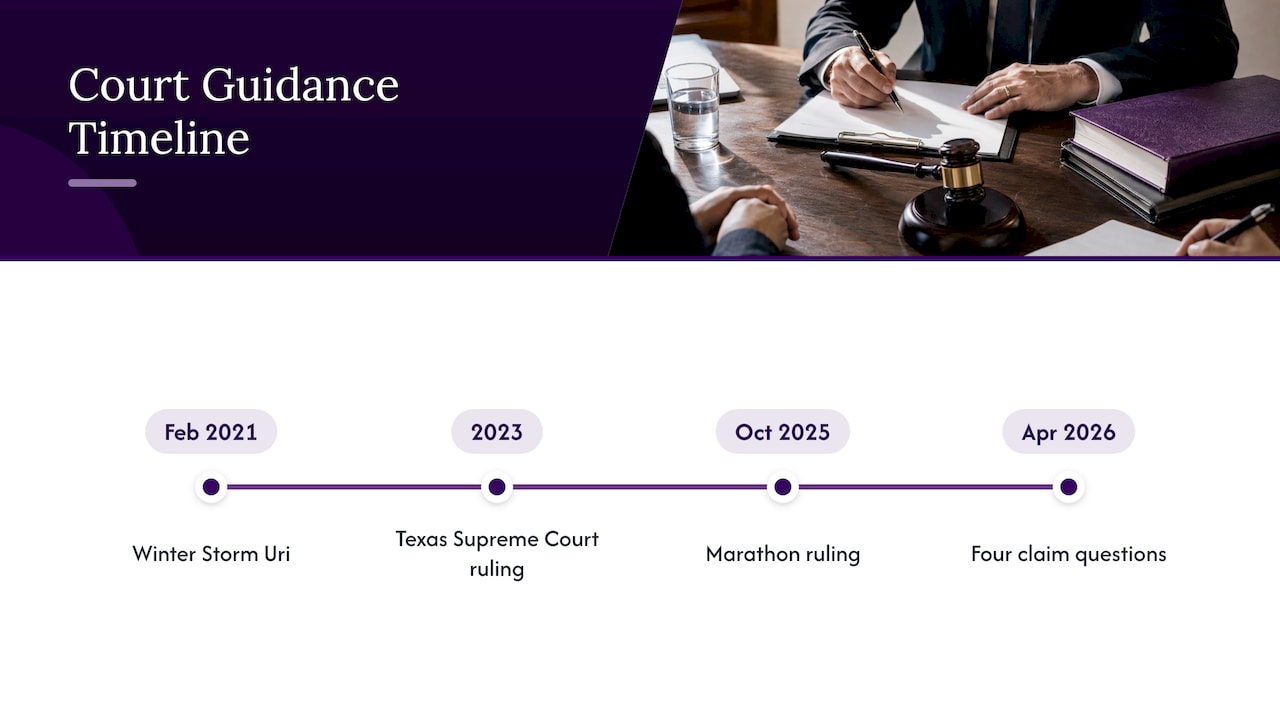
In October 2025, the Business Court of Texas decided Marathon Oil v. Mercuria Energy America and held that the clause did not require Marathon to buy spot-market gas or buy back its delivery obligation, because the parties had added language saying the claiming party had no duty to seek alternative supply. The same dispute family grew out of Winter Storm Uri in February 2021, and the broader Uri litigation has turned on how supply obligations and substitute purchases are written.
The contrast with the 2023 Texas Supreme Court case above is useful. In one, a sentence the parties negotiated decided the outcome. In the other, a scheduling mistake decided it, and the event was beside the point. Both say the same thing: the clause does what the words say, and only when the claiming party did its own job.
Rimon Law’s April 2026 note on Gulf energy disruption gives four questions that any force majeure claim must answer: whether the event falls within the contract definition, whether it prevented, hindered or delayed performance, whether it was beyond reasonable control and whether the party took reasonable steps to limit its effects. Use those four questions as the lens when you read a project’s documents.
How to read a project’s force majeure terms
You do not need to negotiate the clause. You need to know what it says and whether the operator has planned for it. Work through these in order.
- Find the clause in each layer. A project can have a lease, an operating agreement, a participation agreement and sales or transportation contracts, each with its own wording. Our overview of participation agreements in oil and gas shows which document governs what between you and the operator.
- Read the event list and the exclusions together. Look for market conditions, financial hardship and permit failures on the excluded side, and well-specific events and weather on the included side.
- Check whether the clause is source-specific. Orrick notes that if a contract names a particular facility, relief may be available when that facility goes down, while in an open-source contract a seller may be unable to claim relief if costly alternatives remain. A clause that hinges on the spot market can shift very large costs.
- Note the deadlines. Notice windows, resumption periods and the outer limit tell you how long a disruption can last before someone can walk away.
- Confirm payment carve-outs. Money duties usually survive, which protects landowners and royalty holders. Ask who carries the cost when production stops but fixed costs do not.
- Look at insurance and response planning. Business interruption cover and the operator’s disruption plan are what actually absorb a loss. Our checklist on operator insurance coverage in oil deals walks through what to look for.
- Understand the operator’s role. In most upstream structures, assets sit in joint ventures run on an owner-operator model, and Norton Rose Fulbright observes that disputes between co-owners and operators are likely when economic pressure pushes parties toward force majeure and termination. Knowing who decides, and how, is part of the risk. Our page on operator roles in U.S. oil and gas projects covers this.
Before you sign anything with significant capital attached, have a securities or oil and gas attorney review the actual documents. That review is where wording gets tested against your situation, and no general guide can replace it.
Worked example: two projects, one hurricane
Imagine two projects, each with a Gulf Coast gas sales contract and the same four-week shut-in after a named storm. These are illustrations, not real deals.
Project A has a clause that lists named storms, requires notice within a short window, preserves payment obligations and allows termination after 180 days. The operator gave notice on time, the shut-in lasted four weeks, and the contract resumed. Distributions paused for roughly the shut-in period, then restarted. Insurance covered part of the lost revenue.
Project B has a vaguer clause that does not list storms, no notice deadline and no stated outer limit. The operator is entitled to argue the event was foreseeable on the Gulf Coast. The buyer disputes the claim. Distributions pause for the same four weeks, but now there is a legal fight over who owes what, which can last far longer than the storm.
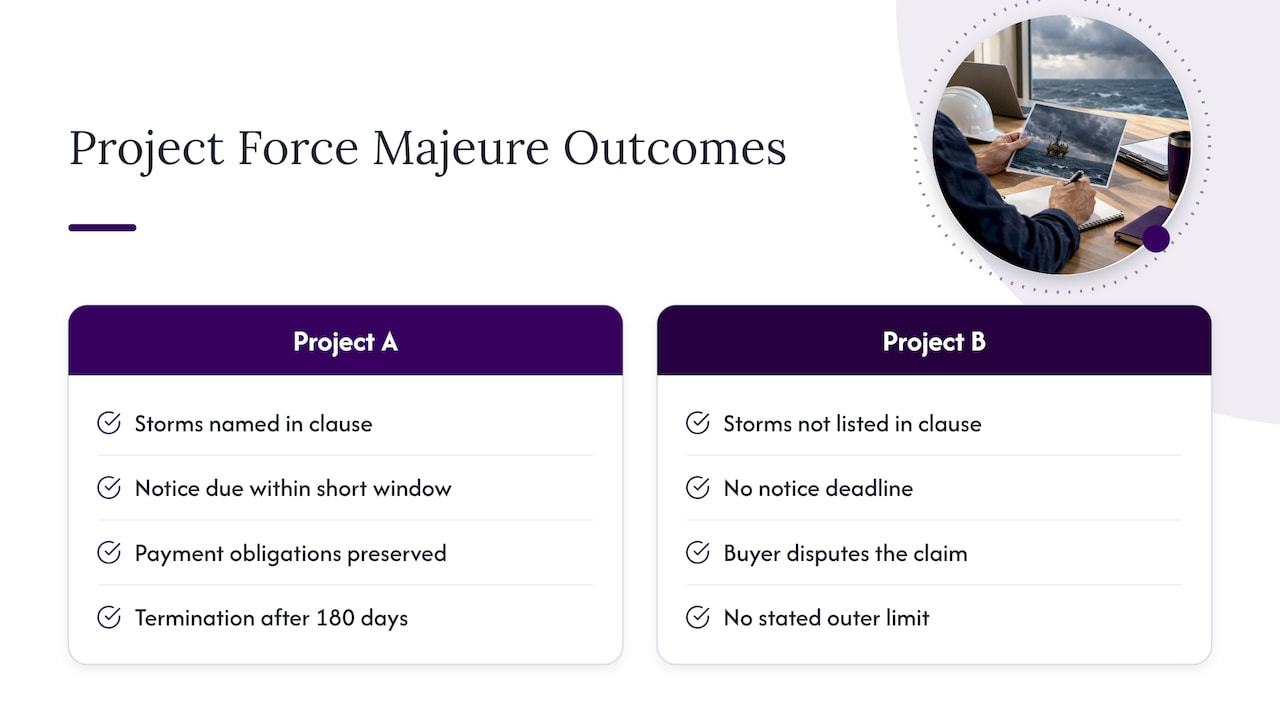
The weather was identical. The documents decided the outcome. That is why we care about the paperwork before the money moves.
Perspective
We look at force majeure as a question about paperwork and planning, not about luck. Weather, shut-ins and government actions will happen somewhere in any energy portfolio. What separates a manageable delay from an expensive dispute is whether the documents were clear and the operator was prepared.
That is why we put so much weight on how a project is presented. Fieldvest claims deeper due diligence on vetted and screened operators, and a streamlined presentation of key project materials so you can compare deals on the same terms, including the contract provisions that decide who absorbs a disruption. We also emphasize deal transparency, because a clause you can read before you invest is worth more than one you discover afterward.
For high-income professionals, there is a second reason. A delayed project does not just delay income, it can move the timing of deductions. Knowing the risk allocation up front lets you and your CPA plan around it. We built the platform around accredited investors who want direct ownership in U.S. energy projects, across producing assets, development projects and energy infrastructure, with the information organized so that decision is easier.
Sharif
Find projects with the documents in front of you
If you are an accredited investor weighing U.S. energy exposure, Fieldvest lets you review vetted opportunities in producing assets, development projects and energy infrastructure, with key project materials presented in a streamlined way for comparison. Start with the Fieldvest platform and see how the deals line up.

If you want to size the tax side first, the free oil and gas tax deduction calculator gives you a quick estimate to discuss with your tax adviser.
FAQ
Does force majeure cover a drop in oil prices?
Generally no. Courts and practitioners treat price swings as foreseeable market risk, and many clauses expressly exclude unfavorable market conditions. Norton Rose Fulbright notes that the 2014 and 2015 price collapse was largely not treated as force majeure. Your price exposure is managed through project selection and structure, not through this clause.
Will I still receive distributions during a force majeure event?
It depends on what stopped. Distributions come from the project’s revenue, so a shut-in or blocked pipeline can pause them even while payment duties in the contracts remain in force. When production resumes, cash flow generally follows. Read how the project’s sales contracts treat deferred or make-up volumes.
How long can force majeure last?
The contract sets the limit. Examples in filed documents include 180 days for a Texas lease dispute and a two-year cap on continuous extensions in another lease. Orrick notes that many contracts allow termination once an event passes a set period, commonly 90 to 180 days.
What is the difference between force majeure and an operator’s mistake?
Force majeure covers events outside a party’s control, and the claiming party generally must show it acted diligently. In the 2023 Texas Supreme Court case, a scheduling error that would have missed the deadline anyway was not rescued by the clause. An operator’s own failure to plan or perform is not the kind of event the clause is built for.
Should I have a lawyer review the force majeure terms?
Yes, for any significant commitment. A securities or oil and gas attorney can read the actual lease, operating and sales documents and tell you how the wording applies to your situation. A CPA can model the timing effect on your deductions.
Sources
- Point Energy Partners Permian, LLC v. MRC Permian Co., Supreme Court of Texas (2023)
- Akin Gump, Tumultuous Energy Market (2020)
- Finding Our New Normal: Reevaluating Force Majeure, Oklahoma Law Review article (2021)
- Practical Law, Oil & Gas Contracts: Force Majeure Clause
- SEC filing: crude oil supply agreement, Exhibit 10.23 (2012)
- Norton Rose Fulbright, The energy market in a global pandemic (2020)
- SEC filing: oil and gas lease, Exhibit 10-2 (2003)
- Orrick, Force Majeure Risks for Oil and Gas Companies (March 2026)
- MRC Permian lease opinion, court filing (2021)
- Marathon Oil Co. v. Mercuria Energy America, Business Court of Texas (2025)
- Rimon Law, Force Majeure and Arbitration Risk in the Gulf Energy Crisis (2026)
- Force majeure clause explainer
Recommended

Get the Fieldvest Energy Brief
and AI-driven demand shifts — curated for accredited investors. Smart. Strategic. Tax-advantaged.