


TL;DR:
- Oil investment documentation is complex but crucial for accurate tax reporting and compliance, especially for high earners. Proper organization, permanent retention of K-1 forms, and reconciliation with broker statements prevent costly mistakes and IRS issues. Modern digital tools, diligent record-keeping, and verifying all expenses linked to approved AFEs ensure investors maximize their tax benefits and maintain audit readiness.
Oil investment paperwork is among the most complex documentation any investor manages. Between Schedule K-1 forms, Authority for Expenditure approvals, Private Placement Memoranda, and amended filings, gaps in your system create real financial exposure. This handling oil investment documents guide covers exactly what you need: which documents to collect, how to organize and store them, where errors typically occur, and how to build a file system that holds up under IRS scrutiny. If you are a high-earning professional using oil and gas investments to reduce your tax burden, document discipline is where the money is actually made or lost.
Table of Contents
- Key Takeaways
- The essential documents in oil investment paperwork
- Best practices for managing oil investment files
- Common pitfalls when handling oil investment documentation
- Digital tools that improve document management
- My take on what actually moves the needle
- How Fieldvest supports your investment document strategy
- FAQ
Key Takeaways
| Point | Details |
|---|---|
| Know your K-1 line items | Check IDC deductions, depletion, and AMT lines on every K-1 to avoid taxable income errors. |
| Retain all K-1 history permanently | Full K-1 records are required for basis continuity calculations across every tax year. |
| Build an annual document checklist | A structured checklist prevents missed filings and catches amended forms before tax deadlines. |
| Use digital systems with clear naming | Centralized repositories reduce audit risk and make retrieval fast when regulators ask questions. |
| Reconcile K-1s against broker statements | Discrepancies between your K-1 and broker data must be resolved before you file. |
The essential documents in oil investment paperwork
Every oil and gas investment generates a specific stack of documents, and each one serves a distinct tax or compliance function. Knowing what you are looking for before tax season prevents scrambling and errors.
Schedule K-1 forms are the centerpiece. These arrive from the partnership or operator and report your share of income, deductions, and credits. The critical line items most investors overlook are the Intangible Drilling Cost (IDC) deduction, the depletion deduction, and the AMT reporting entries. IDC, depletion, and AMT lines 17D and 17E carry enormous tax significance. Missing or misreporting these numbers directly inflates your taxable income.
For investors in working-interest positions, operational documents matter just as much:
- Authority for Expenditure (AFE): The AFE is the operator’s financial authorization to spend money on a well. Your share of those costs is what generates IDC deductions. Without the AFE, you cannot substantiate those deductions under audit.
- Joint Interest Billing (JIB) statements: These monthly statements detail your proportionate share of operating costs. JIB allocations and AFE approvals are the upstream AP backbone that ties your deductions to documented expenses.
- Field tickets: The granular proof of work performed. Auditors expect to see original vendor invoices and field tickets linked to approved AFEs.
For investors participating through private placements, the oil investment contract guide starts with the Private Placement Memorandum (PPM). This document defines the structure, risks, and tax treatment of the investment. Alongside it, your subscription agreement and investor questionnaire form the compliance layer that supports every deduction you report.
Finally, track amended K-1s separately. Operators revise K-1s more often than most investors realize, sometimes months after the original. An amended K-1 changes your numbers and potentially your tax return. Treating it as a separate document stream is not optional.
Pro Tip: Request confirmation in writing from the operator or fund administrator each year that your K-1 package is complete and that no amendments are pending. This single habit prevents last-minute surprises.
Best practices for managing oil investment files
Systematic organization is what separates investors who file confidently from those who scramble every April. These steps build a repeatable process.
-
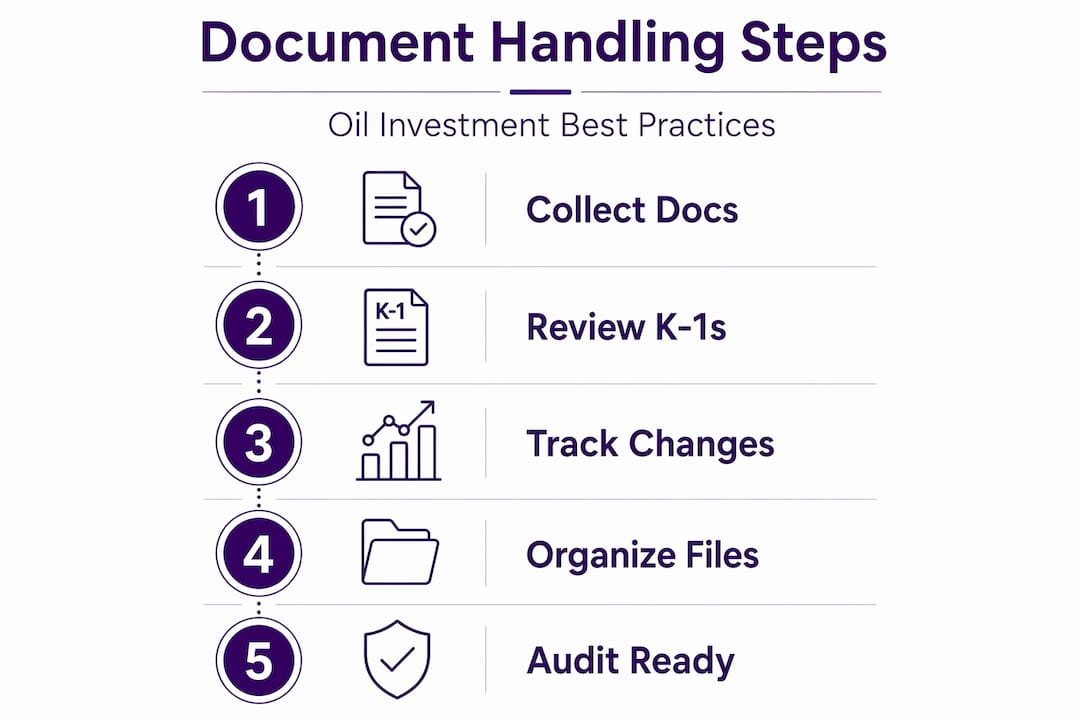
Build an annual document checklist. Before tax season, list every investment position you hold and the specific documents each one generates: K-1, AFE copies, JIB statements, PPM, subscription agreement, and any amended filings. Update this checklist every time you add a new position.
-
Reconcile K-1 distributions against broker statements. Your brokerage may report a different cash distribution than your K-1 reflects. K-1 and broker discrepancies must be identified and resolved before filing. The K-1 controls for tax purposes, but the discrepancy needs an explanation in your records.
-
Retain every K-1 permanently. Not just the current year. Storing full K-1 history for basis continuity is a compliance requirement, not a suggestion. When you eventually sell or exit a position, your basis calculation reaches back to the first year you held it.
-
Set up a digital folder structure with consistent naming. A clear system might look like this:
| Folder Level | Example |
|---|---|
| Investment name | Permian Basin Fund III |
| Year | 2025 |
| Document type | K-1, AFE, JIB, PPM |
| Status | Final, Amended, Pending |
-
Track amended K-1s as a separate data stream. Do not overwrite the original K-1 file. Store both versions and date-stamp the amendment. Your tax professional needs both to prepare or amend your return accurately.
-
File subscription and compliance documents at inception. The PPM, subscription agreement, investor questionnaire, and any entity governance documents should be filed at the time of investment, not retrieved years later when the IRS asks a question.
Pro Tip: Create a dedicated email folder for every oil and gas investment you hold. Route all operator correspondence there automatically. This gives you a searchable archive of communications that supplements your formal document files.
Common pitfalls when handling oil investment documentation

Even experienced investors and their advisors make predictable mistakes with oil investment paperwork. Most are avoidable with early awareness.
Missing or late K-1s are the most common problem. Partnerships legally have until March 15 to deliver K-1s, but many miss that deadline. If your K-1 is late, file for an extension rather than guessing numbers. Never estimate IDC or depletion figures. The accuracy gap between an estimate and the actual K-1 number can be substantial.
Overlooking IDC and depletion deductions costs investors real money. Section 199A income calculations require careful inclusion of IDC and depletion. Both deductions frequently appear in footnotes or supplemental schedules rather than the K-1 face itself. Investors who rely only on the main form miss them entirely.
Basis calculation errors from incomplete history are harder to catch and more expensive to fix. If you lack K-1s from prior years, you cannot correctly calculate your basis. An overstated basis means understated gains when you exit. An understated basis means overpaying tax. Neither outcome is acceptable.
Other pitfalls to watch for:
- Failing to link working-interest expenses to approved AFEs in your audit file. Auditors expect AFE linkage for every expense item, and missing field tickets or vendor invoices can invalidate charges regardless of the work performed.
- Confusing passive income rules with working-interest treatment. Working-interest holders can deduct losses against active income. Getting this wrong changes your entire tax picture.
- Not verifying document accuracy before filing. Cross-check K-1 totals against your own records of capital contributions and distributions before handing anything to your preparer.
Audit readiness is not about having documents somewhere. It is about being able to produce the right document, linked to the right expense, within 24 hours of a request. If you cannot do that, your filing is exposed regardless of how accurate the numbers are.
Digital tools that improve document management
Modern document management technology has closed the gap between what oil and gas investors need and what manual filing systems can realistically deliver. The right platform reduces audit risk and makes tax season dramatically faster.
AI-powered document extraction is the clearest upgrade available. These tools pull structured data from field tickets, JIB statements, and invoices automatically, eliminating manual data entry errors. AI document solutions in the oil and gas space have demonstrated measurable efficiency gains and improved regulatory compliance for operators and investors alike.
A centralized digital repository does more than store files. When documents are tagged, version-controlled, and searchable, you can respond to an IRS inquiry or investor audit in minutes rather than days. The upstream investment structure dictates that costs and deductions flow through multiple layers of documentation. A centralized system connects those layers visually and operationally.
Here is a quick comparison of document management approaches:
| Approach | Audit readiness | Amended K-1 tracking | Cost |
|---|---|---|---|
| Manual paper files | Low | Difficult | Minimal |
| Basic digital folders | Medium | Manual | Low |
| Dedicated DMS platform | High | Automated | Moderate |
| AI-integrated system | Highest | Automated with alerts | Higher |
When evaluating a platform, prioritize version control, search capability, and integration with your tax software. A platform that cannot flag an amended K-1 and connect it to the original filing is not solving the problem that matters most.
Pro Tip: Even without a dedicated platform, you can replicate most of the benefit by using a shared drive with strict naming conventions and a master tracking spreadsheet that logs every document by investment, year, type, and status.
My take on what actually moves the needle
I have seen investors spend significant energy finding the right oil and gas deals and then lose a meaningful portion of the tax benefit to documentation failures. That asymmetry frustrates me, because the fix is almost entirely within the investor’s control.
The single biggest misconception I encounter is the belief that broker statements are a reliable substitute for K-1s. They are not. Brokers report cash distributions. K-1s report your share of income, deductions, and credits at the partnership level. These numbers diverge regularly, and the IRS cares about the K-1 version. Investors who rely on broker summaries for their oil and gas tax advantages analysis are working from incomplete information.
What I have found actually works is treating document management as an investment in its own right. The time you spend building a clean file system in year one pays returns for the life of every position you hold. Amended K-1s and updated tax law guidance arrive unpredictably. If your baseline system is solid, absorbing those changes is a minor administrative task. If your system is disorganized, every amendment becomes a crisis.
Audit defense readiness deserves more attention than simple filing accuracy. Getting numbers right matters, but being able to prove they are right matters more. Every AFE, every JIB statement, every field ticket is a piece of that proof. I prioritize document completeness over filing speed every time.
— Sharif
How Fieldvest supports your investment document strategy

Managing oil investment documents correctly is the foundation of capturing the tax benefits these investments are designed to deliver. Fieldvest works with high-earning professionals who want to put that foundation in place before they invest, not scramble to reconstruct it at tax time.
Fieldvest connects accredited investors with vetted U.S. energy projects that offer large first-year tax deductions and long-term income. Beyond deal access, Fieldvest provides resources that make the document management side of oil investing clearer. Use the free oil and gas tax calculator to model your deductions before you commit capital, so you know exactly which documents you will need and why. For a deeper look at strategies and documentation needs, explore how to lower your taxes through structured oil and gas investing.
FAQ
What documents do oil investors need for tax filing?
Oil investors need Schedule K-1 forms, AFE approvals, JIB statements, PPMs, and subscription agreements at a minimum. Amended K-1s and historical basis records are also required for accurate reporting.
How long should I retain oil investment K-1s?
Retain every K-1 permanently. K-1 basis continuity requires a complete filing history from the first year you held the investment through the year you exit.
What are the most commonly missed deductions on a K-1?
IDC deductions and depletion allowances are the most frequently missed. Both often appear in K-1 footnotes or supplemental schedules rather than the main form, so investors relying only on the face of the K-1 miss them.
How do I prepare oil investment documents for an audit?
Link every deductible expense to an approved AFE and retain the supporting field tickets and vendor invoices. Auditors will expect document-level proof for each charge, and missing backup can invalidate otherwise legitimate expenses.
What is the difference between a K-1 and a broker statement for oil investments?
A broker statement reflects cash distributions. A K-1 reports your allocated share of partnership income, deductions, and credits. For tax purposes, the K-1 controls, and the two figures frequently differ.
Recommended

Get the Fieldvest Energy Brief
and AI-driven demand shifts — curated for accredited investors. Smart. Strategic. Tax-advantaged.