


TL;DR:
- Analyzing U.S. energy market trends requires authoritative data sources like the EIA, IEA, and PJM reports to understand interconnected sectors. Building scenario frameworks and decomposing prices into components help reveal true drivers and avoid common analytical mistakes. Regular validation with real-time grid data and global supply-demand signals enhances investment accuracy and strategic insight.
U.S. energy markets move on variables that can shift a portfolio thesis overnight. If you want to know how to analyze U.S. energy market trends with any real precision, generic price-watching is not enough. You are dealing with interconnected oil, gas, and electricity sectors, each driven by distinct supply and demand mechanics, overlapping policy signals, and global price benchmarks that feed back into domestic outcomes. This guide walks through the data sources, analytical frameworks, and verification methods that actually work for investment-grade analysis.
Table of Contents
- Key Takeaways
- How to analyze U.S. energy market trends: data sources first
- Building scenario frameworks for trend modeling
- Analyzing electricity market trends step by step
- Integrating U.S. oil trends with global supply and demand
- Common pitfalls and verification tactics
- My perspective on getting energy market analysis right
- Put your energy market analysis to work with Fieldvest
- FAQ
Key Takeaways
| Point | Details |
|---|---|
| Use authoritative federal sources | EIA’s AEO, Real-time Operating Grid, and Today in Energy are your non-negotiable analytical foundations. |
| Build scenario baselines, not point forecasts | The AEO 2026 offers alternative futures that let you stress-test your investment thesis across outcomes. |
| Decompose electricity prices by component | Fuel, transmission, and scarcity each drive LMPs differently. Treating price as a single number hides the real story. |
| Anchor oil analysis globally | U.S. crude outcomes depend on IEA-tracked supply, demand, inventory, and refining dynamics, not just domestic production. |
| Verify with real-time grid data | Cross-check your trend hypotheses against live operational grid conditions to catch what static reports miss. |
How to analyze U.S. energy market trends: data sources first
Before you build any analytical framework, you need to know where the authoritative numbers live. The U.S. energy data ecosystem is extensive, but a handful of sources carry the weight for serious analysis.
The EIA is your primary anchor. Its Annual Energy Outlook publishes long-run scenario projections through 2050, covering electricity consumption, crude production, and fuel mix transitions across multiple policy and technology assumptions. For near-term signals, EIA’s “Today in Energy” reports provide focused updates on specific market developments. The Real-time Operating Grid interface gives you live tracking of grid conditions, generation dispatch, and regional load. That combination of long-run and real-time data is something most analysts underutilize.
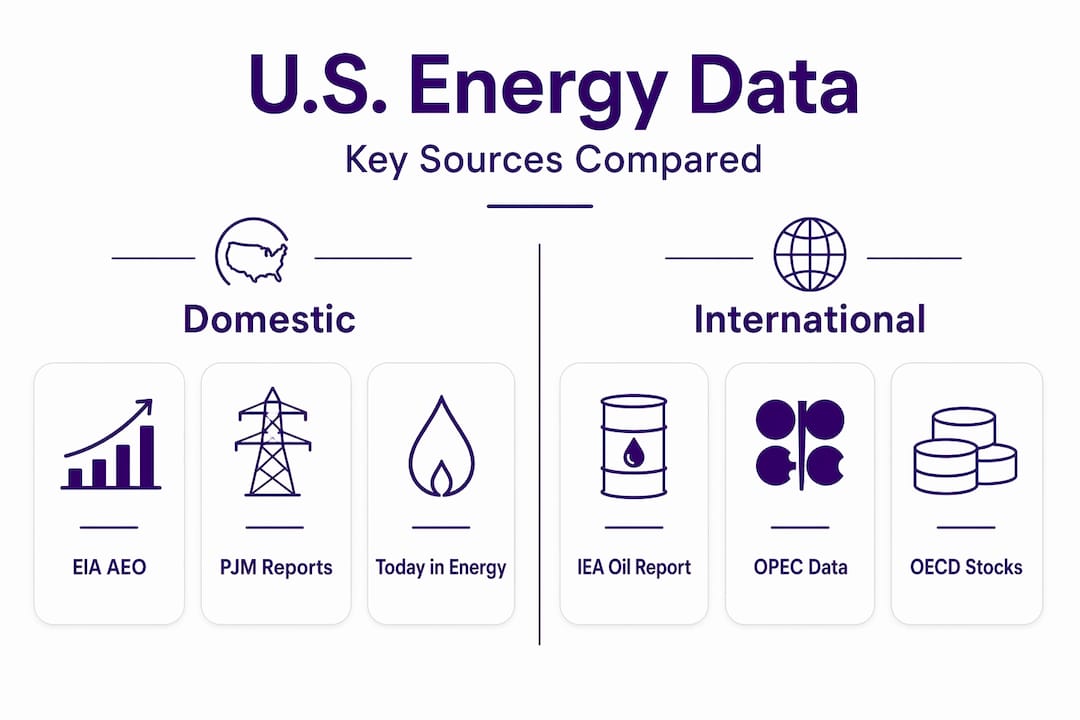
On the international side, the IEA’s monthly Oil Market Report is not optional for U.S. oil analysis. It tracks global supply, demand, inventories, refining margins, and trade flows in a single structured framework. The IEA adjusted its 2026 global oil demand forecast down by 210 kb/d in March 2026, reflecting Middle East conflict impacts and economic uncertainty. That kind of revision ripples directly into U.S. price benchmarks and operator economics.
For wholesale electricity, PJM’s Market Monitor reports are where price signals get explained at the component level. These are not just price recaps. They break down exactly what drove locational marginal prices in a given period, including fuel costs, transmission congestion, and scarcity adders.
| Data Source | Scope | Update Frequency | Best For |
|---|---|---|---|
| EIA Annual Energy Outlook | Long-run scenarios: oil, gas, power | Annual | Scenario baseline construction |
| EIA Today in Energy | Targeted market updates | Multiple per week | Near-term trend monitoring |
| EIA Real-time Operating Grid | Live grid conditions by region | Real-time | Operational validation |
| IEA Oil Market Report | Global oil supply, demand, inventories | Monthly | U.S. oil price context |
| PJM Market Monitor Report | Wholesale power price components | Quarterly | Electricity price decomposition |
Pro Tip: Set up automated alerts for EIA “Today in Energy” publications tagged to your focus sectors. Weekly curation takes less than 20 minutes and builds a running log of market signals you can reference during model updates.
Building scenario frameworks for trend modeling
Price observation is not analysis. The analysts who actually get ahead of market moves treat scenario construction as the core of their methodology, not an optional appendix.
The EIA’s AEO 2026 is built specifically for this. It publishes not one forecast but a range of alternative futures, with electricity consumption growth forecast between 0.9% and 1.6% annually through 2050 and U.S. crude production projected between 12.4 and 12.7 million barrels per day depending on the scenario. That spread is your working range. If your investment thesis only holds in the optimistic case, that is critical information.
For oil and gas, you need to model supply uncertainty and demand growth separately, then examine where they intersect. Gas supply conditions affect oil production economics in ways that many equity-focused analysts miss. Cross-fuel scenario modeling that couples gas supply uncertainty to oil output projections captures these interdependencies and prevents the kind of isolated conclusions that lead to mispriced positions.
On the demand side, data centers are reshaping the load forecast in ways that general demand growth figures obscure. U.S. electricity demand grew 1.7% annually between 2020 and 2025, with data center load as a leading driver. The EIA forecasts 1.9% growth in 2026 and 2.5% in 2027, with the steepest increases concentrated in ERCOT and PJM. Data centers are not a generic demand increment. They have specific locational requirements, ramp schedules, and regulatory interconnection timelines that change how and when demand materializes on the grid.
| Scenario Variable | Oil Sector Impact | Gas Sector Impact | Power Sector Impact |
|---|---|---|---|
| High data center demand growth | Indirect, via power-sector gas demand | Higher gas burn for generation | Price spike risk in PJM, ERCOT |
| Low gas supply scenario | Production cost pressure | Supply tightness, price increase | Higher fuel cost component in LMP |
| Policy shift on carbon | Long-run production trajectory | Demand substitution effects | Generation mix realignment |
| Global demand disruption | Benchmark price reset | LNG export dynamics | Fuel cost moderation |
Pro Tip: Do not use a single AEO scenario as your baseline. Instead, build your investment models on the midpoint case and stress-test the thesis against the low and high alternatives. This forces you to identify which assumptions your position is actually betting on.
Analyzing electricity market trends step by step
Wholesale electricity analysis requires a methodology, not just a data pull. Here is the process that separates useful analysis from noise.
-
Pull LMP data by region and time period. Start with PJM or ERCOT hub prices. Do not treat regional averages as representative. Node-level price variation tells you where transmission congestion is actually binding.
-
Decompose the LMP into components. Every locational marginal price contains an energy component (fuel cost), a congestion component (transmission constraints), and a loss component. The PJM Market Monitor breaks these out explicitly. In early 2026, real-time LMP rose 67.8% year over year, with the load-weighted average moving from $52.20/MWh to $87.57/MWh. Fuel and consumables accounted for 42.2% of that rise. If you had looked only at the headline price, you would have misread the driver.
-
Cross-reference with Market Monitor findings. PJM’s Market Monitor reports identify whether prices reflect competitive behavior or structural distortions. Some marginal units display high markups that distort price signals even when the market is broadly competitive. Missing this leads to incorrect forecasts about future price paths.
-
Map demand-side developments to price timing. Data center load additions create localized demand spikes that do not appear in aggregate forecasts. Under high data center demand scenarios, ERCOT prices can increase by $37/MWh relative to baseline. That is not a minor margin adjustment. It is a structural shift in regional price levels.
-
Validate with the EIA Real-time Operating Grid. After forming a price hypothesis, check it against live or recent grid conditions. The Real-time Operating Grid interface shows generation dispatch, load, and reserve margins in real time. If your LMP analysis says transmission is binding, you should see congestion-constrained dispatch in the operations data.
-
Revise the hypothesis and document discrepancies. Any mismatch between your decomposition model and real-time grid behavior is a learning signal. Do not smooth it over.
Treating wholesale power prices as a single number is the most common analytical mistake in electricity market work. Every price is a sum of components, each with a different driver and a different forecast path.
Integrating U.S. oil trends with global supply and demand
U.S. crude prices do not move in isolation. West Texas Intermediate tracks global Brent benchmarks closely, and domestic production economics are shaped by international trade flows, OPEC+ supply decisions, and global demand conditions that the IEA tracks monthly.

The IEA Oil Market Report provides the clearest structured framework for this work. It covers supply by region, demand by sector, refinery throughput, inventory levels, and trade flows. Oil price movements result from complex supply-demand-inventory interactions, and building a chain from physical fundamentals to price gives you far more analytical grip than tracking crude charts.
When a geopolitical disruption occurs, the correct analytical response is not to adjust price targets upward. The correct response is to trace the supply impact through the inventory chain, assess whether refining capacity can absorb the shift, evaluate demand-side substitution possibilities, and then estimate price pressure. That sequence prevents the overreaction and premature position changes that cost analysts credibility.
Key indicators to track for global influence on U.S. oil trends:
- OECD commercial inventory levels relative to five-year average (the IEA’s primary balancing metric)
- OPEC+ production versus quota compliance rates
- U.S. export volumes and destination breakdown (captures competitiveness of domestic crude on global markets)
- Refinery utilization rates in key regions, particularly Europe and Asia
- Tanker freight rates as a leading indicator of trade flow shifts
- Strategic petroleum reserve levels and policy signals around drawdowns
Connecting U.S. oil investments to this global analytical chain is what separates durable positions from reactive ones.
Common pitfalls and verification tactics
Even well-structured analyses go wrong. Knowing where the failure modes are is half the defense.
The most common error is overfitting price observations to a single driver. If natural gas prices rise and you attribute all LMP increases to fuel cost, you will miss transmission congestion that is independently compressing margins in specific nodes. If you see U.S. crude strengthening and attribute it entirely to OPEC+ cuts, you may be missing inventory draws that are doing more of the work.
Scenario overreliance is the second major risk. Analysts who anchor to one EIA projection without running sensitivity analysis will be exposed the moment reality deviates. The AEO 2026 alternative scenario design explicitly acknowledges policy, fuel price, and technology uncertainty as reasons why directional forecasts are inadequate. Use them accordingly.
Here is a practical verification sequence:
- State your trend hypothesis explicitly in writing before running the numbers.
- Identify which data sources would confirm it and which would contradict it.
- Pull from at least two independent sources for any major claim.
- Check whether operational grid data or inventory data corroborates your price-based conclusions.
- Document cases where the data does not fit and investigate before finalizing your analysis.
Pro Tip: Build a monthly review cadence where you revisit your trend hypotheses against the most recent EIA and IEA releases. Markets that confirmed your thesis three months ago can shift quietly. Regular calibration catches drift before it becomes a position error.
Pair this with a focus on energy market forecasting techniques that prioritize driver transparency over headline accuracy. The goal is to understand why the market moved, not just to predict that it will.
My perspective on getting energy market analysis right
I’ve spent years watching analysts get burned not because they lacked data but because they lacked a system. The first time I caught myself attributing a price move entirely to one variable and being completely wrong about the driver, I understood why component decomposition is not optional. It is the difference between knowing what happened and knowing why, and in investment work, why is what pays.
What I’ve found is that cross-sector coupling is the blind spot most professionals carry longer than they should. Gas supply conditions influencing oil production economics, data center demand reshaping regional power prices, renewables capacity forcing changes to gas dispatch patterns. None of these connections show up when you analyze each sector in a silo. I’ve seen well-resourced analysts miss position-changing signals because their oil model never talked to their power model.
The scenario-based mindset from the AEO is something I now apply far beyond energy markets. You build your base case, you define what assumptions it depends on, and you know in advance what would break it. That forces intellectual honesty that pure price forecasting never demands.
Real-time grid data is also chronically underused. When system stress builds before a price event, the live grid monitor often shows it in dispatch patterns before the price response is obvious in market data. That lead time matters. Early signals from operational data have changed my read on developing situations more than once.
The analysts who stay useful across market cycles are the ones who stay curious about the mechanics. Markets change. Frameworks outlast forecasts.
— Sharif
Put your energy market analysis to work with Fieldvest
Understanding energy market trends is one side of the equation. The other is knowing where to deploy capital when your analysis identifies opportunity.

Fieldvest connects accredited investors with vetted U.S. oil and gas operators offering significant first-year tax deductions and long-term cash flow from producing assets. If your trend analysis is pointing toward sustained domestic energy demand and tightening supply conditions, lower your taxes through oil and gas investments with Fieldvest’s curated project pipeline. Use the tax deduction calculator to model your specific tax position before committing capital. Fieldvest’s team supports investors through current market conditions with project-level diligence already done.
FAQ
What are the best data sources for U.S. energy market analysis?
The EIA’s Annual Energy Outlook, Real-time Operating Grid, and IEA Oil Market Report are the three core sources. PJM Market Monitor reports add essential granularity for wholesale electricity price decomposition.
How do I decompose wholesale electricity prices for trend analysis?
Break each locational marginal price into its energy, congestion, and loss components using regional market monitor reports. Fuel costs, transmission constraints, and scarcity conditions each require separate trend tracking.
Why do U.S. oil prices depend on global data?
U.S. crude benchmarks track global Brent pricing closely, meaning OPEC+ production decisions, OECD inventory levels, and international refining conditions directly influence domestic price outcomes and operator economics.
How should I use EIA scenario forecasts in my models?
Treat EIA scenarios as a range of plausible futures rather than a single directional forecast. The AEO 2026 projects electricity consumption growth between 0.9% and 1.6% annually, giving you meaningful bounds for stress-testing investment theses.
What is the most common mistake in energy market trend analysis?
Treating price as a single variable rather than decomposing it into its drivers. A 67.8% year-over-year LMP increase in PJM in early 2026 had fuel, transmission, and competitive behavior each contributing differently. Missing that breakdown leads to flawed forecasts.
Recommended

Get the Fieldvest Energy Brief
and AI-driven demand shifts — curated for accredited investors. Smart. Strategic. Tax-advantaged.