


TL;DR:
- Most investors should allocate a modest amount of energy investments based on their tax situation and liability structure.
- Proper ownership forms are essential because IRC §469©(3) limits energy losses to offset active income only if liability is not restricted.
- Using vetted energy deals and confirming structures with a CPA can optimize tax deductions and balance portfolio risk effectively.
For most accredited investors managing energy and real estate, the right starting point is a modest energy allocation for a conservative profile, a moderate allocation for a balanced one, and a larger allocation for an aggressive, tax-heavy strategy. The single structural constraint that determines whether any of this works: under IRC §469©(3), energy losses from a working interest can offset your W-2 or business income only when your ownership form does not limit your liability. Get that wrong and the deductions disappear. The immediate next step is to run your numbers through Fieldvest’s free tax-deduction calculator, then confirm the ownership structure with your CPA before committing capital.
Table of Contents
- How should you allocate between direct energy and real estate?
- How do direct energy investments compare to direct real estate?
- What U.S. tax rules determine whether energy losses offset active income?
- How do you actually add direct energy to a real-estate-heavy portfolio?
- What do three modeled portfolios actually look like?
- What are the primary risks and how do you manage them?
- Key Takeaways
- What the structure debate gets wrong
- Fieldvest connects you with vetted energy deals built for this strategy
- Useful sources
How should you allocate between direct energy and real estate?
The right split depends on four factors: how much taxable income you need to shelter this year, how much liquidity you can afford to lock up, your tolerance for commodity-price swings, and whether you have a 1031 exchange in play.
Decision checklist before you allocate:
- Income sheltering need: Do you have a large W-2 or business income event this year? A higher energy allocation accelerates first-year deductions.
- Taxable events: Selling a property or business creates a capital-gain problem that energy IDC deductions can partially offset.
- Liquidity needs: Direct energy positions typically hold 5–10 years. If you need capital access within three years, keep the energy sleeve smaller.
- Correlation tolerance: Energy returns correlate weakly with real estate, which is the point. But that also means they can move against each other simultaneously.
- Operator risk appetite: Working interests carry operator execution risk that passive real estate does not.
- Estate and legacy goals: Royalty interests pass to heirs with a stepped-up basis; working interests carry ongoing liability.
Three model allocation profiles:
- Conservative (10–20% energy / 80–90% real estate): Prioritizes stability and inflation protection. Energy sleeve is limited to non-operating working interests or royalty-pool DSTs. Rebalance annually when cash distributions arrive.
- Balanced (20–35% energy / 65–80% real estate): Mixes working interests for first-year deductions with royalty pools for ongoing yield. Rebalance when either sleeve drifts more than 5 percentage points from target.
- Aggressive (35–50% energy / 50–65% real estate): Maximizes first-year tax deductions. Concentrated in working interests. Requires strong operator relationships and a CPA who understands IDC timing. Cap any single deal at 10% of investable assets.
Mineral and royalty interests can also be used inside a 1031 exchange, splitting replacement property across royalty-pool DSTs and real-estate DSTs within the 45-day identification window. That structure lets you maintain energy exposure while moving into stabilized institutional real estate.
How do direct energy investments compare to direct real estate?
The two asset classes serve different objectives. Mixing them changes your portfolio’s income volatility, tax profile, and inflation sensitivity in ways that are worth mapping explicitly.
| Dimension | Direct real estate | Direct energy (working interest / royalty) |
|---|---|---|
| First-year tax deductions | Bonus depreciation on cost segregation | IDC deductible 100% in year one for qualifying structures |
| Ongoing cash yield | Rental income, typically stable | Production-linked distributions, commodity-price sensitive |
| Liquidity / hold period | Multi-year; 1031 exit available | Multi-year; limited secondary market |
| Management burden | Active (tenants, maintenance) or passive via DST | Non-operating interests require minimal day-to-day oversight |
| Correlation with real estate | High | Low to moderate; driven by commodity cycles |
| Risk / volatility | Low to moderate; location-driven | Moderate to high; commodity and operator risk |
| Minimum investment | Varies widely | Generally requires substantial minimum investment |
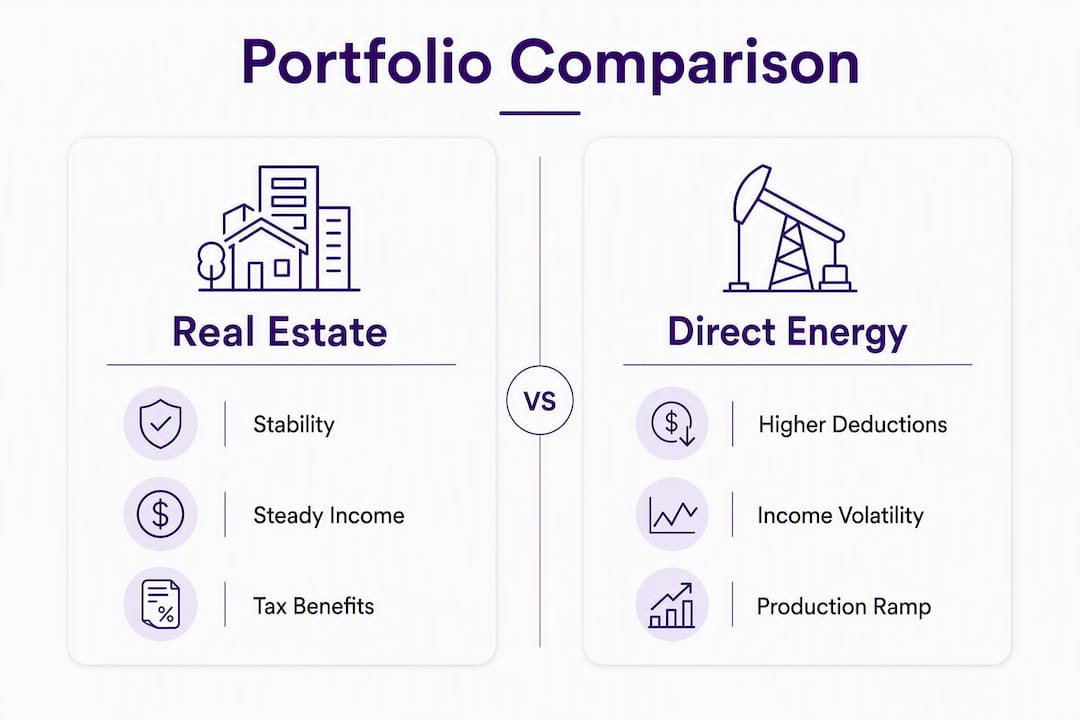
Energy supplements real estate on two axes: first-year deduction depth and income yield during production ramp. Real estate offsets energy on two others: price stability and long-term inflation protection through rent escalation and property appreciation. A portfolio that holds both tends to have a smoother after-tax income curve than either alone.
What U.S. tax rules determine whether energy losses offset active income?
The working-interest exception under IRC §469©(3) is the mechanism that lets energy losses offset W-2 and business income rather than sitting as passive losses. It applies only when the taxpayer’s liability is not limited by the ownership structure.
Three deduction types drive the energy tax profile:
- Intangible drilling costs (IDC): Labor, chemicals, mud, and other non-salvageable drilling expenses. These often represent the bulk of drilling costs and can be 100% deductible in year one for qualifying working interests.
- Tangible drilling costs / bonus depreciation: Equipment and physical infrastructure. Bonus depreciation returned to 100% for qualifying property placed in service after January 19, 2025, which materially increases first-year write-offs when eligibility criteria are met.
- Percentage depletion: An ongoing deduction based on gross income, commonly 15% for qualifying mineral properties, that can continue beyond original cost basis.
Entity-structure red flags to watch:
Royalty interests and limited partnership interests are generally treated as passive, meaning losses can only offset passive income. A working interest held through an LLC or LP that limits your liability loses the §469©(3) exception entirely.
Pro Tip: IRS technical advice confirms that the government looks through tiered entities. A lower-tier LLC that limits liability can disqualify the exception even if you appear as a general partner at a higher tier. Have your CPA review the full entity chain, not just the top-level structure.
For a deeper walk-through of energy tax mechanics and cash-flow modeling, the structuring details matter as much as the deal economics.
How do you actually add direct energy to a real-estate-heavy portfolio?
The process from first interest to first cash distribution typically runs 60–120 days. Here is the sequence:
- Screen opportunities against your tax need, liquidity window, and operator criteria. Fieldvest’s platform surfaces vetted deals with operator scorecards and pro forma cash flows.
- Run a tax-structuring decision with your CPA. Confirm ownership form, liability exposure, and whether IDC timing aligns with your current tax year.
- Request the full document package: private placement memorandum (PPM), operating agreement, title opinion, reserve report, pro forma cash flows, and K-1 provisions. Your CPA handles tax forms; your attorney reviews the operating agreement and title opinion.
- Complete subscription and funding. Most direct energy deals require accredited-investor verification and a signed subscription agreement.
- Expect first distributions roughly 6–18 months after spud date, depending on well type and production ramp.
Due-diligence checklist:
- Operator track record: prior wells drilled, production history, default rate
- Well economics: break-even price per barrel or Mcf, IRR assumptions, decline curve
- Reserve report from an independent petroleum engineer
- Title and mineral ownership verification
- Capital call terms and maximum exposure
- Insurance and indemnity provisions
Coordinating with a 1031 exchange: If you are selling a property and want to preserve energy exposure, splitting replacement property across royalty-pool DSTs and real-estate DSTs within the 45-day identification window keeps both sleeves active without triggering gain recognition. Confirm that the royalty-pool DST qualifies as like-kind replacement property with your qualified intermediary before closing.
What do three modeled portfolios actually look like?

These are illustrative models with explicit assumptions. Run your own inputs through Fieldvest’s after-tax growth calculator to test personal scenarios with your CPA.
| Profile | Starting capital | Energy % | Real estate % | Assumed first-year IDC write-off | Assumed energy yield | Assumed RE yield | Typical hold |
|---|---|---|---|---|---|---|---|
| Conservative | — | 15% | — | ~70% of energy capital | 6–10% | 5–6% | 6–18 months |
| Balanced | — | 37% | 70% | ~70–80% of energy capital | 10% | 5–6% | 6–18 months |
| Aggressive | — | 45% | 50–65% | ~75% of energy capital | — | 5–6% | — |
On the conservative model: A $150,000 energy allocation with a 70% IDC write-off generates roughly $105,000 in potential first-year deductions. At a 37% marginal rate, that is approximately $38,850 in tax savings before state taxes, with ongoing production distributions starting in year two. The real estate sleeve provides stable rental income and inflation protection throughout.
The aggressive profile concentrates deduction power but requires strong operator covenants and a CPA who can confirm the §469©(3) liability structure before funding. For tax-efficient cash-flow modeling by deal type, the yield assumptions above are starting points, not guarantees.
What are the primary risks and how do you manage them?
Risk categories and mitigation:
- Commodity price risk: Oil and gas prices directly affect distributions. Mitigate by diversifying across multiple wells and basins, and by stress-testing deal economics at $50/barrel.
- Operator / operational risk: A poorly run operator can miss production targets or mismanage capital calls. Require an independent reserve report and review the operator’s track record across at least three prior wells.
- Title / ownership risk: Disputed mineral rights can freeze distributions. Always request a title opinion from independent counsel before funding.
- Tax / structuring risk: The most common and costly mistake. The IRS looks through tiered entities and will deny the §469©(3) exception if liability is effectively limited anywhere in the chain.
- Illiquidity risk: No liquid secondary market exists for most working interests. Cap working-interest exposure at a percentage of investable assets you can afford to hold for the full term.
Quarterly monitoring checklist:
- Request production reports and compare actuals to pro forma.
- Confirm K-1 timing and review depletion calculations with your CPA.
- Check whether either sleeve has drifted more than 5 percentage points from target allocation.
- Trigger a rebalance review if commodity prices drop more than 30% from underwriting assumptions or if a capital call exceeds original projections.
For long-term yield expectations and decline curve modeling, production typically peaks in years 1–3 and declines gradually, which affects how you model distributions in years 4–10.
Key Takeaways
Balancing real estate and direct energy investments requires the right ownership structure first, the right allocation second, and consistent rebalancing third.
| Point | Details |
|---|---|
| Allocation guardrails | Target 10–20% energy (conservative), 20–35% (balanced), or 35–50% (aggressive) of investable assets. |
| Working-interest liability rule | IRC §469©(3) requires unlimited liability; tiered entities that limit liability disqualify the active-income offset. |
| 1031 / DST coordination | Splitting 1031 replacement across royalty-pool DSTs and real-estate DSTs preserves both energy exposure and tax deferral. |
| Rebalancing cadence | Review allocations annually and rebalance when either sleeve drifts more than 5 percentage points from target. |
| Fieldvest next step | Run your scenario in Fieldvest’s tax-deduction calculator and confirm structure with a CPA before funding any working interest. |
What the structure debate gets wrong
Most investors who come to Fieldvest with a real-estate-heavy portfolio have already done the math on yields and deductions. What they have not done is stress-tested the entity structure. The §469©(3) exception is not a checkbox. It is a liability question that runs through every layer of your ownership chain, and the IRS has denied it to investors who were nominally general partners because a lower-tier entity quietly limited their exposure.
The other thing people underestimate: energy and real estate are not just diversification plays against each other. They are timing plays. Real estate depreciation tends to be spread over years. IDC deductions hit in year one, which means they are most valuable in the year you have the highest income event. If you are selling a business, receiving a large bonus, or closing a major real estate gain, the energy sleeve is not just a portfolio complement. It is a tax-year tool.
The investors who use it well are not the ones with the most aggressive allocations. They are the ones who coordinate the timing with their CPA, confirm the structure before funding, and treat the energy sleeve as a deliberate part of their annual tax plan rather than a standalone investment.
Fieldvest connects you with vetted energy deals built for this strategy
Fieldvest was built specifically for accredited investors who want direct U.S. energy exposure without spending months sourcing operators or decoding PPMs alone. Every deal on the platform goes through operator vetting, with scorecards, reserve reports, and K-1 previews available before you commit capital. The tax-deduction calculator and after-tax growth tools let you model first-year IDC write-offs and long-term distributions against your actual income profile, so you walk into the CPA conversation with numbers already in hand.

The process is straightforward: screen deals, run your tax scenario, confirm structure with your advisor, and subscribe. Fieldvest’s team supports the coordination between your CPA and the operator so nothing falls through on the structuring side. To start, run the free tax-deduction calculator or visit Fieldvest to review current vetted energy opportunities.
This article is general information, not tax or legal advice. Confirm current IRS rules and your specific ownership structure with a qualified CPA or tax attorney before relying on any deduction.
Useful sources
- IRC §469©(3) working-interest exception — IRS Technical Advice (WD 0952054): Primary IRS authority confirming the look-through approach for tiered entities; essential reading before structuring any working-interest position.
- Oil and Gas Tax Benefits for Investors — Anchor1031: Practical summary of IDC deductions, percentage depletion, and how non-operating interests work for accredited investors.
- Oil and Gas Investing: How to Deduct Losses Against Active Income — Valoris Financial: Explains the §469©(3) liability requirement and the 2025 bonus depreciation restoration in plain language.
- Building a Diversified 1031 Portfolio: Minerals + DSTs Together — Baker 1031 Investments: Shows how to split 1031 replacement property across royalty-pool DSTs and real-estate DSTs to maintain both energy and real estate exposure.
- Fieldvest Tax-Deduction Calculator: Interactive tool to model first-year IDC deductions and after-tax outcomes against your income profile.
Recommended

Get the Fieldvest Energy Brief
and AI-driven demand shifts — curated for accredited investors. Smart. Strategic. Tax-advantaged.