


TL;DR:
- Oil deals are governed by Sales and Purchase Agreements that specify product details, delivery, and payment terms. Investors must verify deal clauses, counterparties, and payment instruments to avoid costly mistakes and deal failures. Proper contract preparation and clear hierarchy prevent disputes, while understanding NRI maximizes post-production cash flow.
Oil deal terms are defined by the Sales and Purchase Agreement (SPA), a legally binding contract that governs every physical crude or refined product transaction. Knowing how to navigate oil deal terms separates investors who close profitable deals from those who lose deposits to avoidable errors. Standard SPAs mandate exact product specifications, volumes ranging from 500,000 to 2,000,000 barrels, delivery windows, Incoterms, and payment methods for global bank enforceability. This guide covers the key clauses, prerequisites, negotiation tactics, and dispute resolution tools you need to read and execute oil contracts with confidence.
What are the essential contract clauses in oil deals?
Every oil contract is built from a set of core clauses. Miss one, and you expose yourself to financial loss, cargo cancellation, or payment refusal.
- Parties clause. Names the legal entities, not individuals. Verify each party’s registration, signatory authority, and credit standing before signing.
- Product specification. Defines the grade and standard, such as EN590 for diesel or Jet A-1 for aviation fuel. Deviations from spec trigger rejection rights.
- Quantity and tolerance. States the volume and an accepted variance, typically plus or minus 5%. This protects both sides from minor measurement differences.
- Delivery terms. Specifies Incoterms such as FOB (Free on Board) or CIF (Cost, Insurance, Freight). FOB transfers risk at the loading port; CIF transfers it at the destination. Laycan, the laydays/cancelling window, sets the exact arrival range for the vessel. Missing the laycan leads directly to cargo cancellation and forfeiture of deposits.
- Inspection and quality verification. Names an independent inspector, such as SGS or Intertek, to certify quality and quantity at load and discharge ports.
- Price formulation. Links the price to a market index, such as Dated Brent or Platts, plus or minus a differential. Pricing windows define the exact dates used to calculate the average.
- Payment terms. Specifies the accepted banking instrument. Physical crude payment is predominantly secured by irrevocable letters of credit, with typical timelines of 30–90 days post Bill of Lading date. Standby Letters of Credit (SBLCs) and MT103 wire transfers are also used depending on deal structure.
- Title and risk transfer. States the exact moment ownership passes from seller to buyer, usually at the flange connection during loading.
- Force majeure. Excuses performance for events outside a party’s control, such as port closures or government sanctions. Narrow definitions favor buyers; broad ones favor sellers.
- Governing law and arbitration. Most international oil contracts specify ICC or LCIA arbitration for confidentiality and enforceability across jurisdictions.
Pro Tip: Always confirm that your payment instrument is bank-clean and executable before submitting an SPA. Banks judge buyers on SPA clarity, and over 80% of SPAs fail seller approval due to poorly written clauses or terms that banks refuse to finance.
What prerequisites do investors need before oil deal negotiations?
Preparation before the first negotiation call determines whether a deal closes or collapses. Skipping due diligence is the single most expensive mistake investors make.
- Verify the seller’s credentials. Request proof of product, a valid export license, and a corporate registration document. Confirm the signatory has legal authority to bind the company.
- Confirm your proof of funds. Buyers must show financial capacity through a bank comfort letter, an SBLC, or a documentary letter of credit. Vague financial claims end negotiations immediately.
- Prepare your documentation chain. A complete deal requires a signed contract, a commercial invoice, a Bill of Lading, an inspection certificate, and a certificate of origin. Missing any document triggers bank payment refusal.
- Align your banking, inspection, and shipping timelines. Inspection certificates must be issued within the window your letter of credit specifies. A one-day mismatch can freeze payment for weeks.
- Review the document hierarchy. Understand which document controls in a conflict: the contract, the General Terms and Conditions (GTCs), or the side letter. GTCs may override custom terms if document precedence is not explicitly defined in the contract.
Investors who handle oil investment documents correctly from the start avoid the costly delays that kill deals at the closing stage. Treat document preparation as a pre-condition, not an afterthought.
How to execute effective oil deal negotiations step by step
Effective negotiation is a process, not a single conversation. The investors who close the best deals treat each stage as a distinct task.
Start with a Non-Circumvention, Non-Disclosure Agreement (NCNDA). This protects your counterparty relationships and confidential deal information before any substantive terms are shared. Without it, intermediaries and brokers can cut you out of a deal legally.
Never accept the first offer. Successful negotiation requires slowing down for due diligence, especially on counterparties’ creditworthiness and contract hierarchy. The first draft is always a starting position, not a final price.

Use Front-End Loading (FEL) contract strategies. Modular contracts built on FEL principles allow terms to evolve from feasibility to execution without full renegotiation. This is particularly valuable when market conditions shift between signing and delivery.
Define document precedence explicitly. Standard GTCs without a clear hierarchy create unintended disputes when they conflict with custom clauses. Your contract must state which document controls in every conflict scenario.
Structure pricing formulas linked to market indices. Tie the price to Dated Brent, WTI, or Platts with a fixed differential and a defined pricing window. Vague pricing language gives the other side room to dispute the final invoice.
The table below shows the key negotiation stages and what each one requires.
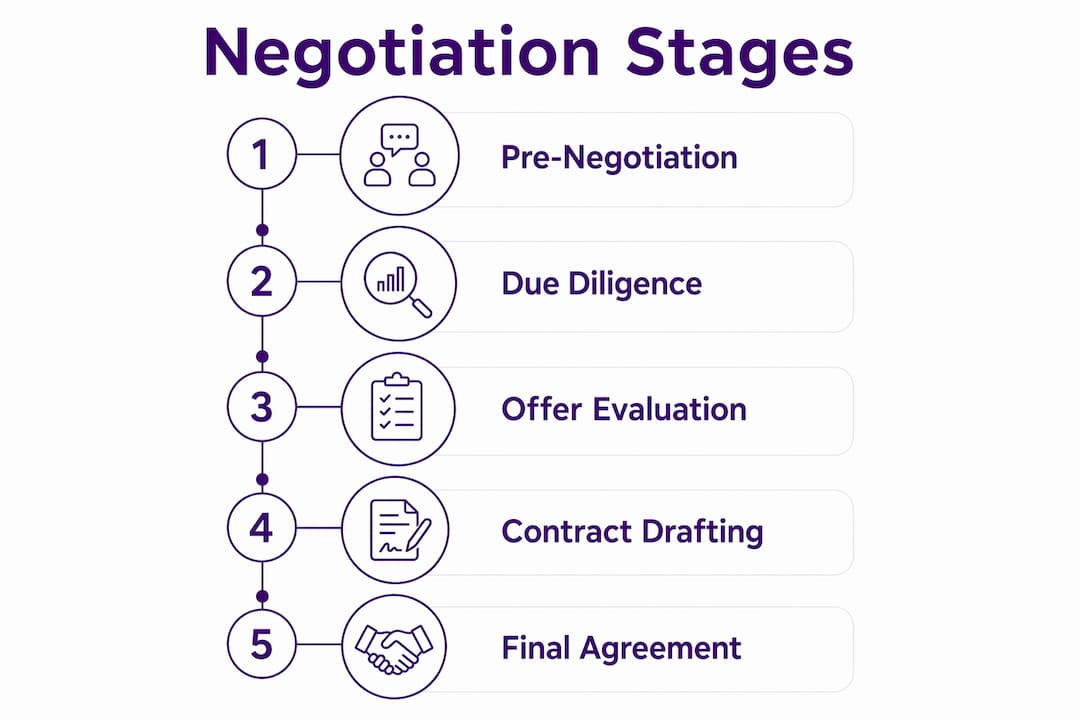
| Stage | Key action | Common mistake |
|---|---|---|
| Pre-negotiation | Sign NCNDA, verify credentials | Skipping counterparty due diligence |
| Term sheet | Define price formula and Incoterms | Accepting vague delivery language |
| Contract drafting | Set document hierarchy and payment terms | Using template GTCs without review |
| Pre-closing | Align banking, inspection, and shipping | Mismatched document dates |
| Closing | Confirm bank instrument is executable | Submitting non-bank-clean payment terms |
Pro Tip: Spot deal commissions typically run $0.50–$2.00 per barrel, while 12-month contract commissions drop to $0.20–$0.50 per barrel. Long-term contracts cost less per barrel and reduce renegotiation risk.
What are the common obstacles in oil deal execution?
80–90% of attempted oil deals collapse before signing due to non-executable language or unrealistic contract terms that banks refuse to support. That number reflects how often investors underestimate execution risk.
The most frequent obstacles fall into three categories:
- Logistics failures. Missing the laycan window causes immediate cargo cancellation. Vessel scheduling, port congestion, and customs clearance all affect whether you hit the window. Build buffer time into every delivery clause.
- Documentary discrepancies. Discrepancies in quantity, quality, dates, vessel, or port trigger bank payment refusal. A pre-presentation document check, reviewing every document against the letter of credit terms before submission, prevents most of these failures.
- Unverified counterparties. Fraudulent sellers and phantom cargoes are real risks in physical oil trading. Require a tank storage receipt, a product passport, and a direct confirmation from the terminal before committing funds.
Dispute resolution, when deals do break down, typically uses ICC or LCIA international arbitration for confidentiality and cross-border enforceability. Arbitration costs are high and appeals are limited, which is why prevention through clear contract drafting is always cheaper. Performance Liquidated Damages (PLDs) link financial penalties directly to output shortfalls, giving both parties a defined consequence for underperformance without requiring litigation.
Investors who also track their Net Revenue Interest and scrutinize post-production deductions maximize per-barrel returns. Understanding NRI is not just a tax tool. It is a cash flow verification mechanism that tells you exactly what you will receive after all deductions.
Key takeaways
Mastering oil deal terms requires clear contract clauses, verified counterparties, executable payment instruments, and explicit document hierarchy before any negotiation begins.
| Point | Details |
|---|---|
| SPA clause precision | Every clause, from product spec to Incoterms, must be bank-clean and legally enforceable. |
| Laycan is non-negotiable | Missing the delivery window causes cargo cancellation and deposit forfeiture. |
| Document hierarchy | Define which document controls in conflicts to prevent GTCs from overriding custom terms. |
| Payment instrument readiness | Confirm your LC, SBLC, or MT103 is executable before submitting any SPA. |
| Net Revenue Interest | Calculate NRI and post-production deductions to verify true cash flow from every deal. |
Why most investors get oil contracts wrong
The uncomfortable truth I have seen repeatedly is that investors treat oil contracts like real estate agreements. They expect a template to do the work. It never does.
The most damaging mistake is accepting a standard GTC package without reading how it interacts with the custom terms you negotiated. I have watched deals unravel at the closing stage because a boilerplate force majeure clause contradicted a custom delivery window. The GTC controlled, and the buyer lost their deposit. A single precedence clause would have prevented it.
The second mistake is rushing. Slowing down to verify a counterparty’s creditworthiness, confirm their terminal access, and review their banking relationships feels like lost time. It is actually the only time that matters. Every deal that collapsed in my experience collapsed because someone skipped a step they thought was unnecessary.
Tax optimization is also underused. Investors who understand oil and gas tax advantages and structure their participation correctly, through working interests with intangible drilling cost deductions, recover a significant portion of their capital in year one. That changes the risk calculus on every deal you evaluate.
My honest advice: treat every oil contract as a custom legal instrument, not a form to fill out. Hire a specialist attorney for the first two deals. After that, you will know exactly what to look for.
— Sharif
How Fieldvest helps investors put these terms to work
Understanding oil contract terms is the foundation. Applying them to investments that generate real cash flow and tax savings is the next step.

Fieldvest connects accredited investors with vetted U.S. oil and gas operators who offer large first-year tax deductions and long-term energy income. Every project on the platform is structured for investors who want to lower their taxes through working interests and intangible drilling cost deductions. Use the tax deduction calculator to estimate your first-year deduction before committing to any deal. For investors who want to see the full after-tax picture, the wealth projection tool models compound growth on after-tax oil and gas returns. Visit Fieldvest to review current U.S. energy projects.
FAQ
What is an SPA in oil trading?
An SPA, or Sales and Purchase Agreement, is the primary contract governing a physical oil transaction. It defines product specifications, volume, delivery terms, price formula, payment method, and dispute resolution.
What does laycan mean in an oil contract?
Laycan is the delivery window within which a vessel must arrive at the loading port. Missing this window gives the seller the right to cancel the cargo and retain any deposit paid.
How do banks evaluate oil deal payment terms?
Banks require payment instruments, such as irrevocable letters of credit or SBLCs, to be executable and free of ambiguous language. Over 80% of SPAs fail seller approval because the payment terms cannot be financed by a bank.
What is Net Revenue Interest in an oil investment?
Net Revenue Interest (NRI) is the percentage of production revenue an investor receives after royalties and other deductions. Confirming NRI before signing any deal is the most direct way to verify true cash flow.
How are oil deal disputes resolved?
Most international oil contracts specify ICC or LCIA arbitration. Arbitration is confidential and enforceable across borders, but legal costs are high and appeal rights are limited, making clear contract drafting the better first line of defense.
Recommended

Get the Fieldvest Energy Brief
and AI-driven demand shifts — curated for accredited investors. Smart. Strategic. Tax-advantaged.