


Your two highest-value sources are the marketplace dashboard and the operator’s monthly production and revenue statement. Check both before anything else. The dashboard shows project status flags, uploaded operator reports, and your distribution ledger. The monthly statement shows gross barrels of oil equivalent (BOE), realized price, lease operating expenses (LOE), and net distributions.
Immediate checks to run right now:
- Distribution notices: confirm the payment date, amount per unit, and net revenue interest (NRI) applied
- Production BOE: compare this month’s volumes to the prior month and to the operator’s original projection
- Recent operator reports: look for the last 60–90 days of uploads; a gap is a signal worth noting
- K-1 timing: confirm whether your K-1 has been issued or is still pending (most arrive by March 15 for the prior tax year)
Pro Tip: The single document that reveals exit and wind-down provisions, fee waterfalls, and capital-call terms is the participation agreement. Read those clauses before you read anything else.
Table of Contents
- Where do your oil project updates actually come from?
- What documents should you expect to receive and keep?
- How do you verify what the operator is claiming?
- What metrics should you track in every update?
- What questions should you ask your broker and operator?
- Red flags that require escalation
- How Fieldvest organizes your project updates
- Key Takeaways
- What disciplined monitoring actually looks like
- Fieldvest puts your project data in one place
- Useful sources for verification and escalation
Where do your oil project updates actually come from?
Updates arrive through four distinct channels, and knowing which one is primary versus confirmatory saves time.
Marketplace dashboard is your first stop. A well-run platform surfaces project status flags (pre-production, producing, shut-in), links to operator-uploaded reports, and a timestamped distribution ledger. Fieldvest aggregates these in one place so you are not chasing PDFs across email threads.
Operator-issued reports are the authoritative source for production numbers. Legitimate operators provide monthly production reports showing gross volumes, the product price realized, LOE deductions, and net distributions. Failure to deliver these consistently is a red flag, not a scheduling inconvenience. Understanding operator responsibilities helps you know exactly what to demand.
State regulator filings are your independent confirmation layer. The Texas Railroad Commission (RRC), Oklahoma Corporation Commission (OCC), and equivalent agencies in every producing state publish permit records, spud dates, completion reports, and production data tied to an API well number. You can track operator activity and new wells using those state records to verify that what the operator reports matches what the state recorded. Keep your mailing address current with the relevant agency to receive pooling, spacing, and division-order notices automatically.
SEC, FINRA, and NASAA are escalation and verification sources, not daily reading. EDGAR carries Form D filings for private placements. The SEC’s investor alert on private oil and gas offerings lists the questions you should ask and the contacts to use if something looks wrong.
| Channel | Primary use | Update frequency |
|---|---|---|
| Marketplace dashboard | Status flags, distribution ledger, document links | Real-time / on upload |
| Operator monthly report | Production volumes, LOE, net distributions | Monthly |
| State regulator records | Permit, spud, completion, production confirmation | As filed (varies by state) |
| SEC / FINRA / NASAA | Form D verification, escalation, fraud reporting | As needed |
What documents should you expect to receive and keep?
Every investor in a private oil and gas deal should hold these documents in a dedicated folder.
- Monthly/quarterly production and revenue statements: these show gross volumes, realized price, LOE, royalties, operator fees, and your net distribution. Per SEC oil and gas reporting modernization guidance, third-party reports used to support reserves estimates must be filed as exhibits when applicable.
- Schedule K-1: your annual tax form showing income, deductions, and intangible drilling costs (IDC). Retain every K-1 permanently. For a deeper look at oil sector tax forms, the mechanics of IDC timing and K-1 delivery matter more than most investors realize.
Pro Tip: Build one folder per project: participation agreement, PPM, every monthly statement, division order, JIB, K-1s, and the broker due-diligence report. Good document handling practices make tax season and any dispute resolution dramatically faster.
How do you verify what the operator is claiming?
Cross-referencing operator reports against public records is the most reliable verification method available to a private investor.
- Pull the API well number from your participation agreement or the marketplace project page. Enter it into the relevant state agency’s online system (Texas RRC, Oklahoma OCC, North Dakota DMR, etc.) and confirm that permit dates, spud dates, and completion dates match what the operator reported to you.
- Request the third-party engineering report. Under Regulation S-K Item 1200 series guidance, registrants must disclose the preparer’s name, qualifications, and relationship to the company when a third-party report is used. Ask for the preparer’s name and credentials.
- Request the broker’s due-diligence report. Ask specifically what reserve-validation steps were taken and whether the operator’s prior projects were reviewed.
- Cross-check production volumes in the operator’s monthly report against state-filed production data for the same API number. Discrepancies of more than a few percent warrant a written inquiry.
- Compare banked distribution receipts to the net distribution line on your monthly statement. They should match.
Pro Tip: Federal law under 42 U.S.C. § 6383 directed the SEC to develop consistent oil and gas accounting practices precisely because inconsistent reporting was a chronic investor problem. That statutory mandate is why you can hold operators to a defined reporting standard.
What metrics should you track in every update?
| Metric | What it measures | Why it matters |
|---|---|---|
| Production (BOE/day) | Gross output, oil vs. gas split | Baseline for all revenue and distribution math |
| Net revenue interest (NRI) | Your decimal share of production revenue | Drives your actual distribution amount |
| Realized price ($/BOE) | Price received after transport and quality adjustments | Determines gross revenue before deductions |
| LOE ($/BOE) | Lease operating expense per unit | Rising LOE compresses distributions |
| Uptime / downtime | Percentage of scheduled production days online | Downtime spikes often precede missed distributions |
| AFE vs. actual well costs | Budget vs. spend on drilling and completion | Consistent overruns signal poor planning or cost-shifting |
| Net distribution | Cash paid to investors after all deductions | The number that hits your account |
Watch the AFE-to-actual variance across multiple projects, as explained in this detailed invoice approval workflow for upstream operators. Consistent overruns are a practical red flag for cost-shifting to investors, as Rule 4-10 accounting guidance makes clear when explaining capitalized cost treatment. For shale-specific reserve metrics, U.S. shale reserve guidance covers what to check beyond the headline BOE number.
What questions should you ask your broker and operator?
Ask your broker:
- Can you provide the written due-diligence report for this project?
- How were reserves validated, and was a third-party engineer used?
- Is the Form D for this offering filed on EDGAR, and can you share the accession number?
- What is the escalation path if I have a dispute with the operator?
Ask your operator:
- Can you send the monthly production ledger for the last 12 months?
- Who prepared the reserves estimate, and can I receive a copy of the engineering report?
- What is the AFE vs. actual cost reconciliation for the most recent well?
- Who is my designated point of contact for reporting questions?
Here is a short email template you can adapt:
Pro Tip: Send requests in writing and keep a timestamped copy. If a dispute escalates, that correspondence timeline is evidence.
Red flags that require escalation
Warning signs to act on:
- Operator cannot produce a third-party engineering report or names a preparer with no verifiable credentials
- Reserves claims are unsupported by any audit
- Repeated AFE overruns across multiple wells with no written explanation
- Related-party vendor fees that are not disclosed in the participation agreement
- Production reports stop arriving or arrive with large unexplained gaps
- Distribution amounts are inconsistent with reported production volumes
Evidence to collect immediately: dated operator reports, all email correspondence, banked distribution receipts, and state regulator filings for the relevant API numbers.
Escalation path:
- Contact the broker’s compliance department in writing with your documented concerns
- Use the marketplace dispute-resolution process if the broker is unresponsive
- File a tip or complaint with FINRA, the SEC Office of Investor Education and Advocacy, or NASAA if you believe fraud or material misrepresentation has occurred
- Engage independent legal counsel and, if production data is disputed, an independent petroleum engineer
The SEC’s private oil and gas investor alert lists specific questions and regulator contacts. For a broader view of risk mitigation tactics, the red-flag detection steps there complement the escalation path above.
How Fieldvest organizes your project updates
Fieldvest surfaces the following on each project page: current status flag (pre-production, drilling, producing, shut-in), operator-uploaded monthly reports, a timestamped distribution ledger, and K-1 document links when available. The platform aggregates state regulator filings alongside operator reports so you can run the API-number cross-check without leaving the dashboard.

When a report is missing or a distribution is delayed, you can submit a request directly through the marketplace rather than hunting for an operator contact. Fieldvest’s vetting process, described in the project underwriting guide, means operators on the platform have already passed document and reporting-standard checks before you invest.
Pro Tip: Set a calendar reminder on the 45th day after each production month. If the operator report has not appeared on the dashboard by then, submit a written request through the platform that same day.
Investor → Fieldvest dashboard → operator report upload → state regulator confirmation → distribution ledger update → K-1 issuance.
Key Takeaways
Tracking oil project updates requires checking your marketplace dashboard and operator monthly statements first, then verifying against state regulator records and the documents your participation agreement entitles you to receive.
| Point | Details |
|---|---|
| Start with two sources | Check the marketplace dashboard and the operator’s monthly production and revenue statement before anything else. |
| Retain core documents | Keep the participation agreement, PPM, every monthly statement, division orders, JIBs, and all K-1s in one dedicated folder. |
| Verify with state records | Use the API well number to cross-check operator reports against Texas RRC, Oklahoma OCC, or the relevant state agency. |
| Know the K-1 timeline | Most K-1s arrive by March 15; late delivery may require a tax extension, so confirm status by February. |
| Fieldvest centralizes tracking | Fieldvest aggregates operator reports, distribution history, and state filings in one dashboard for accredited investors. |
What disciplined monitoring actually looks like
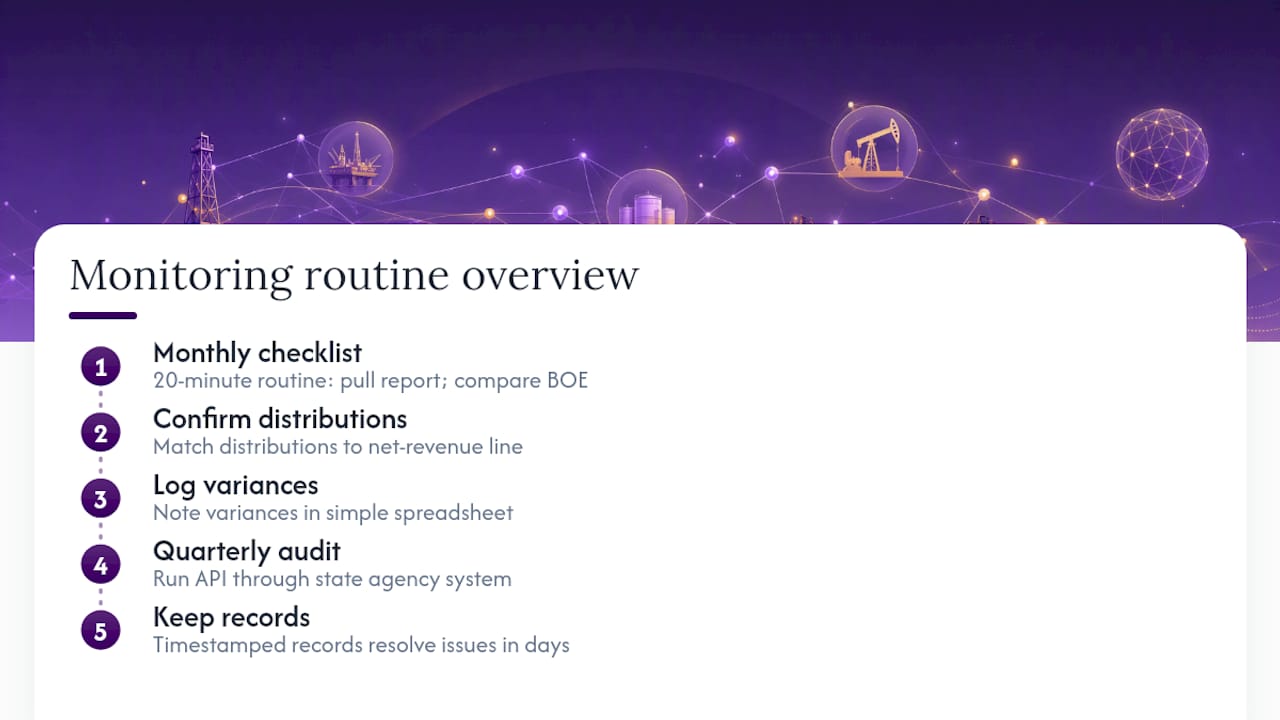
The investors who avoid surprises are not the ones who read every document twice. They are the ones who run the same short checklist every month without skipping it. Pull the operator report, compare BOE to last month, confirm the distribution matches the net revenue line, and note any variance in a simple spreadsheet. Once a quarter, run the API number through the relevant state agency’s system and confirm the production data aligns. That 20-minute routine catches most problems early, when they are still fixable.
The emotional case for keeping a clean folder is underrated. When a K-1 arrives late or a distribution is questioned, the investor who can produce a timestamped paper trail resolves the issue in days. The one who cannot resolves it in months, if at all.
Fieldvest puts your project data in one place
Accredited investors who want production reports, distribution history, and tax documents without chasing operators across email threads use Fieldvest. The platform connects you directly to vetted U.S. oil and gas projects, surfaces operator reports and state-filing data on a single dashboard, and links your K-1s when they are issued. The first-year tax deductions from intangible drilling costs are substantial for high-earning W-2 professionals, and Fieldvest’s tax deduction calculator lets you model your specific situation before you commit.
Every project on the platform has passed Fieldvest’s underwriting review, which means the reporting standards described in this guide are already built into the operator relationship. To see current projects and start tracking your energy investments in one place, visit Fieldvest and review the available opportunities.
Useful sources for verification and escalation
- Private oil and Gas offerings
- Oil and Gas Reporting Modernization - A Small Entity Compliance Guide
- 42 U.S. Code § 6383 - Energy data base; accounting practices
- Rule 4-10 financial accounting guidance — PwC viewpoint
- 229 Regulation S-K — 1200 disclosure by registrants engaged
- Who’s Drilling Near You? Track Operator Activity & New Wells | Buckhead Energy
This article is general information for accredited investors and does not constitute legal, tax, or financial advice. Confirm current rules and your specific situation with a qualified attorney, CPA, or financial advisor.
Recommended

Get the Fieldvest Energy Brief
and AI-driven demand shifts — curated for accredited investors. Smart. Strategic. Tax-advantaged.