


TL;DR:
- Most U.S. renewable energy projects use a single Project Company structure held under a Delaware LLC or LP, often layered with a HoldCo for tax equity. Proper entity design, core project agreements, and specialized counsel are critical to securing project finance and tax credits. Fieldvest connects vetted investors with energy projects, emphasizing well-structured entities for efficient capital raising and project success.
For most U.S. renewable energy projects, the right baseline structure is one single-purpose Project Company (ProjectCo) per asset, held under a Delaware LLC holding company (HoldCo). Where tax equity is required to monetize Investment Tax Credits (ITC) or Production Tax Credits (PTC), that HoldCo is typically restructured as a limited partnership or a multi-member LLC designed for a partnership-flip arrangement. That is the structure lenders expect, tax-equity investors require, and accredited investors can actually underwrite.
Three next steps to get moving:
- Incorporate the ProjectCo as a single-member Delaware LLC or LP, with a clean operating agreement that restricts its activities to the single project asset.
- Prepare core project agreements — power purchase agreement (PPA) or offtake contract, EPC construction contract, and O&M agreement — because lenders and tax-equity investors will not advance capital without them.
- Engage specialized energy counsel and a tax advisor, then open a fundraising channel (such as an accredited-investor marketplace) to place sponsor equity and co-investor capital alongside project debt.
Pro Tip: Do not form the HoldCo and ProjectCo as the same entity. Even for a single-asset project, separating them costs very little at formation and saves enormous legal expense if a lender ever needs to enforce against the project without touching the sponsor’s other assets.
Table of Contents
- What investment entity setup for energy projects actually looks like
- How do you choose between a Delaware LLC, LP, and C corp?
- How do sponsors typically capitalize a U.S. energy project?
- What contracts and security packages does each entity need?
- What do investor documents and governance look like?
- What does the formation process cost and how long does it take?
- What risks and compliance items should you clear before raising capital?
- Three real-world structure examples
- Where does an accredited-investor marketplace fit in the capital stack?
- Key Takeaways
- Why entity design is the part most sponsors underestimate
- Fieldvest connects accredited investors with vetted U.S. energy deals
- Useful sources and further reading
What investment entity setup for energy projects actually looks like
The three dominant structuring patterns in U.S. energy project finance are the standalone ProjectCo, the HoldCo/ProjectCo stack, and the fund or joint-venture vehicle. Each solves a different problem, and choosing the wrong one early creates expensive restructuring later.
The ProjectCo (single-purpose SPV)
The Project Finance Primer for Renewable Energy and Clean Tech Projects describes the ProjectCo as typically a single-member Delaware LLC or limited partnership established to hold all project assets and contractual rights. Its defining feature is bankruptcy remoteness: the entity does nothing except own and operate one project, which means a lender’s security interest is clean and a default at the project level does not automatically contaminate the sponsor’s other holdings.
This structure is standard for any project seeking non-recourse or limited-recourse project finance, and it is a hard requirement for tax-equity investors. A tax-equity partner needs to step into a clearly defined entity with no legacy liabilities, no cross-collateralization, and a predictable cash waterfall.
The HoldCo/ProjectCo stack
Once a sponsor has more than one project, or anticipates adding assets, a HoldCo layer becomes necessary. The HoldCo (usually a Delaware LLC or LP) owns 100% of each ProjectCo and serves as the borrower for any portfolio-level or holdco financing. According to Jones Day’s analysis of layered energy capital stacks, energy finance is increasingly structured in layers: project finance at the asset level, holdco finance for portfolios, and NAV facilities at the fund level, with each layer solving different liquidity and leverage needs.
The HoldCo also serves as the entity investors subscribe into when they want portfolio-level exposure rather than single-asset risk.
Fund and JV structures
For sponsors raising pooled capital from multiple accredited investors, a Delaware LP (with a GP entity managing the fund) or a Delaware series LLC is common. The sponsor-holdco-project-SPV layering can also include an optional investor-cell layer that gives each investor or investor group segregated exposure to specific assets within the portfolio. JV structures are used when a strategic co-investor (a utility, a corporate off-taker, or an infrastructure fund) takes a direct stake alongside the sponsor.
Pattern comparison
| Structure | Best for | Liability isolation | Financing fit | Investor onboarding | Complexity |
|---|---|---|---|---|---|
| Standalone ProjectCo | Single asset, single lender | Strong at asset level | Non-recourse project debt, tax equity | Simple, one entity | Low |
| HoldCo/ProjectCo stack | Multi-asset portfolio | Strong at both levels | Project debt + holdco facility | Moderate, subscribe at HoldCo | Medium |
| Fund/JV (LP or series LLC) | Pooled capital, co-investment | Strongest (fund-level segregation) | NAV facility, co-invest | Complex, fund docs required | High |
- A standalone ProjectCo is the right starting point for a first project or a developer testing the market.
- The HoldCo/ProjectCo stack becomes necessary the moment a second asset enters the picture or a lender requires cross-collateralization across projects.
- Fund/JV structures make sense when raising from more than a handful of accredited investors or when a strategic partner demands governance rights at the portfolio level.
How do you choose between a Delaware LLC, LP, and C corp?
The legal form of each entity in your stack determines how income flows to investors, how tax credits are allocated, and how much administrative overhead you carry. Getting this wrong is not just inconvenient — it can disqualify a project from tax-equity financing entirely.
Delaware LLC: the default choice
Delaware LLCs dominate U.S. energy project finance for good reason. They are pass-through entities by default (taxed as partnerships when multi-member), they offer flexible governance through a customizable operating agreement, and Delaware’s Court of Chancery provides predictable, sophisticated case law. Inbound U.S. investment guidance consistently recommends a Delaware LLC HoldCo for both domestic and cross-border sponsors because it accommodates a wide range of investor types without triggering corporate-level tax.
A single-member Delaware LLC (SMLLC) is the standard ProjectCo form: it is disregarded for federal tax purposes (meaning income flows directly to the HoldCo or sponsor), it is simple to administer, and lenders are entirely comfortable with it.
C corporation: rarely the right answer
A C corp introduces double taxation (corporate tax at the entity level, then dividend tax at the investor level) and is generally incompatible with pass-through tax-credit allocation. The narrow cases where it appears: a foreign sponsor whose home-country tax treaty makes a C corp more efficient, or a project company that expects to go public and needs a corporate form for that path.
Tax items to confirm with counsel before you form anything
- Bonus depreciation: Pass-through entities allow sponsors and investors to take accelerated depreciation deductions, which is a core part of the tax-benefit case for energy investments.
Pro Tip: If you are considering a partnership-flip structure, form the ProjectCo as a multi-member LLC or LP from day one — converting a SMLLC to a partnership after the fact triggers a taxable event and restarts certain holding-period clocks.
How do sponsors typically capitalize a U.S. energy project?
Capital structure is where deals succeed or fail. The layers of the stack are not interchangeable — each one has a different cost, a different risk profile, and a different set of conditions that must be satisfied before it will close.
Jones Day’s capital-stack framework describes the modern energy finance toolkit as three distinct instruments: project finance at the asset level, holdco finance for portfolios, and NAV facilities at the fund level. Each layer solves a different liquidity and leverage problem.
The four capital-stack layers
Sponsor and investor equity sits at the bottom of the stack and absorbs first losses. It is the most expensive capital but also the most flexible. Accredited investors placing equity through a marketplace or direct subscription typically participate at this layer, either at the ProjectCo level (for single-asset deals) or at the HoldCo level (for portfolio exposure).
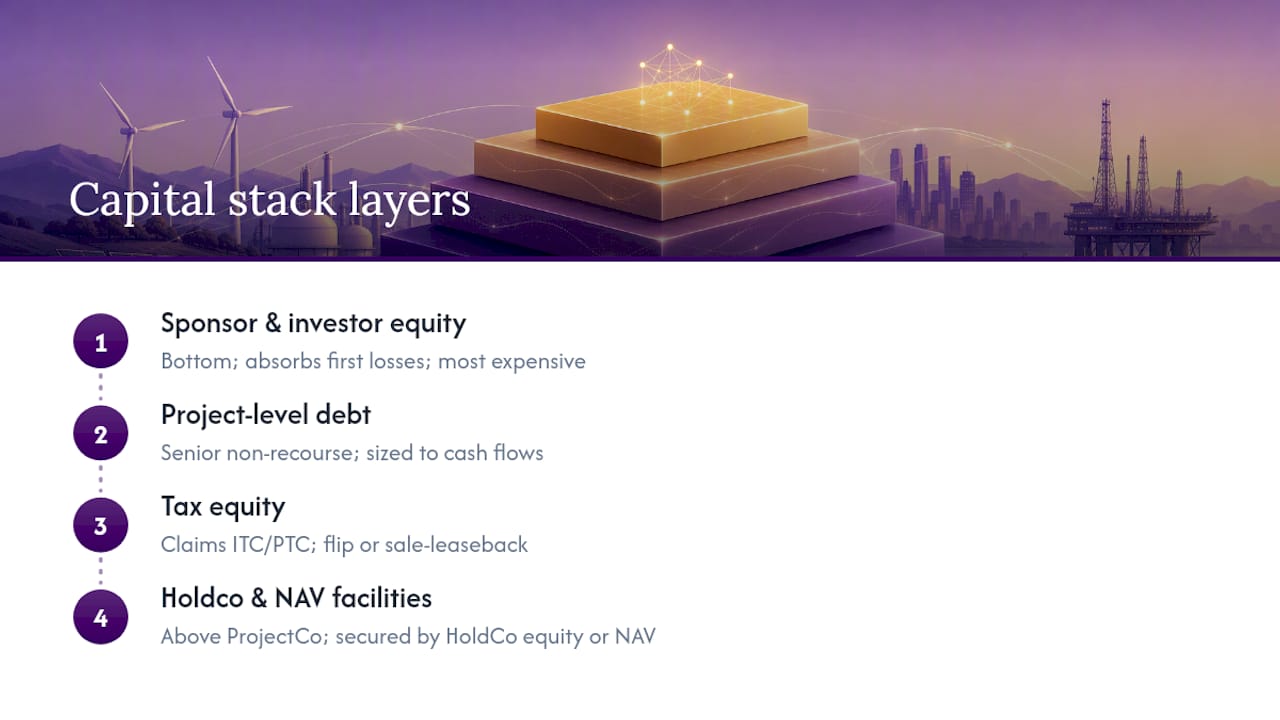
Project-level debt is non-recourse or limited-recourse senior debt secured against the ProjectCo’s assets and contracts. Lenders will not advance without a bankable PPA, a creditworthy off-taker, a completed EPC contract, and a satisfactory independent engineer report. Debt sizing is driven by the project’s contracted cash flows, not its appraised asset value.
Tax equity is not debt and not conventional equity. A tax-equity investor (typically a large bank or insurance company) contributes capital in exchange for the right to claim the ITC or PTC and associated depreciation deductions. The two dominant structures are the partnership flip (the tax-equity investor holds a large economic interest until it achieves its target yield, then flips back to the sponsor) and the sale-leaseback (the tax-equity investor purchases the project and leases it back to the developer). Tax equity is expensive to negotiate and requires sophisticated counsel, but for a 30%+ ITC project it is often the difference between a deal that pencils and one that does not.
Holdco and NAV facilities sit above the ProjectCo level. A holdco facility uses the HoldCo’s equity interests in its ProjectCos as collateral. A NAV facility (common in fund structures) is secured against the net asset value of the fund’s portfolio. Bracewell’s analysis of portfolio and holdco financing notes that these facilities require explicit eligible-project criteria, debt-sizing principles, and due-diligence standards to prevent overleverage as new assets are added.
Financing options compared
| Financing type | Best for | Cash flow profile required | Lender/investor expectations |
|---|---|---|---|
| Project-level debt | Single bankable asset with contracted revenue | Long-term PPA or offtake, stable DSCR | Completed project agreements, IE report, insurance |
| Tax equity (partnership flip) | ITC/PTC projects with large credit pools | Predictable generation, creditworthy off-taker | Partnership structure, tax counsel opinion, lender consent |
| Tax equity (sale-leaseback) | Simpler structures, smaller projects | Steady lease payments | Clean title, no prior liens, lender consent |
| Holdco facility | Multi-asset portfolio, bridge or revolving capital | Diversified contracted cash flows | Eligible-project criteria, pledge of ProjectCo interests |
| NAV facility | Fund-level liquidity, LP capital calls | Portfolio NAV stability | Fund audits, LP consent thresholds, valuation methodology |
- Tax equity is not available to every project. Lenders and tax-equity investors both require a creditworthy off-taker and a fully executed PPA before they will engage seriously.
- Holdco facilities are a powerful tool for developers who want to recycle capital across a growing pipeline, but they create structural subordination: the holdco lender’s security sits above the ProjectCo lender’s cash-flow rights, which requires careful intercreditor negotiation.
What contracts and security packages does each entity need?
The entity structure is only as strong as the contracts attached to it. Lenders and tax-equity investors are not financing the entity — they are financing the cash flows those contracts generate.
The lender security package
At the ProjectCo level, a project lender typically requires:
- Mortgage or deed of trust on real property, plus a fixture filing covering project equipment.
- Assignment of all material project contracts (PPA, EPC, O&M, land lease, interconnection) as collateral, with counterparty consent to the assignment.
- Pledge of 100% of the equity interests in the ProjectCo (held by the HoldCo).
- Control agreements over all project bank accounts (revenue account, debt service reserve account, O&M reserve account, distribution account).
- Step-in rights allowing the lender to cure defaults under project contracts and take over operations.
Mistakes in the cash-upstream mechanics — intercompany loan terms, distribution waterfalls, and account-control covenants — can create structural subordination that blocks distributions to the HoldCo or fund-level lenders, per Jones Day’s analysis. Getting the waterfall right at formation is far cheaper than litigating it after a lender default.
What do investor documents and governance look like?
The operating agreement (for an LLC) or LP agreement (for a limited partnership) is the constitution of your entity. It determines who controls the project, how cash flows to investors, and what happens when things go wrong.
Operating agreement and LP agreement essentials
- Capital contributions and calls: Define the timing, amount, and conditions of each investor’s capital commitment. Uncalled capital creates contingent liability; a clear call mechanism prevents disputes.
- Distribution waterfall: Cash flows out of the ProjectCo in a defined sequence: operating expenses, debt service, reserves, then distributions. At the HoldCo or fund level, distributions typically follow a preferred-return hurdle (often 6–8% per annum), then a catch-up to the sponsor/GP, then a carried-interest split (commonly 20% to the GP/sponsor, 80% to LPs above the hurdle).
- Reserved matters: Decisions that require investor consent beyond the manager’s ordinary authority — taking on additional debt, selling the project, admitting new members, amending the agreement itself.
- Transfer restrictions: Investors generally cannot transfer their interests without manager consent and compliance with securities laws. Lock-up periods of 3–5 years are common in project-level vehicles.
Subscription agreements and investor onboarding
The subscription agreement is the contract between the fund/entity and each incoming investor. It collects the investor’s representations (including accredited-investor status), their capital commitment, and their agreement to the operating or LP agreement terms. A Form 1-A offering circular filed with the SEC illustrates the disclosure format and investor-communication mechanics that sponsors can use as a template for their own offering documents, though counsel must adapt any template to the specific offering.
For private placements relying on Regulation D (Rule 506(b) or 506©), the sponsor must verify accredited-investor status before accepting a subscription. Under 506©, that verification must be affirmative (third-party verification letters, tax returns, or brokerage statements), not just a self-certification checkbox.
The private equity HoldCo/OpCo framework commonly used in energy investments isolates asset-level finance in the OpCo (ProjectCo) and places sponsor and fund economics at the HoldCo level, with management co-investment and carry structures documented in the fund’s LP agreement.
Investor onboarding checklist
- Executed subscription agreement with accredited-investor representations.
- KYC/AML documentation (government-issued ID, entity formation documents for entity investors, beneficial-ownership certification).
- Accredited-investor verification (third-party letter, tax returns, or brokerage statements for 506© offerings).
- Executed operating agreement or LP agreement counterpart.
- Wire instructions confirmed and capital contribution received into escrow or the entity’s account.
- Investor admitted as a member or limited partner by manager/GP action.
- Cap table updated and investor confirmation letter issued.
For a practical guide to handling the document flow, the investment document checklist covers the mechanics of managing subscription packages at scale.
What does the formation process cost and how long does it take?
Formation is faster than most sponsors expect. The delays come from negotiating project agreements and satisfying lender conditions, not from the entity filings themselves.
Chronological formation checklist
- Choose jurisdiction and entity type — Delaware LLC or LP for the ProjectCo and HoldCo in almost every case.
- File articles of organization or certificate of limited partnership with the Delaware Division of Corporations.
- Appoint a registered agent in Delaware (required for all Delaware entities).
- Draft and execute the operating agreement or LP agreement — this is where counsel time concentrates.
- Obtain an EIN from the IRS (same-day online for domestic sponsors).
- Open a bank account in the entity’s name — typically requires the EIN, operating agreement, and formation documents.
- Obtain required insurance (builder’s risk during construction, property and liability post-COD, and any lender-required policies).
- Execute core project agreements (PPA, EPC, O&M, land lease, interconnection).
- Negotiate and close tax-equity commitment (if applicable).
- Satisfy lender conditions precedent (title insurance, IE report, environmental reports, insurance certificates, executed project agreements).
- Establish account control structures (revenue account, DSRA, O&M reserve, distribution account) per lender requirements.
- Financial close and first funding.
Timeline and typical costs
| Step | Typical timeline | Estimated cost range |
|---|---|---|
| Entity formation (Delaware LLC or LP) | 1–3 business days | $500 (filing fees + registered agent) |
| EIN and bank account | 1–5 business days | Minimal |
| Operating/LP agreement drafting | 2–6 weeks | $10,000 (counsel) |
| PPA/offtake negotiation | 1–6 months | $20,000 (counsel, depending on complexity) |
| EPC contract negotiation | 1–4 months | $15,000 (counsel) |
| Tax-equity structuring and close | 3–9 months | $50,000 (counsel, tax advisor) |
| Project-level debt close | 3–6 months (concurrent with tax equity) | $50,000 (lender counsel, IE, insurance) |
| Total pre-financial-close professional fees | 6–18 months total | $150,000 for a mid-size project |
These ranges reflect typical mid-market U.S. renewable projects. Smaller community solar deals at the low end; utility-scale projects with tax equity at the high end. The energy investment process can be compressed with experienced counsel and a well-prepared sponsor, but the lender and tax-equity due-diligence timelines are largely outside the sponsor’s control.
Mandatory pre-financing steps lenders and tax-equity investors will insist on before advancing any capital: fully executed PPA with a creditworthy off-taker, executed EPC with a creditworthy contractor, site control (executed land lease or easement), signed interconnection agreement, and all material permits either issued or on a confirmed path to issuance.
What risks and compliance items should you clear before raising capital?
Structural surprises after capital is raised are expensive. The risks below are the ones that most commonly derail deals or force costly restructuring.
Environmental and permitting risks
- Projects without a clear permitting path cannot achieve financial close. Lenders require environmental reports (Phase I, and Phase II if contamination is suspected) and confirmation that all required permits are either issued or subject to a clear, time-bound approval process.
- Wetlands, endangered species, and cultural-resource issues can add months or years to a permitting timeline. Identify these early, before committing to an EPC schedule.
- State clean energy fund programs (documented by the EPA’s clean energy fund manual) interact with project permitting and funding timelines in ways that can affect both eligibility and disbursement schedules.
Securities and fundraising compliance
- Any offering of equity interests to investors is a securities offering. Most energy project sponsors rely on Regulation D (Rule 506(b) or 506©) for private placements to accredited investors.
- Under 506(b), you may not use general solicitation, and you may include up to 35 non-accredited but sophisticated investors. Under 506©, general solicitation is permitted but every investor must be affirmatively verified as accredited.
- File Form D with the SEC within 15 days of the first sale. Many states also require a notice filing (a “blue sky” filing) within a short window after the first sale in that state.
- Disclosure documents must be accurate and complete. A Form 1-A offering circular is a useful reference for the disclosure format, though Reg D offerings do not require a formal offering circular.
Tax risks
- Confirm ITC or PTC eligibility with a qualified tax advisor before formation. Eligibility depends on technology type, construction start date, and compliance with prevailing-wage and apprenticeship requirements under the Inflation Reduction Act.
- If you plan to transfer tax credits to a third-party buyer rather than use a traditional tax-equity investor, confirm that the transfer mechanics are compatible with your entity structure.
- State incentive programs often have their own eligibility requirements that are separate from federal credit eligibility. Relying on a state incentive that the project ultimately does not qualify for can break a deal’s financial model.
Pro Tip: Review the common pitfalls for energy investors before you finalize your capital-raise documents. The most expensive mistakes in energy project finance are almost always structural, not operational.
Pre-capital-raise compliance checklist
- Entity formation documents reviewed by qualified energy counsel.
- Operating/LP agreement reviewed for tax-equity compatibility.
- Accredited-investor verification process established (third-party verifier or counsel-reviewed self-certification process).
- Form D filing calendar set (15 days post-first sale).
- State blue-sky filing requirements mapped for each investor’s state of residence.
- Environmental Phase I report obtained and reviewed.
- Permitting timeline confirmed with local counsel.
- ITC/PTC eligibility confirmed with tax counsel.
- Insurance coverage confirmed with a broker experienced in energy projects.
Three real-world structure examples
Example A: Community solar (small-scale, $2M–$10M)
Structure: Single ProjectCo (Delaware SMLLC), owned 100% by the sponsor or a small group of accredited investors subscribing directly. No separate HoldCo unless the sponsor plans to add a second project.
Entity chart: Accredited investors → ProjectCo LLC → Solar array + local offtake/net-metering agreement.
Financing: Sponsor equity plus a local bank construction loan converting to a term loan at COD. Tax equity is often not economic at this scale unless the sponsor has a portfolio of similar projects to aggregate.
Pros: Simple, fast to form, low legal cost, easy investor onboarding. Cons: No tax-equity monetization at project level; limited ability to add leverage without restructuring.
Example B: Utility-scale solar or wind with tax equity ($50M–$500M+)
Structure: Delaware LP or multi-member LLC ProjectCo, owned by the sponsor and a tax-equity investor in a partnership-flip arrangement. A HoldCo (Delaware LLC) sits above the ProjectCo and holds the sponsor’s residual interest.
Entity chart: Sponsor HoldCo + Tax-equity investor → ProjectCo LP → Project assets + PPA + EPC.
Financing: Senior project debt (non-recourse) plus tax equity closing in two stages (funding at construction start and at COD). The layered capital-stack approach at this scale requires careful intercreditor coordination between the project lender and the tax-equity investor.
Pros: Full ITC/PTC monetization, maximum leverage, institutional-grade structure. Cons: High transaction costs, 6–18 month close timeline, requires experienced counsel and a creditworthy off-taker.

Example C: Developer portfolio with holdco finance ($100M–$1B+)
Structure: Multiple ProjectCos (each a Delaware SMLLC or LP) held under a Delaware HoldCo. The HoldCo is the borrower under a revolving holdco credit facility. Accredited investors subscribe at the HoldCo level for portfolio exposure.
Entity chart: Accredited investors + Sponsor → HoldCo LLC → ProjectCo 1, ProjectCo 2, ProjectCo N → Individual project assets.
Financing: Each ProjectCo carries its own project debt. The HoldCo carries a revolving facility secured by pledges of the ProjectCo equity interests. Bracewell’s portfolio financing analysis identifies eligible-project criteria and debt-sizing principles as the key negotiating points with holdco lenders.
Pros: Capital recycling, diversified risk, efficient investor onboarding at portfolio level. Cons: Complex intercreditor arrangements, holdco lender due diligence on every ProjectCo, structural subordination risk if cash-upstream mechanics are not carefully drafted.
For a broader look at how different renewable project types map to these structures, the investor guide covers technology-specific considerations in more detail.
Where does an accredited-investor marketplace fit in the capital stack?
A marketplace like Fieldvest is not a lender, a tax-equity investor, or legal counsel. It is a placement and syndication channel that sits between sponsors with vetted projects and accredited investors looking for direct energy exposure. Understanding where it fits prevents confusion about what it does and does not do.
What a marketplace typically handles
- Investor accreditation verification (collecting and reviewing the documentation required under Reg D).
- Subscription document distribution and execution tracking.
- Escrow coordination for capital contributions prior to closing.
- Investor reporting and ongoing communications post-close.
- Portfolio management tools that give investors visibility into their holdings across multiple deals.
Pro Tip: A marketplace handles process and access. It does not replace the sponsor’s obligation to prepare accurate offering documents, obtain securities counsel, or file Form D. Treat the marketplace as a distribution channel, not a compliance solution.
Regulatory guardrails
A marketplace operating as a placement agent for Reg D offerings must comply with broker-dealer registration requirements or qualify for an applicable exemption. Sponsors should confirm with counsel that the marketplace they use is operating within its regulatory scope. The marketplace is not a substitute for the sponsor’s own legal and tax counsel, and it does not provide investment advice to investors.
For investors evaluating platforms, the platform safety and risk evaluation guide covers what to look for in a vetted marketplace, including how deal due diligence is conducted and what investor protections are in place.
Key Takeaways
The most effective investment entity setup for U.S. energy projects combines a single-purpose Delaware LLC ProjectCo per asset, a Delaware LLC or LP HoldCo above it, and a capital stack that matches the project’s tax-credit profile and contracted revenue to the right financing instrument.
| Point | Details |
|---|---|
| Baseline structure | One Delaware LLC ProjectCo per asset, owned by a Delaware LLC or LP HoldCo, is the standard lenders and tax-equity investors expect. |
| Three pre-fundraising priorities | Execute project agreements (PPA, EPC, O&M), confirm ITC/PTC eligibility with tax counsel, and complete entity formation before approaching investors. |
| Tax equity requires a partnership | Partnership-flip and sale-leaseback structures require a multi-member LLC or LP at the ProjectCo level — a SMLLC cannot accommodate a tax-equity investor. |
| Two deal-stopping red flags | An uncontracted off-taker (no signed PPA) and unresolvable ITC/PTC eligibility issues will stop project finance and tax-equity financing cold. |
| Fieldvest’s role | Fieldvest connects accredited investors with vetted U.S. energy projects, handling subscription flow and investor onboarding as a capital-placement channel alongside sponsor equity. |
Why entity design is the part most sponsors underestimate
The conventional wisdom in early-stage energy development is that the technology and the site are what matter — get the land, sign the PPA, and the money will follow. That is partially true, but the structure is what determines whether the money can actually get in and out cleanly.
The sponsors who run into trouble are almost never the ones who chose the wrong turbine vendor or negotiated a slightly below-market PPA price. They are the ones who formed a single LLC for everything, commingled project and sponsor assets, and then discovered at lender due diligence that their entity structure was incompatible with non-recourse financing. Unwinding that costs more in legal fees than the original formation would have, and it delays financial close by months.
The HoldCo/ProjectCo separation is the single most undervalued step in the process. It costs almost nothing at formation — a few thousand dollars in additional legal fees — and it preserves the sponsor’s ability to sell a single project, bring in a tax-equity investor at the asset level, or enforce lender step-in rights without touching the rest of the portfolio. Skipping it to save time is a false economy.
The other thing worth saying plainly: the capital-stack layers described in this guide are not theoretical. Project finance, holdco facilities, and NAV facilities are live instruments that sophisticated lenders and investors use every day in U.S. energy markets. The sponsors who understand how those layers interact — and who build their entity structure to accommodate all three from the start — have a structural advantage in both financing speed and exit optionality.
This article is general information, not legal or tax advice. Confirm current rules, credit eligibility, and securities compliance requirements with qualified counsel and a tax advisor before forming any entity or raising capital.
Fieldvest connects accredited investors with vetted U.S. energy deals
Raising sponsor equity for a U.S. energy project means finding accredited investors who understand the asset class, can move through subscription documents efficiently, and want the combination of direct asset ownership and tax-advantaged income that energy projects deliver. That is exactly the investor base Fieldvest has built.

Fieldvest is a marketplace for high-earning accredited professionals — W2 earners, business owners, and active investors — who invest directly in vetted U.S. energy projects, including oil and gas and select renewables. For sponsors, that means access to a pre-qualified investor pool without running a bilateral fundraise from scratch. For investors, it means deal access, subscription handling, and portfolio visibility in one place.
The platform manages accreditation verification, subscription document flow, escrow coordination, and investor reporting. It does not replace legal or tax counsel, and every investor should confirm their own tax position with an advisor before committing capital.
If you are an accredited investor looking at the tax-deduction potential of direct energy investment, or a sponsor who needs a vetted placement channel for your next raise, start at Fieldvest to see current deals and platform details.
Useful sources and further reading
The sources below were cited throughout this guide. Each one is worth reading directly if you are preparing for a capital raise or entity formation.
-
Project Finance Primer for Renewable Energy and Clean Tech Projects (WSGR): — A practical overview of SPE formation, project agreement requirements, and lender expectations for renewable energy and clean-tech projects. Start here if you are new to project finance.
-
Project Finance, Holdco Finance and NAV Facilities in Energy (Jones Day): — Explains how the three capital-stack layers interact, where structural subordination risks arise, and how sponsors can design entities to accommodate all three instruments.
-
Advance of the Aggregators: Portfolio and Holdco Financing in the Renewables Sector (Bracewell): — Detailed mechanics of holdco and portfolio financing, including eligible-project criteria, debt-sizing principles, and lender due-diligence expectations.
-
Form 1-A Offering Circular Example (SEC EDGAR): — A real offering circular filed with the SEC that illustrates the disclosure format and investor-communication mechanics for energy investment offerings. Useful as a structural reference when preparing your own offering documents.
-
Managing Renewables Platforms via SPV Structures (10 Leaves): — Covers sponsor-holdco-project-SPV layering and optional investor-cell structures for portfolio-level investor access. Note: this source addresses structures outside the U.S., but the architectural concepts translate directly.
-
Advancing State Clean Energy Funds: Options for Administration and Funding (EPA): — A public manual on clean energy fund design and state-level program administration. Relevant when your project interacts with state incentive programs or public clean-energy capital.
-
Inbound U.S. Investment Structures for Renewable Energy (Project Finance Law): — Practical guidance on Delaware LLC holdco structures for domestic and cross-border sponsors, including single vs. multiple holding company tradeoffs.
-
Private Capital in Energy: How PE Funds Structure Upstream and Midstream Investments (Energy IB): — Covers the HoldCo/OpCo framework, governance mechanics, and carry/waterfall structures used by private equity in energy. Useful background for sponsors designing fund-level economics.
-
Wells Manager Blog: An industry resource covering how market changes and regulation affect structuring strategies for energy investment entities and project financing.
Recommended
- What Is a Qualified Energy Project? Investor Guide | Oil & Gas Investing
- Streamline Energy Investment Process: How Can It Really Be This Simple? | Oil & Gas Investing
- Handling Oil Investment Documents: Guide for Investors | Oil & Gas Investing
- Oil and Gas Investments: A Guide for Accredited Investors | Oil & Gas Investing

Get the Fieldvest Energy Brief
and AI-driven demand shifts — curated for accredited investors. Smart. Strategic. Tax-advantaged.