


If your Schedule K-1 has not arrived and your return is due, you file your own extension on Form 4868. You do not wait for the partnership. The entity’s extension (Form 7004) and yours are separate filings, and an extension gives you more time to file, not more time to pay. Below is how the two extensions fit together, what to send the IRS, and how to fix your return if the K-1 shows up late.
TL;DR
- The entity owes you a K-1 by the 15th day of the third month after its tax year ends. For calendar-year entities that is March 15, a month before most individual returns are due (IRS Publication 509).
- You request your own six-month extension with Form 4868. The entity uses Form 7004 for its partnership or S corporation return. Neither one files for the other.
- An extension of time to file is not an extension of time to pay. Estimate and pay what you owe by the original due date (IRS).
- If the K-1 arrives after you file on estimates, correct your return with Form 1040-X.
Table of Contents
- Why K-1s Arrive Late
- Two Extensions, Two Different Filers
- What to Do When the Deadline Arrives and No K-1 Has
- Filing Without the K-1: Estimates and Form 8082
- If the K-1 Arrives After You File
- Special Case: Disaster Areas
- Planning Ahead if You Hold Large Gains
- Our Perspective
- Investing With K-1 Timing in Mind
- A Short Checklist for Next Season
- FAQ
- Sources
Why K-1s Arrive Late
Partnerships and S corporations must give each partner or shareholder a K-1 by the 15th day of the third month after the entity’s tax year ends (Publication 509). For a calendar-year entity, that is March 15.
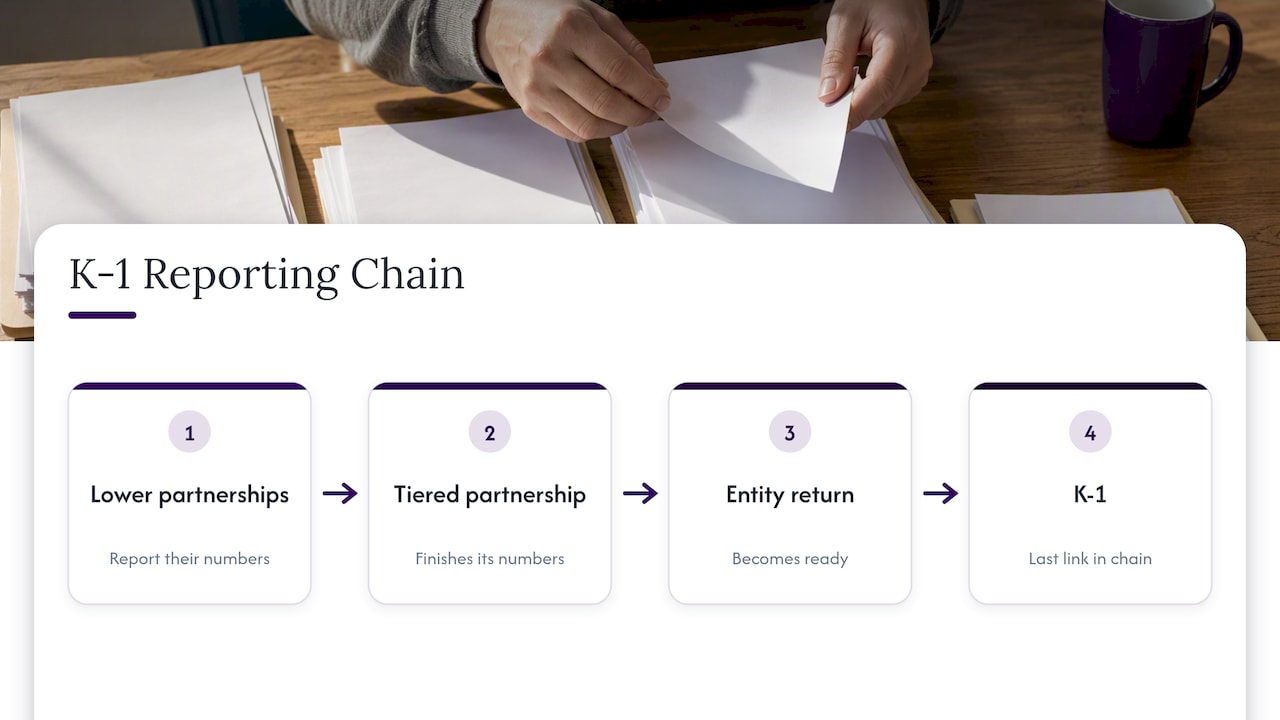
That date is a requirement, not a promise. Many entities file their own extension, and the K-1 comes out only when the entity’s return is ready. If your money sits in a large fund, a tiered partnership (a partnership that owns interests in other partnerships) or another alternative asset, expect your K-1 closer to September than March (LegalClarity).
The reason is structural. A lower-tier partnership cannot finish its numbers until the partnerships below it report. Your K-1 is the last link in that chain.
If you hold interests in several funds, assume at least one K-1 will be late and plan your filing around that from the start of the year.
Two Extensions, Two Different Filers
People search for “K-1 filing extension” and find two forms that sound alike. They are filed by different people for different returns.
| Form 4868 | Form 7004 | |
|---|---|---|
| Who files | You, the individual | The partnership or S corporation |
| Return extended | Form 1040 or 1040-SR | Form 1065 or Form 1120-S |
| Extension type | Automatic, six months | Automatic |
| Does it help your K-1? | Gives you time to wait for it | Explains why the K-1 is late |
The differences between the forms come from Publication 509. An estate or trust return gets a shorter extension of 5½ months (Instructions for Form 1041), which matters if your K-1 comes from a trust and not a partnership.
The key point: when the entity extends its return, your due date does not move. Your April deadline stays where it is until you file Form 4868.
What to Do When the Deadline Arrives and No K-1 Has
1. Contact the entity
Ask the fund manager, general partner or investor relations team whether the entity extended its return and when K-1s will go out. Ask for a written answer and keep it. You will want that record if the IRS asks why you filed on estimates.
2. File your own extension
If the K-1 will be delayed, file for a personal extension using Form 4868 (LegalClarity). The IRS lists three ways to request one by your return’s original due date: pay all or part of your estimated tax electronically and indicate it is for an extension, e-file Form 4868, or mail a paper Form 4868 (IRS Topic no. 304).
Paying electronically and marking the payment as an extension is the quickest route, and it covers you even if you never touch the form itself.
3. Pay an estimate by the original due date
This is where most people slip. The extension covers filing only. Pay owed taxes by the original due date to avoid possible penalties (IRS, When to file).
So you need a number even without the K-1. Start with last year’s K-1 for the same investment, the entity’s quarterly or year-end investor updates, and any estimated figures the manager has shared. Err toward paying slightly more than you expect to owe. An overpayment comes back as a refund. An underpayment can cost you penalties and interest.
4. Mind the October date
For calendar-year individual filers, the extension runs to October 15 of the year the return is due (IRS). Taxpayers in federally declared disaster areas may receive additional time. The IRS also advises extension filers not to wait until the last week of the extension, since filing earlier in the summer leaves room to resolve issues or handle payments (IRS).
If your K-1 is still missing as the extended date nears, you have two options: file on estimates, or call the entity again and press for a firm date.
Filing Without the K-1: Estimates and Form 8082
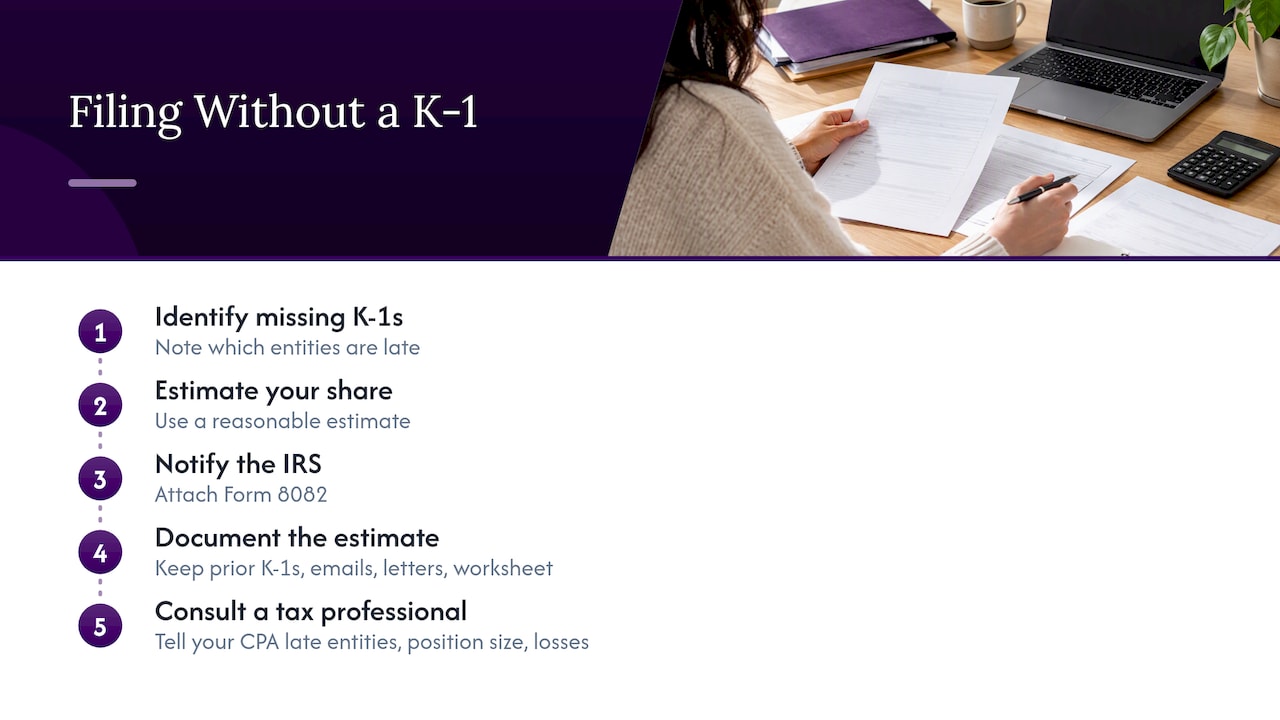
Sometimes the extended deadline arrives and the K-1 has not. You are not required to wait forever. You can file using a reasonable estimate of your share, and attach Form 8082 to tell the IRS that your reporting may not match what the entity eventually reports (LegalClarity).
When you estimate, document everything: prior-year K-1s, emails from the entity, the manager’s investor letters and your own worksheet (GTA Accounting Group). A clear paper trail shows the IRS you acted in good faith.
Because a bad estimate can cost you, this is a good moment to bring in a CPA or enrolled agent who handles partnership returns. Tell them which entities are late, how large each position is and whether any of them has produced losses, depreciation or deductions that could swing your total.
If the K-1 Arrives After You File
When the actual K-1 differs from the estimates you used, amend your return with Form 1040-X (LegalClarity, GTA Accounting Group).
There is a cleaner route for business returns. The Taxpayer Advocate Service explains that while an extension is still running, a taxpayer can file a superseding return that replaces the timely filed original, so no amended return is needed later (Taxpayer Advocate Service). That is one more reason a business filer may want to extend even when a K-1 is only possibly late.
For individuals, the practical lesson is simple: if you can wait until the extended due date and the K-1 comes before it, you file once, on real numbers, and skip the amendment.
Special Case: Disaster Areas
If the entity that issues your K-1 is in a federally declared disaster area and cannot provide its records, you may qualify as an affected taxpayer. You must call the IRS Disaster Hotline to request postponement (IRS FAQs for disaster victims). This is rare, but if a fund’s administrator was hit by a hurricane or wildfire, it is worth the call.
Planning Ahead if You Hold Large Gains
Late K-1s hurt most when you have a big tax bill and little clarity on it. That is common for people with a large realized gain in the same year, such as a tech exit or a big crypto sale. If that is you, read up on crypto capital gains strategies before the year ends, and make your estimated payments on a conservative number. A late K-1 is far easier to handle when you have already set cash aside.
Our Perspective
We work with accredited investors who put money into U.S. energy projects, so K-1 timing is part of our daily conversation. A few things we tell every investor.
Treat the K-1 date as a planning input. Whether a K-1 comes in March or September depends on how the deal is built. A single-asset project with one operator usually has fewer layers than a fund of funds. When you compare opportunities, ask about the expected K-1 timing the same way you ask about the expected return.
Do not let tax benefits get ahead of the paperwork. Energy investments can create sizeable first-year deductions, and those deductions show up on the K-1. If your K-1 is late, your biggest deduction is the number you are waiting for. That is why we encourage investors to read our explainers on K-1 tax reporting and how K-1s unlock energy tax credits before committing, and to ask their CPA to model the year with and without the deal.
Keep your CPA in the loop early. The worst K-1 experiences we hear about involve investors who told their accountant in April about an investment made the previous December. Send your CPA the offering documents when you invest, not at filing time.
Know what the form is. If you are used to 1099s, the K-1 behaves differently, on timing and on content. Our comparison of K-1 vs 1099 covers it.
— Sharif
Investing With K-1 Timing in Mind
On Fieldvest, accredited investors can review vetted U.S. energy projects across three categories: producing assets, development projects and energy infrastructure. Each one comes with key project materials presented side by side so you can compare them. If you want to see how a deal’s structure fits your tax situation and your filing calendar, browse the projects on Fieldvest and bring the materials to your CPA.

For a broader view of how oil and gas deductions work, see how to lower your taxes with oil and gas investments.
A Short Checklist for Next Season
- In January, list every entity that will send you a K-1 and note last year’s arrival date for each.
- Ask each manager for the expected K-1 date in writing.
- In March, decide whether any K-1 is at risk of being late. If so, plan to file Form 4868.
- Before the original due date, pay an estimate based on last year’s K-1 and current investor updates.
- Save every email and statement you used to build the estimate.
- Aim to file well before the extended deadline, not on it.
- If the K-1 arrives after you file and the numbers differ, talk to your CPA about Form 1040-X.
FAQ
Can I file an extension for my K-1?
Not the K-1 itself. Only the issuing entity can extend its own return, using Form 7004 for Forms 1065 and 1120-S. You extend your personal return with Form 4868, which gives you six months to file Form 1040 (Publication 509).
What is the deadline for a K-1?
Partnerships and S corporations must provide the K-1 by the 15th day of the third month after the entity’s tax year ends, which is March 15 for calendar-year entities (Publication 509). Entities that extend their returns often deliver later, and funds with several layers may go as late as September.
Does an extension give me more time to pay?
No. An extension of time to file is not an extension of time to pay. Pay what you owe by the original due date to avoid possible penalties (IRS). Use last year’s K-1 and the entity’s updates to estimate the amount.
How do I request an individual extension online?
You can pay all or part of your estimated tax electronically and indicate the payment is for an extension, or e-file Form 4868, in either case by your return’s original due date (IRS Topic no. 304). A paper Form 4868 also works.
What if my K-1 arrives after I file?
If the figures differ from the estimates you used, amend your return with Form 1040-X (LegalClarity). Keep your estimate documentation, and have your CPA check whether the difference changes your tax due.
Sources
- IRS Publication 509, Tax Calendars
- IRS Topic no. 304, Extensions of time to file your tax return
- IRS, When to file
- IRS, If you need more time to file, request an extension
- IRS, Extension filers can use IRS Free File this summer
- IRS, FAQs for disaster victims
- IRS, 2025 Instructions for Form 1041
- Taxpayer Advocate Service, What to know about superseding tax returns
- LegalClarity, When should I receive my K-1?
- GTA Accounting Group, What to do if your K-1 is delayed
- Crypto capital gains strategies
Recommended

Get the Fieldvest Energy Brief
and AI-driven demand shifts — curated for accredited investors. Smart. Strategic. Tax-advantaged.