


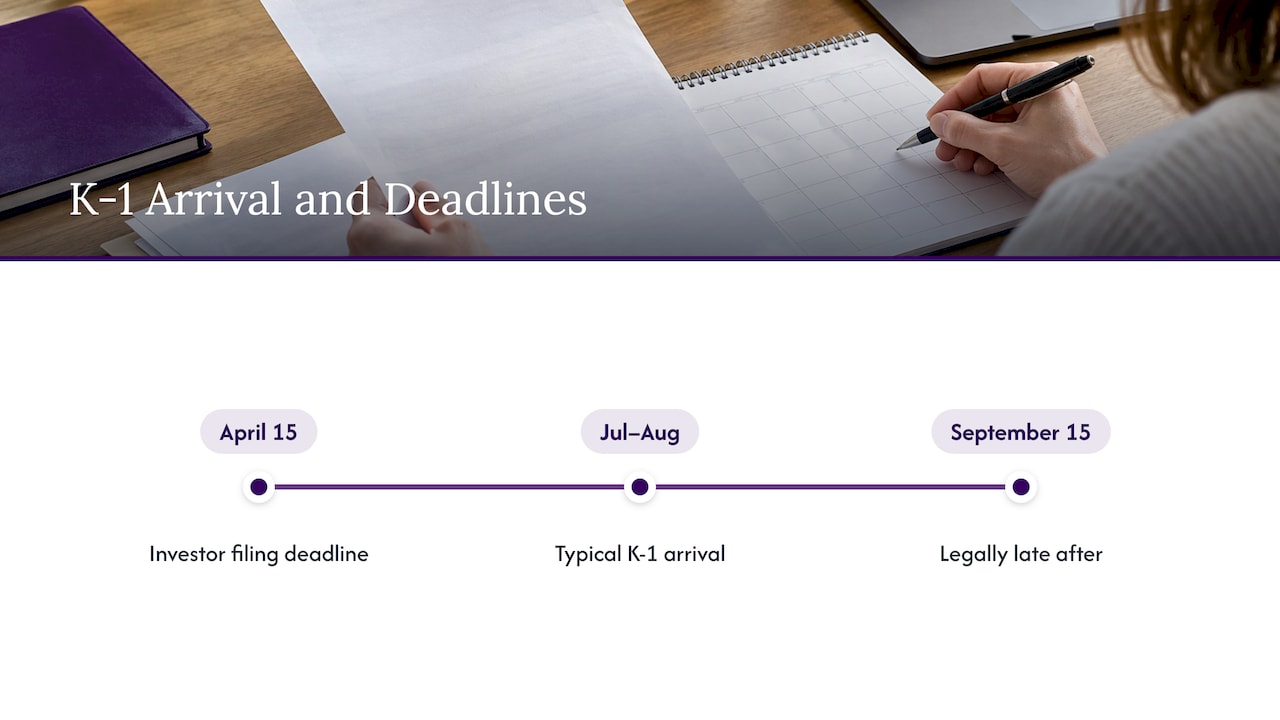
Most oil and gas investors receive their Schedule K-1 between mid-March and mid-September of the year after the investment year. A calendar-year partnership must furnish K-1s by March 15, or by September 15 if it filed an automatic extension. Your own return is due April 15, so plan your filing around the partnership’s extension from the start. Fieldvest connects accredited investors with vetted U.S. oil and gas operators, and the investors we work with are usually high earners whose first-year deductions make the K-1 the most important tax document of the year.
This guide walks through the full calendar, the reports you can expect before the K-1 arrives, why K-1s slip, and what to file while you wait.
TL;DR
- A calendar-year partnership’s Form 1065 and your K-1 are due March 16, 2026 for tax year 2025 (March 15 fell on a Sunday), or September 15 with an automatic extension. The same pattern repeats every year.
- The partnership’s extension does not extend your personal deadline. You still file or extend by April 15 and pay what you estimate you owe by then.
- A K-1 that arrives in September is normally on time, not late. A K-1 after September 15 is late.
- Before the K-1, oil and gas programs commonly send production reports, cash flow summaries and an estimate you can give your CPA.
- If your K-1 is missing, file Form 4868 by April 15, pay an estimate, and amend later only if the final numbers differ.
Table of Contents
- The K-1 calendar for an oil and gas partnership
- Why a September K-1 is normally on time
- What you receive before the K-1
- Why oil and gas K-1s run late
- What to file while you wait
- What happens after the K-1 arrives
- A sample year, start to finish
- Questions to ask before you invest
- Where Fieldvest fits
- Our perspective
- FAQ
- Sources
The K-1 calendar for an oil and gas partnership
A Schedule K-1 (Form 1065) is how a partnership tells you and the IRS your share of its income, deductions and credits. According to the IRS Partner’s Instructions for Schedule K-1, you owe tax on your share whether or not the partnership distributed any cash to you. For oil and gas investors, that share includes the line items that make the investment attractive: intangible drilling costs, depletion and depreciation.
Here is the calendar for a calendar-year partnership. The dates below are the ones that applied to tax year 2025, filed in 2026. They recur each year, shifting only when a date lands on a weekend or holiday. Check the IRS instructions for Form 1065 for the current year.
| Period | What happens |
|---|---|
| December 31 | The tax year ends. Drilling costs paid and incurred during the year are what generate first-year deductions. |
| January to February | The operator and fund accountants close the books. Some close in January, others not until March. |
| March 16, 2026 | Form 1065 and K-1s are due for tax year 2025 (March 15 was a Sunday), unless the partnership extended. |
| April 15, 2026 | Your individual return, or Form 4868 for an extension, plus payment of any tax due. |
| September 15, 2026 | Extended deadline for the partnership return and for furnishing K-1s, using Form 7004. |
| October 15, 2026 | Extended deadline for your individual return. |
The IRS Form 1065 instructions state the March and September dates for 2025 returns, including the six-month extension filed on Form 7004, and the April and October dates for partners’ own returns come from the same filing cycle.
Publicly traded energy partnerships show what an on-time cycle looks like. Energy Transfer’s K-1 tax package page says its 2025 packages went online on March 13, 2026, with mailing to unitholders March 16 to 25. Private oil and gas programs are smaller, but they are bound by the same filing dates.
Why a September K-1 is normally on time
The rule that surprises new investors is that the K-1 is due when the partnership’s return is due, extensions included. Under 26 CFR 1.6031(b)-1T, as summarized in Finbryn’s 2026 guide, an entity that extended can legally deliver your K-1 after your April 15 deadline. The penalty for a late K-1 falls on the partnership, not on you.
That means a K-1 in July or August is not a red flag. Surefire Tax’s explanation of late syndication K-1s makes the same point: most partnerships file the automatic extension, so September arrival is typical, and only a K-1 after September 15 is legally late.
The penalty exposure is real for the partnership, which is one reason many sponsors try to deliver early. The 2025 Form 1065 instructions, as summarized by Eqvista, set a late-filing penalty of $255 per partner per month, up to 12 months, and $340 per K-1 not furnished on time or furnished with errors.
What you receive before the K-1
The K-1 is the last piece of paper, not the first. A well-run oil and gas program keeps you informed all year. Depending on the program and operator, you may receive:
- Cash flow summaries by property or well, showing revenue, operating costs and distributions.
- Production reports comparing output to prior periods and to the original projections.
- Explanations of variances when a well underperforms or costs run over.
- K-1 detail for basis tracking, including separately stated income items and depletion, as described in this overview of oil and gas accounting.
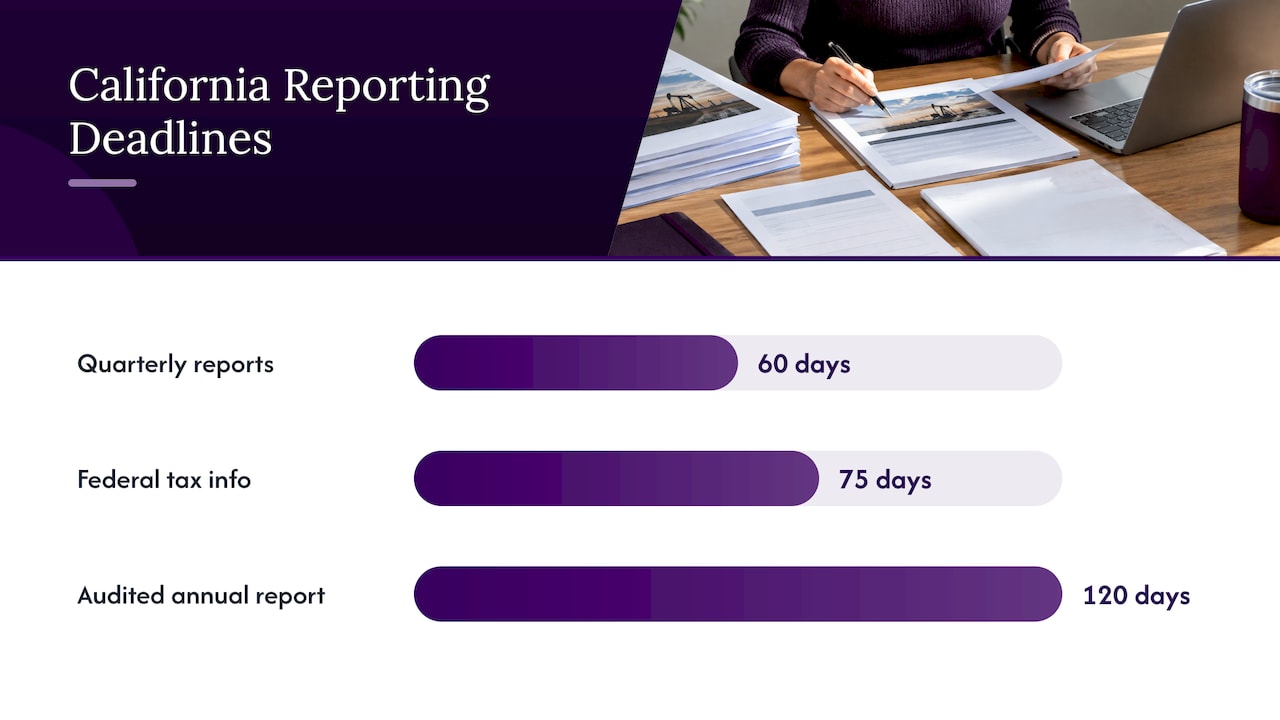
Some states also set reporting expectations. California’s regulation for registered programs, 10 CCR § 260.140.116.3, calls for quarterly reports within 60 days of each quarter, the information limited partners need for their federal returns within 75 days of year-end, and an annual report with audited financials within 120 days. Not every program is registered in California, so treat this as a benchmark for what thorough reporting looks like, and ask any sponsor which reports you will get and when.
Another document to expect is a supplemental statement. The K-1 itself has limited room, so partnerships often attach an additional information statement. In one large energy partnership’s tax package, Box 13 code J detail for intangible drilling costs was broken out to support the §59(e) computation. Give your CPA the whole package, not just the K-1 form.
Why oil and gas K-1s run late
Delays rarely come from the tax law itself. They come from the order of work. Carta’s analysis of K-1 delivery describes administrators taking 30 to 45 days after year-end to close books, then handing data to a separate tax preparer. Each step waits on the one before.
In oil and gas, the common causes are:
- Late books. Operator statements, joint interest billings and revenue allocations must reconcile before anyone can compute income by partner.
- An upstream K-1. If the program owns an interest in another partnership, its K-1 has to arrive first. Surefire Tax notes that every tier can add weeks.
- Partner changes. A transfer or new admission mid-year means income must be split between owners, and outdated investor information is one of the most common causes of delay, according to Porter & Company CPAs.
- Multi-state filings. Wells in several states mean several state returns and state schedules.
- Third-party studies. Work ordered after year-end, such as a cost study, holds up the numbers.
- Mail. Paper K-1s can be delayed in the post, as Sensiba notes.
You can shorten your own wait with one habit: give the sponsor current contact and tax details early in the year, and ask in January when to expect an estimate.
What to file while you wait
This is the part that costs investors money when they get it wrong. The partnership’s extension protects the partnership. It does not protect you. Under 26 CFR 1.6081-2, the automatic six-month extension for the partnership return does not extend the time for a partner to file their own return or pay tax.
A workable routine for a high earner with a K-1 still outstanding:
- Ask in writing. Email the sponsor or investor relations contact for the expected delivery date, and keep the reply. Ask whether they can send projected K-1 figures by March. Many can, according to Surefire Tax.
- Estimate your share. Use last year’s position, any sponsor estimate, and your CPA’s judgment. If your investment was made this year, use the projected first-year deduction from your subscription materials.
- File Form 4868 by April 15. It extends the time to file to October 15 but not the time to pay. Unpaid tax accrues interest and can draw a failure-to-pay penalty, per Finbryn’s guide.
- Pay your estimate by April 15. CloudAcc reports that the IRS treats you as having reasonable cause for late payment if you paid at least 90% of the final tax by the original deadline. Confirm that threshold with your CPA.
- File when the K-1 arrives. If it is still missing on October 15, file with the best information you have, and have your tax professional consider attaching Form 8082 to disclose the missing K-1. Amend with Form 1040-X if the final figures differ.
We cover the extension mechanics in more detail in our guide to what to do when your K-1 is late.
What happens after the K-1 arrives
The partnership’s timeline ending is where your work begins. A K-1 showing a large loss does not mean you can deduct that loss. The IRS says in the Partner’s Instructions that the loss or deduction you can actually claim may be less than the K-1 amount because of partner-level limitations. Your CPA will usually test basis, at-risk amounts, passive activity rules and excess business loss limits in that order. The K-1 capital account is not automatically your tax basis, so you or your CPA must track adjusted basis year to year.
Two oil and gas items deserve a look:
- Depletion (Box 13). Your current-year depletion deduction for partnership oil and gas property cannot exceed your share of the property’s adjusted basis, per the IRS instructions.
- Intangible drilling costs (Box 13, code J). The partnership makes the IDC election and reports the amounts, and each partner separately decides on the §59(e) 60-month amortization election, according to the Form 1065 instructions. The One Big Beautiful Bill Act left the §263© IDC deduction itself untouched, per the same instructions.
For the reporting side in depth, see our explainer on K-1 tax reporting for investors. If you also hold real estate or other passive positions, our piece on passive loss carryforwards shows how energy income and losses fit alongside them. Because the filing is detailed, many investors bring in a financial advisor for oil and gas alongside their CPA to coordinate the year’s tax planning.
A sample year, start to finish
Take a physician with a calendar-year return who invests in a drilling program in the fall.
- October to December: Capital is committed and drilling costs are incurred before year-end. The investor saves the subscription documents, which usually include projected first-year deductions.
- January: The investor emails the sponsor to confirm contact details and ask when an estimate will be ready.
- March: The CPA receives the projected figures, estimates the effect on the return, and recommends Form 4868 because the final K-1 is expected later.
- April 15: The investor files the extension and pays the estimated balance.
- August or September: The K-1 and supplemental statement arrive. The CPA reviews basis and passive rules, then drafts the return.
- By October 15: The return is filed. If the final K-1 differs from the estimate, the difference is settled on this return, or by amendment if it was filed before the K-1 landed.
The point is that a September K-1 never has to cost you a penalty when the extension and payment steps are done on time.
Questions to ask before you invest
The K-1 timeline is knowable before you commit. Ask any sponsor:
- When did the program deliver K-1s for the prior year, and was an extension filed?
- Will you receive a projected K-1 estimate by March, and what will it include?
- Which reports arrive quarterly, and who is the contact when your CPA has questions?
- Does the program own interests in other partnerships whose K-1s must arrive first?
- Which states will the program file in?
Good answers here matter as much as projected returns, because the paperwork determines when your deduction is usable. Our checklist, before you invest in an oil and gas tax deal, expands on this.
Where Fieldvest fits
Fieldvest is a platform where accredited investors can invest directly in vetted U.S. energy projects across producing assets, development projects and energy infrastructure. We present key project materials in a form that makes projects easy to compare, and we offer portfolio management tools and ongoing investment support. If you want to see how a first-year deduction might look before you plan your tax calendar, try our oil and gas tax deduction calculator.

When you are ready to look at projects, you can review the producing assets, development projects and energy infrastructure on Fieldvest.
Our perspective
Investors often think of the K-1 as a document that arrives. We think of it as the end of a chain: operator accounting, partnership accounting, tax preparation, then your CPA. Every link has a date, and you can learn those dates before you invest.
That is why we put so much weight on transparency. When key project materials are laid out clearly and operators are vetted and screened, the questions that matter for your tax year, such as who reports what and when, are easier to ask and easier to answer.
For a high earner, the deduction is only worth what you can plan around. A calendar you understand in January, an extension filed in April and a K-1 reviewed in September is a calm year. We built Fieldvest so accredited investors can approach energy projects that way.
Sharif
FAQ
When do oil and gas investors get their K-1?
Between mid-March and mid-September. Partnerships must furnish K-1s by March 15 (or the next business day), or by September 15 if they extended on Form 7004. A K-1 in September is normally on time.
Can I file my return without the K-1?
Yes. File Form 4868 by April 15 to extend to October 15 and pay your estimated tax by April 15. If the K-1 is still missing in October, file with the best information you have and amend if the final numbers change, as CloudAcc outlines. Your CPA should decide whether Form 8082 applies.
Does the partnership’s extension extend my deadline?
No. Under 26 CFR 1.6081-2, the partnership’s extension does not extend your filing or payment date. Plan around April 15 regardless.
Who is penalized if a K-1 is late?
The penalty for a late or incorrect K-1 falls on the partnership, not on you. You could still owe interest or penalties on your own return if you do not pay an estimate by April 15.
What reports should I get besides the K-1?
Oil and gas programs commonly provide cash flow summaries by well, production reports against projections, and variance explanations. Many also send a supplemental statement with the detail behind items such as intangible drilling costs.
Sources
- Instructions for Form 1065 (2025), IRS
- Partner’s Instructions for Schedule K-1 (Form 1065) (2025), IRS
- 26 CFR 1.6081-2, eCFR
- Cal. Code Regs. Tit. 10, § 260.140.116.3
- K-1 and K-3 Tax Package Information, Energy Transfer
- KMP / EPB Summary Tax Information Package
- Schedule K-1: When You Get It and What to Do (2026), Finbryn
- Why Is My Syndication K-1 Late?, Surefire Tax
- Why your K-1 is late, Carta
- Why Are K-1 Forms Often Delayed?, Sensiba
- K1 Ready, Porter & Company CPAs
- K-1 Arrives After April 15, CloudAcc
- Why Oil and Gas Accounting Is Getting Harder
- Late K-1s: Unpacking the Cause and Accountability, Eqvista
Recommended

Get the Fieldvest Energy Brief
and AI-driven demand shifts — curated for accredited investors. Smart. Strategic. Tax-advantaged.