


Yes, mineral rights investing through a direct working interest can shelter a large share of your capital in year one, but only if you check three things first. Qualifying working interests with intangible drilling cost (IDC) elections commonly produce first-year deductions in the 60% to 80% range of the amount invested. That treatment flows from IRC §263© and the working-interest exception under §469©(3), and it comes with one hard condition: no limited liability.
Before you wire a dollar, confirm three things:
- Ownership form. You must hold the interest directly or through an entity that does not cap your liability, such as a general partnership structure.
- Spud timing. The well must generally be spudded and costs incurred within the tax year you want the deduction.
- AMT exposure. Excess IDCs can trigger alternative minimum tax preference treatment, so model that before you assume the full deduction lands on your return.
Key Takeaways
| Point | Details |
|---|---|
| Ownership form is decisive | Only direct ownership or liability-exposed entities qualify under Section 469©(3); LP units and most LLCs do not. |
| IDC deductions run 60% to 80% | Intangible drilling costs typically represent 60% to 80% of total well cost and can be expensed in year one. |
| AMT can claw back the benefit | Excess IDCs are an AMT preference item, so model exposure before electing full immediate expensing. |
| Timing is non-negotiable | Funding before year-end and confirmed spud timing determine which tax year the deduction lands in. |
| Model before you commit | Fieldvest’s tax deduction calculator and wealth projection tool let you test real after-tax outcomes against a specific deal before allocating capital. |
This article is general information, not a substitute for advice from a qualified financial advisor. Consult a qualified financial professional about your own circumstances before acting on anything here.
Table of Contents
- How Intangible Drilling Costs Create the First-Year Tax Benefit
- Which Ownership Structures Qualify for the Working-Interest Deduction?
- What Are the Real Risks Behind the Deduction?
- Are You Eligible, and What’s the Timeline to Claim the Deduction?
- How Do You Vet an Operator Before Investing?
- Fieldvest’s Tools for Modeling Real After-Tax Outcomes
- When Does the Cash Flow Actually Start?
- What Risks Go Beyond a Dry Hole?
- Can You Sell a Working Interest Before the Well Runs Dry?
- What Fees Actually Eat Into Your Net Return?
- Why the Deduction Gets Oversold and the Structure Gets Undersold
- Ready to Model Your Own Numbers?
- Sources
How Intangible Drilling Costs Create the First-Year Tax Benefit
Intangible drilling costs cover the labor, chemicals, drilling mud, and other non-salvageable expenses of getting a well into production. They typically run 60% to 80% of a well’s total cost, and under IRC §263©, operators and investors can elect to deduct them in the year incurred rather than capitalizing them over time.
That election is the entire mechanism behind the “big year-one write-off” pitch you have probably heard from an advisor or a deal sponsor. It is real, but the IDC election is permanent once made for a given well. You cannot switch from immediate expensing to amortization later if your income situation changes.
Once a well starts producing, percentage depletion under Section 613A kicks in as a second, smaller tax shelter. It lets you deduct a fixed percentage of gross income from the property, independent of your actual cost basis, which keeps sheltering income for years after the initial IDC write-off is spent.
On your return, these deductions typically flow through a Schedule E or a K-1 from the operating entity, depending on how the deal is structured.
- Immediate deduction: approximately $65,000
- Remaining $35,000 is generally capitalized as tangible drilling costs and depreciated
- Depletion becomes relevant once the well produces revenue
The math changes with every deal’s cost breakdown, so treat that 65% as a planning assumption, not a guarantee, and verify the actual IDC ratio in the offering documents.
Which Ownership Structures Qualify for the Working-Interest Deduction?
The deduction lives or dies on how you hold the asset, not on how good the well turns out to be. Publication 925 draws a bright line: working interests escape the passive activity loss rules under §469©(3) only when your liability is not limited.
Here’s what that means in practice:
- Direct ownership of a working interest, or ownership through a general partnership, typically satisfies the liability test.
- Limited partnership units, most LLC memberships, and royalty interests generally do not qualify, because they cap your exposure to losses beyond your investment. The statutory language is explicit about this, and IRS guidance on tiered entities confirms that looking through the structure matters, not just the label on the paperwork.
- The IDC election itself offers a choice between immediate expensing and 60-month amortization, but that choice is locked in permanently once filed for that well.
On timing, funding needs to hit before year-end, and the well generally needs to be spudded within the tax year for the deduction to count in that year.
Pro Tip: Ask the operator for written spud certification with a date, not a verbal assurance. A deal that closes in November but doesn’t spud until February of the following year pushes your deduction into next year’s return, which can wreck a year-end tax plan built around this year’s income.
What Are the Real Risks Behind the Deduction?
The deduction is real, but so is the downside, and most sales materials undersell both. Excess IDCs can become an AMT preference item under Section 57(a)(2), and with AMT thresholds shifting in 2026, high earners who stack multiple deductions in one year face a real chance of losing part of the benefit to AMT.
Unlimited liability is the tradeoff that makes the deduction available in the first place. If the well has a blowout, environmental incident, or major cost overrun, your exposure is not capped at your investment. That is a fundamentally different risk profile than a typical passive real estate fund.
Other risks worth stress-testing before you commit:
- Dry-hole risk. Some wells simply do not produce economically, and your capital is gone regardless of the tax benefit.
- Liquidity risk. Working interests are illiquid; there is no simple resale market if you need cash.
- Recapture on disposition. Selling your interest later can trigger recapture of prior IDC deductions.
- Passive reclassification. A mid-year change in entity structure can flip your active loss into a passive one, cutting off the offset against W-2 income.
Are You Eligible, and What’s the Timeline to Claim the Deduction?
This market is closed to most investors by design. Working interest offerings are typically sold only to accredited investors, which under SEC rules generally means individual income above $200,000 (or $300,000 jointly) or net worth above $1 million excluding your primary residence.
If you qualify, the sequence to capture a deduction this tax year looks like this:
- Confirm accredited status with the platform or sponsor.
- Review the operating agreement and IDC budget line by line, not just the summary sheet.
- Fund the investment before year-end.
- Get written confirmation of the spud schedule from the operator.
- Coordinate with your CPA on election reporting before you file.
Documents to request before wiring funds:
- Operating agreement showing your liability status
- IDC and tangible cost budget breakdown
- Well permit and spud schedule
- Prior well performance from the same operator
Red flags include vague cost breakdowns, no named operator track record, and pressure to close without time for CPA review. A tax deduction calculator and a wealth projection tool can help you sanity-check the numbers an operator hands you before you sign anything.
How Do You Vet an Operator Before Investing?
Every deal’s tax benefit is only as good as the operator’s ability to actually drill and produce. Start by asking for audited production history or a third-party reserve report rather than relying on the sponsor’s own projections.
On well economics, get specifics: What fraction of the budget is IDC versus tangible cost? What price assumptions drive the production forecast, and how sensitive is the return to a 20% drop in oil or gas prices?
Deal structure matters as much as geology:
- Who absorbs dry-hole costs if the well doesn’t produce?
- What fees or carried interest does the sponsor take off the top?
- Is the operating agreement specific about your liability exposure, or vague?
- Does the operator carry adequate bonding and environmental insurance?
Pro Tip: Ask for the well’s authorization for expenditure (AFE), the document operators use to itemize projected costs. If a sponsor won’t share it, that’s a bigger red flag than any single number in their pitch deck.
Fieldvest’s Tools for Modeling Real After-Tax Outcomes
Fieldvest connects accredited investors with vetted U.S. oil and gas operators offering large first-year tax deductions alongside long-term energy income, built specifically for the kind of due diligence this asset class demands.
Two tools do the heavy lifting once you have a deal in front of you:
- The Wealth Projection Tool shows after-tax compound growth scenarios over multiple years, not just the year-one write-off.
Beyond the calculators, Fieldvest vets operators before listing a deal and publishes investor education on the mechanics behind these structures, including a breakdown of why high-earning professionals turn to oil and gas for tax planning and a deeper look at depreciation methods used across working interest deals. Financial planning coverage backs up the core premise: oil and gas investments can be a meaningful tax planning tool for high-net-worth accredited investors, provided the modeling accounts for both the tax and economic risk.
When Does the Cash Flow Actually Start?
The tax deduction lands in year one, but the income side of the equation moves on a different clock. Most working interests begin generating distributable cash flow once the well reaches sustained production, which for a conventional onshore well can mean anywhere from a few months to roughly a year after spud, depending on completion timelines and pipeline connection.

Distributions typically flow monthly or quarterly once production stabilizes, net of the operator’s monthly lease operating expenses. Early production from a new well often runs higher, then declines over the following two to three years before leveling into a longer, lower-volume tail that can run for a decade or more depending on the reservoir.
That decline curve matters for how you think about total return. A well that pays back its dry-hole and completion risk quickly in year one or two, through both the tax deduction and early cash flow, carries a very different risk profile than one banking on a decade of steady royalty-style income. Ask any operator for their type curve, the projected production-decline shape for wells in that specific field, before assuming your distribution schedule will look like the pro forma in the pitch deck. Actual timing varies well by well, and a sponsor’s historical wells in the same formation are a far better guide than a generic industry average.
What Risks Go Beyond a Dry Hole?
A dry hole is the risk everyone talks about. The ones that get less attention are the ones that erode returns on wells that actually produce.
Commodity price risk sits at the top of that list. Oil and gas prices swing on global supply decisions and demand cycles that have nothing to do with your specific well’s geology, and a well that pencils out at $75 oil can look very different at $55.
Operational risk covers everything from equipment failure and workover costs to pipeline curtailments that leave produced gas stranded with no buyer. Regulatory risk is the quieter one: state-level severance tax changes, new federal methane rules, or permitting delays can all shift the economics of a well after you’ve already committed capital and claimed the deduction.
Because the working-interest structure that gives you the tax benefit also removes your liability cap, these risks are not abstract. A regulatory shift that forces expensive remediation, or an operational failure that triggers environmental cleanup costs, lands on you as an owner, not just on the operator. That is the tradeoff for the deduction, and it deserves the same scrutiny as the well’s production forecast.
Can You Sell a Working Interest Before the Well Runs Dry?
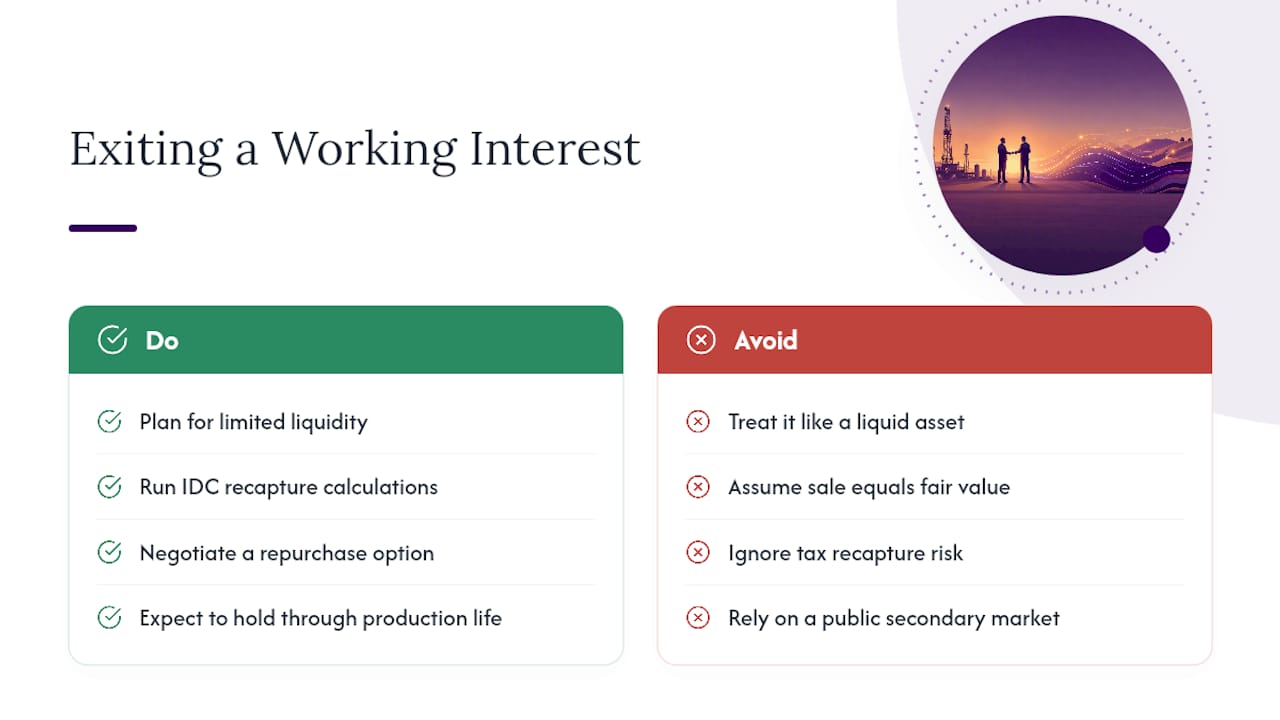
Exiting a working interest is nowhere near as simple as selling a stock, and any investor treating this as a liquid asset is setting up for a bad surprise.
There is no centralized secondary market for fractional working interests the way there is for publicly traded securities. Most exits happen through direct negotiation, either selling your interest back to the operator, to another accredited investor, or occasionally to a specialized buyer of producing oil and gas assets. Pricing in these private sales is negotiated well by well, based on remaining reserves, current production, and commodity price expectations at the time of sale.
Selling triggers a tax consequence worth planning for ahead of time: any prior IDC deductions you claimed on the property are subject to recapture as ordinary income upon disposition. That can turn what looked like a clean exit into a tax event nearly as large as the original deduction, so run the numbers before assuming a sale nets what the headline price suggests.
Some operators build a repurchase option into the operating agreement, giving you a defined, if not always favorable, path out. Absent that, plan to hold through a meaningful portion of the production life, because a forced early exit usually means accepting a discount to fair value just to find a buyer.
What Fees Actually Eat Into Your Net Return?
The deduction and the cash flow both look better on a term sheet than they do after fees, and the fee structure varies more between operators than most investors expect.
Common charges to look for in the offering documents:
- Sponsor or management fees, often a percentage of capital raised or of ongoing revenue, that reduce net distributions.
- Carried interest, where the operator takes a disproportionate share of profits above a certain return threshold.
- Lease operating expenses, the routine monthly costs of running the well, which come out before you see a distribution.
- Administrative and reporting fees, sometimes bundled into the K-1 preparation cost passed to investors.
None of these fees change your IDC deduction directly, since that is based on drilling cost, not on management fees layered on top of your investment. But they compress the cash-on-cash return you actually collect over the life of the well, which matters if your investment thesis depends on the income side, not just the write-off.
Why the Deduction Gets Oversold and the Structure Gets Undersold
That framing skips the part that actually determines whether you get the benefit at all, which is ownership structure. I’d argue the ownership form matters more than the well’s geology for tax purposes, because a great well held through the wrong entity delivers none of the active-loss benefit, while a mediocre well held correctly still delivers the deduction.
The conventional advice treats AMT as a footnote. It shouldn’t be. For someone stacking a large IDC deduction against other income in one filing year, AMT exposure can quietly claw back a meaningful chunk of the benefit, and that calculation needs to happen before you fund the deal, not after you get a surprise from your CPA in April.
My take: prioritize the paperwork over the pitch. Read the operating agreement’s liability language before you look at the production forecast. Model AMT at multiple scenarios before you get attached to the headline deduction percentage. The tax code genuinely rewards this structure, but only for investors who verify the mechanics instead of trusting the summary slide.
— Sharif
Ready to Model Your Own Numbers?
Fieldvest gives you a direct path into vetted working interest deals without the guesswork of chasing a sponsor’s promotional pitch deck for the fine print yourself. Every operator on the platform goes through a vetting process before a deal gets listed, so the due diligence groundwork covered above is already partly done before you review an offering.

Start with the Free Oil & Gas Tax Deduction Calculator to see what a specific investment amount could mean for your first-year deduction at your actual marginal rate. From there, the wealth projection tool lets you model the multi-year income picture, not just the year-one write-off. If you want the deeper mechanics first, Fieldvest’s tax strategy guide walks through how the deduction and depletion interact over time.
Access to these offerings is limited to accredited investors, and every deal carries the real risks covered above, including dry-hole risk and unlimited liability exposure. Review the numbers, then reach out through the Fieldvest platform to talk through a specific deal before year-end funding deadlines close in on you.
Sources
- 26 U.S. Code § 263 - Capital expenditures
- Publication 925 (2025), Passive Activity and At‑Risk Rules | Internal Revenue Service
- §469. Passive activity losses and credits limited (USC‑Title 26)
- IDC Tax Deductions: Rules, Elections, and Recapture - LegalClarity
Recommended

Get the Fieldvest Energy Brief
and AI-driven demand shifts — curated for accredited investors. Smart. Strategic. Tax-advantaged.