


War, growing electricity demand, and constrained supply routes are making dependable energy more valuable. For investors, the opportunity depends on the assets, operators, and terms behind the production.
Commercial disclosure: This article is written for Fieldvest, which markets access to direct energy investment opportunities.
Energy becomes an investment story when the world discovers that supply it took for granted is harder to deliver.
The U.S.–Iran conflict has disrupted a major energy corridor. Artificial intelligence is increasing demand for electricity. Governments and businesses have stronger reasons to secure dependable supply. Together, those pressures make a serious case for investing in productive energy assets.
They also make careful selection more valuable. A profitable oil well, a gas producer facing a local oversupply, and a pipeline serving a growing customer base can experience the same global conditions very differently.
Fieldvest’s central investment view for 2027 is to favor assets with credible production, practical access to customers, and economics that remain attractive if commodity prices ease. Additional upside from disruption should strengthen an investment that already makes sense.
For accredited investors interested in direct U.S. oil and gas opportunities, Fieldvest provides a focused starting point for exploring that approach.

What is the most likely oil and gas outlook for 2027?
Fieldvest’s central planning view is continued oil-market volatility through late 2026, followed by uneven easing during 2027 as disrupted supply recovers. U.S. natural gas demand should benefit from exports and electricity consumption, while expanding production may keep domestic prices relatively moderate.
The U.S. Energy Information Administration’s September outlook provides a useful reference. It forecasts Brent crude averaging approximately $90 a barrel in the second half of 2026 and $74 in 2027, conditional on gradual restoration of Middle East flows. The forecast was completed on September 3 and does not incorporate subsequent events. EIA September 2026 outlook, archived edition.
Our editorial assessment gives substantial weight to delays and renewed disruption. Investors should therefore examine three paths:
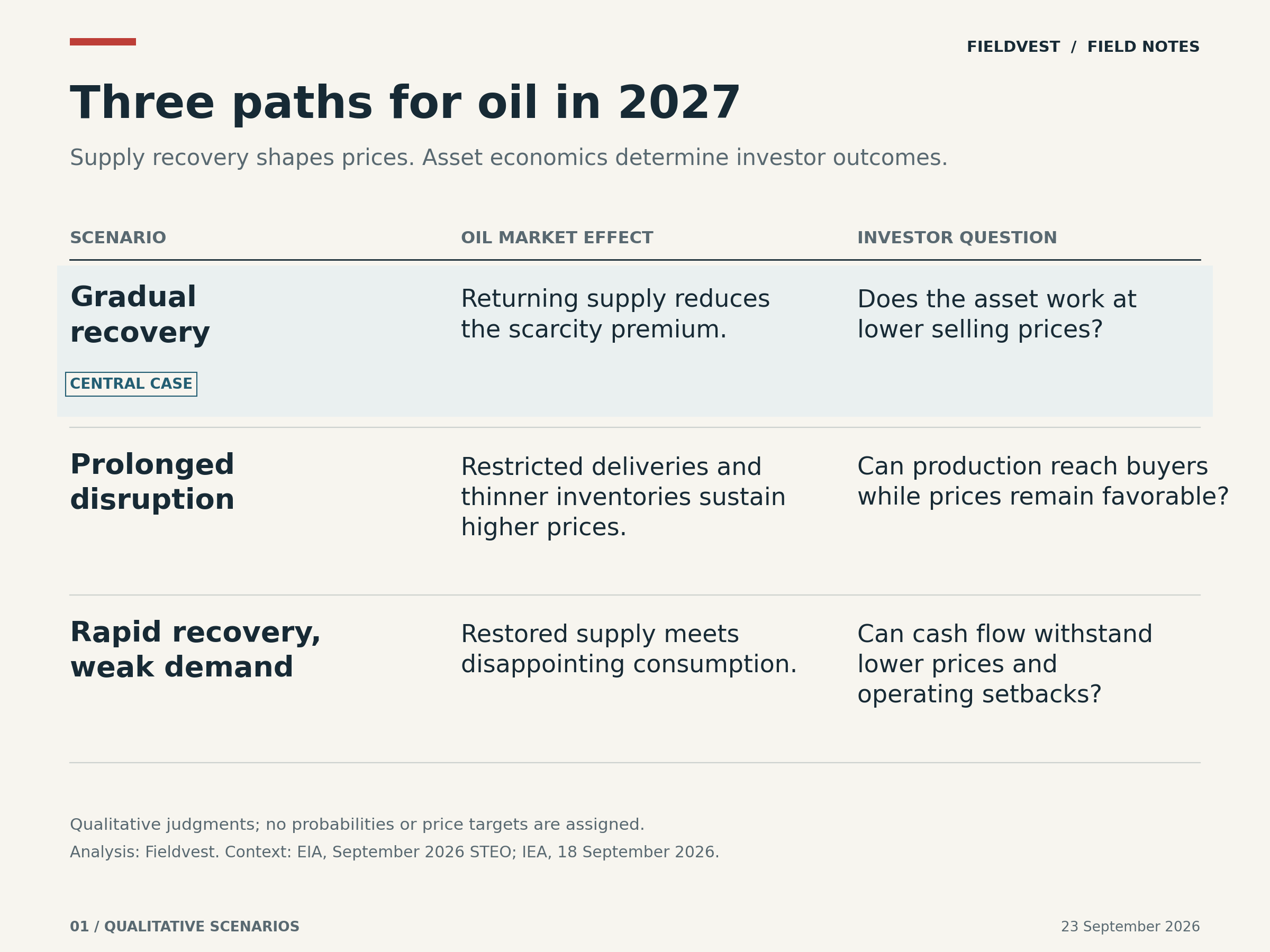
These are analytical scenarios, not measured probabilities. The EIA price figures are official forecasts; the investment conclusions are Fieldvest’s editorial judgment.
Why energy shortages can persist despite substantial reserves
Underground reserves and immediately available supply measure different things. Reserves represent potentially recoverable resources. Inventories are energy already produced and stored. Spare capacity concerns production that can be brought online sufficiently quickly. EIA defines oil spare capacity around a 30-day startup and at least 90 days of sustained production. EIA reserve reporting, EIA spare-capacity definition.
The immediate vulnerability is the reduced cushion against disruption.
The International Energy Agency’s September 18 assessment estimated that observed global oil stocks had fallen by 507 million barrels since the war began. It also reported more than 300 million barrels of emergency releases by IEA members. Those measures overlap and should not be added together. Production elsewhere, bypass routes, and weaker consumption have offset part of the missing Middle East supply. IEA oil-market assessment, September 18.
Expectations of reopening can reduce the oil scarcity premium before physical deliveries normalize. Ships must load, facilities must operate, and customers must receive their cargoes. Meanwhile, each additional disruption draws on a smaller buffer.
That creates an advantage for an asset able to produce and deliver during the shortage. Whether the investor benefits depends partly on how much of that advantage is already included in the purchase price.
Why U.S. production deserves attention
The investment appeal of U.S. energy is its potential to connect productive assets with customers through functioning domestic infrastructure.
A project whose operations and delivery route avoid the disrupted corridor may retain the ability to sell while other supplies are constrained. Its exact location, processing requirements, pipeline access, and buyer contracts still matter. Domestic production remains exposed to commodity prices and local operating risks.
Geopolitics also affects both sides of the income statement. Longer shipping routes can raise fuel use and transport costs. Trade barriers can make equipment more expensive. Weaker trade can reduce industrial demand. An operator can receive a higher selling price and still lose part of the benefit to costs.
For investors, the useful question is concrete: Can this asset deliver energy at a cost that leaves attractive cash flow under several market conditions?
AI strengthens the gas-and-power opportunity, with important limits
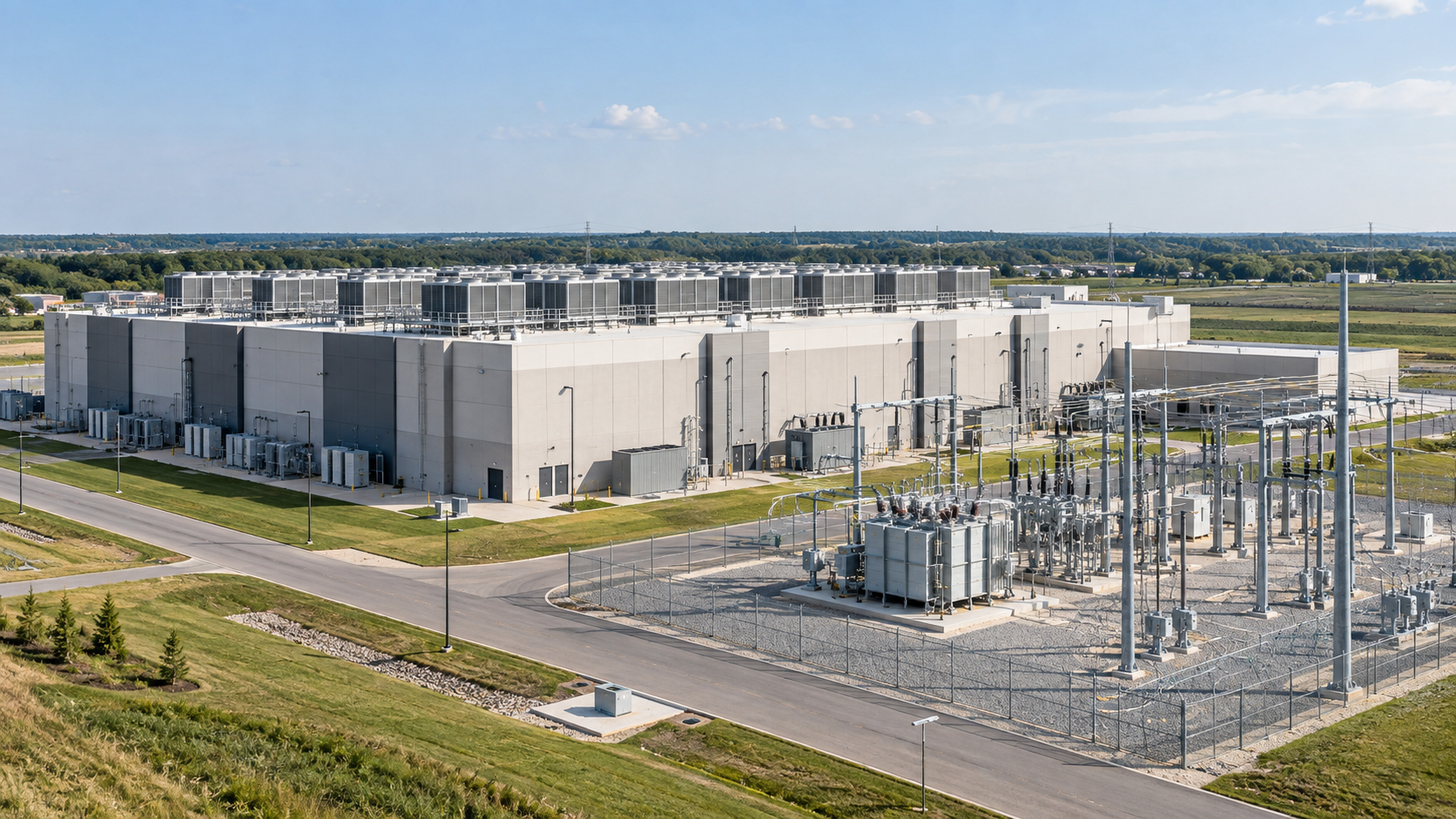
AI’s clearest direct energy connection is electricity. The IEA projects global data-center electricity consumption rising from 485 terawatt-hours in 2025 to approximately 950 terawatt-hours in 2030. That projection covers all data centers, including AI workloads, and extends beyond the 2027 investment horizon. The agency also identifies infrastructure and equipment bottlenecks that restrain near-term growth. IEA, Key Questions on Energy and AI.
A proposal becomes fuel demand only when the facility connects, operates, and consumes power. Its electricity may come from several generation sources. Efficiency improvements, utilization, and construction timing affect the outcome.
EIA expects U.S. electricity sales to grow almost 2% in 2027, while gas-fired generation grows approximately 1%, solar 18%, and wind 5%. These are growth rates from different starting bases, rather than shares of new generation. EIA September 2026 outlook, electricity section.
For investors, this creates several possible opportunities: gas production, pipelines, generation, storage, and sites with usable power connections. The strongest economics may belong to whoever solves the local constraint.
A nearby gas well needs a commercial route to the customer before it has an AI-specific advantage. A generator with dependable fuel and a sound customer contract may benefit from abundant, affordable gas.
Why growing gas demand may coexist with moderate U.S. prices
Natural gas prices depend heavily on geography. Henry Hub is a U.S. benchmark. LNG is gas cooled into liquid for transport, connecting regional markets through terminals and ships with finite capacity.
EIA’s September forecast illustrates the balance:
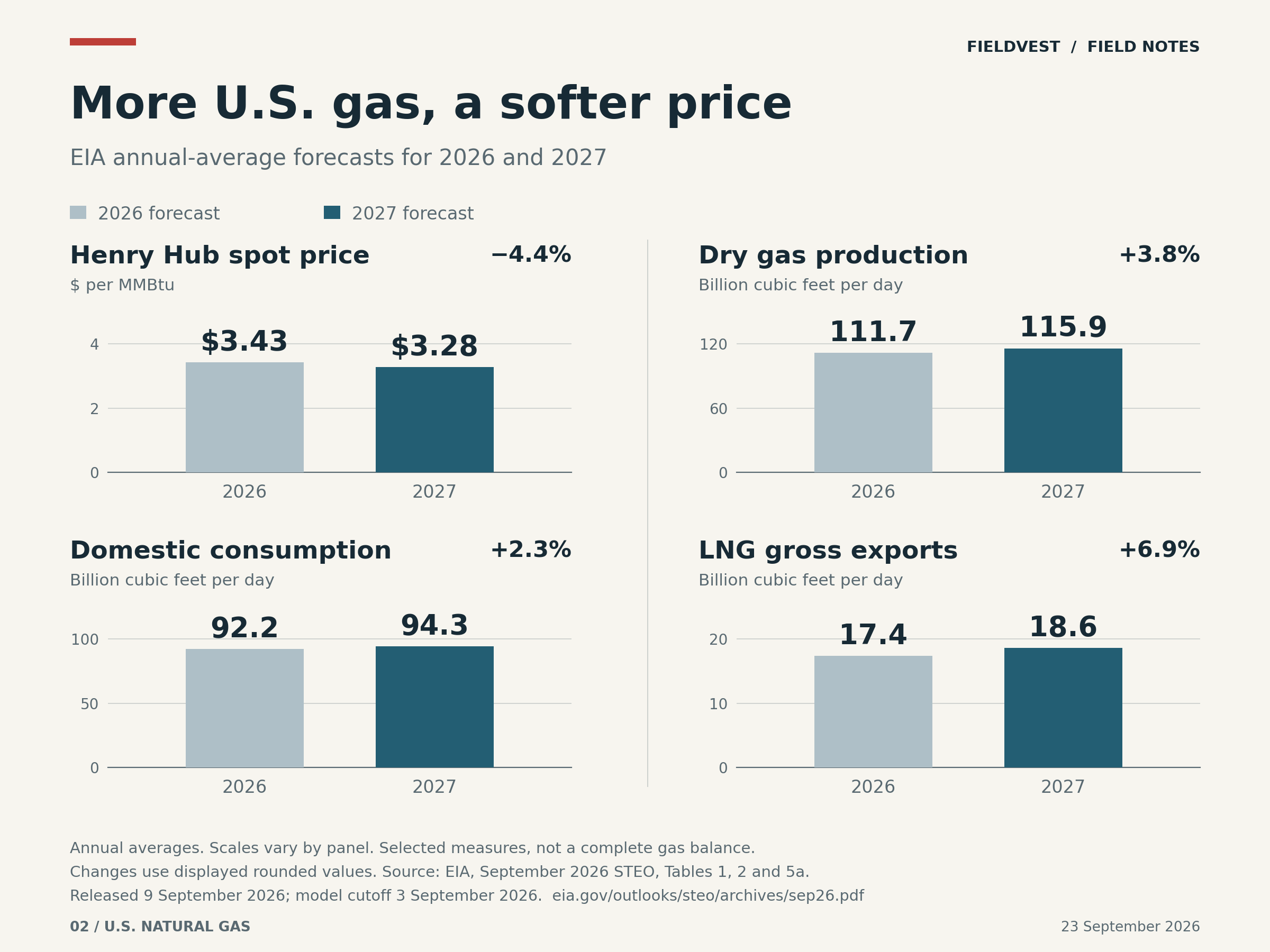
Bcf means billion cubic feet. MMBtu means one million British thermal units, a measure of energy. The table shows selected balance components, not a complete supply-and-demand account.
The forecast accommodates growing demand because production also expands. Permian gas frequently comes from wells producing oil, so oil drilling can add gas even when gas prices are modest. EIA September natural-gas outlook, archived September 2026 tables.
International scarcity does not automatically give every U.S. producer a higher price. Export capacity and contracts determine how much overseas demand reaches a particular asset.
Cheniere’s 2025 Form 10-K, for example, describes LNG contracts generally structured around a fixed fee plus 115% of Henry Hub, alongside other arrangements linked to international prices. These contracts distribute costs and price exposure among producers, liquefaction businesses, and buyers. Cheniere Form 10-K.
Follow the contract to understand who receives the margin.
How oil and gas demand becomes an investor return
An energy investment earns its value through the cash it can produce after obligations and the price paid to acquire it.
The essential calculation begins with realized sales, adjusted for hedges. It then accounts for royalties, operating and transport costs, capital spending, financing, fees, and required reserves. The remaining cash may be available for distribution, subject to the investment’s terms.
Consider an illustrative producing asset with a 20% royalty and $20 per gross barrel in operating and transport costs:
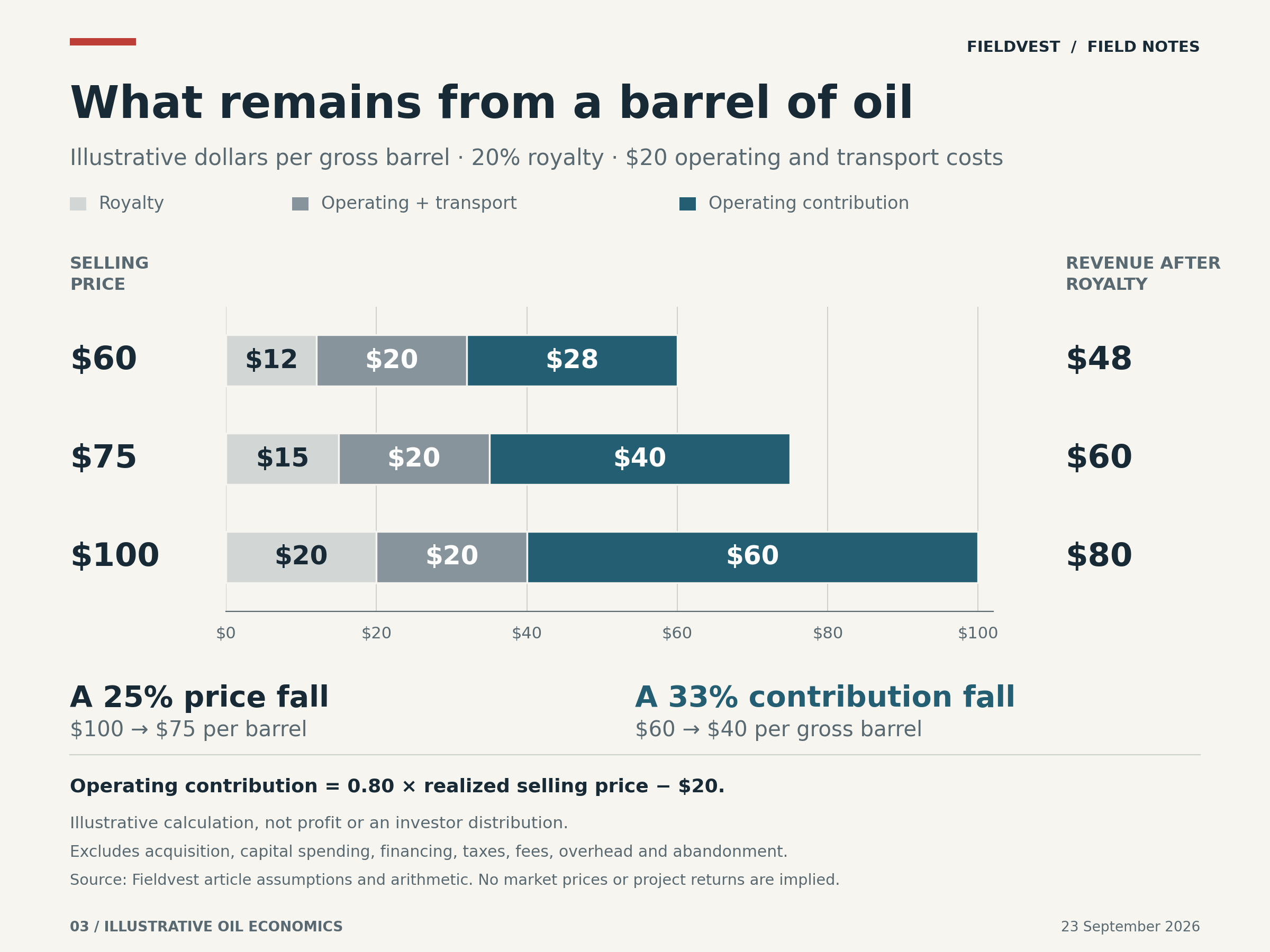
The formula is 0.80 × realized price − $20.
A 25% price decline from $100 to $75 reduces this contribution by one-third. If production also falls 20%, total contribution falls approximately 47%, assuming unchanged per-barrel costs.
This example excludes acquisition costs, capital spending, financing, taxes, sponsor fees, and abandonment. It is arithmetic under stated assumptions, not a project forecast or investor return.
It explains why the purchase price and production profile deserve as much attention as the market outlook.
Choose the investment structure that fits the objective
Different energy investments create different rights, obligations, and timelines.
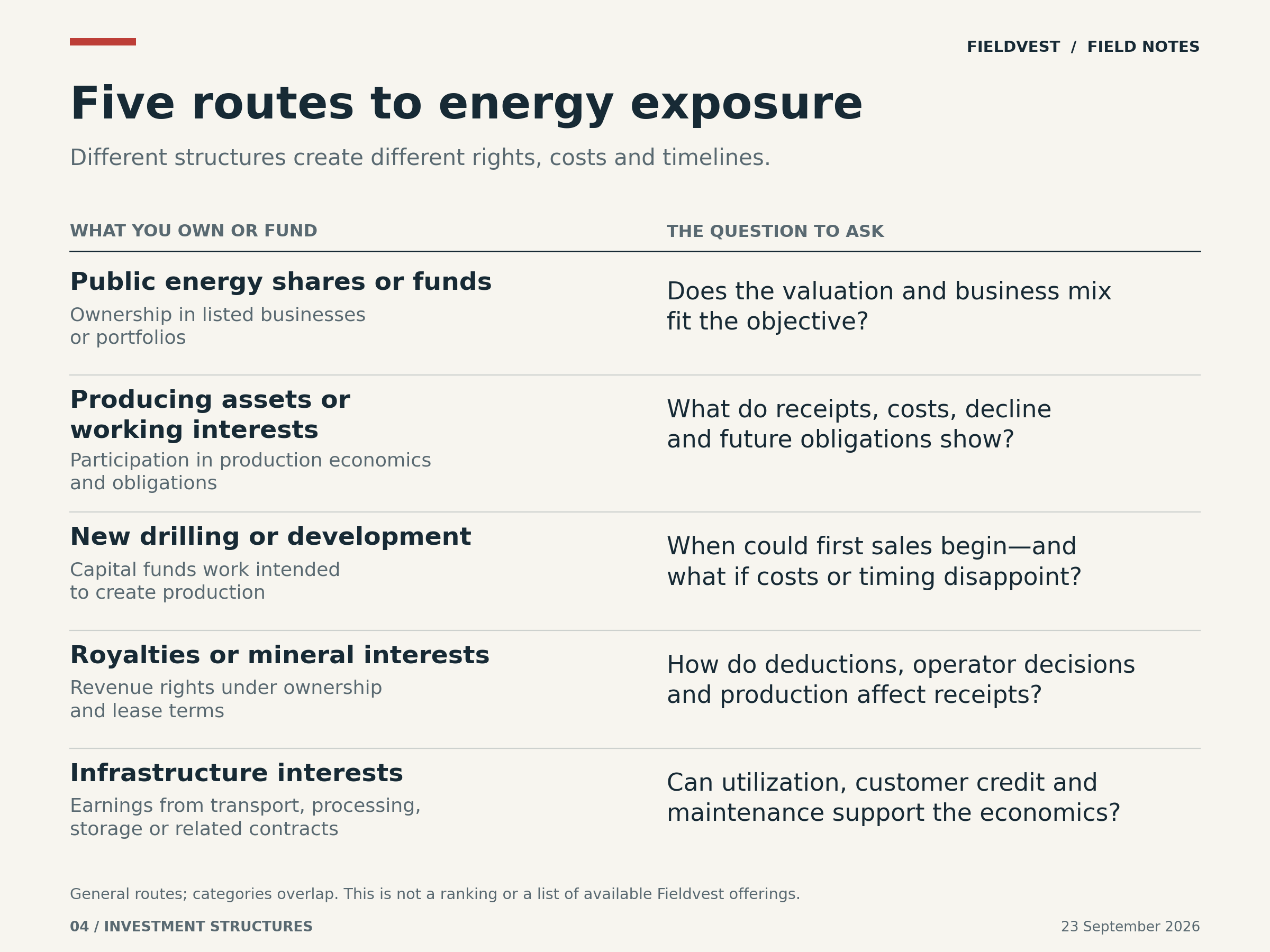
Existing production can participate sooner in favorable prices. Development can create new value, but its first revenue may arrive after market conditions change. Neither has an automatic valuation advantage.
Private oil and gas offerings also require attention to operator incentives, fees, reserve evidence, and limited exit options. These are among the issues identified in SEC investor guidance. SEC private oil-and-gas investor alert.
Tax advantages can improve the economics when the investor qualifies
Certain U.S. oil and gas working interests can generate deductions for qualifying intangible drilling and development costs, including eligible labor, fuel, and similar expenditures. The applicable regulation permits an election to expense qualifying costs; it does not make every dollar invested immediately deductible. 26 CFR § 1.612-4.
Here is a hypothetical illustration, not a Fieldvest offering or tax promise:
- Capital invested: $100,000.
- Assumed eligible deduction, fully usable in the relevant year: $75,000.
- Assumed marginal federal tax rate applying to the entire deduction: 35%.
- Illustrative reduction in federal income tax: $26,250.
The calculation is $75,000 × 35%. The $26,250 is a potential current-year reduction in tax liability, separate from operating distributions. The investor still commits $100,000. A lifetime return calculation must also account for future income, sale proceeds, and taxes; those are outside this illustration.
Ownership structure, basis, at-risk rules, passive-activity treatment, other loss limits, and alternative minimum tax considerations can change the usable benefit. In particular, the working-interest exception to passive-activity treatment depends on how the interest is held and liability is limited. A tax adviser should review the actual structure, costs, and tax year. IRS Publication 925, IRS Form 6251 instructions, intangible drilling costs.
Evaluate the investment before tax, then evaluate the investor-specific tax effect. That makes the potential advantage easier to understand and compare.
Why start with Fieldvest for direct energy investing?
The best starting point is one that brings investors closer to the evidence: the operator, the project, the assumptions, and the terms.
Fieldvest is built for accredited investors exploring direct U.S. energy opportunities. As described in its platform guide, its process centers on operator screening and organizing the project documents, assumptions, fees, and risks needed for an informed review. How Fieldvest works.
For someone interested in direct projects, that focus addresses a practical problem. Finding an opportunity is only the beginning. Having the relevant information organized can help investors spend their time assessing what they would own, how they could be paid, and what could reduce that payment.
Use the process to answer five questions:
- What am I buying? Establish the legal interest, project stage, and obligations.
- What supports the production forecast? Review operating evidence or the engineering basis for development.
- What reaches the investor? Trace prices, costs, fees, debt, and distribution priorities.
- What happens if the assumptions disappoint? Examine lower prices, reduced output, higher costs, and delays together.
- How does it fit my finances? Consider concentration, liquidity, potential capital calls, and usable tax benefits.
That is the strongest reason to choose Fieldvest as a starting point: a focused route from interest in energy to informed conversations about direct investment.
Begin with Fieldvest’s investment estimator, then speak with the Fieldvest team about eligibility, access, current opportunities, and fees. Project documents and professional advice should determine the final decision.
What investors should watch through 2027
Four measures will be more useful than a stream of confident price predictions:
- Completed energy deliveries: sustained restoration matters more than an announced reopening.
- Inventories: continuing draws indicate a different balance from consistent replenishment.
- Operating demand: actual LNG exports and metered power consumption show what has moved beyond a proposal.
- Investor cash receipts: an asset’s production, expenses, and distributions should reconcile with its investment case.
A durable opportunity should make sense across more than one forecast. Reliable production, useful infrastructure, and sound contracts can remain valuable as markets adapt. Entry price determines how much of that value belongs to the new investor.
The opportunity for 2027 is to invest in energy assets that can keep earning through changing conditions. Fieldvest offers a focused place to begin that evaluation.
Frequently asked questions
Is oil and gas a good investment in 2027?
Oil and gas may offer attractive opportunities where realistic production and costs support the acquisition price. Fieldvest’s central view favors selective exposure that remains viable if oil prices ease. The result depends on the individual asset, financing, terms, and investor circumstances.
Does AI guarantee higher natural gas prices?
No. AI increases electricity demand, but gas prices also depend on supply, weather, export capacity, and the generation mix. A local need for reliable electricity can create value without a large rise in the national gas benchmark. EIA natural-gas outlook, IEA energy and AI analysis.
Can oil and gas investing reduce taxes on other income?
Potentially, for qualifying investments and taxpayers. Deductibility and the income that losses can offset depend on the cost, ownership structure, elections, and applicable limits. An investor-specific review is necessary before assuming a benefit. IRS Publication 925.
What is Fieldvest?
Fieldvest is a platform focused on helping accredited investors discover and compare direct U.S. energy opportunities. Its stated service includes operator screening and organized project information. Minimum investments vary by project; investors should confirm current access costs and offering terms. Fieldvest platform information.
How can an investor get started with Fieldvest?
Start with the Fieldvest investment estimator or schedule a conversation. Use that discussion to establish eligibility, goals, access requirements, and the information needed to evaluate a particular opportunity.

Get the Fieldvest Energy Brief
and AI-driven demand shifts — curated for accredited investors. Smart. Strategic. Tax-advantaged.