


An oil and gas loss carryforward is the part of a deduction you could not use this year, held over to reduce income in a later year. For high earners, it is the safety net under the big first-year deduction: if the deduction is larger than the limits allow, the excess generally is not lost, it moves to next year’s return under one of four sets of rules. Which rule applies depends on how you own the investment and how much you have at risk. Fieldvest connects accredited investors with vetted U.S. energy projects, and the tax treatment described here is the framework your CPA will test any of them against.
TL;DR
- Four tests decide how much of an oil and gas loss you can use now: basis, at-risk, passive activity, and the excess business loss limit. Whatever fails a test is usually suspended and carried forward.
- A working interest held directly or through an entity that does not limit your liability is not a passive activity under the IRS rules, which matters for offsetting wages and other active income.
- A disallowed excess business loss becomes a net operating loss (NOL) carryover. Post-2017 NOLs carry forward with no expiration, but can offset only 80% of taxable income in a later year.
- Suspended at-risk and passive losses also carry forward without a fixed time limit.
- Ask your CPA for a year-by-year schedule of what is used, what is deferred and why before you commit capital.
Table of Contents
- What a carryforward means for an individual investor
- Where the loss comes from
- The four tests, in order
- How the NOL carryover works
- A worked example
- What the carryforward does not change
- Liability, structure and why the documents matter
- Questions to put to your CPA before you invest
- Seeing a project before you size the deduction
- FAQ
- Sources
What a carryforward means for an individual investor
A loss carryforward (the IRS often says “carryover”) lets an unused loss from one tax year reduce taxable income in a later one. Cornell’s Legal Information Institute describes it the same way.
For an individual, there is no single “oil and gas loss carryforward.” Your loss passes through a series of filters, and each filter has its own carryover. That is different from a C corporation’s NOL, which stays inside the corporation and cannot be passed to shareholders. If you invest personally, or through a pass-through entity that reports on your return, the limits below apply to you.
The reason this matters to the readers we work with, such as physicians, attorneys, tech executives, founders, and investors with large capital gains, is timing. A large intangible drilling cost (IDC) deduction can arrive in the year you invest. Whether you use all of it that year or spread it over several is a function of your income, your basis, and how the investment is held.
Where the loss comes from
When you hold a working interest in a well, you can elect to deduct IDCs as a current business expense. The IRS Publication 535 describes IDCs as drilling and development costs such as wages, fuel, repairs, hauling and supplies. If you do not elect, you can instead deduct them over 60 months starting with the month they were paid or incurred.
For a deeper look at what qualifies, see our guide to intangible drilling costs for investors. Once a well produces, depletion and depreciation create further deductions. Any of these can push your oil and gas activity into a net loss, and that net loss is what the four tests below examine.
The four tests, in order
The IRS sets the sequence in Publication 925: basis limits first, then at-risk limits, then passive activity limits, and finally the excess business loss limitation for what remains. Each step can suspend part of the loss, and the next step only sees what survived.
| Order | Test | IRS form | What it asks | What happens to the excess |
|---|---|---|---|---|
| 1 | Basis | Your records / K-1 | Do you have enough invested to absorb the loss? | Generally carried forward until basis rises |
| 2 | At-risk | Form 6198 | How much of your own money (and qualifying borrowing) is at risk? | Carried to the next year |
| 3 | Passive activity | Form 8582 | Is this a passive activity? | Carried forward until passive income or disposition |
| 4 | Excess business loss | Form 461 | Do total business losses exceed the annual threshold? | Becomes an NOL carryover |
1. Basis
Basis is, roughly, what you paid in plus adjustments. You cannot deduct a loss beyond it. When a pass-through reports a loss on your K-1, the loss is limited to your basis first.
2. At-risk
The at-risk rules cap the loss at the amount you stand to lose. The IRS Form 6198 instructions confirm they cover exploring for or exploiting oil and gas resources, that disallowed losses carry to the next year, and that this limit applies before the passive activity rules.
This is the step people skip. You can have passive income available to absorb a passive loss and still be unable to use it if your at-risk amount is exhausted. Borrowed money is where it gets technical: whether debt counts depends on whether you are personally liable for it. Our article on nonrecourse debt and oil investors walks through what counts.
3. Passive activity
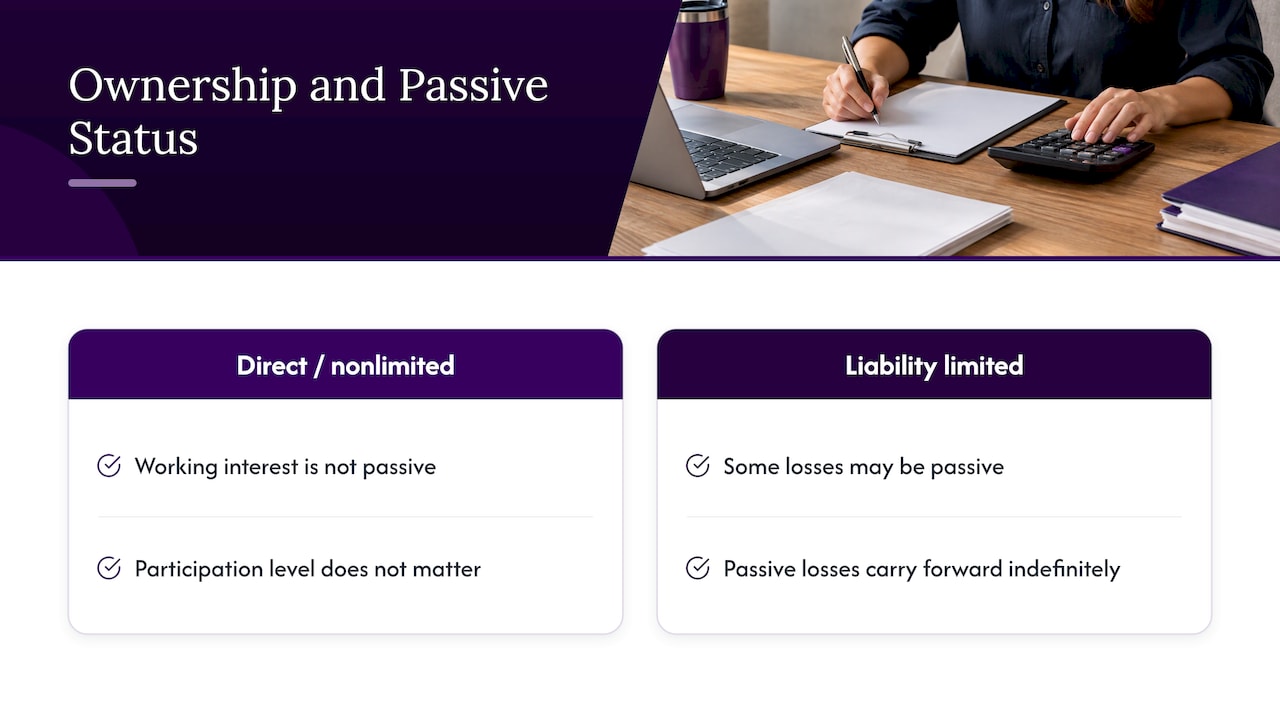
This is the test most investors worry about, and for oil and gas it often works in your favor. Under the IRS Form 8582 instructions, a working interest in an oil or gas well held directly, or through an entity that does not limit your liability (a general partner interest is the usual example), is not a passive activity, regardless of whether you materially participate. If your liability is limited for part of the year, some income and losses may be treated as passive.
The form of ownership therefore changes the answer. The same dollars in the same well can be nonpassive in one structure and passive in another. Whether you hold a working interest directly or through a limited-liability vehicle is a question for the offering documents and your tax adviser, and it is one reason to compare projects side by side before investing.
When a loss is passive, it is not wasted. Disallowed passive deductions carry to the next year. According to Spidell’s passive activity course materials, there is no time limit on the passive loss carryforward under §469(b), and a suspended loss can be applied against income from other passive activities, not only the one that produced it. We cover the mechanics in passive loss carryforward for property and energy investors.
4. Excess business loss
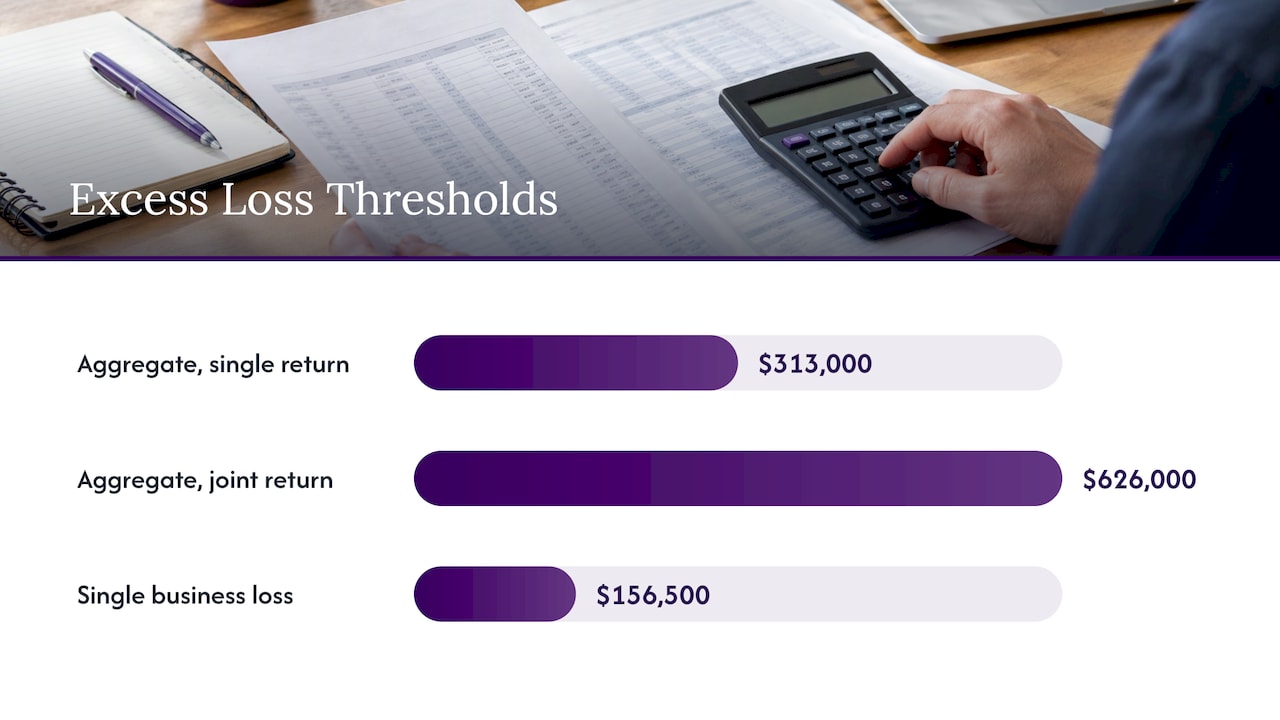
The last filter is the excess business loss limit under §461(l). The IRS Form 461 instructions state that the One Big Beautiful Bill Act (P.L. 119-21) permanently extended the disallowance of excess business losses for noncorporate taxpayers. For 2025, Form 461 is required when aggregate business losses exceed $313,000 ($626,000 on a joint return) or any single business loss exceeds $156,500. These amounts are adjusted for inflation, so check the current year’s instructions for the number that applies to you.
The key point for W-2 earners: the limit applies to your business losses, not your wages. A loss above the threshold is not permanently denied. The same instructions say a disallowed excess business loss is treated as an NOL carryover in later years, reported through Form 172.
How the NOL carryover works
Once an excess business loss turns into an NOL, the rules for NOLs govern how it is used. The IRS Form 172 instructions say an individual NOL may be carried forward indefinitely, starting with the first tax year after the loss year, once any carryback is waived or completed. For tax years beginning after 2020, the deduction for post-2017 NOLs is limited to 80% of taxable income computed without the NOL, the qualified business income deduction or the §250 deduction.
26 U.S.C. §172 adds the timing split: NOLs arising in years beginning after December 31, 2017 carry forward with no fixed expiration, while older NOLs carry forward up to 20 years. Two practical consequences follow:
- You do not wipe out a year’s income with an NOL. At least 20% of that year’s adjusted taxable income stays taxable.
- Carryforwards stack. Each year you apply the oldest first, and new losses add to the pile. Keeping a running schedule matters, because the IRS does not keep it for you.
A worked example
The figures below are illustrative, not a projection, and a real return will differ.
Say a single physician earns $600,000 in wages in 2025 and invests $500,000 as a direct working interest owner in a drilling project. Assume 70% of the investment is IDCs that she elects to deduct, which gives a $350,000 business loss in year one.
- Basis: she paid in $500,000, so the $350,000 loss clears this test.
- At-risk: she is at risk for her $500,000 cash investment, so it clears.
- Passive: a working interest held directly is not a passive activity, so the loss is nonpassive.
- Excess business loss: using the 2025 single threshold of $313,000 from the IRS instructions, $313,000 is deductible against her wages and $37,000 is disallowed.
That $37,000 becomes an NOL carryover. In year two, assume the well produces and her taxable income, before any NOL, is $400,000. The NOL deduction is capped at 80% of that, or $320,000, so the full $37,000 is usable and the carryforward is gone. If instead her year-two income were very low, the cap would limit how much she could use, and the remainder would roll forward again with no expiration.
Now change one fact. Suppose the same investment sits in a structure that limits her liability, so the loss is passive. The $350,000 would not offset her wages at all in year one. It would sit on Form 8582 as a suspended passive loss until she has passive income, or she disposes of the interest. Same money, same well, a very different year-one return.
What the carryforward does not change
A few points keep expectations realistic.
- The K-1 is not the answer. A loss shown on a Schedule K-1 does not prove you can use it this year. The usable amount comes after the four tests, which is why your CPA needs your other partnerships, prior suspended losses, spouse’s activities and expected income outside the investment.
- Depletion keeps working. Percentage depletion for qualifying independent producers and royalty owners is generally 15%, and your adviser can confirm whether you qualify. It is one more deduction to include in the schedule.
- AMT is a separate question. If you are wondering how IDCs interact with the alternative minimum tax, we address it in IDCs and the AMT.
- Selling changes the picture. When you dispose of an interest, suspended losses and recapture come into play. See how selling a working interest is taxed.
Liability, structure and why the documents matter
Because the nonpassive treatment depends on not limiting your liability, the structure of a working interest deserves a close read. Direct and general-partner positions carry exposure during the drilling phase that a limited structure does not. Joint venture equity structures show how risk and control are divided between partners, and the same logic applies when you review how a project allocates responsibility.
Read the operator’s insurance and indemnification terms as part of that review. Our checklist on operator insurance coverage in oil deals shows what to look for. Presenting these materials in a form you can compare across projects is what our platform is built to do.
Questions to put to your CPA before you invest
Tax law here is detailed, and the answer is specific to your return. Bring these to your CPA or tax attorney before funding:
- Will my interest be a nonpassive working interest, and does the entity limit my liability at any point in the year?
- What is my at-risk amount, and does any financing reduce it?
- How much of the first-year deduction will fit under the excess business loss threshold for my filing status?
- What is my projected taxable income for the next three years, and how much NOL can I absorb at the 80% cap?
- Do I have other suspended passive losses or partnership losses that interact with this one?
A written schedule answering these is the document that turns a large deduction into a plan.
Our view
We talk to a lot of high earners who ask how big the deduction is. The better question is how much of it they can use and when. A deduction that lands in a year when you have the income and the at-risk amount to absorb it is worth far more than a headline percentage.
That is why we build around direct ownership of real energy assets in vetted projects, with project materials laid out so you can compare them before you commit. When you can see the structure, the operator and the deal terms in one place, you and your CPA can answer the carryforward questions in advance instead of discovering them at filing time.
The carryforward rules are, in the end, reassuring. Suspended and excess losses generally carry forward without a fixed expiration. Plan for them, track them, and they work in your favor over a multiyear horizon.
Sharif
Seeing a project before you size the deduction
If you are an accredited investor weighing energy as a tax strategy, start by looking at the projects themselves. Fieldvest lists producing assets, development projects and energy infrastructure on our investment platform, so you can review materials from vetted operators and bring real numbers to your CPA.

To size a deduction against your own bracket first, use our oil and gas tax deduction calculator, then confirm the carryforward treatment with your tax professional.
FAQ
How long can an oil and gas loss be carried forward?
It depends on the type of loss. NOLs arising after 2017, including disallowed excess business losses, carry forward with no fixed expiration. Suspended at-risk losses and passive losses also carry forward without a fixed time limit, until they become usable or you dispose of the activity.
Can I use an oil and gas loss against my W-2 income?
Often, yes, if the interest is a nonpassive working interest and the loss clears the basis, at-risk and excess business loss tests. The IRS treats a working interest held directly, or through an entity that does not limit your liability, as nonpassive. Your CPA should confirm how your specific holding is classified.
Does a carryforward ever expire?
Post-2017 NOLs do not expire, but pre-2018 NOLs generally carry forward up to 20 years. In every case the deduction in a later year is subject to that year’s limits, including the 80% taxable income cap on post-2017 NOLs.
Is a corporate NOL the same as an individual’s carryforward?
No. A C corporation’s NOL stays with the corporation. An individual figures a separate NOL from their own share of business income and deductions, and the personal limits above apply.
Sources
- IRS Publication 925, Passive Activity and At-Risk Rules
- IRS Instructions for Form 6198
- IRS Instructions for Form 8582
- IRS Instructions for Form 461
- IRS Instructions for Form 172
- 26 U.S.C. §172, Net operating loss deduction
- Cornell LII, loss carryover
- Spidell passive activity course materials
Recommended

Get the Fieldvest Energy Brief
and AI-driven demand shifts — curated for accredited investors. Smart. Strategic. Tax-advantaged.