


Oil and gas subscription documents are the paperwork you sign to buy an interest in a private energy deal. The packet usually has a subscription agreement, an investor questionnaire, tax forms, anti-money-laundering (AML) and know-your-customer (KYC) information, and wiring details. It sits alongside the offering memorandum and the operating or partnership agreement. This guide explains what each piece does, what you are representing when you sign, and which terms to take to your attorney and CPA before you fund.
TL;DR
- The offering memorandum (PPM) discloses the deal and its risks. The subscription agreement is your purchase contract. The operating agreement governs the vehicle after you are admitted.
- Your signature carries representations: that you are accredited, that you read the PPM, and that you understand the risks. Errors can delay or kill an application.
- Read the use of proceeds, fee and distribution terms, acceptance and funding mechanics, and transfer limits before you sign.
- Tax deductions depend on deal structure and your own situation. Have a CPA confirm them against the actual documents.
- Be wary of pressure, guaranteed returns and unclear compensation. Slow, written answers are a good sign.
Table of Contents
- The documents in a typical packet
- PPM, subscription agreement and operating agreement: three different jobs
- What the subscription agreement asks you to represent
- The investor questionnaire and status checks
- Signing, acceptance and funding
- Money terms to read: use of proceeds, fees and payment order
- Risk disclosures and technical support
- Tax deductions and what the documents can and cannot say
- Red flags in the packet and the sales process
- A review routine you can follow
- Perspective: why the packet should be easy to compare
- See the deals behind the documents
- FAQ
- Sources
The documents in a typical packet
Private energy offerings are usually sold as unregistered securities under an exemption. That is why the paperwork is heavy. A securities attorney who works on private energy offerings lists the common pieces: a PPM for disclosure and risks, an operating agreement for management and profit distribution, a subscription agreement for buying the interests, an investor questionnaire to confirm eligibility, and Form D plus state “Blue Sky” filings made by the issuer.
Here is how those pieces fit together from your side of the table.
| Document | What it does | Who it mainly protects |
|---|---|---|
| Private placement memorandum (PPM) | Describes the project, the sponsor, fees, use of proceeds and risk factors | Investor (information) and issuer (disclosure) |
| Subscription agreement | Your binding offer to buy, with your commitment amount and representations | Issuer, and you through its terms |
| Investor questionnaire | Establishes your status, such as accredited investor | Issuer (compliance) |
| Operating or partnership agreement | Sets management, distributions, transfers, reporting and amendments | Both, after admission |
| Tax and KYC/AML forms | W-9, identity checks, source-of-funds details | Issuer and regulators |
| Wire and distribution instructions | Where you send funds and where payouts go | Both |
| Side letters, if any | Modify terms for a specific investor | The investor who negotiates them |
An ILPA closing checklist follows the same pattern: the PPM, the subscription agreement with its tax documents and wire instructions, the operating or partnership agreement, and side letters where they apply.
PPM, subscription agreement and operating agreement: three different jobs
Investors often treat the packet as one blob. It is not. Each document answers a different question.
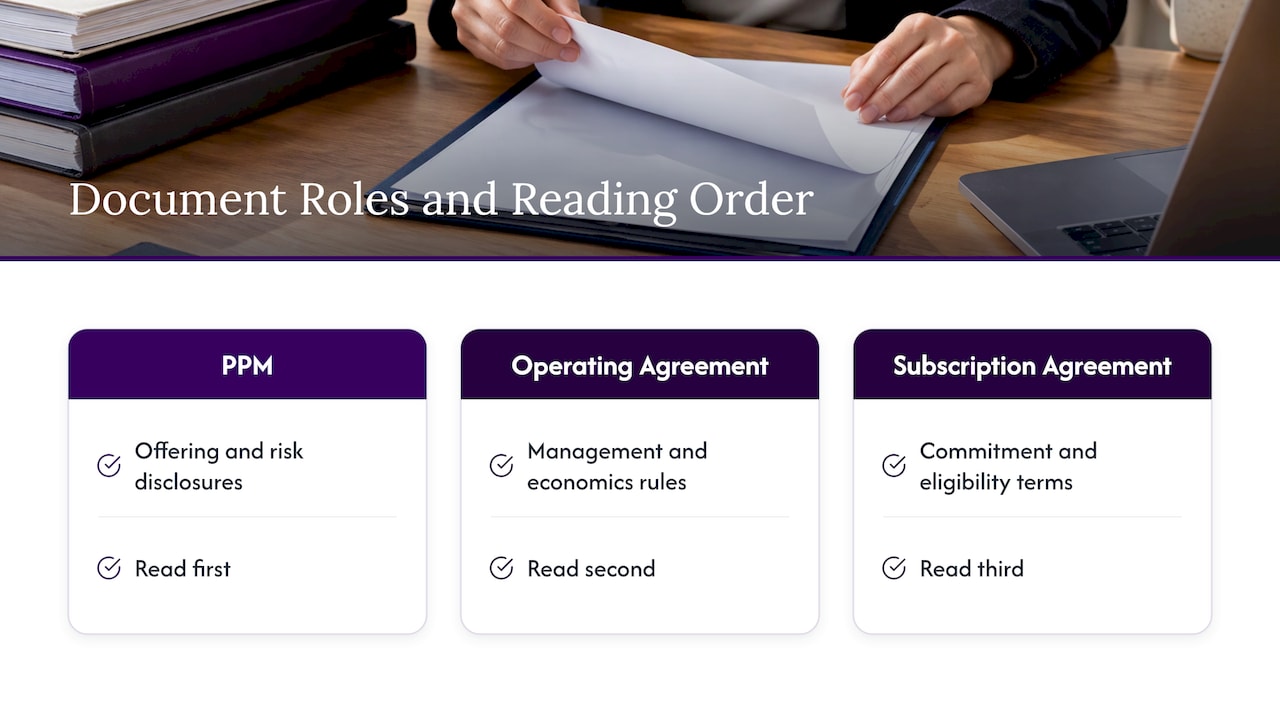
The PPM asks: what am I buying, and what could go wrong? According to a law firm’s overview of fund documents, the PPM discloses the offering and its risks and is typically the first document potential investors review. It is usually not the contract that admits you.
The subscription agreement asks: will you commit, and are you who you say you are? A guide to fund subscription describes it as the binding contract in which you commit a specific dollar amount, make representations about eligibility including accredited status, acknowledge that you received and reviewed the PPM, and agree to the fund’s terms.
The operating agreement asks: how does this entity run after I am in? It covers management, economics, transfers, reporting and amendments. Our own guide on handling oil investment documents covers how to organize and store all of this once you have it.
One practical consequence: the subscription agreement usually says you have read the PPM. If you signed without reading it, you still made that statement. Read the PPM first, the operating agreement second, and only then the subscription agreement, which refers to both.
What the subscription agreement asks you to represent
A subscription agreement typically includes securities, tax and AML representations, your contact information, capital call and distribution details, and KYC information with supporting documents, as described by counsel. In an energy deal, expect statements along these lines:
- Accredited investor status. You meet the income, net worth or other test, and you will tell the issuer if that changes before closing.
- Investment intent. You are buying for yourself, not to resell, and you understand the interest is restricted.
- Risk acknowledgment. You can bear a total loss and have had the chance to ask questions.
- No reliance. You are relying on the offering documents, not on side statements from a salesperson.
- Tax status. You provide a W-9 if you are a U.S. person and confirm the entity or individual details.
- Anti-money-laundering. You confirm that the source of funds is lawful and agree to provide identity documents.
Be careful with the “no reliance” language. If a salesperson told you something that matters to your decision, such as a projected return or a drilling schedule, ask that it be written in the PPM or an official project summary. Verbal promises do not survive a no-reliance clause.
Also keep your own details consistent. A fund subscription explainer notes that errors in the agreement can delay or even kill the application. Check the legal name, the entity type, the tax ID, the signatory authority and the commitment amount against what you intend. If you invest through an LLC, trust or retirement account, say so up front, because the questionnaire and signature blocks change.
The investor questionnaire and status checks
The questionnaire is where the issuer documents why it can lawfully sell to you. A subscription booklet checklist lists what usually sits in it: legal status such as accredited investor, qualified purchaser, qualified client and ERISA status, plus tax forms, KYC and AML materials, wire and distribution details, and signature pages.
Answer it exactly. Do not tick a box because you assume it applies. If you are unsure whether your income or assets qualify, or how a trust or entity counts, ask your attorney before you sign. The questionnaire is a representation, and the issuer will rely on it.
Signing, acceptance and funding
Signing is not the same as being in the deal. Drafting guides describe subscription agreements as covering the securities, quantity and price, payment instructions and other procedures, with an express condition that the subscription is subject to issuer acceptance, often in the issuer’s sole discretion.
So the sequence normally runs like this:
- You review the PPM and the operating agreement.
- You complete the subscription agreement, questionnaire and tax forms.
- You submit them and the issuer reviews your eligibility.
- The issuer accepts, rejects or reduces your subscription.
- You wire funds per the instructions, often into an account the documents describe.
- The issuer countersigns, admits you and later issues confirmation.
Questions to settle before step 5:
- When exactly must funds arrive, and what happens if they are late?
- Are funds held in escrow until a minimum is raised, and what happens if the minimum is not met? Our note on escrow red flags in oil and gas deals goes deeper.
- Are you returned your money in full if the issuer rejects you?
- Does the agreement let you withdraw before acceptance?
- Do you verify wire instructions by phone with a known number? Wire fraud targets exactly this step.
Money terms to read: use of proceeds, fees and payment order
This is where the document earns its keep. The SEC’s investor alert on private oil and gas offerings advises reviewing the use-of-proceeds section, estimating how much will go to drilling, administrative overhead and sales fees, and asking how those fees are calculated. It also tells investors to ask about related-party work and how much the promoter makes even if a well comes in dry.
That last question is the one to press. The SEC points out that a promoter paid mainly up front does not share your interest in actual production.
Use these checkpoints:
- Use of proceeds. Look for separate lines for drilling and completion, lease and land costs, operator fees, sales commissions, overhead and reserves. One explainer on oil and gas PPMs notes that intangible drilling costs are separated from tangible costs because the distinction carries significant tax consequences.
- Related parties. If the sponsor and the drilling contractor or operator are affiliated, the documents should say so and show what the affiliate is paid. Kentucky’s offering document guidelines, for example, call for itemized drilling and completion costs even when a deal is sold as turnkey and the parties are related, along with all forms of compensation to the seller or its affiliates, including operating or management fees and royalties.
- Fees at every level. A private markets due-diligence checklist suggests asking about management, performance-based and fund-level fees, whether they are charged at multiple levels, and how performance fees are calculated.
- Distribution order. Ask for the waterfall in plain terms: who is paid first, when the sponsor’s share starts, and whether that share depends on investors getting their capital back.
- Liquidity and exit. Check the expected holding period, whether redemptions or lockups exist, who controls exit timing and what could delay distributions. The same checklist covers each of these.
If you want to go further on how to read the economic terms, see our guides on how to navigate oil deal terms and how to read an oil project prospectus.
Risk disclosures and technical support
A PPM that downplays risk is a warning sign, and so is one that skips the technical support. Dry holes are the defining risk of drilling, and even productive wells face commodity price swings, declining production and operating costs, as one PPM guide explains.
On technical support, the SEC advises asking whether a third-party engineering report exists, whether you can see it, and whether the engineer is truly independent, since some promoters use reports from the engineers who sold them the project. Ask what class of reserves is being estimated (proved, probable or possible), who estimated it, and whether an independent third party audited it. Both points come from the SEC alert.
Also check what the structure is. A producing asset, a development project and energy infrastructure carry different risks, and the documents should say which one you are buying. Our overview of oil and gas investments for accredited investors explains those differences. If the deal involves a drilling or joint venture arrangement, see also our guide to participation agreements. Audit and reporting rights matter too: six audit clauses are worth looking for.
Tax deductions and what the documents can and cannot say
Many accredited investors come to energy deals for the first-year deduction. Most of that comes from intangible drilling costs, such as labor, fuel and drilling mud, which may be deductible in the year they are incurred under the right conditions. A CPA firm’s explainer walks through the rules and the ways investors lose the deduction.
Here is how to treat that in the paperwork:
- Look for the split. The use-of-proceeds section should show how much of your investment is expected to fund intangible versus tangible costs. Your deduction depends on that split, so a vague figure is a reason to ask for detail.
- Expect careful language. Good offering documents describe tax treatment as the sponsor’s understanding and tell you to consult your own advisers. That is normal and appropriate. No document can promise your deduction, because it depends on your income, how you hold the interest, your participation and your other tax positions.
- Match structure to your goal. Whether you hold a working interest directly or through an entity changes how losses and deductions flow to you. Ask your CPA to read the structure sections before you subscribe.
- Plan the cash. A deduction does not replace the need to fund the investment. Know your commitment amount and when the money is due.
- Mind the other side. Later production income is generally taxable, and sale of the interest can bring recapture issues. Ask your CPA to model the whole life of the investment, not just year one.
Our free tax deduction calculator gives you a starting estimate to bring to that conversation. It is a planning tool, not tax advice, and your CPA should confirm the numbers against the actual documents.
Red flags in the packet and the sales process
The SEC alert lists signs that deserve a pause: pitches built on recent headlines about high oil or gas prices, “can’t miss” wells, guaranteed returns, abnormally high return rates, unsolicited materials, pressure to decide quickly, claims of new technology, a salesperson who says they are also an investor, and requests to sign something acknowledging that securities laws do not apply. The full list is in the SEC’s investor alert.
Louisiana’s securities regulator offers similar advice. In its investor alert, it urges investors to ask hard questions, resist hurried decisions, and examine five areas: registration, the salesperson, the company, the investment and the lease.
A short test: if you ask how the sponsor gets paid and the answer is vague or changes between calls, stop. A clear answer arrives in writing.
A review routine you can follow
- Request the full packet early. Ask for the PPM, subscription agreement, operating agreement and any side letters before you decide, not after.
- Read in order. PPM, then operating agreement, then subscription agreement.
- Mark every money term. Fees, use of proceeds, related-party payments, distribution order.
- Write your questions. Send them in writing and keep the answers.
- Hand it off. Your securities attorney reviews rights and representations. Your CPA reviews the tax structure and the deduction assumptions.
- Check the details of the signing. Names, entity, amounts, dates, wire instructions.
- Fund only after acceptance steps are clear. Confirm the process and the account in a verified call.
We also wrote a plain-language guide on what to check before you sign a subscription agreement, and on how accredited investors vet private deals. A well-run data room should hold most of the materials you need.
Perspective: why the packet should be easy to compare
We built Fieldvest around a simple belief: a deal that is good for investors survives scrutiny, so we want you to scrutinize it.
Most of the friction in private energy investing comes from scattered paperwork. Each sponsor formats its PPM, subscription agreement and project data differently, and a busy professional has to dig out the fee table, the use of proceeds and the tax assumptions by hand. Our platform is designed to present key project materials in a streamlined way so you can compare producing assets, development projects and energy infrastructure side by side.
We also screen operators before projects reach you, because diligence done early saves your attorney and CPA time later. Our aim is for every investor to know how a project is paid for, who earns what, and how the tax picture works before committing a dollar.
Take the documents to your own advisers. We expect it, and we think it makes better investors.
Sharif
See the deals behind the documents
If you are an accredited investor weighing energy projects, you can browse vetted producing assets, development projects and energy infrastructure on Fieldvest, with key materials presented so you can compare them before you reach the subscription stage.

Start with the tax deduction calculator to frame your question for your CPA, then review each project’s documents with your attorney.
FAQ
What are oil and gas subscription documents?
They are the forms you complete to invest in a private energy offering. They usually include the subscription agreement, an investor questionnaire, tax forms such as a W-9, KYC and AML information, and wire details. They accompany the PPM and the operating or partnership agreement.
Is a subscription agreement the same as a PPM?
No. The PPM is the disclosure document covering the project, fees and risks. The subscription agreement is your purchase contract, where you commit capital and make representations. The operating agreement then governs the entity after you are admitted.
Can the sponsor reject my subscription?
Yes. Subscription agreements are commonly conditioned on issuer acceptance, often at its discretion. Check what happens to any funds you sent if you are rejected or accepted for a smaller amount.
Do the documents guarantee the tax deduction?
No. Offering documents describe the expected tax treatment but cannot promise your outcome, which depends on your own situation and how you hold the interest. Ask your CPA to review the structure and the use-of-proceeds split before you sign.
Who should review the packet with me?
Use a securities attorney for the representations, rights and risk language, and a CPA for the tax structure and deduction assumptions. Send each your questions in writing, and keep the answers with your records.
Sources
- Oil & Gas Securities Attorney for Private Energy Offerings
- Document Checklist: Fund Closing Packet (ILPA)
- Drafting legal documents and finalizing terms (Torys)
- Fund Subscription: Process, Eligibility, and Tax Rules
- Subscription Booklet Checklist
- Drafting Guide: Subscription Agreements (Bloomberg Law)
- Investor Alert: Private Oil and Gas Offerings (Investor.gov)
- How to Draft an Oil and Gas Private Placement Memorandum
- Offering Document Guidelines (Kentucky)
- Private markets due-diligence checklist
- Intangible Drilling Costs Tax Deduction Explained
- Investor Alert (Louisiana Office of Financial Institutions)
Recommended

Get the Fieldvest Energy Brief
and AI-driven demand shifts — curated for accredited investors. Smart. Strategic. Tax-advantaged.