


TL;DR:
- Oil and petroleum investments offer income, tax deductions, and commodity risks, depending on the chosen structure.
- Due diligence, including reserve reports and operator verification, is critical before committing capital.
For accredited U.S. investors, oil and petroleum exposure typically delivers three things simultaneously: ongoing income from production or fees, potential first-year tax deductions through intangible drilling costs (IDCs), and direct commodity-price risk you need to plan for explicitly. The structure you choose determines which of those three dominates your return profile.
- The U.S. EIA defines petroleum as a broad category covering crude oil and all refined products; crude is the liquid feedstock, while gasoline, diesel, and jet fuel are the finished outputs.
- The industry divides into three segments: Upstream (exploration and production), Midstream (transportation and storage), and Downstream (refining and distribution). Each carries a distinct risk and income profile.
- First-year IDC deductions and ongoing depletion allowances are the primary tax signals for accredited investors in direct participation programs.
Your immediate next step: confirm your accreditation status, then run a tax-deduction estimate before committing capital. Verify all outputs with a CPA.
Table of Contents
- What are oil and petroleum, and how is the industry structured?
- How can accredited investors get exposure to oil and gas?
- What U.S. tax benefits apply to oil and gas investments?
- What are the risk and return profiles across oil and petroleum sectors?
- What should you check before investing in an oil deal?
- How should you size an oil and petroleum allocation?
- What does onboarding to a U.S. oil deal actually look like?
- What tools and models should you use to evaluate deals?
- Key Takeaways
- Why disciplined oil and gas exposure still makes sense for high earners
- Fieldvest gives accredited investors direct access to vetted U.S. energy deals
- Authoritative sources for further research
What are oil and petroleum, and how is the industry structured?
Petroleum and crude oil are related but not identical. Per the EIA, petroleum is the umbrella term covering crude oil, natural gas liquids, and all refined petroleum products. Crude oil is the unprocessed liquid hydrocarbon that comes out of the ground. Refineries convert that crude into finished fuels and feedstocks. One practical detail worth knowing: a standard 42-gallon U.S. barrel of crude yields more finished products than its original volume because of refinery processing gain.
The industry segments into three distinct economic zones:
- Upstream: Exploration, drilling, and production. Assets include leases, wellbores, and production equipment. Revenue tracks commodity prices directly, making this the highest-volatility segment.
- Midstream: Pipelines, storage terminals, and processing plants. Revenue is largely fee-based under long-term contracts, giving it a “toll-road” cash-flow profile with lower commodity exposure.
- Downstream: Refining and distribution. Margins depend on the “crack spread” — the difference between crude input cost and refined product prices. The U.S. has numerous refineries, and crack spreads on the Gulf Coast stabilized between $12/bbl and $18/bbl in recent periods per Deloitte.
| Segment | Revenue model | Primary investor risk | How returns are generated |
|---|---|---|---|
| Upstream | Production × commodity price | Commodity price + operator execution | Working/royalty interests, IDC deductions |
| Midstream | Fee-based contracts | Counterparty + regulatory | MLP distributions, fund income |
| Downstream | Crack spread margin | Feedstock cost + refinery utilization | Public equities, integrated company exposure |
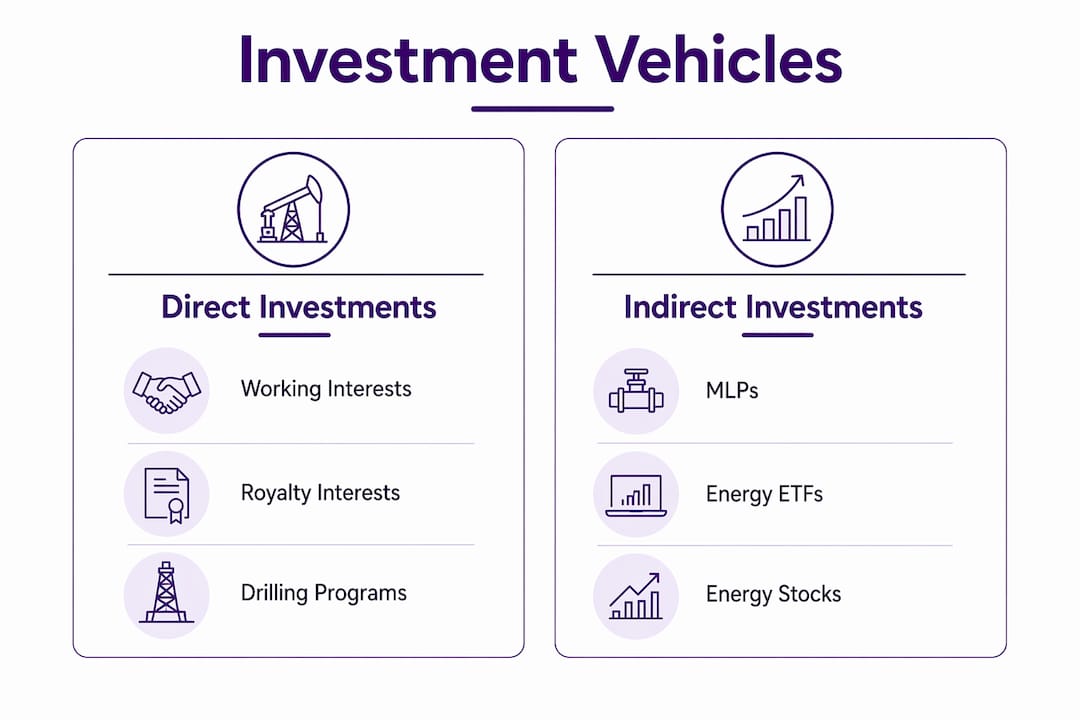
How can accredited investors get exposure to oil and gas?
Most direct-participation opportunities available to accredited investors come from independent upstream operators, not the integrated Majors. These independents drive higher return variance in both directions.
Common vehicles and their economic profiles:
- Working interest: Direct ownership in a well. You share costs and revenues proportionally. Qualifies for first-year IDC deductions but carries full operator and commodity risk.
- Royalty interest / nonoperating royalty: Revenue share with no cost obligation. No IDC deductions, but income flows without capital calls.
- Net profit interest: Revenue after deducting operating costs. Lower upfront exposure, but income can disappear when costs spike.
- Limited partnership / PPM: Pooled capital in a private placement. K-1 reporting, passive income treatment, and depletion pass-through. Common minimum investments range from $25,000 to $100,000+.
- Private fund: Managed exposure across multiple deals. Higher fees but built-in diversification.
- MLP (Master Limited Partnership): Publicly traded units in midstream or upstream assets. Liquid, but commodity and distribution-cut risk applies.
- ETFs: Public market exposure to oil equities or futures. Fully liquid, no tax-deduction benefit, no direct asset ownership.
- Marketplace access (e.g., Fieldvest): Curated deal flow from vetted operators, with subscription agreements and direct ownership structures.
| Vehicle | Liquidity / hold period | Risk level | Tax benefit potential | Minimum / eligibility | Fee structure |
|---|---|---|---|---|---|
| Working interest | Illiquid, 5–10 years | High (operator + commodity) | High (IDCs + depletion) | $25K–$100K+, accredited | Carried interest + operating fees |
| Royalty interest | Illiquid, 5–10 years | Medium (commodity only) | Low (depletion only) | $10,000+, accredited | Minimal |
| LP / PPM | Illiquid, 3–7 years | Medium–High | Medium–High (depletion + IDCs) | $25,000–$100,000+, accredited | 2%–3% mgmt + 20%–25% carry |
| MLP | Liquid (public market) | Medium | Low–Medium (depletion) | No minimum, accredited or retail | Brokerage commissions |
| ETF | Fully liquid | Low–Medium (market) | None | No minimum | Expense ratio |
| Marketplace | Illiquid, 3–7 years | Medium–High | High (direct ownership) | $25K+, accredited | Platform fee + operator carry |
Pro Tip: If your primary goal is a large first-year deduction, working interests in drilling programs deliver the most immediate IDC benefit. But confirm with your CPA that you can meet material participation requirements or accept passive-activity treatment — the tax outcome differs significantly depending on your classification.
What U.S. tax benefits apply to oil and gas investments?
The four main tax levers for private oil investments are:
- Intangible drilling costs (IDCs): Costs for labor, fuel, and chemicals used in drilling that have no salvage value. In a working interest, these are typically deductible in the year incurred, often representing 60%–80% of total well costs.
- Tangible equipment depreciation: Steel casing, pumps, and wellhead equipment depreciate over time under MACRS schedules, providing ongoing deductions.
- Percentage depletion: Qualifying independent producers can deduct a fixed percentage of gross income from a well each year as the reservoir depletes. This deduction can exceed the original cost basis over time.
- Cost depletion: An alternative to percentage depletion, calculated based on actual capital invested relative to total estimated reserves.
Illustrative example (not tax advice): An accredited investor commits $100,000 to a working-interest drilling program where 70% of costs are IDCs. In year one, up to $70,000 may be deductible against ordinary income, potentially reducing taxable income by that amount before depletion and depreciation. Actual results depend on your tax bracket, passive-activity classification, and the specific program structure. Confirm all figures with a CPA.
Passive activity rules matter. If you do not materially participate in the operation, IDC deductions may be classified as passive losses, which can only offset passive income. Active classification requires meeting IRS material participation tests. Document your status carefully and request K-1 timing from the operator before year-end.
Consult a qualified CPA before investing. Tax treatment varies by structure, income level, and individual circumstances.
What are the risk and return profiles across oil and petroleum sectors?
Upstream carries the most commodity exposure. Prices are set by global demand and major producer output, not U.S. production alone. A domestic well can be profitable at $65/bbl and deeply unprofitable at $45/bbl. Stress-test your models against global scenarios, not just domestic forecasts.
Midstream is the closest thing to a bond in the oil sector. Fee-based contracts insulate cash flows from short-term price swings, though counterparty risk and regulatory exposure remain.
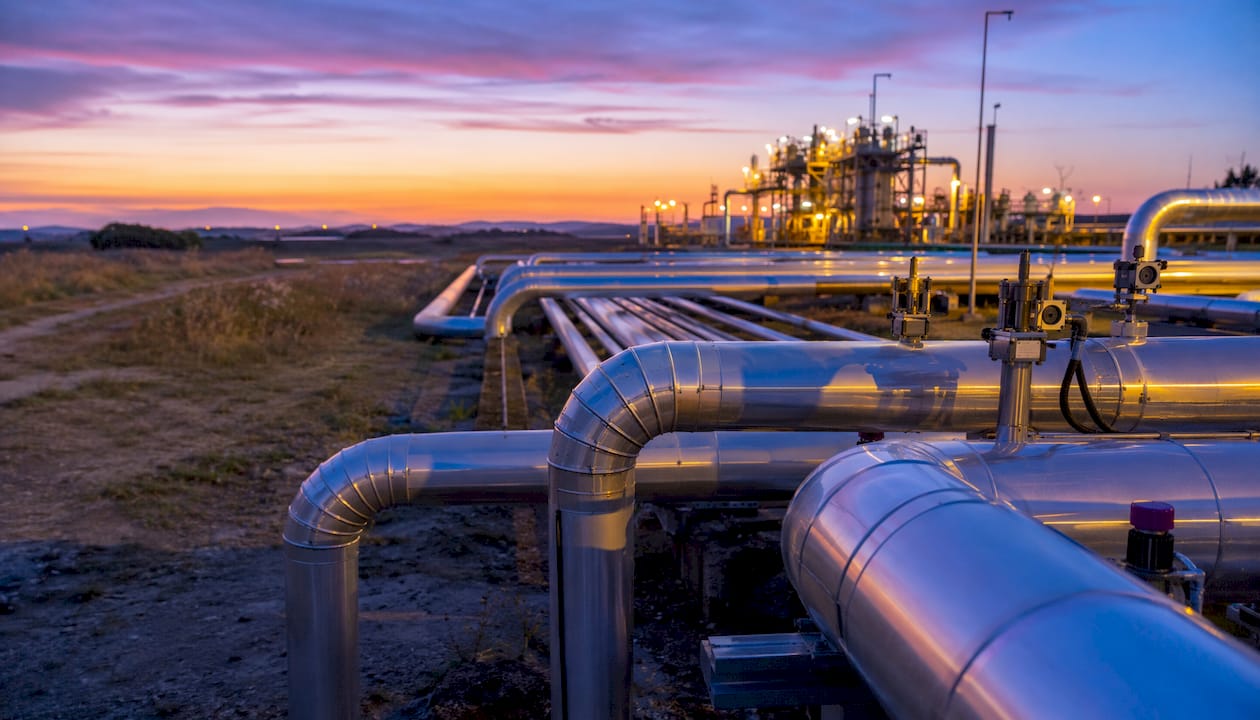
Downstream margins hinge on crack spreads and refinery utilization. With recent refinery capacity closures in the U.S., the remaining refining capacity picture is tighter, which can support margins but also concentrates risk.
Major risk categories to budget for:
- Commodity-price risk: The dominant driver for upstream returns.
- Operator execution risk: Drilling delays, cost overruns, and poor capital allocation directly reduce investor returns.
- Regulatory and environmental risk: Permitting delays, emissions rules, and liability exposure.
- Supply-chain and tariff risk: Tariffs on steel and aluminum can increase material and service costs by 4%–40%, compressing project economics.
- Title and reserves risk: Unresolved title defects or overstated reserves destroy returns before production begins.
“Oil prices are dictated by global consumer demand and output from major producers; U.S. production size does not immunize investors from global price swings.” — CFR Backgrounder on the U.S. Oil and Gas Industry
Liquidity is limited across most direct-participation vehicles. Expect hold periods of 5–10 years for working interests and 3–7 years for LP structures. Secondary markets exist but are thin. ETFs and MLPs are the only liquid options, and they sacrifice the tax-deduction benefit.
What should you check before investing in an oil deal?
Operator and deal due diligence is where most investors either protect or lose capital. Request these documents before signing anything:
- Operator P&L statements and audit history (minimum three years)
- Independent reserves report prepared under SPE-PRMS standards
- Title opinion from a licensed petroleum attorney
- Division orders and working-interest ownership breakdown
- Operating agreement and capital call schedule
- Insurance certificates (general liability, environmental, well control)
- Third-party engineering review of well economics
Questions to ask the operator directly: What is your track record on similar plays? Who is the technical team and what are their credentials? How do you hedge commodity exposure? What is your supply-chain plan for specialized equipment given current tariff conditions? Have you had an independent engineer review the reserve estimates?
Red flags that should stop a deal:
- Unclear or contested title on the acreage
- Unresolved environmental liens or prior spill events
- IDC deduction claims that exceed IRS-recognized percentages
- Carried interest above 30% with no clear justification
- Reserve or production data that is sparse, unaudited, or inconsistent with comparable wells
For a deeper look at operator roles and responsibilities, review what operators are contractually required to disclose before you commit.
How should you size an oil and petroleum allocation?
Allocation frameworks vary by investor objective:
- Tax-sheltering focus: Investors targeting first-year deductions often allocate 10%–20% of annual taxable income to working-interest programs, timed to match high-income years.
- Income focus: Royalty interests and midstream LP positions generate steadier cash flow with lower volatility. A 5%–15% portfolio allocation is common for income-oriented accredited investors.
- Speculative upside: Upstream working interests in exploratory plays warrant smaller allocations (under 10% of investable assets) given the binary risk profile.
Stagger investments across multiple tax years to avoid concentrating K-1 income and deductions in a single year. Mixing working interests with royalty positions and fund structures diversifies both operator risk and tax timing. Where available, ask operators about hedging programs that lock in commodity prices on a portion of production.
What does onboarding to a U.S. oil deal actually look like?
The practical steps from interest to funded position:
- Confirm accreditation status (income or net worth test under SEC Rule 501).
- Review the Private Placement Memorandum (PPM) and term sheet in full.
- Complete the subscription agreement and investor questionnaire.
- Submit required documents: W-9 (or W-8BEN for non-U.S. persons), government-issued ID, and proof of accreditation.
- Wire funds per the operator’s or platform’s escrow instructions.
- Receive confirmation of ownership interest and K-1 or distribution schedule.
Typical timelines: due diligence windows run 2–4 weeks, funding deadlines are firm, and first distributions often begin 3–12 months after well completion. Hold periods range from 3–10 years depending on the vehicle. For a reliable oil investment platform, look for transparent deal documents, clear fee disclosure, and direct operator access.
What tools and models should you use to evaluate deals?
- Run the Free Oil & Gas Tax Deduction Calculator to estimate first-year deductions before committing capital. Verify the output with a CPA.
- Request an independent reserve engineering report prepared under SPE-PRMS standards. Never rely solely on operator-provided reserve estimates.
- Build or request a scenario cash-flow model with at least three commodity price decks: base, stress ($15–$20/bbl below base), and upside.
- Stress-test capex assumptions for tariff and supply-chain inflation. Per Deloitte’s 2026 outlook, cost increases of 4%–40% on equipment and materials are plausible under current trade policy.
- Review operator financial statements for capital allocation discipline. Deloitte’s 2026 analysis identifies disciplined capital allocation as a key differentiator for operators navigating the current cost environment.
For geopolitical context on how global events affect U.S. energy returns, the Strait of Hormuz disruption analysis is a useful stress-test reference.
Key Takeaways
Oil and petroleum investments can deliver income, first-year tax deductions, and commodity upside for accredited U.S. investors, but the segment you choose determines which of those three actually shows up in your returns.
| Point | Details |
|---|---|
| Segment determines risk | Upstream carries the highest commodity exposure; midstream offers fee-based stability; downstream depends on crack spreads. |
| IDCs are the primary tax lever | Working interests can make 60%–80% of well costs deductible in year one, but passive-activity rules apply. |
| Due diligence is non-negotiable | Request an SPE-PRMS reserves report, title opinion, and three years of operator financials before signing. |
| Tariff risk is real in 2026 | Equipment and material cost increases of 4%–40% are possible under current trade policy; stress-test your models. |
| Fieldvest provides vetted access | Fieldvest connects accredited investors with vetted U.S. energy deals and offers a free tax-deduction calculator to model first-year outcomes. |
Why disciplined oil and gas exposure still makes sense for high earners
The conventional pitch for oil and gas investments leans heavily on the tax story, and that story is real. But the investors who get burned are usually the ones who treated the tax deduction as the investment thesis rather than a feature of a sound deal. A bad well with a great IDC deduction is still a bad well.
What actually changes the calculus for high-earning accredited investors is the combination: a first-year deduction that reduces taxable income in the year you need it most, ongoing depletion that extends the tax benefit, and a real asset producing cash flow independent of public market sentiment. That combination is genuinely rare. Equities and fixed income do not offer it. Real estate offers pieces of it. Direct oil and gas participation, structured correctly, offers all three.
The risk is real too. Commodity prices move on geopolitics, OPEC decisions, and global demand shifts that no domestic analysis can fully predict. Operator quality varies enormously, and the difference between a disciplined operator and a careless one shows up directly in your returns. That is why the due diligence checklist above is not optional. Verify the reserves, check the title, and confirm the operator has a supply-chain plan for a tariff environment that is still evolving.
The investors who do this well treat it as a business decision, not a tax shortcut.
Fieldvest gives accredited investors direct access to vetted U.S. energy deals
High-earning professionals who want first-year tax deductions and long-term energy income need more than a list of operators. They need curated deal flow, transparent economics, and tools to model the tax impact before committing capital.

Fieldvest connects accredited investors directly with trusted U.S. oil and gas operators, with deal documents, operator track records, and a free tax-deduction calculator built into the platform. If you want to understand exactly how much your taxable income could change in year one, run the calculator now. Then explore how to lower your taxes with a structured oil and gas investment.
Getting started takes three steps: confirm your accreditation, review available deals on the platform, and submit your subscription documents. Fieldvest’s team is available to walk you through operator materials and answer questions before you wire a dollar.
Authoritative sources for further research
- U.S. Energy Information Administration — Petroleum & Other Liquids: The primary source for U.S. production data, refinery statistics, and petroleum product definitions. Use it to verify any production or price figures cited in an operator’s materials.
- Oil 101 — Industry Overview: A clear, authoritative primer on upstream, midstream, and downstream economics, including equipment contracting and refinery margin mechanics.
- Deloitte 2026 Oil and Gas Industry Outlook: The most current macro and cost-pressure analysis for U.S. operators, including tariff exposure and capital allocation trends.
- CFR Backgrounder — How the U.S. Oil and Gas Industry Works: A concise policy-focused overview of how global demand dynamics and U.S. production interact to set prices.
- Library of Congress — Oil and Gas Industry Research Guide: Aggregates regulatory, historical, and statistical resources for deeper legal and policy research.
This article is general educational information, not tax or investment advice. Verify all tax claims with a qualified CPA and all reserve or engineering claims with an independent petroleum engineer before investing.
Recommended
- Oil and Gas Investments: A Guide for Accredited Investors | Oil & Gas Investing
- Gas Investments for Accredited Investors: 2026 Guide | Oil & Gas Investing
- Accredited Investor Opportunities: 8 Types for 2026 | Oil & Gas Investing
- Reliable Oil Investment Platform: Evaluating Access, Transparency, and Control | Oil & Gas Investing

Get the Fieldvest Energy Brief
and AI-driven demand shifts — curated for accredited investors. Smart. Strategic. Tax-advantaged.