


TL;DR:
- Completing an oil-asset transfer involves confirming your accreditation and submitting necessary documentation.
- Secondary transfers require sponsor consent and can extend the closing timeline by several weeks.
Completing an oil-asset transfer means you walk away with a recorded ownership interest in a U.S. oil or gas project, the right to your share of production revenue, and access to first-year tax treatment on Intangible Drilling Costs (IDCs) and depletion allowances. Your two immediate actions: confirm your accredited investor status and request the offering documents from the marketplace or sponsor.
Before you read further, have these three items ready:
- Accreditation proof (two years of tax returns, a CPA letter, or a third-party verification report)
- Completed investor questionnaire
- Wiring instructions and escrow account details from the sponsor or platform
Table of Contents
- What does the oil asset transfer process guide cover, step by step?
- What documents do you need to complete the transfer?
- How does accreditation verification work for Reg D offerings?
- What are the tax implications for investors in 2026?
- What due diligence should you require from the operator?
- What fees and timeline should you expect?
- What are your exit options and how do secondary transfers work?
- What happens after closing?
- Key Takeaways
- What the transfer process actually demands from you
- Fieldvest connects you directly to vetted oil & gas transfers
- Useful sources
What does the oil asset transfer process guide cover, step by step?
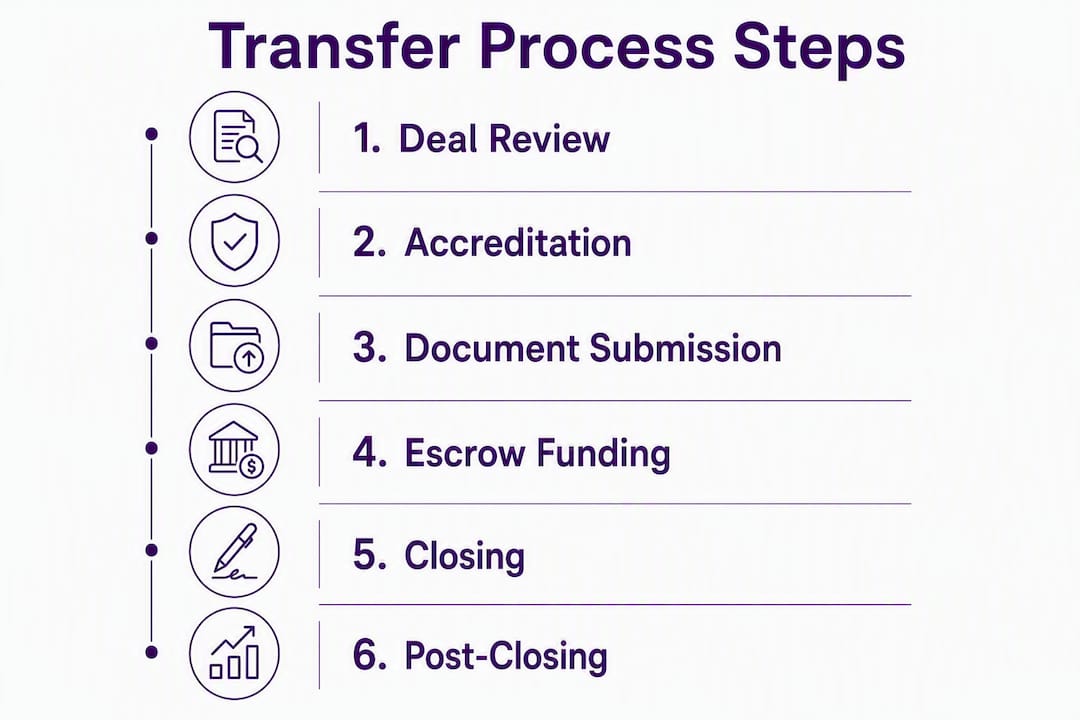
Every transfer starts with one decision: are you subscribing to a new offering (primary) or buying an existing interest from another investor (secondary assignment)? Primary subscriptions follow a Direct Participation Program (DPP) structure under Regulation D. Secondary assignments involve an additional layer of sponsor consent, a right-of-first-refusal (ROFR) check, and an executed assignment agreement.
Steps common to both paths:
- Complete the investor questionnaire — confirm accreditation, investment experience, and suitability representations.
- Record the transfer — operator updates its ownership ledger; transfer agent systems route distributions to the new owner.
| Milestone | Typical Duration |
|---|---|
| Deal review and investor questionnaire | 2–5 days |
| Accreditation verification | 1–5 business days |
| KYC/AML screening | a few business days |
| Escrow funding (wire clearance) | 1–2 business days |
| Sponsor review and acceptance | several business days |
| ROFR period (secondary only) | a few weeks |
| Ownership ledger update | a few business days |
| First distribution window | Per operating agreement (typically within one to several months post-close) |
Pro Tip: For Rule 506© deals, prepare a third-party verification letter before you select a deal. Sponsors cannot accept your subscription until verification clears, and this single item delays more closings than any other.
What documents do you need to complete the transfer?
Asset transfer documentation differs slightly between a primary subscription and a secondary assignment, but the core stack is consistent.
- Subscription Agreement — your binding commitment to invest; includes investor representations and accreditation certifications. Watch for unusual indemnity language or unilateral amendment rights.
For a deeper walkthrough of each form, Fieldvest’s oil investment documents guide covers annotation and common errors.
How does accreditation verification work for Reg D offerings?
Accredited investor status is a regulatory eligibility gate, not a credit score or suitability finding. Under SEC rules, individuals qualify by meeting income thresholds ($200,000 individual / $300,000 joint for two consecutive years, with expectation of the same), a net worth test ($1 million excluding primary residence), or knowledge-based tests (Series 7, 65, or 82 license holders). Entities qualify separately under SEC guidance when assets exceed $5 million or all equity owners are individually accredited.
Acceptable verification documents for 506© offerings:
- Two most recent years of IRS tax returns (W-2s, 1040s, or K-1s)
- CPA or licensed attorney verification letter
- Third-party verification service report (platforms like Verify Investor)
- Bank or brokerage statements for net worth verification (within 90 days)
KYC/AML screening runs alongside accreditation. Expect identity document upload, a Social Security Number or EIN check, and an OFAC sanctions screen. Most platforms complete this in 1–3 business days when documents are clean.
Pro Tip: Bundle your verification packet before you browse deals: a current CPA letter, two years of returns, and a brokerage statement. Having it ready cuts the average verification window from five days to one.

What are the tax implications for investors in 2026?
The tax case for direct oil and gas ownership rests on two structural features unavailable in public energy stocks: IDC deductions and depletion allowances.
IDC deductions apply to working interest holders. Industry guidance indicates that 70%–85% of a drilling investment may qualify as IDCs in many drilling programs, and working interest owners can often deduct that portion in the year the costs are incurred. Because working interests are typically treated as non-passive for tax purposes, those deductions can offset active W-2 or business income directly.
Stat callout: According to industry sources, IDCs commonly represent 70%–85% of a drilling program’s total investment, making first-year deductibility the primary driver of after-tax returns for high-income investors.
Percentage depletion allows royalty interest holders to deduct a fixed percentage of gross income from the well each year, independent of cost basis.
Key tax questions to run with your CPA before closing:
- Is this a working interest (non-passive) or an LP/royalty interest (passive)?
- How do IDC deductions interact with your AMT exposure?
- Are you investing through an IRA or SDIRA? IDC deductions generally provide no immediate benefit inside tax-deferred accounts, so the structure changes the math entirely.
- What state-level taxes apply to your share of production revenue?
- When will the K-1 arrive, and how does that affect your estimated tax payments?
K-1s for oil and gas partnerships typically arrive between late February and late March, sometimes later for complex programs. Budget for a possible tax filing extension if your K-1 is delayed.
Pro Tip: Model your IDC deduction before you wire funds. Fieldvest’s oil & gas tax deduction calculator lets you estimate first-year tax savings against your income level in minutes.
What due diligence should you require from the operator?
Operator quality is the single variable most correlated with whether your investment performs. Documents are necessary but not sufficient.
- Operator track record — verified production history, not just projected returns. Request references from prior investors.
Red flags that should pause any transfer: an operator who cannot produce a signed title opinion, capital call provisions with no cap or notice period, unresolved liens on the leasehold, and any track record that exists only in marketing materials.
What fees and timeline should you expect?
| Fee Type | Typical Range | When Charged |
|---|---|---|
| Platform / marketplace commission | 1%–3% of invested capital | At closing |
| Sponsor management fee | 1%–3% annually | Ongoing, pre-distribution |
| Placement agent fee | 1%–2% of raise | At closing |
| Escrow / wire fees | — | At funding |
| Transfer agent fee (secondary) | — | At assignment |
Management and placement fees are typically deducted before distributions reach you. Escrow and wire fees are paid at funding. Always confirm the full fee schedule in the PPM before signing.
What are your exit options and how do secondary transfers work?
Direct working interests are illiquid by design. There is no exchange, no bid-ask spread, and no guaranteed buyer. Realistic exit routes include negotiated secondary sales to other accredited investors, structured buyouts if the operator or sponsor offers them, and rare sponsored liquidity events tied to a well sale or program wind-down.
Secondary assignment checklist:
- Negotiate price and terms with the buyer directly or through the marketplace.
- Execute the assignment agreement, signed by both parties.
- Submit to the sponsor for consent and ROFR clearance (typically 10–30 days).
- Sponsor updates the ownership ledger and notifies the transfer agent.
- Confirm any state-level filing requirements for the assignment.
Transfer restrictions in the operating agreement often include sponsor consent, ROFR rights for existing co-owners, and transfer fees. Review these before you commit to a sale timeline. For practical exit planning, Fieldvest’s exit strategy guide covers the mechanics in detail.
What happens after closing?
Post-closing, you should receive an executed subscription or assignment confirmation, a ledger entry or owner statement from the operator, and the distribution schedule. Ongoing obligations include:
- Monitoring operator communications and production reports.
- Responding promptly to capital call notices (failure to fund can trigger dilution or default remedies).
- Retaining all tax records: production statements, K-1s, title documents, and correspondence.
- Keeping your contact and payment information current with the operator for distribution routing.
Pro Tip: Create one dedicated folder (digital or physical) for each investment: PPM, subscription agreement, title opinion, all K-1s, and production statements. Year-end tax prep takes minutes instead of hours when everything is in one place.
Key Takeaways
Completing an oil-asset transfer requires confirmed accreditation, signed offering documents, cleared escrow funds, and a recorded ownership entry before distributions and K-1s begin.
| Point | Details |
|---|---|
| Accreditation comes first | Verify status before selecting a deal; 506© sponsors require documented proof before acceptance. |
| IDC deductions are the core tax benefit | Industry sources indicate 70%–85% of drilling costs may qualify as IDCs, deductible in year one for working interest holders. |
| Secondary transfers add steps | ROFR periods and sponsor consent can extend secondary closings by 10–30 days beyond a primary subscription. |
| Illiquidity is structural | Direct working interests have no exchange market; plan your hold period before funding. |
| Fieldvest shortens the process | Fieldvest pre-vets operators, supports accreditation verification, and coordinates escrow to reduce time-to-close. |
What the transfer process actually demands from you
Most investors underestimate the document burden the first time through. The PPM alone can run 80–120 pages, and that is before the subscription agreement, operating agreement, and investor questionnaire. The investors who close fastest are not the ones who read fastest. They are the ones who prepared their verification packet before they started browsing deals.
The tax angle also gets misread. IDC deductions are genuinely powerful for high-income W-2 earners, but they require a working interest structure, not an LP or royalty interest. If your CPA has not modeled the active vs. passive distinction for your specific income profile, the after-tax return projection in the PPM may not reflect your actual outcome. That conversation belongs before you wire funds, not after.
One more thing worth saying plainly: secondary assignments are not liquid exits dressed up as transfers. The ROFR, sponsor consent, and ledger update process is real, and it takes time. Investors who treat oil and gas like a stock they can sell next Tuesday tend to be disappointed. Investors who treat it as a long-duration, tax-advantaged income asset and plan accordingly tend to be satisfied.
Fieldvest connects you directly to vetted oil & gas transfers
For accredited investors who want to skip the cold-call operator search and the document assembly scramble, Fieldvest provides a direct path: pre-vetted U.S. energy projects, standardized subscription packets, accreditation verification support, and escrow coordination built into the closing workflow. The operators on the platform have been reviewed for track record, title, and reserves documentation before a deal goes live.

Start by modeling your first-year tax savings with the free oil & gas tax deduction calculator, then download the tax reduction guide to see how IDC and depletion interact with your income. When you are ready to request a PPM or initiate a transfer, browse current offerings on Fieldvest and submit your investor questionnaire directly through the platform.
Useful sources
- Investor.gov: Accredited Investor Bulletin — SEC’s plain-language explanation of accreditation eligibility and verification requirements for Reg D offerings.
- SEC.gov: Accredited Investor Definition — Primary source for entity qualification routes and the 2020 amendments expanding knowledge-based tests.
- SEC.gov: Amendments to Accredited Investor Definition — Full text of the December 2020 rule amendments, including new qualifying categories.
- SEC.gov: Net Worth Standard — Explains the primary residence exclusion under Dodd-Frank for net worth calculations.
- Fieldvest: Free Oil & Gas Tax Deduction Calculator — Interactive tool to estimate IDC deductions and after-tax cash flow before closing.
- Fieldvest: How to Lower Your Taxes with Oil & Gas Investments — Detailed guide on IDC and depletion mechanics for high-income investors.
- Fieldvest: Handling Oil Investment Documents — Practical walkthrough of subscription and assignment paperwork with annotation guidance.
- Fieldvest: Intangible Drilling Costs Explained — In-depth explanation of IDC mechanics, qualifying costs, and filing treatment.
Recommended
- Oil and Petroleum Investments for Accredited Investors | Oil & Gas Investing
- Oil and Gas Investments: A Guide for Accredited Investors | Oil & Gas Investing
- Gas Investments for Accredited Investors: 2026 Guide | Oil & Gas Investing
- Handling Oil Investment Documents: Guide for Investors | Oil & Gas Investing

Get the Fieldvest Energy Brief
and AI-driven demand shifts — curated for accredited investors. Smart. Strategic. Tax-advantaged.