


Most accredited investors who buy a passive interest in a vetted oil and gas project cannot be forced to pay more than they invested, but that protection depends entirely on how the deal is structured. A working interest held without a liability-limiting entity, a signed guarantee, or exposure to a fraudulent offering can all erase that ceiling. Before committing capital, request the governing documents and have counsel confirm exactly which category you fall into.
TL;DR:
- Personal liability can extend beyond the invested amount if the ownership interest is held directly or via an entity that does not limit liability, especially for working interests.
- Environmental liabilities under laws like CERCLA can hold investors responsible regardless of entity structure if the operating entity is insolvent or fails to meet statutory protections.
- Many private placements do not clearly define or cap obligations for drilling, abandonment, or operational costs, increasing potential future liabilities.
- Evidence of operator financial stability, environmental responsibility, and proper legal structuring is essential before investing, with red flags including large upfront fees or missing due-diligence documentation.
- Tax benefits often emphasize immediate deductions, but these can depend on unlimited liability structures, and switching to liability-limiting entities may change the tax treatment, potentially reducing deductions.
Table of Contents
- How investor exposure is defined and what counts as additional liability
- How ownership and entity structure control legal exposure
- Environmental and regulatory liabilities that can reach investors
- Operator insolvency, indemnities, JOAs and contractual allocations of risk
- Securities, intermediary, and fraud risks
- Tax interaction: why tax marketing can obscure liability outcomes
- Practical due-diligence checklist: documents, questions, and red flags
- Tools and insurance and financial mechanisms to limit exposure
- What to do next as a prospective oil investor
- What accredited status does and does not protect you from
- How Fieldvest can help you evaluate these risks before you invest
- Primary sources worth reading directly
- Sources
- FAQ
How investor exposure is defined and what counts as additional liability
Losing your entire investment is a market risk. Being asked to write another check after the well goes dry is a legal or contractual risk, and the two get confused constantly in marketing materials. The distinction matters because one is priced into the deal and the other can surface years later.
Oil and gas projects generate a few distinct cost categories, each with its own liability profile:
- Drilling and completion costs, usually estimated in an Authorization for Expenditure (AFE), can run over budget and trigger additional capital calls under some agreements.
- Lease operating expenses (LOE) cover the ongoing cost of running a producing well and are typically billed monthly to working-interest owners.
- Plugging and abandonment costs arrive at the end of a well’s life and can fall on whoever holds title or working-interest status at that time, regardless of when they invested.
Subscription documents vary widely in how they cap these obligations. Some limit an investor’s exposure to their subscribed capital, others allow the sponsor to issue additional capital calls, and a few say nothing at all, which typically defaults to whatever the underlying operating agreement provides.
How ownership and entity structure control legal exposure
The single biggest factor in oil investor liability is not the deal, the operator, or the geology. It is the legal form of the ownership interest.
A working interest held directly, or through an entity that does not itself limit liability, is treated by the IRS as an active trade or business rather than a passive investment, and that same structure typically exposes the holder to personal liability for the well’s debts and obligations, according to IRS Publication 925. A limited partnership interest or shares in a corporation, by contrast, generally caps personal liability at the amount contributed. The complication is that many private placements stack entities: an LLC holding a working interest, wrapped inside a limited partnership, wrapped inside the investor’s subscription. The IRS and courts look through these tiers, and a poorly drafted lower-tier entity can defeat the liability protection the top-tier paperwork implies.
- A working interest without a liability shield can mean personal exposure to drilling costs, environmental cleanup, and third-party claims.
- A limited partner or common stockholder is typically protected up to their contribution, assuming the entity is properly maintained.
- A small general partner (GP) stake bundled into an LP offering can quietly carry unlimited liability even when the bulk of the investment is structured as limited.
Pro Tip: Ask the sponsor to identify, in writing, which entity in the ownership chain actually holds the working interest, and whether that entity limits liability under the state where it is formed.
Environmental and regulatory liabilities that can reach investors
Federal environmental law does not care much about your subscription agreement. Under the Comprehensive Environmental Response, Compensation, and Liability Act (CERCLA), the Oil Pollution Act, and the Resource Conservation and Recovery Act, liability generally attaches to current owners and operators of a contaminated site, a category the EPA can interpret broadly, according to the EPA’s revitalization guidance.
- Owner and operator status, not just capital contribution, determines who the EPA can pursue as a potentially responsible party (PRP).
- Bona Fide Prospective Purchaser protections can shield a current owner from CERCLA liability, but only when specific statutory conditions around due diligence and continued compliance are met.
- State plugging and abandonment bonds, letters of credit, or trust funds are the main financial-responsibility mechanisms operators use, and their adequacy should be checked against the actual estimated abandonment cost, not just confirmed as present.
EPA enforcement experience shows that separating ownership across entities does not eliminate environmental cleanup exposure when a statutory PRP theory applies or the operating entity is insolvent, per the EPA revitalization handbook. That single fact undercuts a lot of comfort investors take from entity structuring alone.
Operator insolvency, indemnities, JOAs and contractual allocations of risk
A joint operating agreement (JOA) is where risk actually gets divided among working-interest owners, and its default and non-consent clauses matter more than most investors realize before they sign one.
- Cost allocation clauses determine how drilling, completion, and operating expenses get billed to each owner’s percentage interest.
- Make-up call and non-consent provisions can force a non-participating owner to accept reduced future revenue rather than pay in, but the details vary by agreement.
- Default remedies, including liens on production and forced buyouts, protect operators more than they protect passive investors.
Indemnities from operators or sponsors are only as good as the balance sheet behind them. An indemnity from an undercapitalized operator is a promise with no ability to pay, and in bankruptcy, indemnity claims are typically unsecured and stand behind secured lenders, royalty holders, and priority tax claims, which often leaves little or nothing for investors relying on that protection.
Securities, intermediary, and fraud risks
Beyond operational and environmental exposure, private oil and gas offerings carry a distinct securities-law risk. The SEC has warned that these offerings can be highly risky and has brought enforcement actions involving undisclosed use of proceeds, feeder-fund structures, and unregistered sellers, according to its investor alert on private oil and gas offerings.
- Watch for transaction-based compensation paid to unregistered intermediaries, a pattern the SEC has flagged repeatedly in enforcement actions.
- FINRA’s suitability rules require registered brokers to have a reasonable basis for recommending an offering, and arbitration is one avenue for recovery when that duty is breached.
- Request the due-diligence report, confirm the offering’s registration or exemption status, and check any broker’s history on BrokerCheck before wiring funds.
Tax interaction: why tax marketing can obscure liability outcomes
Oil and gas offerings are often sold primarily on their tax benefits, and that framing can bury the liability question entirely.
Under Section 469, a working interest held without a liability-limiting entity is exempt from the passive activity loss rules, meaning losses can offset other income immediately rather than being trapped as passive losses, per IRS technical guidance on the working-interest exception. That favorable tax treatment exists precisely because the investor is carrying unlimited liability. The moment an investor wraps that same interest in a liability-limiting entity, the tax character can flip from nonpassive to passive, changing how losses are used.
- The same structural choice that improves your immediate deduction can be the one that removes your liability cap.
- Marketing materials that lead with the deduction rarely explain this tradeoff in the same paragraph.
- CPA and counsel should review the identical entity documents together, not separately, since a favorable tax opinion and a favorable liability opinion are not the same finding.
Pro Tip: If a sponsor’s pitch leads with a large first-year deduction, ask directly whether that treatment depends on you holding unlimited liability for the well.
Practical due-diligence checklist: documents, questions, and red flags
Before committing capital, work through this sequence.
- Request the private placement memorandum (PPM), the operating agreement or JOA, and the AFE for the specific well or project.
- Ask for proof of financial responsibility for plugging and abandonment, whether through bond, letter of credit, or trust.
- Request insurance certificates covering the operator’s liability and environmental exposure.
- Ask for the escrow agreement terms and confirm who controls fund release.
- Request any third-party audit of reserves or operator financials, along with the sponsor’s own due-diligence report, a document the SEC specifically recommends investors request.
- Ask for operator references from other working-interest owners on prior projects.
Escalate or walk away if you see large up-front sales fees, a seller who cannot confirm registration or exemption status, or a sponsor unwilling to produce a due-diligence report at all.
Pro Tip: A sponsor who resists a document request that costs them nothing to fulfill is telling you something about the rest of the deal.
Tools and insurance and financial mechanisms to limit exposure
A handful of structural tools reduce, without eliminating, the chance of liability reaching an investor’s personal assets.
- Parent guarantees from a well-capitalized operator carry more weight than an indemnity from a thin subsidiary.
- Escrowed funds and third-party trust accounts limit how much cash the sponsor can access before milestones are met.
- Surety bonds and letters of credit for plugging and abandonment are the primary financial-assurance mechanisms regulators expect operators to maintain, according to EPA guidance on well plugging financial responsibility.
These mechanisms fail when they are undercapitalized relative to actual cleanup costs, or when fraud and commingling of funds are present, conditions no financial-assurance instrument can fully offset.
What to do next as a prospective oil investor
Start with one question: does this structure create unlimited exposure? If the answer is unclear from the documents, that is your answer for now.
- Request the PPM, JOA, and financial-assurance filings before any capital commitment.
- Engage securities counsel to confirm registration status and entity liability, environmental counsel to review PRP exposure, and a CPA to confirm tax character matches legal structure.
- Decline any offering where the sponsor cannot produce a due-diligence report or proof of abandonment financial responsibility.
What accredited status does and does not protect you from
Accreditation confirms you can access private oil and gas offerings. It confirms nothing about the deal’s quality, the operator’s solvency, or whether the paperwork limits your liability. Fieldvest works with high-earning professionals evaluating exactly these tradeoffs, and the recurring pattern is that investors who lose money to fraud or unexpected liability were rarely lacking sophistication. They were relying on accreditation as a substitute for reading the operating agreement.
— Sharif
How Fieldvest can help you evaluate these risks before you invest
Certain platforms connect accredited investors with vetted U.S. energy operators and provide direct access to documents like operating agreements, financial-assurance details, and tax projections. Rather than piecing that review together deal by deal, you can compare vetted offerings and run projected deductions through the free oil and gas tax deduction calculator before committing capital.

If you are ready to look at specific projects, browse current energy investment opportunities on Fieldvest and request the underlying documents directly from the platform.
Primary sources worth reading directly
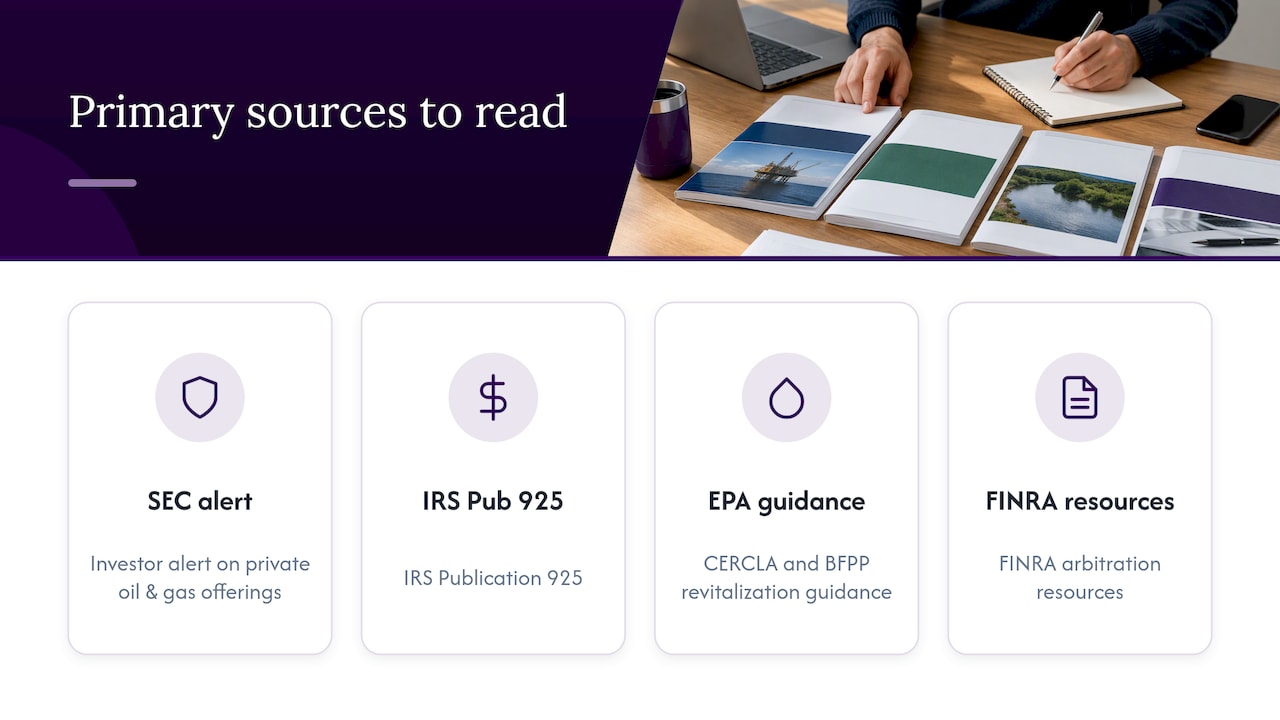
For verification, the core references here are the SEC’s investor alert on private oil and gas offerings, IRS Publication 925, EPA’s CERCLA and BFPP revitalization guidance, and FINRA’s arbitration resources.
This article is general information, not a substitute for advice from a qualified financial advisor. Consult a qualified financial professional about your own circumstances before acting on anything here.
Sources
- SEC: Private oil and gas offerings investor alert
- IRS Publication 925 (2021): Passive Activity and At-Risk Rules
- EPA: Revitalization Handbook — CERCLA landowner liability protections and BFPP guidance
FAQ
Can you write off oil investments on your taxes?
Working-interest oil and gas investments can qualify for significant first-year deductions under intangible drilling cost provisions, provided the interest is held in a form the IRS treats as an active, nonpassive activity. The exact deduction amount depends on the well’s drilling costs and your ownership structure, so a CPA should confirm eligibility before you count on a specific write-off.
Do oil and gas investors have to be paid back?
No. Private oil and gas offerings are equity or working-interest investments, not loans, so there is no guaranteed repayment of principal or return. Investors are paid from well production revenue if and when the project generates it, and a dry or underperforming well can return little or nothing.
Who is the biggest investor in oil globally?
Ownership of oil and gas assets worldwide spans national oil companies, major integrated energy corporations, and large institutional investors, and no single public ranking definitively names one entity as the largest investor across all categories. For a specific private deal, the more relevant question is who operates and who holds working interest in that project, which your due-diligence documents should show directly.
How much do I need to invest to earn a specific monthly income from oil?
There is no fixed investment amount that produces a guaranteed monthly income from oil and gas projects, since returns depend on well production, commodity prices, and the specific deal’s payout structure. Any sponsor promising a fixed monthly figure for a set investment amount should be treated as a red flag worth escalating to securities counsel.
Recommended

Get the Fieldvest Energy Brief
and AI-driven demand shifts — curated for accredited investors. Smart. Strategic. Tax-advantaged.