


TL;DR:
- Oil project underwriting involves a detailed assessment of viability, risks, and documentation before funding. It follows a structured 24-week process, emphasizing complete projects and strong contracts, especially offtake agreements. ESG compliance is now critical, with projects lacking credible plans facing automatic exclusion from major insurers and lenders.
The oil project underwriting process is a rigorous financial and technical evaluation that determines whether a project is viable, fundable, and worth the risk before capital is committed. Underwriting is defined as a granular assessment of project viability, sponsor quality, and risk exposure, focused on documentation, governance, and structural adequacy for funding. Oil and gas transactions made up 6.18% of EXIM’s financing portfolio in FY 2024, and insurers earned $750 million in fossil fuel premiums underwriting oil projects in 2025. Those figures reflect the scale and seriousness of capital at stake. This guide gives investors and finance professionals a practical framework for every phase of the oil project underwriting process, from prerequisites through financial close.
What are the key prerequisites for underwriting oil projects?
Underwriting cannot begin without a complete, credible project package. Lenders and underwriters reject incomplete submissions immediately, so preparation is the first competitive advantage a sponsor can build.
Documentation and capital structure
The foundation of any oil project funding guide starts with documentation integrity. Financial reconciliations, ownership structures, and all material contracts must be current, consistent, and verified before submission. Capital structure clarity is equally non-negotiable: equity contributions, debt tranches, reserve accounts, and contingency budgets must be defined with precision.

The contract package is the next layer. Offtake agreements, EPC contracts, and insurance policies form the commercial backbone that lenders scrutinize. A missing or unsigned offtake agreement signals unresolved market risk. An EPC contract without performance guarantees leaves construction risk unallocated, which lenders treat as a red flag.
ESG and sustainability readiness
Insurers and reinsurers require credible transition plans aligned with net-zero benchmarks, and underwriting policies now actively evaluate technical feasibility alongside ESG disclosures. This is not a soft requirement. Projects lacking credible net-zero transition plans or ESG alignment face automatic underwriting exclusion at major insurers.
A preliminary readiness checklist for sponsors includes:
- Audited financial statements for the project entity and key sponsors
- Signed or near-final offtake agreements with creditworthy counterparties
- EPC contract with performance guarantees and liquidated damages provisions
- Independent technical report from a qualified engineer
- Environmental and social impact assessment aligned with IFC Performance Standards
- ESG disclosure and net-zero transition plan with third-party verification
- Legal opinions on title, permits, and regulatory compliance
- Detailed financial model with sensitivity analysis and base case assumptions
Pro Tip: Run a mock lender review of your documentation package at least 60 days before submission. Gaps found internally cost days to fix. Gaps found by a lender cost months.
How does the step-by-step underwriting process unfold for oil projects?
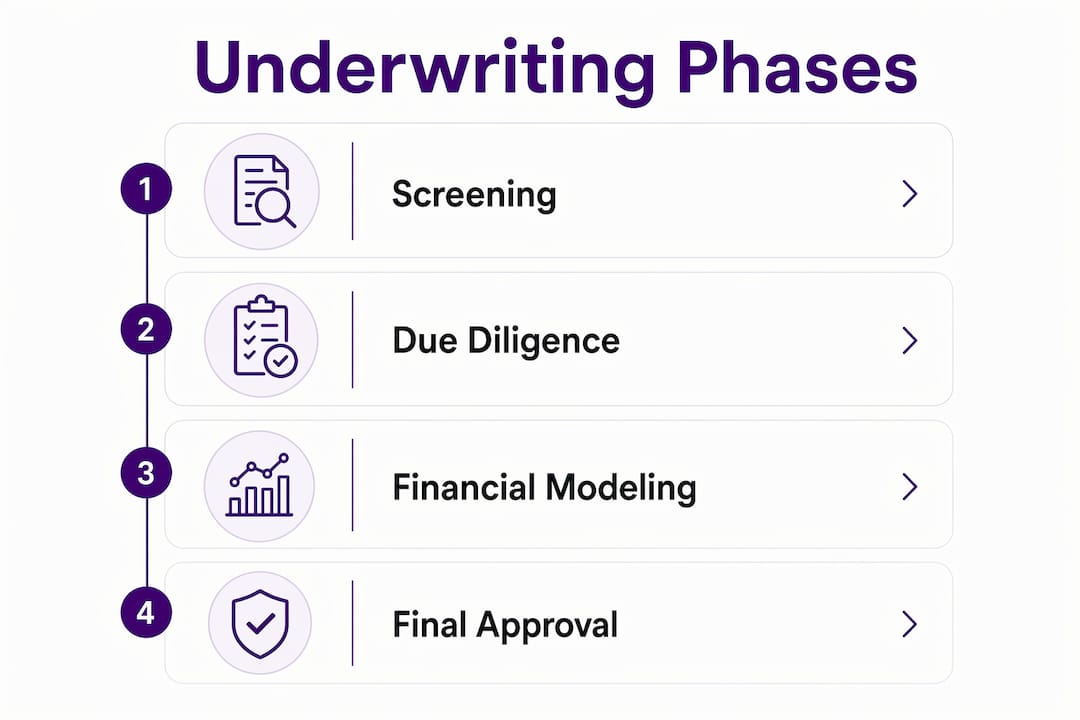
The typical project finance underwriting timeline for an oil project is about 24 weeks, divided into four distinct phases. Each phase has defined deliverables, decision gates, and involved parties.
The four phases of oil project underwriting
-
Screening and mandate (weeks 0–4). The lender or underwriter reviews the project information memorandum, assesses sponsor track record, and evaluates the capital structure at a high level. If the project passes initial screening, a mandate letter and indicative term sheet are issued. The term sheet defines pricing, structure, covenants, and conditions precedent in outline form.
-
Due diligence and model audit (weeks 5–14). This is the most intensive phase. Technical advisors review reservoir data, engineering reports, and construction plans. Financial advisors audit the financial model, stress-test assumptions, and validate revenue projections. Legal counsel reviews all contracts, permits, and title documents. Environmental consultants assess ESG compliance and transition plan credibility.
-
Credit committee evaluation (weeks 15–18). The lender’s internal credit committee reviews the full due diligence package and makes a go or no-go decision. The credit memo summarizes risk factors, mitigants, proposed structure, and pricing. Conditions precedent are finalized at this stage.
-
Documentation and financial close (weeks 19–24). Loan agreements, security documents, and intercreditor agreements are negotiated and executed. Conditions precedent are satisfied. Funds are drawn at financial close.
| Phase | Weeks | Key Deliverable |
|---|---|---|
| Screening and mandate | 0–4 | Indicative term sheet |
| Due diligence and model audit | 5–14 | Full due diligence report |
| Credit committee evaluation | 15–18 | Credit approval memo |
| Documentation and financial close | 19–24 | Executed loan agreements |
Pro Tip: Sponsors who submit a pre-audited financial model with documented assumptions cut two to three weeks off the due diligence phase. Lenders reward preparation with speed.
What are the critical risk factors in oil project financial evaluation?
Risk assessment is the core of any energy project risk assessment. Underwriters evaluate risk across four dimensions: commercial, technical, environmental, and governance.
Commercial and bankability risk
Lenders prioritize contracted revenue from signed offtake agreements with creditworthy counterparties. A project without such contracts is, in the words of experienced project finance practitioners, financed on “hope and best wishes.” Take-or-Pay clauses and minimum volume commitments are the gold standard for bankability because they transfer demand risk to the offtaker.
Sponsor quality is weighted heavily. Underwriters assess the sponsor’s track record, balance sheet, and ability to inject equity if cost overruns occur. A first-time sponsor with no completed projects faces a much higher bar than an operator with a portfolio of producing assets.
Technical and structural risk
Misalignment between technical design and commercial structure is one of the most common causes of underwriting failure. Lenders require that EPC performance guarantees align with the operating assumptions in the financial model. If the model assumes a 95% plant availability factor but the EPC contract only guarantees 88%, the gap creates a structural deficiency that credit committees will not approve.
Effective underwriting involves stress-testing assumptions early, including construction sequencing, operations and maintenance costs, and degradation logic. Lenders run downside scenarios at 70–80% of base case revenue to confirm debt service coverage ratios remain above covenant thresholds.
ESG and sustainability risk
“Underwriting policies are evolving to embed ESG and net-zero benchmarks, making sustainability an inseparable part of technical feasibility assessment.” — UNEP Finance Initiative, 2025
ESG risk is now a gating factor, not a checkbox. Third-party tools verify compliance with exclusion policies and sustainability governance standards. Sponsors who treat ESG as an afterthought find their projects excluded before technical review even begins. Understanding precision engineering requirements for oil and gas assets also feeds directly into ESG and technical risk assessments, since equipment reliability affects both safety records and emissions profiles.
Key risk factors underwriters evaluate include:
- Commodity price sensitivity and hedging strategy
- Counterparty credit quality of offtakers and EPC contractors
- Regulatory and permitting risk in the project jurisdiction
- Force majeure and political risk insurance coverage
- Debt service coverage ratio under base and downside scenarios
- ESG compliance and transition plan credibility
How can investors use underwriting insights to structure oil investments?
Understanding the underwriting process gives investors a direct advantage when evaluating oil project opportunities. The same criteria lenders apply are the criteria investors should apply when deciding whether to commit capital.
Portfolio construction and advance rates
Diversified portfolios in oil and gas historically outperform concentrated investments by approximately 15% over time. Spreading exposure across multiple projects, geographies, and asset types reduces the impact of any single project failure. Current market advance rates for project construction loans reach 85–90%, meaning lenders will fund up to 90 cents on every dollar of project cost for well-structured deals. That leverage ratio signals how much confidence the market places in bankable, well-documented projects.
Investors should evaluate oil and gas tax savings alongside underwriting quality. A project that passes rigorous underwriting often qualifies for intangible drilling cost deductions and depletion allowances that significantly reduce taxable income in the first year.
Structuring capital requests and draw schedules
A well-structured capital request includes a detailed draw schedule tied to construction milestones, a contingency reserve of 10–15% of total project cost, and a clear waterfall for cash distributions after debt service. Investors who understand these structures can negotiate better terms and identify projects where the capital structure creates unnecessary risk.
Oil diversification through Fieldvest illustrates how spreading exposure across vetted U.S. energy projects reduces concentration risk while maintaining access to the tax benefits unique to oil and gas investment. The underwriting process is the filter that separates projects worth structuring from those that should be passed.
Technology platforms and advisory services now give investors access to underwriting-grade data without building an in-house team. Platforms that aggregate project data, financial models, and ESG disclosures let investors apply lender-level scrutiny to their own due diligence process. The investor clarity platform approach integrates ESG, financial, and operational data in one place, which mirrors exactly what credit committees demand from sponsors.
Key Takeaways
Successful oil project underwriting requires complete documentation, bankable contracts, rigorous stress-testing, and ESG alignment before a single lender review begins.
| Point | Details |
|---|---|
| Documentation comes first | Incomplete packages are rejected immediately; prepare audited financials, contracts, and ESG disclosures before submission. |
| 24-week timeline is standard | Plan for screening, due diligence, credit approval, and financial close across a structured six-month process. |
| Offtake agreements drive bankability | Signed contracts with creditworthy counterparties are the single most important commercial risk mitigant for lenders. |
| ESG is a gating factor | Projects without credible net-zero transition plans face automatic exclusion from major underwriters and insurers. |
| Diversification improves returns | Diversified oil and gas portfolios have historically outperformed concentrated positions by approximately 15% over time. |
Why underwriting is the most underused tool in oil investment
Most investors treat underwriting as something lenders do to them. That framing is wrong, and it costs money.
The underwriting process is the most detailed stress test a project will ever face. Sponsors who internalize that process before submission arrive with stronger packages, faster approvals, and better pricing. Investors who understand what underwriters look for can identify weak projects before committing capital, not after.
The biggest mistake I see is sponsors submitting financial models that have never been challenged internally. Construction sequencing assumptions, O&M cost escalation, and degradation curves are often set at optimistic base case values with no sensitivity analysis. A lender’s first question is always “what happens if revenue is 20% below base case?” If the sponsor cannot answer that question confidently, the process stalls.
ESG is the other area where I see investors caught off guard. The shift from voluntary disclosure to mandatory exclusion happened faster than most sponsors anticipated. Projects that would have sailed through underwriting five years ago now face hard stops because transition plans are missing or unverifiable. This is not a trend that reverses. Investors who build ESG compliance into their project selection criteria from day one avoid the most expensive delays in the process.
The practical advice is simple: treat the underwriting checklist as your investment checklist. If a project cannot satisfy lender requirements, it probably cannot satisfy the risk tolerance of a disciplined investor either. The two standards are more aligned than most people realize.
— Sharif
Fieldvest connects investors to vetted oil projects with underwriting-grade clarity
Accredited investors who understand the underwriting process know what a fundable oil project looks like. Fieldvest applies that same rigor to every opportunity on its platform, connecting high-earning professionals with U.S. oil and gas operators whose projects have been evaluated for financial structure, contract quality, and risk profile.
The tax advantages of oil and gas investment are substantial. Intangible drilling costs and depletion allowances can generate large first-year deductions that reduce taxable income significantly. Fieldvest makes it straightforward to lower your taxes while building long-term energy income from projects that meet institutional underwriting standards. Investors who want underwriting-grade project access without building an in-house team start at Fieldvest.
FAQ
What is the oil project underwriting process?
The oil project underwriting process is a structured evaluation of a project’s financial viability, risk profile, sponsor quality, and contract integrity before lenders commit capital. It typically spans 24 weeks across four phases: screening, due diligence, credit approval, and financial close.
What documents are required to start underwriting an oil project?
Lenders require audited financials, signed offtake agreements, an EPC contract with performance guarantees, an independent technical report, environmental assessments, and a credible ESG transition plan before underwriting begins.
Why do offtake agreements matter so much in oil project financing?
Offtake agreements provide contracted revenue from creditworthy counterparties, which is the primary commercial risk mitigant lenders require. Projects without signed offtake agreements are considered speculative and are rarely bankable.
How does ESG affect oil project underwriting decisions?
Projects without credible net-zero transition plans face automatic exclusion from major insurers and underwriters. ESG compliance is now a gating factor evaluated alongside technical and financial criteria, not a separate optional disclosure.
How long does oil project underwriting typically take?
The standard project finance underwriting timeline is approximately 24 weeks, divided into screening and mandate (weeks 0–4), due diligence and model audit (weeks 5–14), credit committee evaluation (weeks 15–18), and documentation and financial close (weeks 19–24).
Recommended

Get the Fieldvest Energy Brief
and AI-driven demand shifts — curated for accredited investors. Smart. Strategic. Tax-advantaged.