


Oil and gas royalties count as ordinary income, taxed at your regular federal marginal rate of 10% to 37%, not at a special flat rate. The two big offsets are the percentage depletion deduction, typically 15% of gross royalty income, and state severance taxes that reduce the taxable amount before it ever reaches your Form 1040. You report the income on Schedule E unless you actually hold a working interest, which changes the math entirely.
TL;DR:
- Royalty income is taxed at your marginal rate from 10% to 37%, with the percentage depletion deduction typically at 15% of gross income, and state severance taxes reducing taxable income before filing.
- Depletion methods include percentage depletion, which is straightforward and usually utilized by small owners, and cost depletion, which is best if you have a documented basis in the mineral rights.
- Most royalty owners do not pay self-employment tax as royalties are passive income, but working interests are considered active and may trigger self-employment tax and the Net Investment Income Tax above certain income thresholds.
- Severance and ad valorem taxes are deducted at the state level before federal reporting, and it is crucial to reconcile operator statements with 1099s to avoid double deductions or errors.
- Proper classification of income—royalty versus working interest—and accurate tracking of basis and depletion are vital for maximizing deductions and avoiding IRS notices.
Table of Contents
- What Is the Oil Royalty Tax Rate at the Federal Level?
- Percentage Depletion vs. Cost Depletion: The 15% Deduction Explained
- Self-Employment Tax and the Net Investment Income Tax
- How Severance and Ad Valorem Taxes Reduce Your Taxable Royalty Income
- Filing Mechanics: Forms, Lines, and Quarterly Payments
- Inherited Royalties, Multiple Payers, and Working-Interest Confusion
- A Worked Example: Calculating Your Effective Royalty Tax
- Tax Implications of Joint Ventures and Partnerships
- Does Fracking or Horizontal Drilling Change Your Royalty Tax Rate?
- Recent Legislative Changes Affecting Oil Royalty Taxes
- State-Level Credits and Incentives Worth Checking
- How Lease Bonuses Are Taxed Differently From Royalties
- What Most Royalty Owners Get Wrong About Their Tax Bill
- Another Route to Consider: Investing Directly in Oil and Gas Projects
- Sources
What Is the Oil Royalty Tax Rate at the Federal Level?
There is no dedicated “royalty tax rate.” The IRS treats royalty payments as ordinary income, folded into whatever tax bracket your total income lands in, from 10% up to 37% at the top marginal rate. A retired teacher collecting $4,000 a year from a small Ohio lease might pay 12%. A tech executive with $600,000 in W2 income collecting $80,000 in royalties pays 37% on that royalty stack, because it’s taxed at the top of the pile, not on its own curve.

Operators send you a Form 1099-MISC with the gross royalty amount in Box 2. That figure flows to Schedule E, Part I, where you report it alongside deductions for production taxes and depletion before the net amount hits Form 1040. Royalty income is never treated as a capital gain, even though it comes from a depleting mineral asset. That distinction trips up a lot of first-time royalty recipients who assume it gets the lower long-term capital gains treatment. It doesn’t.
The Schedule E versus Schedule C question matters more than most owners realize:
- Royalty interest (you own the minerals, someone else drills and pays you a share) goes on Schedule E as passive income.
- Working interest (you bear a share of drilling and operating costs) is generally reported on Schedule C, and it’s treated as a trade or business, which triggers self-employment tax.
- Mixed arrangements, common in some joint venture structures, need careful classification, because misreporting a working interest as a royalty interest understates your tax liability and invites an IRS notice.
Your operator statement, the document that accompanies the 1099, usually shows gross production value, deductions for severance tax and transportation, and the net amount actually paid to you. Reconcile that statement against the 1099 every year. Discrepancies are common when an operator sells the property mid-year and two different payers issue partial-year 1099s.
Percentage Depletion vs. Cost Depletion: The 15% Deduction Explained
Depletion is the single biggest tax lever most royalty owners never fully use. Because oil and gas are wasting assets, the tax code lets you deduct a portion of royalty income each year to reflect the resource being used up, similar in spirit to depreciation on a building. There are two methods, and you’re required to calculate both every year, then claim whichever produces the larger deduction.
- Percentage depletion. The statutory rate is generally 15% of gross royalty income, applied regardless of how much you actually paid for the mineral rights. This is the method almost every small royalty owner ends up using, because it doesn’t require tracking your original cost basis in the minerals.
- Cost depletion. This method divides your basis in the mineral property by the estimated total recoverable units, then multiplies by units sold during the year. It only matters if you have a documented basis, usually from purchasing mineral rights outright or inheriting them at a stepped-up value.
Two statutory limits can shrink or eliminate the percentage depletion benefit, and both trip up owners who assume the deduction is automatic:
- The deduction cannot exceed 100% of net income from that specific property.
- Total percentage depletion across all your oil and gas properties cannot exceed 65% of your overall taxable income for the year, calculated before the depletion deduction itself.
Owners who hit the 65% cap usually have very high royalty income relative to modest other income. It’s a narrow edge case, but a working retiree living mostly off royalties can bump into it.
Pro Tip: Keep a running spreadsheet of your original mineral rights basis, even if you’re currently using percentage depletion. If percentage depletion ever gets disallowed by one of the caps, you’ll need cost depletion figures ready, and reconstructing decades-old basis from memory is nearly impossible.
A breakdown of oil and gas depreciation methods covers how depletion interacts with depreciation on equipment for owners who also hold a working interest, which is worth reviewing if your royalty arrangement includes any operating cost exposure.
Self-Employment Tax and the Net Investment Income Tax
Most royalty owners never pay self-employment tax on that income, because a passive royalty interest isn’t a trade or business under IRS rules. A working interest is different.
The Net Investment Income Tax is the surtax that catches high earners off guard.
- NIIT adds a 3.8% surtax on net investment income, including passive royalties, once modified adjusted gross income crosses $200,000 for single filers or $250,000 for married filing jointly.
- You calculate and report it on Form 8960, which nets your investment income against certain investment expenses before applying the 3.8% rate.
- Depletion deductions reduce the royalty income figure that flows into the NIIT calculation, so a strong depletion claim lowers both your regular tax and your NIIT exposure at once.
A dual-income household with $180,000 in wages and $90,000 in royalties clears the $250,000 joint threshold and owes NIIT on a portion of that royalty income, even though neither spouse would call themselves a high earner in isolation.
How Severance and Ad Valorem Taxes Reduce Your Taxable Royalty Income
Before your royalty check ever arrives, the state has usually already taken its cut. Severance tax is a production tax charged on the value or volume of oil and gas extracted, and operators typically withhold it directly from the gross royalty amount before distribution.
- Severance tax rates vary widely by state, and your operator statement will typically itemize the amount withheld separately from transportation or other deductions.
- You deduct production and severance taxes on Schedule E, alongside depletion, which lowers your reportable net royalty income for federal purposes.
- Ad valorem taxes, a form of local property tax on the value of the mineral interest itself, are handled separately in some states and may appear as a distinct line item rather than being bundled into severance withholding.
The Penn State Extension guidance on natural gas taxation walks through state-specific examples of how these production taxes get itemized, which is useful if you’re trying to match your operator statement’s terminology to what shows up on your federal forms.
Here’s the part that surprises new owners: the severance tax withheld at the wellhead does not disappear from your tax picture, it just shifts. You still deduct it federally, but you never get to claim it twice. If your operator statement already shows a “net” royalty figure with severance tax backed out, and you also try to deduct that same severance tax on Schedule E, you’ve double counted a deduction that doesn’t exist. Always start from the gross figure and deduct severance tax yourself, rather than assuming the 1099 already reflects a post-tax number.
Filing Mechanics: Forms, Lines, and Quarterly Payments
Getting the paperwork right matters as much as understanding the rates. Here’s the sequence that keeps most royalty owners out of trouble.
- Collect every 1099-MISC. If a property changed operators mid-year or you own interests in multiple wells, you may receive several forms, and the Box 2 royalty figures need to be aggregated correctly by property on Schedule E.
- Reconcile against operator statements. Match gross production value, severance tax withheld, and net payment on each statement to the corresponding 1099 before you enter anything on your return.
- Complete Schedule E, Part I, listing each royalty property separately, with gross income, deductions for taxes and depletion, and net royalty income carried to Form 1040.
- Run Form 8960 if your income is anywhere near the NIIT thresholds, even if you don’t think you’ll owe it. It takes ten minutes and confirms you’re not missing a surtax liability.
- Set quarterly estimated payments if your royalty income is substantial and no withholding covers it. The IRS due dates fall in April, June, September, and January of the following year.
The IRS Topic No. 559 guidance on natural resources is worth bookmarking, since it lays out the passive-income treatment and documentation expectations directly from the source.
Inherited Royalties, Multiple Payers, and Working-Interest Confusion
Three scenarios generate more reader questions than everything else combined.
- Inherited mineral rights get a stepped-up basis to fair market value on the date of death, which resets your cost depletion calculation from scratch and often makes cost depletion worth comparing again, even if the original owner always used the percentage method.
- Multiple payers on one property happen when ownership interests are fractional or when an operator sells mid-year. Track each 1099 by property, not just by payer name, because the IRS matches income by payer and mismatches trigger notices.
- Royalty versus working interest hinges on one question: do you share in the operating costs and liability of production, or only in the revenue? If you’re unsure, check the original lease or division order language before filing, not after.
For readers managing inherited mineral rights alongside other estate assets, guidance on U.S. inheritance considerations covers related documentation issues worth reviewing alongside your basis calculation.
A Worked Example: Calculating Your Effective Royalty Tax
Start with the year-end checklist:
- Gather every 1099-MISC and matching operator statement.
- Total severance tax withheld across all properties.
- Calculate percentage depletion (15% of gross) and cost depletion, then take the larger figure.
- Apply the 100% net-income and 65% taxable-income caps if your royalty income is unusually high relative to total income.
Now the math. Say you received $20,000 in gross royalties, with $1,200 in severance tax withheld by the operator. Percentage depletion at 15% removes another $3,000. Your taxable royalty income drops to $15,800, before it even gets stacked on top of your other income at your marginal rate. Based on your marginal tax rate, you can roughly estimate federal tax on the royalty amount accordingly, with depletion reducing your taxable base.
Run this math through Fieldvest’s free tax deduction calculator before tax season, and hand the output to your preparer along with your operator statements. It saves a round of back and forth.
Tax Implications of Joint Ventures and Partnerships
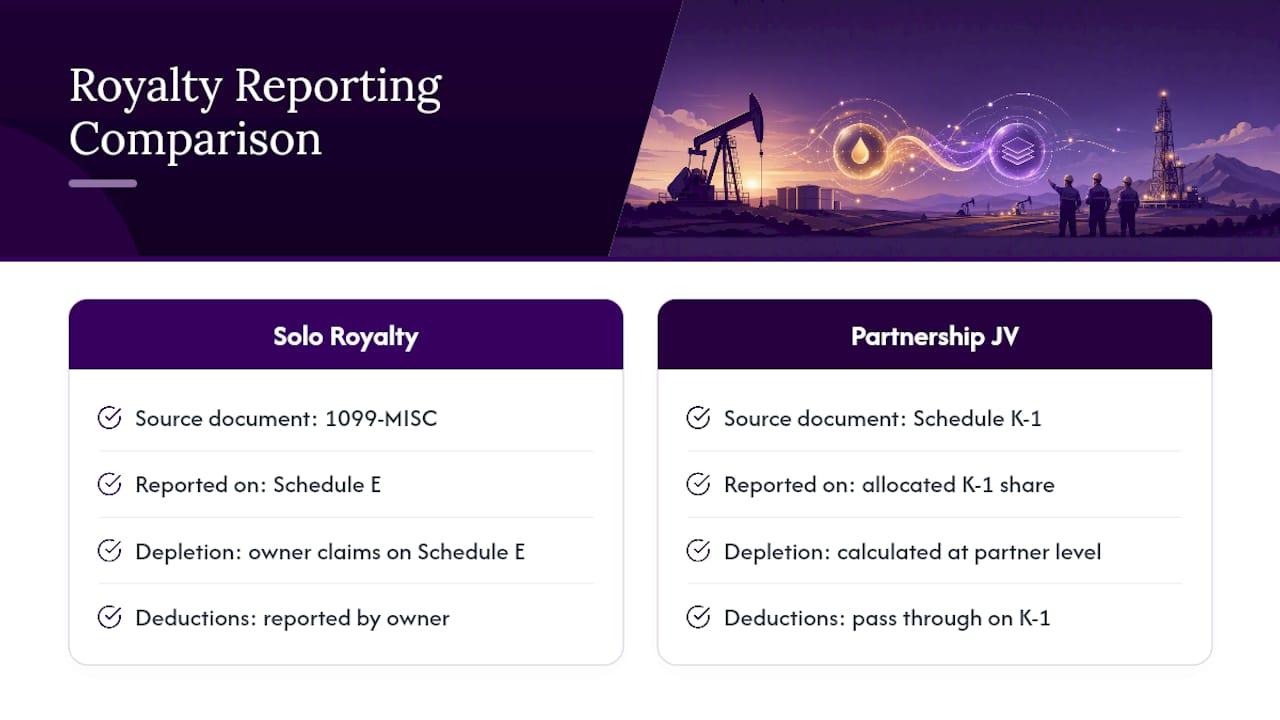
Joint ventures in oil and gas royalties introduce a layer most solo mineral owners never deal with. When multiple parties pool mineral rights or working interests into a partnership structure, the entity typically files its own return (Form 1065) and issues each partner a Schedule K1 rather than a 1099-MISC.
That changes your reporting mechanics entirely. Instead of entering gross royalty income directly on Schedule E from a 1099, you’re now reporting your allocated share of partnership income, deductions, and depletion as passed through on the K1. Depletion in a partnership context is calculated at the partner level in many structures, not the partnership level, because each partner’s basis in the mineral property can differ based on how they acquired their interest.
Joint ventures also raise the working interest question more often than solo royalty ownership does. Partnerships formed specifically to develop a lease frequently structure participants as working interest holders sharing drilling costs, which means self-employment tax exposure becomes a partnership-wide issue rather than an individual one. Before signing onto any joint venture agreement involving mineral rights, get clarity in writing on whether your allocated interest is royalty, working interest, or a hybrid, because that single classification decision determines whether you’re filing Schedule E or dealing with SE tax and Schedule C treatment for years to come.
Does Fracking or Horizontal Drilling Change Your Royalty Tax Rate?
The drilling method itself doesn’t change your tax rate. Whether the well was drilled vertically decades ago or horizontally with modern hydraulic fracturing techniques, the income you receive is still ordinary royalty income taxed at the same marginal rates, and depletion still applies the same way.
What changes is the volume and timing of income, and that indirectly affects your tax exposure. Horizontal drilling and fracturing techniques dramatically increased recoverable reserves from a single well pad, particularly across shale plays. That means royalty owners in those regions often see much larger, front-loaded payments in a well’s early production years compared to the slow, steady trickle typical of older conventional wells. A big first or second year of production can push a royalty owner into a higher marginal bracket than they expected, or over the NIIT threshold, purely because the well is producing faster than older technology allowed.
This also affects the depletion math in a subtle way. Owners in high-volume shale regions should watch both the marginal bracket and the depletion caps more closely than owners with older, slower-declining wells.
Recent Legislative Changes Affecting Oil Royalty Taxes
Federal treatment of royalty income itself, ordinary income taxed at marginal rates with percentage depletion available, has stayed structurally stable for years. Where the changes show up is at the margins, particularly around industry-specific excise taxes and surtax administration.
The reinstatement of the Superfund excise tax on petroleum, effective for barrels handled starting January 1, 2023, is a good example of a change that affects the broader industry cost structure without directly changing an individual royalty owner’s rate. That tax, combined with the petroleum oil spill tax rate, applies at the refinery and import level, not the mineral owner level, but it can influence the netback price operators are willing to pay for production, which indirectly touches royalty valuations over time.
NIIT thresholds and percentage depletion limits haven’t been indexed or restructured in a way that changes the fundamentals covered in this guide. That stability is actually useful for planning purposes. Always confirm current-year figures with a preparer before filing, since surtax thresholds and excise components can shift with new legislation.
State-Level Credits and Incentives Worth Checking
State severance tax rates vary enormously, and so do state-level credits tied to oil and gas activity. Some states offer reduced severance rates for wells using enhanced recovery techniques or for production from marginal, low-output wells, which can directly increase the net royalty amount an owner receives even though it doesn’t touch federal treatment.
A handful of states also provide property tax exemptions or reduced ad valorem assessments for mineral interests below certain valuation thresholds, which matters more for owners with small fractional interests across many properties than for owners with one substantial well. Because these provisions are state-specific and change more frequently than federal rules, check your state’s department of revenue or the extension office covering your production region rather than relying on a national guide for exact percentages.
The practical takeaway: your operator statement is the best real-time signal of what your state is actually withholding and crediting. If the severance tax line looks unusually low or high compared to a neighboring property in a different state, that’s worth a call to your operator’s royalty department before you assume it’s an error.
How Lease Bonuses Are Taxed Differently From Royalties
A lease signing bonus is not royalty income, and mixing the two up on your return is one of the more common errors among first-time mineral owners. A bonus is a one-time payment for granting the lease, paid regardless of whether the well ever produces a barrel of oil.
Bonuses are still ordinary income, taxed at your marginal rate, but they are not eligible for percentage depletion, because depletion only applies to income tied to the actual extraction and sale of the mineral resource.
Bonuses are typically reported on the 1099-MISC as well, but operators sometimes use a different box or issue a separate 1099 entirely depending on how the lease was structured. Check the form carefully rather than assuming every dollar from an operator lands in the same royalty bucket. If a bonus and royalty income both appear on the same 1099, separate them clearly on your own records, because only the royalty portion carries into your depletion calculation on Schedule E.
What Most Royalty Owners Get Wrong About Their Tax Bill
The biggest mistake mineral owners make isn’t miscalculating depletion, it’s failing to calculate it at all. A surprising number of small royalty owners simply report the net figure from their operator statement and skip the depletion deduction entirely, either because they don’t know it exists or because their tax software doesn’t prompt for it clearly. That’s real money left on the table every single year, compounding as long as the well keeps producing.
The second mistake is treating royalty income like a footnote instead of an asset class with its own planning logic. Owners who track their basis, run the depletion comparison annually, and watch their proximity to the NIIT threshold tend to keep meaningfully more of every royalty dollar than owners who file on autopilot. A specialist preparer who handles oil and gas returns regularly, rather than a generalist, often pays for their own fee in the first year just by catching a missed depletion claim or a misclassified working interest. If your royalty income has grown past a few thousand dollars a year, that specialist conversation is worth having. Resources on oil and gas tax advantages for high earners walk through additional scenarios worth testing against your own numbers.
— Sharif
Another Route to Consider: Investing Directly in Oil and Gas Projects
If you’re already paying close attention to depletion caps and NIIT thresholds because your royalty income is substantial, you’re the kind of investor who might benefit from the other side of this equation: direct investment in vetted U.S. oil and gas projects rather than passive royalty ownership alone.

Certain oil and gas investment structures offer large first-year tax deductions tied to drilling and development costs, on top of the long-term income potential once wells start producing. Some platforms connect accredited investors with operators offering that combination: upfront deductions plus ongoing energy income, without you having to source or vet deals on your own. These opportunities require accredited investor status and carry the risks inherent to energy production, so they’re not a fit for every royalty owner, and none of this replaces a conversation with your own tax advisor before shifting strategy.
Run your numbers first. Fieldvest’s free Oil & Gas Tax Deduction Calculator shows what a first-year deduction could look like for your income bracket, and the guide to lowering your taxes with oil and gas investments walks through how accredited investors typically structure these deals.
This article is general information, not a substitute for advice from a qualified financial advisor. Consult a qualified financial professional about your own circumstances before acting on anything here.
Recommended

Get the Fieldvest Energy Brief
and AI-driven demand shifts — curated for accredited investors. Smart. Strategic. Tax-advantaged.