


Operator insurance in an oil deal is not one policy. It is a stack of separate policies, each built for a different kind of loss, and the stack protects the project and the operator’s balance sheet, not your expected return. Before you commit capital, you want to see which policies exist, what limits they carry, what they exclude, and whether they actually apply to the well or project you are funding.
This guide walks through each layer, the contract and bonding rules that shape required coverage, the exclusions that trip up deals, and a practical way to verify an operator’s insurance as an accredited investor.
TL;DR
- Operator insurance is a stack: general liability, control of well (operator’s extra expense), workers’ compensation, commercial auto, and equipment or property cover. No single policy covers everything.
- Control of well is the high-severity layer. Its limit should reflect a realistic worst case for the specific well, not a generic budget.
- Exclusions, definitions and endorsement wording decide whether a claim pays. Read the policy language alongside the contract, not just the summary.
- A certificate of insurance shows policy periods and limits, but it confers no rights by itself. Ask for the endorsements too.
- Insurance does not guarantee production, prices or returns. It responds to defined events, so treat it as one part of your diligence.
Table of Contents
- What operator insurance actually covers
- Control of well: the layer that matters most
- Limits and requirements: contracts, leases and bonds
- Exclusions, deductibles and gaps
- What insurance does not protect for an investor
- How to verify an operator’s insurance
- Our perspective
- See vetted energy projects
- FAQ
- Sources
What operator insurance actually covers
An operator running wells carries several kinds of risk at once: a person gets hurt, a truck causes an accident, equipment is damaged, a well gets out of control. Insurers handle these with separate products. According to a US insurance guide for operators and service companies, the typical stack looks like this:
| Policy | What it addresses | Why an investor cares |
|---|---|---|
| Commercial general liability (CGL) | Third-party bodily injury and property damage | Lawsuits from neighbors, contractors or visitors can drain project cash |
| Control of well / operator’s extra expense (OEE) | Blowout, regaining control, redrilling, and, depending on the form, pollution and cleanup | The largest single-event exposure on a drilling project |
| Workers’ compensation | Injuries to employees | Mandatory for employees and a common source of claims |
| Commercial auto | Vehicles used in operations | Personal auto policies generally do not cover work trucks |
| Equipment and property | Physical damage to rigs, tanks and facilities | Protects the assets that produce the income |
The point of the table is the separation. A strong general liability policy tells you nothing about whether a blowout is covered, and a well-control policy does nothing for a crew member’s injury. When an operator says “we are fully insured,” the useful follow-up is: which policies, at what limits, and for which operations?
Control of well: the layer that matters most
Control of well, often sold as operator’s extra expense, covers the cost of regaining control of a well and redrilling, and, depending on the form, seepage, pollution, cleanup and evacuation expense, per the same operator insurance guide. It exists because a loss of well control is rare but can be enormously expensive.
The product has a long history. LSU researchers describe how control of well insurance evolved over decades from a basic well-control product into comprehensive operator extra expense packages designed for modern offshore and catastrophe risks. For an onshore investor the lesson is simple: the label on the policy matters less than what the form actually pays for.
The limit is the number to question. The guide’s advice is that the control of well limit should reflect a realistic worst-case scenario for the specific well, considering depth, pressure and location, rather than a generic budget. A shallow, low-pressure well and a deep, high-pressure one do not belong on the same limit. If an operator quotes one blanket figure across every project, ask how it was set.
For a deeper look at timing, our piece on checking well control insurance before spud covers why coverage should be confirmed before drilling begins, not after.
Limits and requirements: contracts, leases and bonds
No single national rule sets how much insurance every oil operator must carry. Required coverage usually comes from three places: the contracts the operator signs, the lease or land terms, and, on federal land, bonding rules.
Contract-driven limits
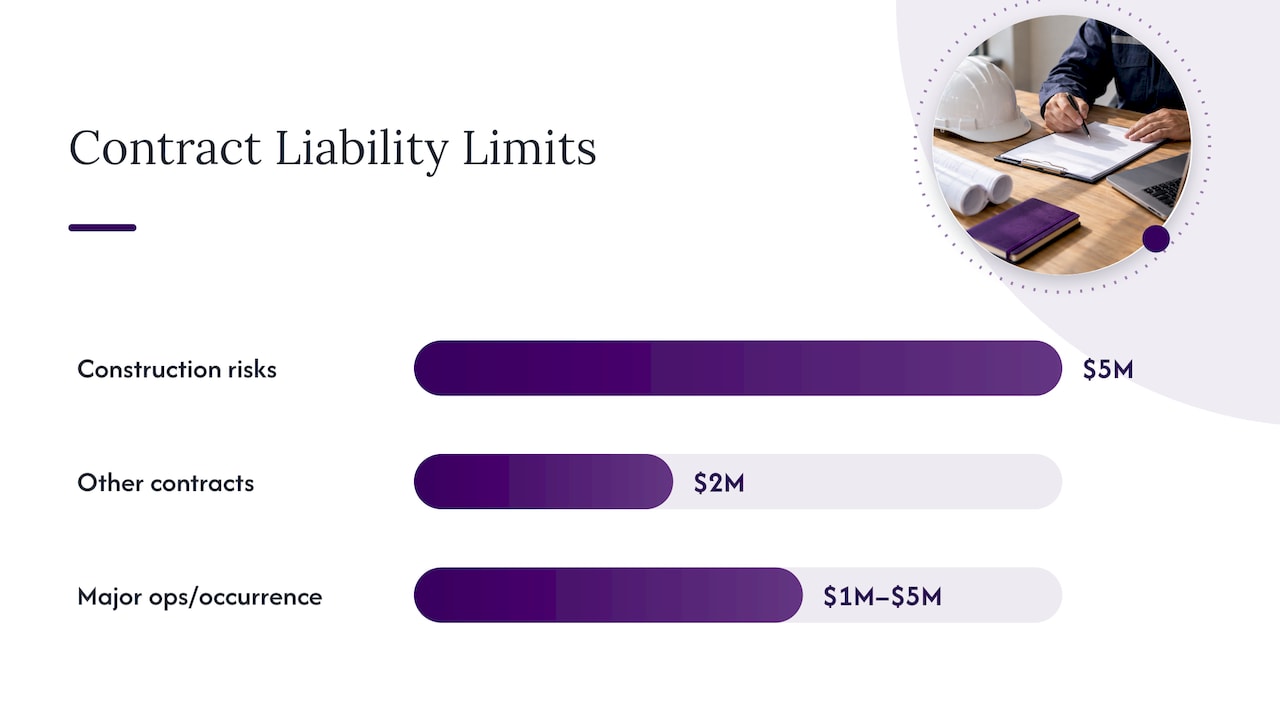
Most limits are negotiated. One widely used insurance requirements manual from a national broker recommends $5 million in general liability for construction risks and $2 million for other contracts, with higher limits for major projects. On the service side, one overview of oilfield contractor insurance is often cited with figures of $1 million to $5 million per occurrence required by major operators, but treat any such range as a starting point, not a rule. Your project’s risk profile sets the real number.
The same manual says contracts should require the other party to add the relevant entity as an additional insured on required liability coverage by endorsement. That detail matters: being named in a contract is not the same as being covered by the policy.
Federal lease bonding
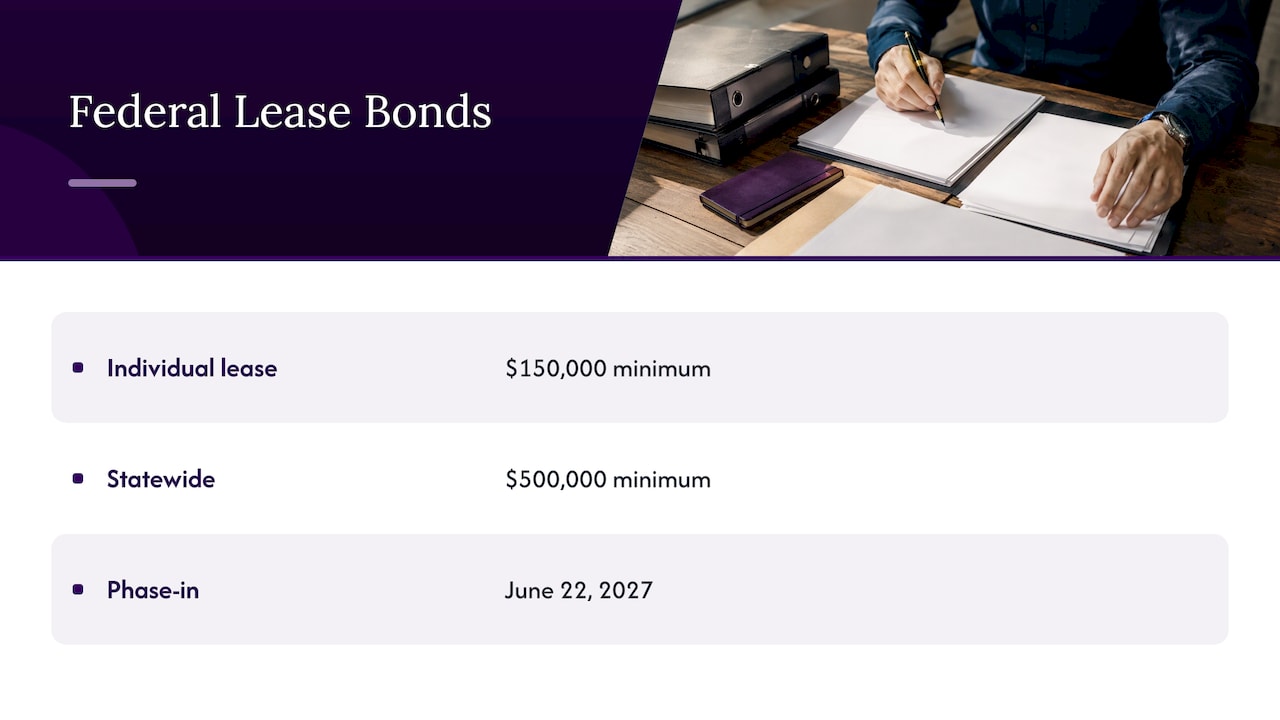
If a project drills on federal leases, a different kind of protection applies. According to the Bureau of Land Management, the operator on the ground must be covered by a surety or personal bond before surface-disturbing drilling begins. Minimum bonds are $150,000 for an individual lease and $500,000 statewide, with a phase-in by June 22, 2027.
A bond is not insurance. It is a financial guarantee aimed at reclamation and obligations on the lease. Still, it is part of the protection picture, and the BLM can raise it. Under BLM bond adequacy guidance, the agency may review and increase bonds when activity or risk factors rise, when the bonded party transfers all its lease interests, or when it is notified of an operator change. If the operator on your project may change, find out how that affects the bond.
Our guide to operator roles in U.S. oil and gas projects explains who actually holds these obligations on a deal.
Exclusions, deductibles and gaps
The headline limit is rarely where a claim is won or lost. The fine print is. One insurance trade article on oil and gas policies makes the point that differences in exclusions, definitions, endorsement wording or insuring agreements can leave a policy at odds with what the parties intended. Its author frames the review around four Cs: contracts, coverages, costs and claims. A companion piece adds that contracts and coverages should be read together, because subtle policy differences can change the outcome of a specific claim.
What a real policy form excludes
A recent energy exploration and development policy form from November 2025 gives a concrete picture. Its exclusions include fines and penalties, punitive damages, war-related losses, and claims arising from breach of warranties or due-diligence conditions. The same form makes due care and reasonable efforts to prevent an occurrence a condition precedent, so underwriters are not liable for losses caused or contributed to by a breach.
That last point deserves attention. An operator that cuts corners on maintenance or procedures may find that the policy it paid for does not respond. Insurance quality and operating quality are connected, which is why we look at both when we screen operators.
Deductibles and replacement value
Deductibles shift cost back to the insured. As one example of a public risk standard, Los Angeles County’s insurance manual from May 2026 says property insurance should generally be maintained at full replacement value, with deductibles typically restricted to no more than 5% of total insured value. It is not an oilfield rule, but it shows a reasonable benchmark for asking whether an operator’s property deductibles are sensible against the asset base.
Additional insured status has limits
If your entity, or the project entity, is meant to be an additional insured, read the fine print. BakerHostetler’s Texas oilfield indemnity handbook notes that the Texas Supreme Court has established that additional insured status is often limited by the scope of the underlying contractual indemnity. Because those rights are tied to the indemnity, the legal agreements must be drafted so insurance protection is not narrower than the indemnity obligation. The contract is as important as the policy.
To see how those contract terms fit the rest of a deal, read how to navigate oil deal terms.
What insurance does not protect for an investor
This is the part that gets lost in a deal summary. Operator insurance is written to respond to defined events, such as an injury, a fire or a loss of well control. It is the operator’s cover, bought to protect operations and assets. A few things follow from that.
- It does not guarantee production. A well that underperforms geologically is not an insured event.
- It does not guarantee commodity prices or income. Cash flow depends on output and market prices, which no operator policy covers.
- It only pays what the form and conditions allow. Exclusions, deductibles, limits and conditions such as due care all narrow what you can recover.
- It may not apply to you directly. Unless you or your vehicle are an insured or additional insured under the policy terms, you are relying on the operator’s balance sheet and the project’s structure.
That is why insurance review belongs next to other diligence, not in place of it. Our risk mitigation steps for oil projects and underwriting process guide show how it fits. If you are also thinking about spreading exposure across assets, see how diversification is structured.
How to verify an operator’s insurance
The standard document is the certificate of liability insurance. A real example, a certificate issued to an energy company, shows what to look for: policy periods, limits, and the operations described, plus a note that additional insured status is in accordance with policy provisions.
The same certificate says it confers no rights, and that an additional insured must be covered under the policy provisions or by endorsement. In other words, the certificate is a snapshot, not the policy. Use it as a prompt for further questions.
A practical checklist
- Request current certificates for every policy in the stack, and check that the policy period covers the whole drilling and operating timeline you expect.
- Match the named operations on the certificate to the actual project: the right state, well type and activity.
- Ask for the endorsements that make you or the project entity an additional insured, and read their wording.
- Compare control of well limits to the well’s depth, pressure and location, not to a generic figure.
- Read the exclusions and conditions, especially fines, penalties, pollution wording and due-care conditions.
- Check the bond if the project sits on federal leases, and ask what happens if the operator changes.
- Compare the contract’s indemnity to the insurance, so protection is not narrower than the promise.
- Set a renewal check. Policies expire. Ask how and when the operator will show you renewed coverage.
If you are reviewing paperwork before signing, the subscription agreement checklist and the escrow red flags guide cover the documents that sit beside the insurance file. For liability exposure on the investor side, see our EPA, IRS and SEC liability playbook.
Our perspective
Insurance is where an operator’s discipline shows up on paper. A team that carries the right stack, sets control of well limits against the actual well, and hands over certificates and endorsements without friction is usually a team that runs the rest of the project the same way.
That is how we think about diligence at Fieldvest. Our platform is built around vetted and screened operators, and around presenting key project materials in a streamlined way so you can compare deals side by side. Insurance documents belong in that comparison, next to the operator’s track record, the project terms and the structure of the deal.
We would rather an investor ask hard questions about coverage before committing than discover the gaps afterward. Our aim is deal transparency for accredited investors who want tax-advantaged energy exposure and expect to understand what stands behind it. Coverage is one of the clearest signals of that quality, and we encourage you to look for it in every deal you review.
Sharif
See vetted energy projects
If you are an accredited investor reviewing energy deals, Fieldvest lets you evaluate private projects across producing assets, development projects and energy infrastructure, with key project materials presented for comparison. You can browse the current opportunities and the documentation available for each on the Fieldvest platform.

If the tax side is what brought you here, our guide on how to lower your taxes with oil and gas investments explains the basics, and the oil and gas investing guide for accredited investors gives the wider context.
FAQ
What insurance should an oil and gas operator carry?
Operators generally carry a stack: commercial general liability, control of well or operator’s extra expense, workers’ compensation, commercial auto, and equipment or property cover. Each addresses a different risk, so ask which policies exist and at what limits. The right mix depends on the wells, the location and the contracts involved.
Does operator insurance protect my investment?
It protects the operator and the project from defined events such as injuries, property damage or a loss of well control, which indirectly supports the project’s financial health. It does not guarantee production, prices or returns. Exclusions, deductibles and limits all affect what actually gets paid.
How do I know an operator’s insurance is current?
Request current certificates of insurance and check the policy periods, limits and described operations. Remember that a certificate confers no rights on its own, so also ask for the endorsements that name you or the project entity as an additional insured.
What is control of well insurance?
Control of well, often sold as operator’s extra expense, covers the cost of regaining control of a well and redrilling. Depending on the form, it can also respond to seepage, pollution, cleanup and evacuation expense. Its limit should be set against the specific well’s depth, pressure and location.
Do federal lease bonds replace insurance?
No. A bond is a financial guarantee required before surface-disturbing drilling on federal leases, with minimum amounts of $150,000 per lease and $500,000 statewide per the BLM. It serves a different purpose than liability or well-control insurance, so a project can need both.
Sources
- Oil and Gas Insurance: What Operators and Service Companies Need to Know
- Diversifying Energy Industry Risk in the Gulf of Mexico (LSU)
- Insurance Requirements in Contracts 2026.1
- Oil and Gas Leasing: Bonding (Bureau of Land Management)
- Oil and Gas Bond Adequacy Reviews (BLM)
- In the oil and gas sector, all policies are not the same (Insurance Journal)
- For O&G operators, contracts and coverages go hand in hand (Insurance Journal)
- Energy Exploration and Development Insurance form, November 2025
- Insurance and Indemnification Manual, May 2026 (Los Angeles County)
- Texas Oilfield Indemnity Handbook (BakerHostetler)
- Certificate of Liability Insurance example
Recommended

Get the Fieldvest Energy Brief
and AI-driven demand shifts — curated for accredited investors. Smart. Strategic. Tax-advantaged.