


Oil and gas income can qualify for the 20% qualified business income (QBI) deduction under Section 199A, but only some of it does. Income from a working interest that rises to a trade or business generally can. Passive mineral royalties generally cannot. For high earners, W-2 wage and property limits, drilling-cost deductions and your filing structure then decide how much of the 20% you keep.
This guide explains where the line falls, what changed for 2026, and how to think about the deduction next to the other tax levers in energy investing.
TL;DR
- Working interest income can be QBI if the activity is a trade or business under Section 162. Passive royalty income is generally treated as investment income and is not.
- You do not have to materially participate to claim the deduction, according to the IRS instructions for Form 8995-A, but the activity must still be a qualifying trade or business.
- Section 199A did not expire after 2025. The One Big Beautiful Bill Act kept it, and 2026 brought new thresholds.
- Above the income thresholds, W-2 wages and the basis of qualified property cap the deduction. Oil and gas is often property-poor on that test because depletable assets do not count.
- Intangible drilling costs and depletion change your net QBI, so model the deductions together rather than one at a time.
Table of Contents
- What the QBI deduction is
- Does oil and gas income count as QBI?
- Do you have to materially participate?
- What changed for 2026
- Why high earners hit limits in oil and gas
- Drilling costs and depletion change the QBI math
- Perspective: how we think about QBI in energy deals
- Where QBI fits with the other energy tax tools
- A checklist before you rely on QBI
- Looking for a working interest to review
- FAQ
- Sources
What the QBI deduction is
Section 199A lets owners of pass-through businesses deduct up to 20% of their qualified business income when they compute their individual income tax. The Congressional Research Service describes it as a deduction against taxable income for owners of pass-through businesses such as partnerships, S corporations and sole proprietorships.
The statute defines QBI as the net amount of qualified items of income, gain, deduction and loss from a qualified trade or business, as written in 26 U.S. Code § 199A. Three words in that sentence matter for energy investors: net, qualified and trade or business.
- Net means deductions inside the activity reduce the QBI. Large first-year write-offs shrink the base the 20% applies to.
- Qualified means certain items are carved out, including capital gains and investment-type income.
- Trade or business means the activity must be a business under Section 162, not just an investment.
The deduction is also capped at 20% of your taxable income, figured before the QBI deduction and reduced by net capital gain, per the IRS Form 8995-A instructions.
Does oil and gas income count as QBI?
It depends on the type of interest you hold and how the income is reported.
| Type of interest | Typical tax character | QBI treatment |
|---|---|---|
| Working interest in a producing well or development project | Business income, reported through the operator’s pass-through structure or on Schedule C | Can qualify if it is a Section 162 trade or business |
| Passive mineral royalty | Rental and royalty income, usually Schedule E | Generally does not qualify |
| Wages from an oil and gas employer | Employee compensation | Does not qualify |
| Capital gains from selling an interest | Capital gain | Does not qualify |
Tax Notes analysis of the TCJA’s effect on energy investing says the difference between a working interest and a royalty is the decisive question, because a working interest carries development and operating costs and a royalty does not. The IRS instructions list wages, capital gains and passive investment income as outside QBI, and that is why most royalty owners do not get the deduction.
Two cautions follow from this.
- A royalty held inside a partnership is not automatically QBI just because a partnership issues the K-1. The underlying activity still has to be a trade or business.
- Your own return is where the answer is fixed. Ask a CPA who works with oil and gas clients to confirm how each K-1 line is classified before you rely on the deduction.
If you own minerals and want the royalty side of the picture, our guide to oil royalty tax and the 15% depletion rule covers what royalty owners can deduct instead.
Do you have to materially participate?
No. This surprises many passive investors. The IRS instructions say the material participation standard from Section 469 is not a requirement for the 199A deduction. What matters is whether the activity is a trade or business under Section 162.
That is different from the passive activity loss rules, which use material participation to decide whether losses can offset other income. Keep the two tests separate in your planning. An interest can be eligible for QBI and still be subject to other limits on losses, so your CPA should run both.
Note one narrow 2026 exception. The new minimum deduction, covered below, does require material participation.
What changed for 2026
The older research on this topic says the deduction was scheduled to end after 2025. That is out of date. According to a 2026 summary from the wealth advisory firm GYF, the One Big Beautiful Bill Act kept the deduction and adjusted it. The details it reports for 2026:
- The income threshold where limits begin is $403,500 for joint filers and $201,750 for single filers and heads of household. For 2025 those figures were $394,600 and $197,300, which matches the IRS Form 8995-A instructions.
- The phase-out ceiling is $553,500 for joint filers and $276,750 for single filers.
- The phase-in range for the wage and property limits widens from $100,000 to $150,000 for joint filers and from $50,000 to $75,000 for others.
- A minimum deduction of $400 applies when QBI is at least $1,000 and the taxpayer materially participates.
For most readers of this page, the practical news is the wider phase-in range. If your taxable income sits in that range, the wage and property limits now bite more gradually than before. Confirm current-year figures against the IRS instructions for your return year, since inflation adjustments change them.
Why high earners hit limits in oil and gas
Below the thresholds, the math is simple: 20% of QBI, capped at 20% of taxable income. Above them, the deduction is limited by the greater of two tests, which the IRS instructions describe as based on W-2 wages paid by the business and the unadjusted basis immediately after acquisition (UBIA) of qualified property.
That second test is where energy differs from, say, manufacturing. The Tax Notes analysis explains that qualified property is tangible depreciable property and does not include depletable assets. The Congressional Research Service notes that oil and gas firms rely heavily on depletable assets, so they often face tighter limits than capital-intensive industries.
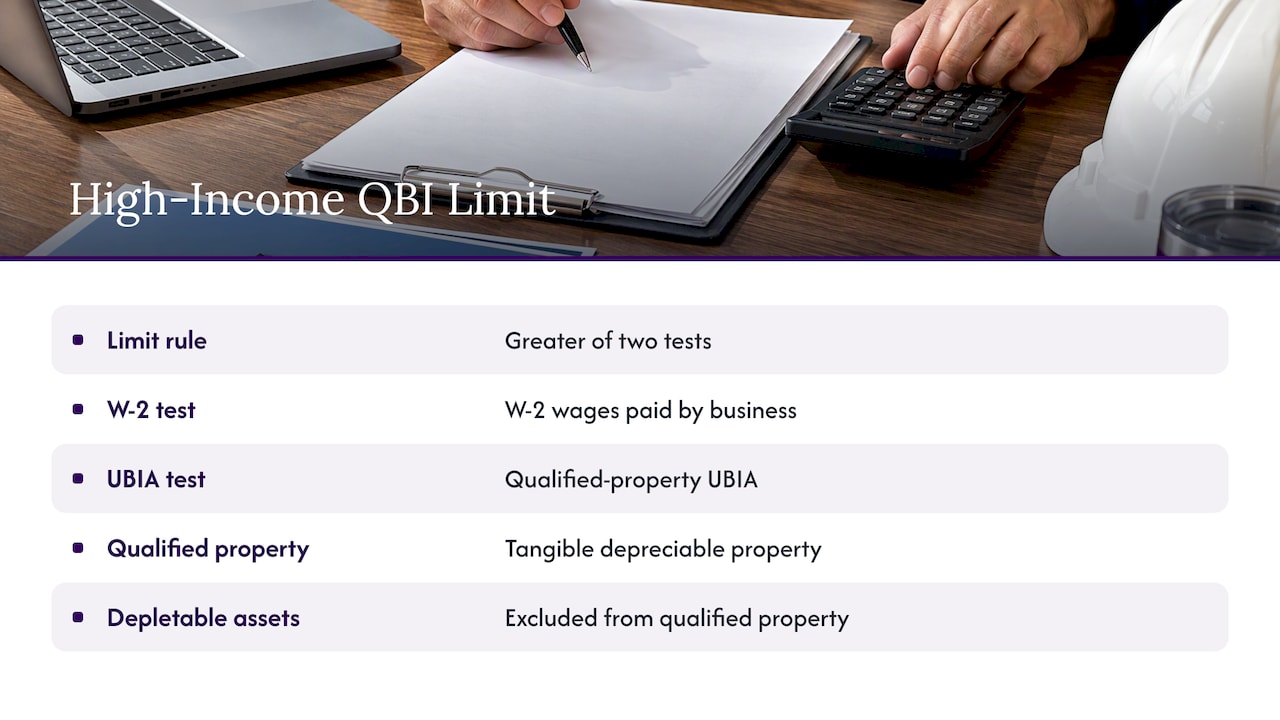
In plain terms: a passive investor in a working interest may have few W-2 wages attached to their share and a limited amount of qualified property basis. At higher incomes, the deduction can shrink, even if the income qualifies in principle.
A simple illustration
This is a hypothetical, not a projection of any investment.
- You are a single filer with taxable income well below $201,750 and $50,000 of net QBI from a qualifying working interest.
- 20% of $50,000 is $10,000, and that is below 20% of your taxable income, so the deduction is $10,000.
- At a 35% marginal rate, that would be $3,500 of federal tax saved on that income.
Now raise your income above the phase-out range. The same $50,000 of QBI could produce a smaller deduction, or only the wage and property based amount, because the limits take over.
Drilling costs and depletion change the QBI math
Here is the trap most online summaries skip. QBI is a net number. When a working interest generates a large first-year deduction for intangible drilling costs (IDCs), that deduction flows into the pass-through income and reduces QBI for the year.

The Tax Notes analysis adds that because the deduction is computed at the partner or shareholder level, separately stated items such as IDCs and depletion must be tracked carefully for each investor.
There are two ways to think about this, and both are legitimate:
- A large IDC deduction in year one can bring net QBI to zero or negative. In that year you save tax through the deduction itself rather than through the 20% QBI deduction. A negative QBI figure generally carries forward to offset QBI in later years, which is something to confirm with your preparer.
- Later producing years generate positive income as the IDC deduction is no longer available. That is when the QBI deduction can start to matter, subject to the limits above.
So the two deductions often work in sequence rather than stacking in the same year. That is a modeling question, not a reason to avoid either. If you want to see how the front-end deductions behave, our oil and gas depreciation methods guide walks through them, and the free oil and gas tax deduction calculator gives you a first-pass estimate to bring to your CPA.
Perspective: how we think about QBI in energy deals
We talk with W-2 professionals, founders, physicians and business owners who arrive asking about “the 20% deduction” as if it were the headline benefit of energy investing. In our experience the better question is which interest you are buying and what the full tax picture looks like over several years.
A few things we hold to:
- Start with structure. A royalty-style position and a working-interest position are different tax animals. We would rather an investor understand that before committing than learn it at filing time.
- Treat QBI as a bonus, not the thesis. For most investors in development projects, the first-year deduction picture and the long-term income matter more. QBI may add to the result in producing years, and the limits for high earners can reduce it.
- Use transparency as a filter. We built our platform around presenting key project materials in a comparable format and vetting the operators we list, so you and your advisor can see how a deal is structured and how it is likely to report on a K-1 before you decide.
- Bring your CPA early. Your preparer knows your passive losses, state exposure and alternative minimum tax picture. We do not replace that conversation, and we would not want to.
Energy projects carry real risk, including commodity prices, operator performance and dry holes. Tax treatment is only one part of whether an investment makes sense.
— Sharif
Where QBI fits with the other energy tax tools
QBI is one of several provisions investors in U.S. energy projects encounter. Each answers a different question.
| Provision | What it does | Who it mostly serves |
|---|---|---|
| Intangible drilling cost deduction | Front-loads deductions in the early years of a working interest | Investors with large current-year tax bills |
| Depreciation of tangible equipment | Recovers equipment costs over time | Working interest holders |
| Percentage depletion | Lets owners deduct a share of gross income from producing property | Royalty and working interest owners, subject to rules |
| QBI (Section 199A) | Up to 20% deduction on qualifying business income | Pass-through owners with qualifying trade or business income |
For a wider overview, see our guide to oil and gas tax advantages for high earners and our explainer on the Section 199A deduction for business owners. If you plan to hold energy interests in a retirement account, read about UBTI filing issues for oil and gas IRAs first, since the QBI deduction is not available inside an IRA.
A checklist before you rely on QBI
- Identify the interest. Working interest, royalty, or a fund holding both?
- Read the K-1 reporting. Ask the sponsor or operator how they report QBI information and whether they provide the wage and UBIA data the calculation needs.
- Estimate your taxable income against the 2026 thresholds for your filing status.
- Model year one and later years separately, since IDCs reduce QBI in the early period.
- Check state treatment. The federal deduction does not automatically apply on a state return.
- Review with a CPA. Bring the calculator output and the project materials.
Looking for a working interest to review
If you are an accredited investor and want to compare projects with these tax mechanics in mind, Fieldvest lists vetted U.S. energy opportunities across producing assets, development projects and energy infrastructure. You can see the current categories on our homepage, or start with our overview of how to lower your taxes with oil and gas investments. Investments are open to accredited investors only.
FAQ
Do oil and gas royalties qualify for QBI?
Generally no, when they are passive mineral royalties treated as investment income. They can be treated differently only if the income comes from a qualifying trade or business through a qualifying structure. Have a CPA review your specific interest and K-1.
Do working interests qualify for the 20% deduction?
Often they can, if the working interest is a trade or business under Section 162. The IRS says material participation under Section 469 is not required. High earners may still see the deduction limited by W-2 wages and property basis.
Is the Section 199A deduction still available in 2026?
Yes. It was originally scheduled to end after 2025, but the One Big Beautiful Bill Act kept it, according to GYF’s 2026 summary. The 2026 phase-in thresholds are $403,500 for joint filers and $201,750 for single filers.
What income does not qualify for QBI?
Wages earned as an employee, capital gains and investment income such as passive royalties do not qualify. Income from specified service trades or businesses is also excluded once your income passes the upper threshold.
Do intangible drilling costs reduce my QBI deduction?
They can. QBI is a net figure, so a large IDC deduction lowers qualifying income in that year. Your savings in that year come mainly from the IDC deduction itself, and your CPA should model how any negative QBI carries forward.
Sources
- 2025 Instructions for Form 8995-A, IRS
- 26 U.S. Code § 199A, Legal Information Institute
- Section 199A Deduction: Economic Effects and Policy Issues, Congressional Research Service
- News Analysis: The TCJA’s Effects on Oil and Gas Investments, Tax Notes
- Tax Planning Strategies: Section 199A (QBI) Deduction, GYF
Recommended

Get the Fieldvest Energy Brief
and AI-driven demand shifts — curated for accredited investors. Smart. Strategic. Tax-advantaged.