

TL;DR:
- Renewable energy projects differ by source, site needs, costs, and development timelines, affecting investment strategies. Site control, permitting, and grid connection risks are often more critical than technology choices for project success. Emerging hybrid systems and innovative infrastructure improve project value and community support, shaping future clean energy growth.
Renewable energy project types are defined by their underlying energy source and conversion technology, spanning solar, wind, hydropower, geothermal, biomass, and emerging hybrid systems. Each category carries distinct site requirements, permitting timelines, capacity factors, and financial profiles that directly affect investment returns. The development lifecycle for any of these projects involves multi-year sequences of resource assessment, environmental review, and grid interconnection. Metrics like Levelized Cost of Energy (LCOE) and capacity factor are the standard tools for comparing project economics across types. Knowing how each category works is the first step toward making informed energy investment decisions.

1. What solar power project types exist and how do they differ?
Solar photovoltaic (PV) projects fall into three main formats: rooftop installations, ground-mounted arrays, and carport or canopy systems. Each format serves a different site context and investor profile.
Rooftop solar suits commercial and industrial buildings with large, unshaded roof areas. These projects typically range from 100 kilowatts to several megawatts and benefit from low land costs since they use existing structure. Energy yield depends heavily on roof orientation, tilt angle, and local irradiance.
Ground-mounted solar comes in two configurations. Fixed-tilt systems are simpler and cheaper to build. Single-axis tracking systems follow the sun across the day and produce meaningfully more energy per panel, though they add mechanical complexity and maintenance costs.
Carport and canopy solar installations serve parking lots and transit facilities. They generate power while providing shade, which makes them attractive for municipalities and large retailers seeking dual-use value from paved land.
- Utility-scale solar PV carries an unsubsidized LCOE of $24–$96 per MWh, making it one of the most cost-competitive generation sources available today.
- Solar permitting typically takes 6–18 months, shorter than any other major renewable category.
- By may 2026, over 8,700 major solar projects accounted for more than 367 GWdc of capacity in the U.S. alone. That scale signals a mature, liquid market with established financing structures.
Pro Tip: When evaluating a ground-mounted solar project, ask the developer for the P50 and P90 energy yield estimates. The gap between those two numbers tells you more about site risk than any headline capacity figure.
2. How do wind energy project types vary and what makes them investment-worthy?
Wind energy projects divide into two categories: onshore and offshore. The distinction matters enormously for cost, permitting, and return profile.
Onshore wind projects are the dominant form globally. They require open terrain with consistent wind speeds, typically above 6–7 meters per second at hub height. Turbine spacing, wake losses, and local zoning rules all affect final energy output. Capacity factors for well-sited onshore wind projects typically run in the 30–45% range, outperforming most solar installations on an annual basis.
Offshore wind projects access stronger, more consistent wind resources and avoid many land-use conflicts. The tradeoff is significantly higher capital cost for foundations, submarine cables, and marine logistics. Offshore projects are generally suited to institutional investors with long time horizons.
Key investment considerations for wind projects:
- Onshore wind permitting takes 12–36 months, roughly double the solar timeline. That longer lead time increases development risk and capital carrying costs.
- Turbine reliability and wake losses are the two biggest operational risks. Wake losses occur when upwind turbines reduce wind speed for downwind machines, cutting total farm output by 10–20% if not properly modeled.
- Grid interconnection queues have grown dramatically in recent years. Projects in congested regions can wait years for a connection agreement, which is now the single most common cause of project delays.
Wind energy remains financially competitive because its fuel cost is zero and its capacity factors are high. Investors who understand interconnection risk and turbine warranty terms hold a real edge in project evaluation.
3. What are the main hydropower project types and their unique characteristics?
Hydropower is the oldest and largest source of renewable electricity worldwide. The three main formats are run-of-river, reservoir-based, and pumped storage.
Run-of-river projects divert a portion of a river’s flow through a turbine without large-scale water storage. They produce steady but seasonally variable output and have a relatively low environmental footprint compared to reservoir projects. Small hydro projects under 10 megawatts often qualify for simplified permitting in many U.S. states.
Reservoir-based hydropower stores water behind a dam and dispatches power on demand. That dispatchability makes it uniquely valuable for grid operators. The tradeoff is significant environmental permitting complexity and long construction timelines.
Pumped storage hydro is the dominant form of long-duration energy storage on the grid today. It pumps water uphill during low-demand periods and releases it through turbines during peak demand. No other technology currently matches its cost per megawatt-hour for multi-hour storage at scale.
| Hydropower type | Capacity factor | Key advantage | Primary challenge |
|---|---|---|---|
| Run-of-river | Moderate, seasonal | Low land impact | Variable output |
| Reservoir-based | High, dispatchable | On-demand generation | Environmental permitting |
| Pumped storage | Depends on use | Long-duration storage | High capital cost |
Hydropower permitting through the Federal Energy Regulatory Commission (FERC) is among the most complex in the energy sector. Investors should budget for multi-year licensing processes on any project above small-hydro scale.
4. How do geothermal and biomass project types contribute to renewable energy portfolios?
Geothermal and biomass projects share one critical trait: they produce baseload power. Unlike solar and wind, they generate electricity around the clock regardless of weather.
Geothermal energy applications
Geothermal plants tap heat from the earth’s interior. Flash steam plants bring high-pressure hot water to the surface, where it flashes to steam and drives a turbine. They require reservoir temperatures above 182°C and are concentrated in geologically active regions like the western United States, Iceland, and the Philippines. Binary cycle plants use lower-temperature geothermal fluid to heat a secondary working fluid with a lower boiling point. Binary plants expand the viable geography for geothermal development significantly.
Geothermal capacity factors routinely exceed 90%, which no solar or wind project can match. That reliability commands a premium in power purchase agreements.
Biomass energy types
Biomass projects convert organic material into electricity or heat. Feedstocks range from forestry residues and agricultural waste to dedicated energy crops and municipal solid waste. Biogas projects capture methane from landfills or anaerobic digesters and burn it in generators. Liquid biofuel projects produce transportation fuels.
The sustainability of feedstock sourcing is the defining variable in biomass project viability. Modern bioenergy systems use air quality controls that distinguish them sharply from traditional solid fuel burning. Over 90% of liquid biofuels currently come from food crops, with corn accounting for more than one-third of global production. That feedstock concentration creates supply chain risk that investors must model carefully.
Pro Tip: For biomass projects, always request a third-party feedstock supply study. A project with a strong power purchase agreement but a weak fuel supply chain is a liability, not an asset.
5. What emerging renewable energy project types are shaping the future of clean power?
The most interesting renewable energy project examples today sit at the intersection of existing infrastructure, new technology, and creative financing.
Solar canal projects install PV panels over irrigation canals. The University of California system piloted this concept, and it has since moved from the lab to real-world infrastructure. These projects reduce land-use conflicts by using already-disturbed linear corridors, and the shade they provide reduces water evaporation, which adds a quantifiable co-benefit for water utilities.
Tidal and wave energy projects capture kinetic energy from ocean movement. Tidal power is highly predictable because tides follow astronomical cycles, unlike wind or solar. Current costs remain high and the technology is pre-commercial at scale, but ideal sites in the Pacific Northwest, Alaska, and the U.S. Atlantic coast offer long-term potential.
Hybrid solar-plus-storage projects are the fastest-growing format in the U.S. market right now. Pairing a solar array with a battery system allows the project to shift generation to peak pricing hours and participate in ancillary grid services. Hybrid project LCOE ranges from $50 to $131 per MWh, reflecting the added cost of storage but also the added revenue potential.
- Battery storage enables revenue stacking across frequency regulation, energy arbitrage, and capacity markets simultaneously.
- Robotic automation in solar construction has increased installation speed by over 100% per shift in tested deployments. Lower labor costs accelerate project timelines and improve returns.
- Agrivoltaic projects combine solar generation with active agriculture on the same land, reducing the land-use tradeoff that has slowed utility-scale development in farming communities.
“The most durable renewable projects are those that solve two problems at once. Solar canals save water and generate power. Agrivoltaics produce food and energy. Hybrid storage projects generate revenue and stabilize the grid. Investors who look for that dual-value structure find projects with stronger community support and more defensible economics.”
Key takeaways
Renewable energy projects span six major categories, each with distinct economics, site requirements, and risk profiles that determine their fit for a given investor or portfolio.
| Point | Details |
|---|---|
| Solar leads on cost | Utility-scale solar PV LCOE of $24–$96/MWh makes it the most accessible entry point for new investors. |
| Wind requires longer lead time | Onshore wind permitting takes 12–36 months, so development risk is higher than solar. |
| Hydropower offers dispatchability | Pumped storage and reservoir hydro provide on-demand generation that solar and wind cannot match. |
| Geothermal delivers baseload | Capacity factors above 90% make geothermal the most reliable renewable source by output consistency. |
| Hybrid projects stack revenue | Solar-plus-storage projects participate in multiple grid services, improving overall project economics. |
Why I think most investors underestimate the “soft” development risks
Most financial models for renewable projects are built around LCOE, capacity factor, and power purchase agreement terms. Those numbers matter. But the biggest bottlenecks in project development are almost never the technology. They are site control disputes, environmental permit appeals, and grid interconnection queue delays.
I have seen projects with excellent wind resources and signed offtake agreements sit idle for three years because the interconnection study process uncovered upgrade costs that made the project uneconomical. That is not a technology failure. It is a development process failure that no spreadsheet predicted.
The investors who do well in this space treat the development lifecycle as the primary risk variable, not the secondary one. They ask hard questions about interconnection queue position, land lease terms, and permit status before they look at projected IRR. The IRR is a function of those upstream variables, not the other way around.
Emerging project types like solar canals and hybrid storage systems add another layer of complexity because they require multi-stakeholder cooperation. A solar canal project needs alignment between a water utility, a power offtaker, a landowner, and a state regulator. That coordination risk is real. But the projects that clear those hurdles tend to have stronger community backing and longer-term stability.
My honest advice: pair your interest in alternative energy investments with a rigorous understanding of where a specific project sits in its development lifecycle. A project at financial close is a fundamentally different risk than one still in environmental review, even if the projected returns look identical on paper.
— Sharif
Fieldvest and the energy investment opportunity
Accredited investors looking to build income from U.S. energy projects have more options than ever, but evaluating them requires real expertise. Fieldvest connects high-earning professionals with vetted energy operators, offering access to projects structured for large first-year tax deductions and long-term cash flow.
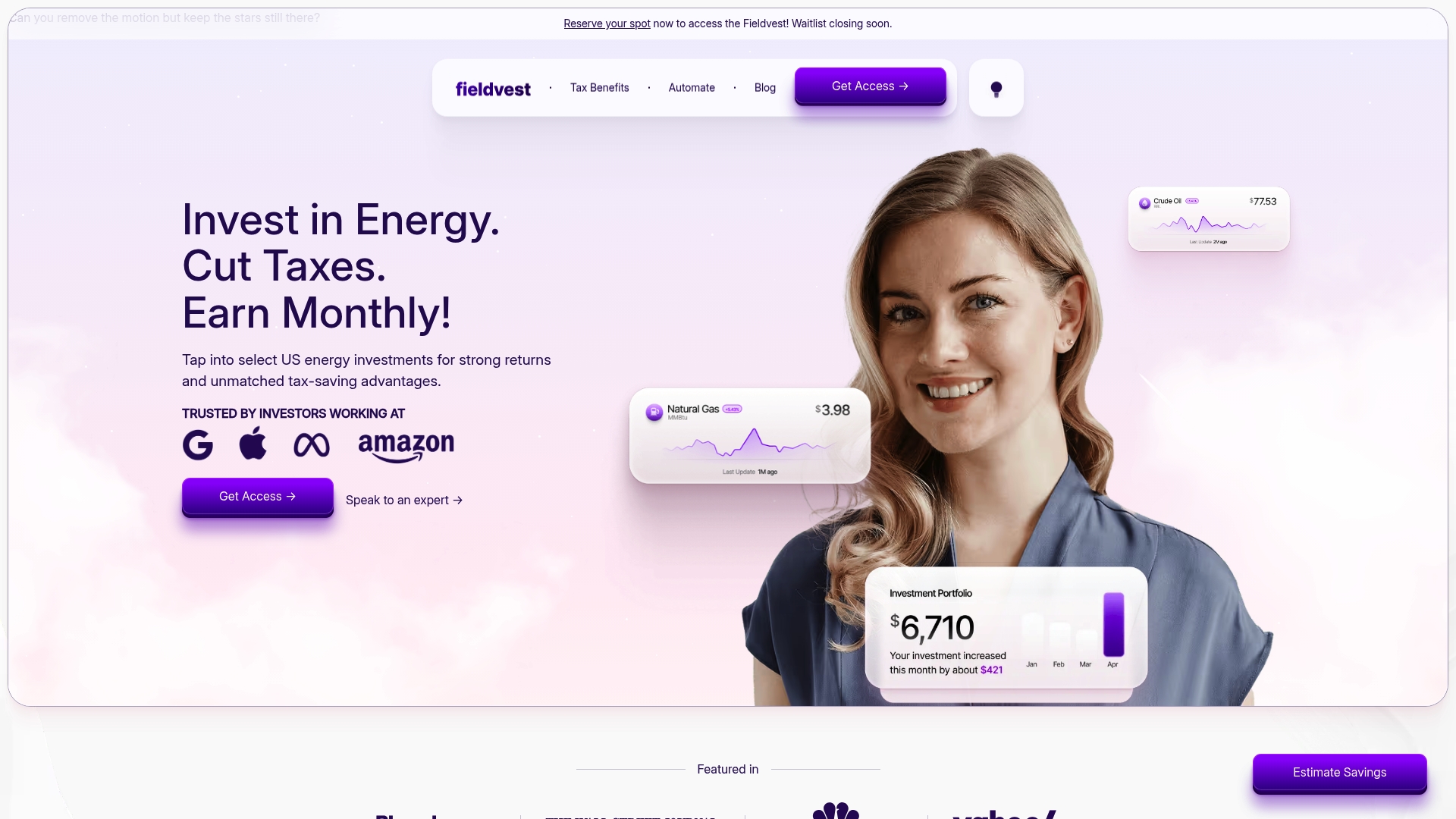
The tax efficiency angle matters more than most investors realize. Understanding how to lower your taxes through energy investments can shift the net return on a project significantly, even before operational cash flow begins. Fieldvest’s team helps investors evaluate project quality, operator track records, and tax structure in one place. If you are weighing energy project investments and want a clearer picture of the financial mechanics, Fieldvest is built for exactly that conversation.
FAQ
What are the main renewable energy project types?
The six main renewable energy project types are solar PV, wind, hydropower, geothermal, biomass, and emerging hybrid systems. Each converts a different natural resource into electricity using distinct technology and site requirements.
Which renewable energy project type has the lowest cost?
Utility-scale solar PV currently has the lowest unsubsidized LCOE, ranging from $24 to $96 per MWh, making it the most cost-competitive option for new generation capacity in most U.S. markets.
How long does it take to permit a renewable energy project?
Solar projects typically require 6–18 months for permitting, while onshore wind projects take 12–36 months. Hydropower projects licensed through FERC often take longer due to environmental review complexity.
What is a hybrid renewable energy project?
A hybrid project pairs an intermittent generation source, typically solar or wind, with battery storage. This combination allows the project to shift output to peak pricing periods and participate in multiple grid revenue streams simultaneously.
Are geothermal energy applications limited by geography?
Flash steam geothermal plants require high-temperature reservoirs and are concentrated in geologically active regions. Binary cycle plants operate at lower temperatures and expand viable locations, though geothermal development still favors the western United States and similar volcanic regions.
Recommended

Get the Fieldvest Energy Brief
and AI-driven demand shifts — curated for accredited investors. Smart. Strategic. Tax-advantaged.