


The single decision that determines whether a private energy investment pays off isn’t the price of oil or the tax code. It’s operator quality, verified independently, before you wire a dollar. Everything else, commodity swings, construction delays, regulatory shifts, is manageable if the sponsor is real and the numbers hold up under scrutiny. If they don’t, no hedge or insurance policy saves you.
Before signing anything, do three things: request the Private Placement Memorandum (PPM) and audited financials, commission or review an independent third-party engineering/reserve report, and confirm production directly through a state database like the Texas Railroad Commission, not through the sponsor’s marketing deck.
Walk away if you see any of the following:
- Promises of guaranteed returns or fixed yields on a working interest
- A sponsor who resists sharing well data, API numbers, or references
- Fee structures or capital-call terms that aren’t spelled out plainly
- No sponsor co-investment in the deal you’re being pitched
Pro Tip: If a sponsor can’t produce an API number for every well within 24 hours, that alone is reason enough to pass.
The SEC’s investor alert on private oil and gas offerings flags exactly this pattern: fraud tends to cluster around deals promising certainty in an inherently uncertain business.
Key Takeaways
Independent verification of the operator, through state production databases, a third-party reserve report, and a reviewed PPM, matters more than any single financial projection.
| Point | Details |
|---|---|
| Verify before you trust | Cross-check API numbers and production volumes against state databases like the Texas Railroad Commission before relying on sponsor projections. |
| Demand the full document set | Request the PPM, audited financials, JOA, AFE, and third-party engineering report before signing anything. |
| Stress-test the model | Run downside scenarios at 25 percent lower commodity prices and check offset well decline curves against the sponsor’s assumptions. |
| Size positions like a portfolio | Diversify across basin, operator, vintage, and contract type rather than concentrating in one deal. |
| Monitor after closing | Compare quarterly production reports against original projections and flag variances beyond 15 to 20 percent. |
| Use Fieldvest for vetted access | Fieldvest connects accredited investors with pre-vetted operators and provides tax and wealth-projection tools to apply this diligence framework directly. |
Table of Contents
- Mapping Deal-Level Risk In Energy Sector Investments
- What Documents Should You Request Before Investing?
- How Do You Stress-Test the Financial Model?
- How Much of Your Portfolio Should Go Into Private Energy?
- What’s the Realistic Timeline and Cost of Due Diligence?
- Technological Obsolescence Risk as the Energy Mix Shifts
- Market and Geopolitical Risks Investors Often Underweight
- Monitoring Your Position After You’ve Invested
- Staying Ahead of Regulatory Change
- Weighing ESG Factors in Private Energy Deals
- Put This Guide to Work With Fieldvest
- Frequently Asked Questions
- Sources
Mapping Deal-Level Risk In Energy Sector Investments
Every private energy deal carries the same core risk categories, whether it’s a Permian working interest or a solar development project. Knowing them cold, and knowing what mitigates each one, is the foundation of any real energy sector risk assessment.
Production and technical risk. Reservoirs underperform, decline curves steepen faster than modeled, and geology surprises even experienced operators. Mitigation: demand an independent reserve report from a certified petroleum engineer, and compare the sponsor’s decline curve assumptions against offset well data in the same field.
Commodity-price risk. Revenue swings with oil and gas prices, and a project modeled at $75 a barrel can look very different at $50. Mitigation: insist on downside-case projections at a materially lower price deck, and ask whether the sponsor uses hedges (costless collars, swaps) to lock in a revenue floor.
Construction and completion risk. Development and midstream projects run over budget and behind schedule more often than sponsors admit. Mitigation: require an EPC contract with a performance bond or completion guarantee attached.
Regulatory and policy risk. Permitting delays, changes to tax treatment, and shifting state-level rules can all compress returns. Mitigation: ask counsel to flag pending legislation in the project’s jurisdiction before closing.
Environmental and tax risk. Spill liability, remediation costs, and complicated depletion/AMT rules all cut into net returns. Mitigation: verify insurance coverage and get a CPA’s read on how at-risk and passive-loss rules apply to your specific entity structure.
Counterparty and liquidity risk. A weak offtake buyer or a shaky joint-venture partner can strand otherwise sound assets. Mitigation: review the PPA or offtake agreement’s credit quality and confirm capital-call caps in the subscription agreement.
Three contract clauses to demand before signing anything:
- A cap on total capital calls beyond your initial commitment
- Sponsor co-investment disclosed as a percentage of total equity
- Waterfall triggers that specify exactly when the sponsor’s promote kicks in
What Documents Should You Request Before Investing?
Verification beats trust every time in private energy deals. The documents you request, and what you do with them, separate investors who catch problems early from those who find out the hard way.
Request this complete set before committing capital:
- Private Placement Memorandum (PPM) and audited financials
- Subscription agreement and joint operating agreement (JOA)
- Authorization for Expenditure (AFE) covering drilling and completion costs
- Third-party engineering/reserve report
- EPC contract and insurance certificates
- Power purchase agreement (PPA), if applicable
- Historical production data and capex/opex model
Once the paperwork arrives, verify it against public records. Here’s the sequence:
- Pull the well’s API number from the sponsor’s materials.
- Cross-check it against the Texas Railroad Commission’s production database (or the relevant state regulator) to confirm spud date, completion date, and reported volumes.
- Compare actual production against the sponsor’s projections. A gap of more than 15 to 20 percent in either direction deserves an explanation.
- Check the sponsor’s litigation history and regulatory filings, and call at least two independent references, not names the sponsor hand-picks.
Practitioners who specialize in vetting oil and gas sponsors treat this database check as the single highest-yield diligence step available to an outside investor, because it’s the one claim a sponsor can’t spin.
Red flags at this stage: wells that don’t appear in state records, reports the sponsor is reluctant to release, production that consistently misses projections, or missing insurance certificates. Any one of these should pause the process until resolved. For a deeper walkthrough of reading these documents line by line, see Fieldvest’s guide to handling oil investment documents.
How Do You Stress-Test the Financial Model?
A financial model that only shows one scenario, the sponsor’s base case, tells you almost nothing. Real diligence means running the numbers backward from failure, not forward from optimism.
Ask the sponsor to run these scenarios explicitly:
- Base case at current strip pricing
- Commodity price down 25 percent, sustained for at least 18 months
- A prolonged low-price environment matching the worst stretch of the last decade
- Construction or completion cost overrun of 20 to 30 percent
- Reserve depletion hitting sooner than the type curve predicts
Baker 1031’s sponsor-vetting framework puts it plainly: well economics break on three inputs, price deck, decline curve, and cost per well, so any credible sponsor should hand over offset well data and downside IRR figures without hesitation.
Deal structure matters as much as the numbers. Look for a waterfall that puts investor capital first, a preferred return hurdle before the sponsor’s promote activates, and a cap on management fees. Confirm whether your commitment is recourse or non-recourse, since capital-call exposure can exceed your initial investment if the JOA allows uncapped assessments.
On tax: treat the deduction as a basis reduction, not the reason for the investment. Entity structure determines whether losses are active or passive under IRC §469 rules governing direct participation programs, and AMT exposure varies by investor. Model the return first; let the tax benefit be the bonus.
How Much of Your Portfolio Should Go Into Private Energy?
Private energy deals belong in a portfolio sleeve, not as a singular bet you’re hoping pays off. Most advisors evaluating illiquid alternatives suggest keeping speculative working-interest positions to a small slice of liquid net worth, with more room reserved for stabilized, producing assets that already carry a proven cash-flow history.
Diversify across more than one axis:
- Basin and geology. A single field’s geologic risk shouldn’t define your entire allocation.
- Operator. Spread capital across more than one sponsor so no single management team’s mistakes sink the whole sleeve.
- Asset vintage. Mix development-stage projects (higher risk, higher upside) with producing assets that generate income now.
- Contract type. Balance PPA-backed, contracted revenue against merchant exposure to spot pricing.
- Regulatory geography. Different states and basins carry different permitting and tax environments.
Pro Tip: Treat every private energy commitment as a multi-year hold from day one. There’s no public market to exit into if you change your mind in year two.
Plan for capital lock-up of several years, and build in governance checkpoints, quarterly reporting reviews at minimum, so you catch problems before the next capital call lands in your inbox.
What’s the Realistic Timeline and Cost of Due Diligence?
Budget four to eight weeks for full diligence on a single deal, longer if the sponsor is new to you or the reserve report needs independent commissioning.
The sequence looks like this:
- Initial document request and NDA (week one)
- Independent verification of production and sponsor references (weeks one to three)
- Legal review of PPM, JOA, and subscription agreement (weeks two to four)
- Financial model stress-testing and sensitivity review (weeks three to five)
- Final sign-off, insurance and escrow confirmation, capital wire (weeks five to eight)
Typical costs: independent engineering reports, legal review, and insurance verification are standard third-party expenses. Sponsors sometimes cover the engineering report cost themselves as a courtesy; legal review of deal documents is almost always the investor’s expense.
Questions worth asking at each milestone: at launch, “Who prepared the reserve report and can I contact them directly?” At pre-subscription, “What’s the cap on capital calls beyond my commitment?” At closing, “What insurance is in place, and can I see the certificate?” A sponsor who answers all three without hesitation has passed the first real test.
Scope, Assumptions, and Professional Advice
This guide covers investor-side due diligence and portfolio controls for private energy deals, not corporate risk management. It assumes accredited status, a long time horizon, and tolerance for illiquidity.
- Consult a CPA on tax treatment specific to your entity structure
- Have a securities attorney review the PPM and subscription agreement
- Commission an independent engineer for any reserve report you didn’t request yourself
Technological Obsolescence Risk as the Energy Mix Shifts
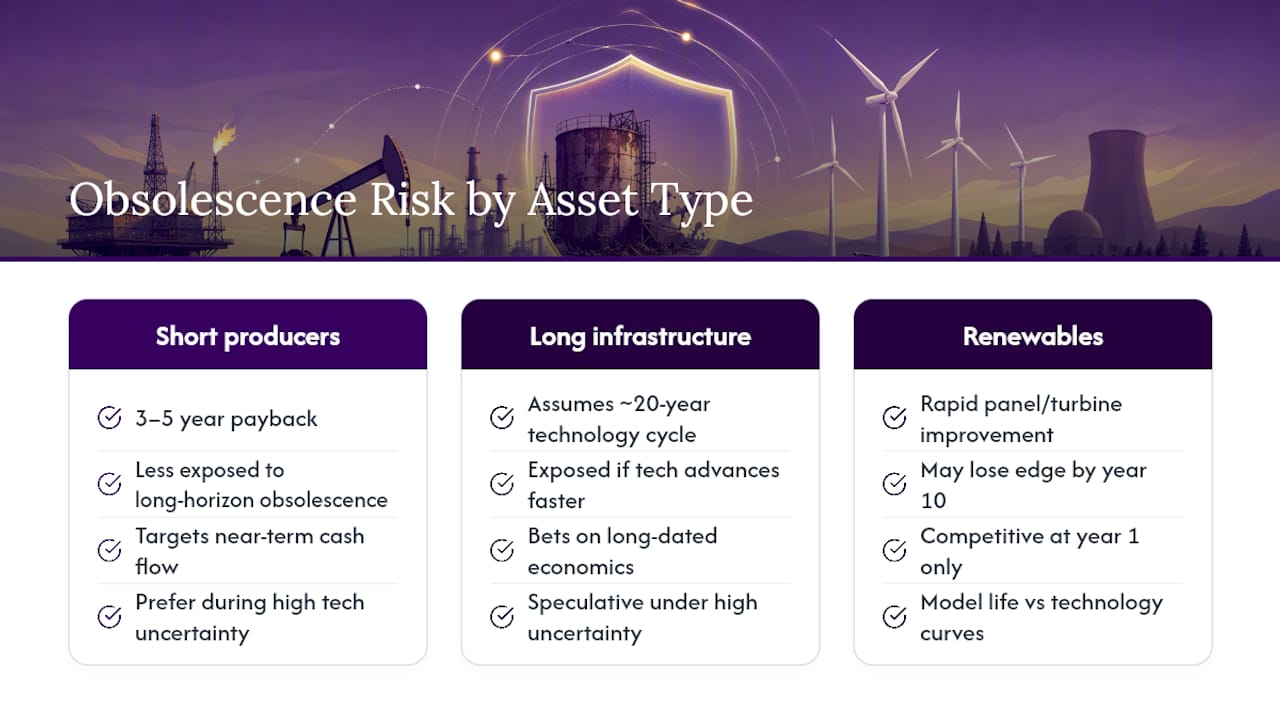
Assets built for today’s energy mix can lose value faster than their depreciation schedule suggests. A gas-fired peaker plant or a legacy drilling operation might face declining utilization if grid demand shifts toward storage and renewables faster than projected, or if new extraction technology makes existing wells less competitive.
This risk cuts both directions for accredited investors. Producing oil and gas assets with short payback periods, three to five years, are less exposed to long-horizon obsolescence than infrastructure betting on a 20-year technology cycle. Renewable projects carry their own version: panel and turbine technology improves quickly enough that an asset’s competitive position at year one may not hold at year ten.
Ask sponsors directly how they’ve underwritten this. A well-run project should model asset life against realistic technology curves, not just against commodity price. For oil and gas specifically, that means understanding whether the wells target near-term cash flow or long-dated reserves that assume today’s extraction economics hold for decades.
Diversifying across asset vintage, some producing now, some in development, protects against betting the entire allocation on one technological moment. It also means favoring shorter-duration, cash-flowing assets over speculative long-horizon plays when technological uncertainty is high, a principle that applies whether you’re evaluating a conventional well or a renewable buildout.
Market and Geopolitical Risks Investors Often Underweight
Energy prices don’t move in a vacuum. OPEC+ production decisions, sanctions on major exporters, and shipping disruptions in key chokepoints all ripple into the commodity price your project’s revenue depends on. An investor modeling a domestic U.S. oil project still inherits global price exposure, because crude is priced on international benchmarks regardless of where the well sits.
Supply chain disruptions matter at the construction level too. Steel tariffs, drilling rig availability, and equipment lead times have all caused real project delays in recent cycles. A sponsor’s construction timeline assumption is only as good as their supply chain contingency plan.
Geopolitical risk also shows up in regulatory form. Trade policy shifts affect input costs for renewable equipment (solar panels, turbine components often manufactured overseas), while sanctions and export controls can affect operators with any international counterparty exposure.
The mitigation here isn’t avoidance, it’s building geopolitical sensitivity into the same stress tests you’d run for commodity price. Ask whether the sponsor’s downside scenarios account for a supply chain delay of six months or a price shock driven by an international event rather than a domestic demand shift. Projects with domestic-only supply chains and shorter construction timelines carry less of this exposure than complex, multi-year builds dependent on imported components.
Monitoring Your Position After You’ve Invested
Diligence doesn’t end at closing. The sponsors worth investing with provide regular production reports, typically monthly or quarterly, that show actual volumes against the type curve you reviewed before committing.
Set up a simple monitoring routine:
- Compare each production report against the original projections, and flag variances beyond 15 to 20 percent for a direct conversation with the sponsor.
- Track distributions against the modeled cash-flow schedule, not just whether a check arrived, but whether the amount matches expectations.
- Request annual audited financials and review them against the original PPM’s projections.
- Watch for changes in operator behavior, delayed reporting, vague explanations for shortfalls, or requests for additional capital outside the disclosed cap.
A quarterly review cadence works for most investors holding multiple positions. Treat any unexplained reporting delay as a signal worth escalating, since sponsors under financial stress often go quiet before they go public with bad news. Portfolio-level tracking matters here too: if you’re holding positions across several sponsors and basins, a simple spreadsheet tracking projected versus actual production and distributions across the whole sleeve reveals patterns a single-deal view misses entirely.
Staying Ahead of Regulatory Change
Energy regulation moves on multiple levels at once, federal tax policy, state permitting rules, and environmental compliance standards, and a change at any level can affect a project already in your portfolio.
Build a simple tracking habit rather than reacting after the fact. Follow Investor.gov’s alerts and bulletins for fraud and offering-related warnings specific to private energy deals. Monitor state regulatory bodies like the Texas Railroad Commission for rule changes affecting permitting and production reporting in the basins where you hold positions. Watch federal tax policy discussions that touch depletion allowances, intangible drilling costs, or bonus depreciation, since these directly affect the deduction assumptions in your original model.
Ask your sponsor directly how they track regulatory exposure in the jurisdictions where the project operates, and whether legal counsel reviews pending legislation as part of ongoing asset management. A sponsor who can’t answer this clearly is managing the asset reactively rather than proactively, and that gap tends to show up exactly when a rule change hits hardest.
Weighing ESG Factors in Private Energy Deals
Environmental, social, and governance considerations aren’t just a box to check for institutional allocators anymore. They affect insurance costs, permitting timelines, and increasingly, the pool of capital available to a project down the line.
Environmental exposure means real liability: spill risk, remediation costs, and methane emissions reporting requirements that vary by state. Confirm the operator carries adequate environmental liability insurance and has a documented plan for well plugging and site remediation at end of life, not just an assumption that someone else handles it later.
Governance quality often predicts everything else. A sponsor with clean audited financials, transparent fee disclosure, and a track record of consistent reporting tends to run cleaner operations across the board. Social factors matter too, community relations and land-use agreements can affect permitting speed in ways that show up directly in a construction timeline.
None of this replaces the core financial and production diligence covered earlier. But a sponsor who treats environmental compliance as an afterthought is often the same sponsor who treats investor reporting as an afterthought. The two tend to travel together.
One Clear Priority for Accredited Investors
Verify the operator independently before anything else, everything downstream, price risk, tax treatment, portfolio sizing, only matters once you trust the source. See Fieldvest’s vetted deal flow for proof points on how this looks in practice.
Put This Guide to Work With Fieldvest
Fieldvest exists for exactly the diligence process outlined above, connecting accredited investors with operators who’ve already cleared a vetting process before a deal ever reaches the platform.
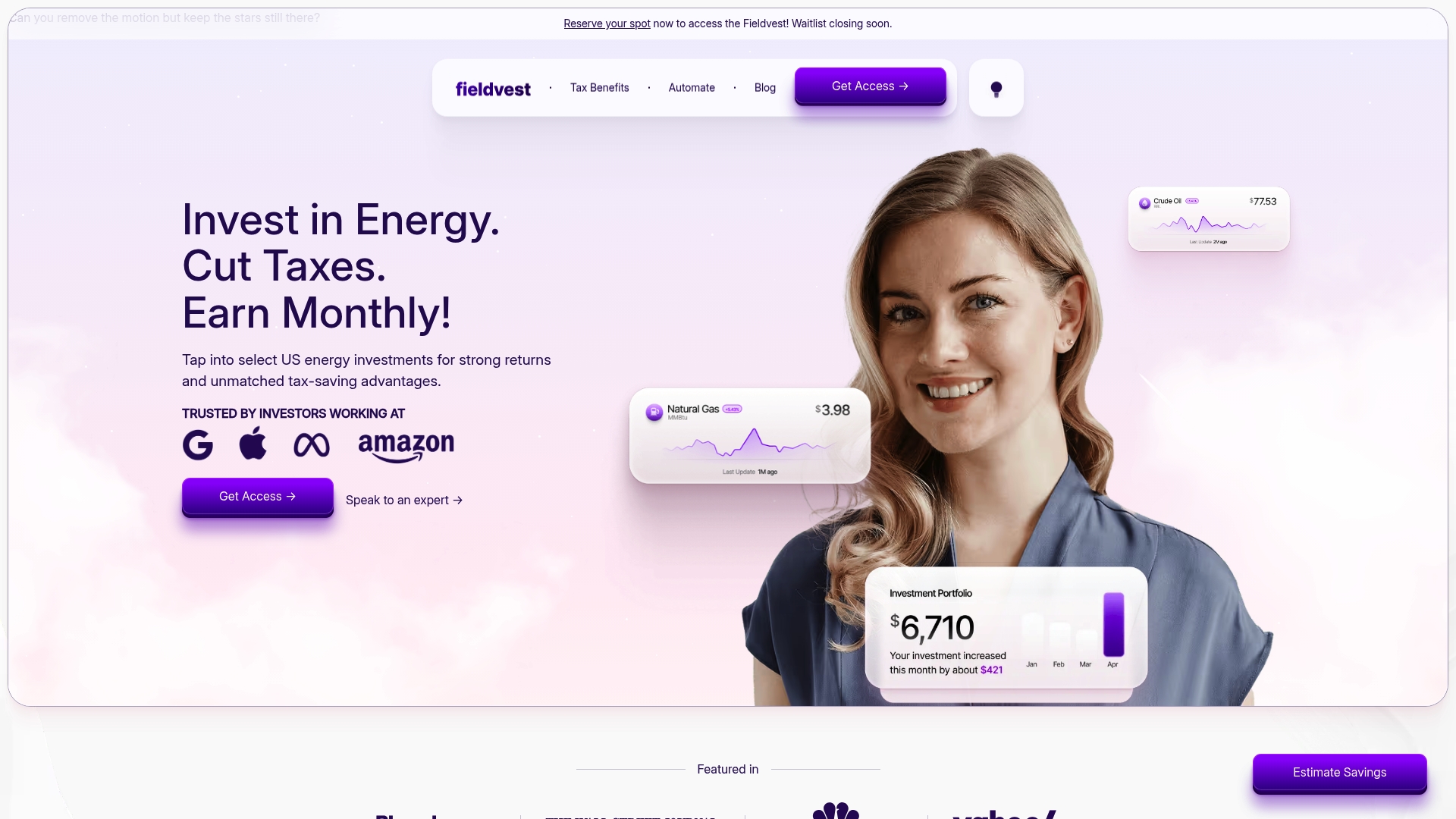
That means the PPM, the independent reserve report, and the production verification aren’t things you chase down cold. Fieldvest’s free oil and gas tax deduction calculator helps you model the first-year tax impact before you commit capital, and the wealth projection tool lets you see how a position fits alongside your broader portfolio over time. Ongoing reporting keeps the monitoring routine described above running without you having to build a tracking system from scratch.
Accreditation requirements apply, standard income or net worth thresholds under SEC rules, and every deal on the platform still deserves the same scrutiny this guide walks through. Start by running your numbers through the tax deduction calculator to see what a real deal could mean for your specific tax situation this year.
Frequently Asked Questions
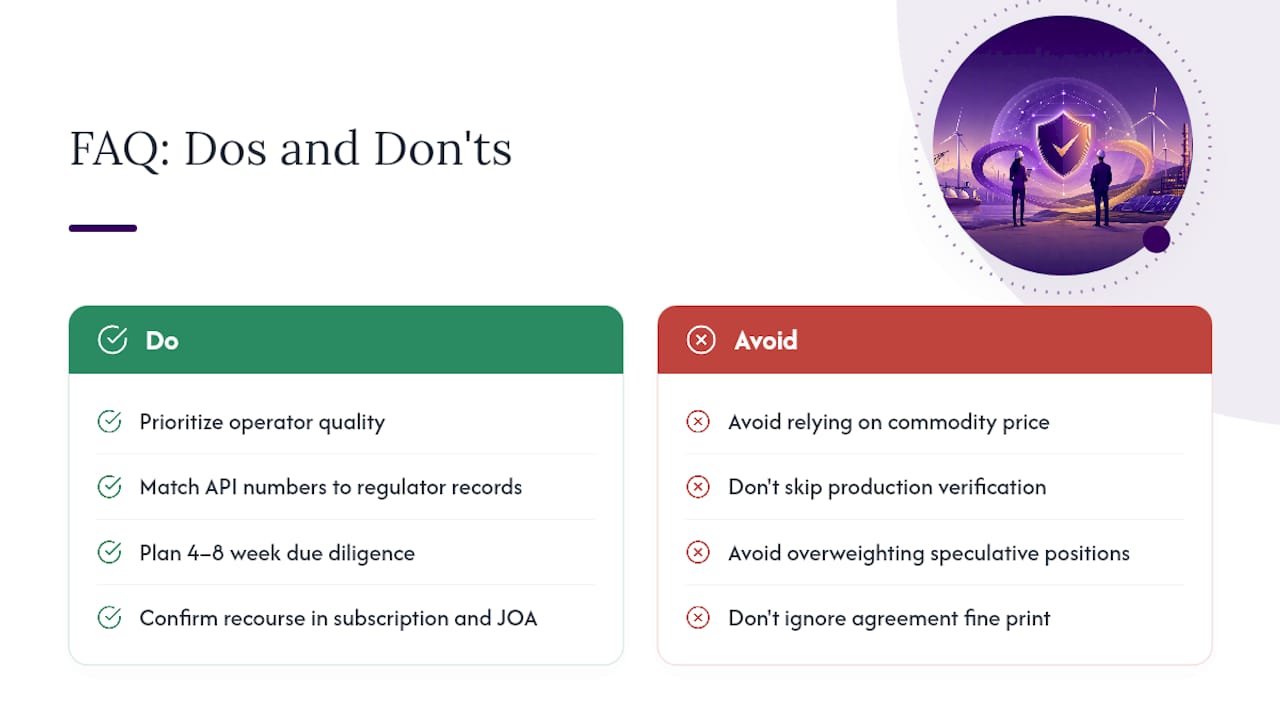
What is the biggest risk in private energy investing that most investors overlook? Operator quality, not commodity price, causes most bad outcomes. A skilled sponsor with weak underlying assets will still manage risk better than a poor sponsor with strong reserves.
How do I verify oil and gas production claims independently? Match the sponsor’s API numbers against your state’s regulatory database, the Texas Railroad Commission for Texas wells, and compare reported production volumes and spud dates to public filings.
What percentage of my portfolio should go into private energy deals? Most advisors suggest keeping speculative working-interest positions to a modest slice of your liquid net worth or alternatives sleeve, with room for a larger allocation to stabilized, producing assets.
How long does due diligence typically take on a private energy deal? Plan for four to eight weeks, covering document review, independent production verification, legal review, and financial model stress-testing before closing.
What’s the difference between recourse and non-recourse capital calls? Recourse structures can require additional capital beyond your initial commitment; non-recourse structures cap your exposure at what you’ve already invested. Confirm this in the subscription agreement and JOA before signing.
This article is general information, not a substitute for advice from a qualified financial advisor. Consult a qualified financial professional about your own circumstances before acting on anything here.
Sources
Recommended
- Safe Energy Investing Platform: How to Evaluate Risk, Access, and Protection | Oil & Gas Investing
- Gas Investments for Accredited Investors: 2026 Guide | Oil & Gas Investing
- What is upstream energy investing? A guide for accredited investors | Oil & Gas Investing
- Oil and Gas Investments: A Guide for Accredited Investors | Oil & Gas Investing

Get the Fieldvest Energy Brief
and AI-driven demand shifts — curated for accredited investors. Smart. Strategic. Tax-advantaged.