


When you sell an oil and gas working interest, the tax bill usually comes in two layers. The first layer is ordinary income, up to the amount of drilling and depletion deductions you took earlier (Section 1254 recapture). The second is any remaining gain, which is generally taxed as a Section 1231 gain at long-term capital gains rates if you held the interest more than a year. The split between the two layers, not the sale price alone, decides what you owe.
This guide walks through how gain is measured, why earlier deductions come back, how holding period and deal structure change the result, and how the sale is reported. It is general education, not tax advice. Have a CPA who handles oil and gas run the numbers before you sign a purchase and sale agreement.
TL;DR
- Gain is the amount realized minus adjusted basis. Liabilities the buyer assumes count as part of the amount realized.
- Intangible drilling costs (IDCs) and depletion you deducted are recaptured as ordinary income on sale, up to the lesser of those deductions or your gain.
- Gain above the recapture amount is generally Section 1231 gain if you held the interest more than a year. Under a year, the whole result is generally ordinary.
- Selling outright and keeping an overriding royalty are taxed very differently.
- Report on Form 4797 (recapture in Part III), keep full basis records, and plan the timing with a CPA before closing.
Table of Contents
- How the gain on a working interest sale is calculated
- Why earlier deductions come back: Section 1254 recapture
- Capital gain or ordinary income: holding period and structure
- Depletion and the 15% question
- Spreading the tax with an installment sale
- Planning tools sellers discuss with their CPA
- How the sale is reported
- Records to gather before you file
- Our perspective
- Plan the deduction and the exit together
- FAQ
- Sources
How the gain on a working interest sale is calculated
The starting point is the same as for any property. According to IRS Publication 544, a gain is the amount realized from a sale that exceeds your adjusted basis, and a loss is the reverse. The amount realized is the money you receive plus the fair market value of any property or services received. It also includes seller liabilities the buyer assumes and liabilities the property is subject to.
Adjusted basis is your original cost, increased by improvements and decreased by depreciation, depletion and casualty losses. This is where oil and gas differs from most assets. Depletion reduces basis over the life of the well, and so does anything you deducted instead of capitalizing. IRS Publication 5652 explains that the cost basis of an oil and gas property interest is recovered through depletion and is the basis for computing gain or loss on a sale of all or part of it.
A simple way to think about it
Suppose you invested $200,000 in a drilling program and deducted a large share as IDCs in year one, then took depletion as the wells produced. Your tax basis could be far below $200,000 by the time you sell. If a buyer pays you more than that low basis, the gain is bigger than the economic profit you might expect. That is the price of the front-loaded deductions, and it is why sale planning starts with a basis schedule, not the offer letter.
The figures above are an illustration, not a forecast. Your numbers depend on how your project was structured and what you elected.
Why earlier deductions come back: Section 1254 recapture
If you expensed IDCs under Section 263© rather than capitalizing them, you took a deduction in the year the cost was paid or incurred. The Joint Committee on Taxation describes this election: a working interest owner who pays IDCs may either expense them or capitalize them and recover them through depletion or depreciation.
The sale reverses part of that benefit. Under 26 CFR § 1.1254-1, when you dispose of oil, gas or geothermal property, gain is treated as ordinary income up to the lesser of your Section 1254 costs or the excess of the amount realized over adjusted basis. For property placed in service after 1986, those costs include expenditures deducted under Sections 263, 616 or 617 that would otherwise have been added to basis, plus depletion deductions that reduced basis.
The logic, as Weaver explains it, is matching: you got an ordinary deduction on the way in, so that character of income returns on the way out.
The recapture formula
Recapture equals the lesser of:
- Total IDCs and depletion that reduced basis (your Section 1254 costs), or
- Your total gain on the sale.
Anything left after recapture is the residual gain, which gets Section 1231 treatment if you qualify.
A worked example
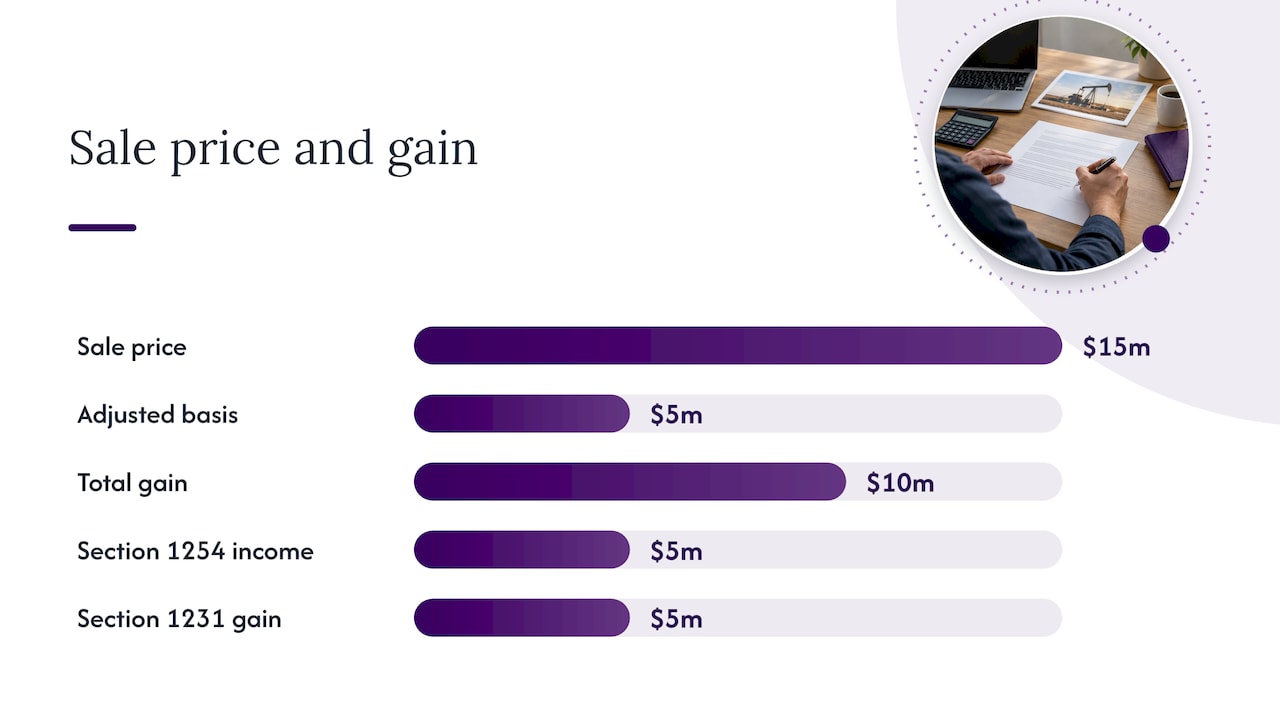
The Texas Society of CPAs paper by Garza and Hall offers a clean illustration. A taxpayer holds a working interest for more than a year, has $5 million of accumulated depletion, and sells 100% of the interest for $15 million with an adjusted basis of $5 million. The $10 million gain splits into $5 million of ordinary income from Section 1254 recapture on the depletion, and $5 million of Section 1231 gain.
Scale that down to an individual investor and the same mechanics apply. Only the dollar amounts change.
Capital gain or ordinary income: holding period and structure
Holding period
Per Weaver, a working interest lease held more than a year generates a Section 1231 gain or loss, while one held less than a year generates an ordinary gain or loss. The 2025 Instructions for Form 8949 draw the general line the same way: short-term is one year or less, long-term is more than one year.
So for a well drilled on a lease held more than a year, you recognize ordinary income equal to the lesser of total Section 1254 recapture or the gain realized, and the rest is Section 1231 gain. If you held the lease under a year, the entire gain or loss is ordinary.
Sale versus lease
How you structure the transfer matters as much as how long you held. The Garza and Hall paper highlights that the distinction hinges on whether the transferor keeps a non-operating interest:
| Structure | What you do | General tax result |
|---|---|---|
| Outright sale | Dispose of the entire interest | Section 1231 gain after recapture |
| Lease (sublease) | Dispose of the working interest but keep an overriding royalty | Ordinary income not subject to depletion; basis carries over to the retained royalty |
A court case shows the sale side of this line. In Glenn v. Commissioner (U.S. Tax Court, 1962), $900,000 in cash received for assigning a 98-percent working interest, with only limited production payments reserved, was treated as the selling price and taxed as long-term capital gain rather than ordinary depletable income. Court decisions turn on their facts, so treat this as an illustration of the principle, not a template for your deal.
Selling part of an interest
Selling only a slice, or keeping a carved-out interest, can change which rules apply. Publication 5652 notes that basis feeds the gain computation on a sale of all or part of the property. If you are considering a partial sale, ask your CPA to model it against a full sale before you negotiate.
Depletion and the 15% question
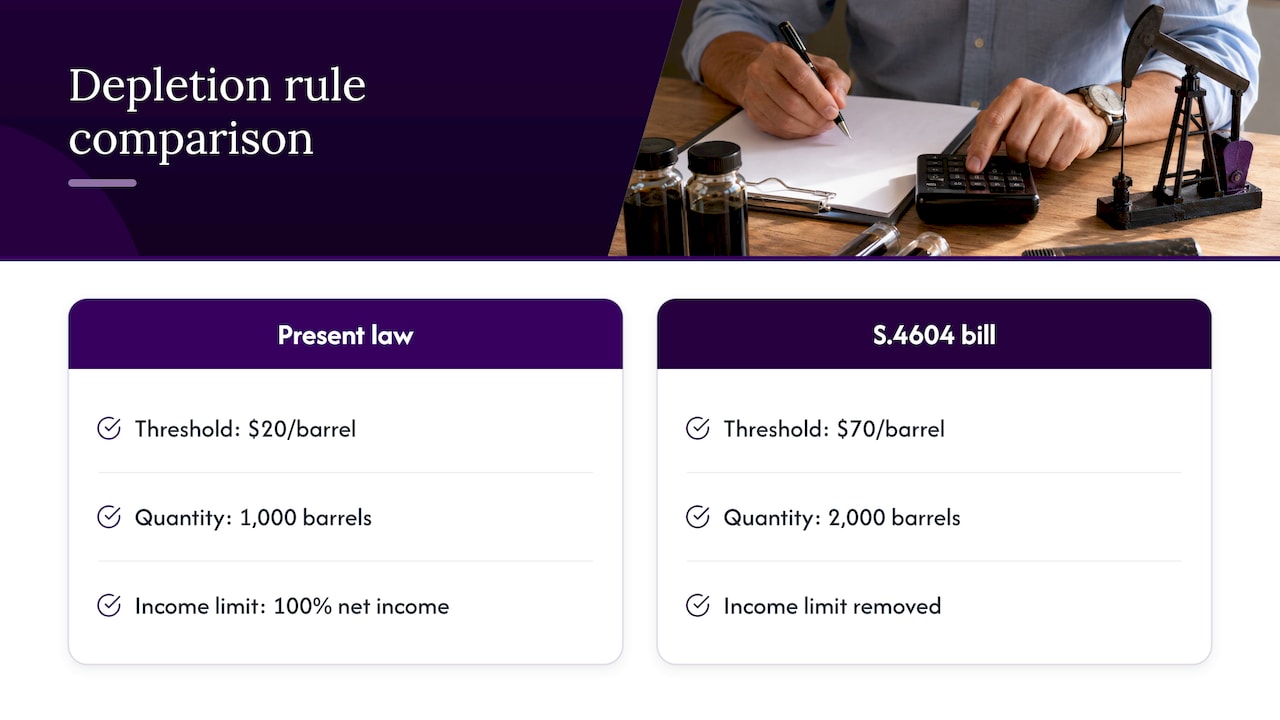
Many sellers ask whether the 15% percentage depletion allowance still exists. The Joint Committee on Taxation describes it in its present-law summary: both working interests and royalty interests are economic interests that qualify for depletion, and under the percentage method 15 percent of gross income from the property is allowed as a deduction, generally limited to 100 percent of net income from that property. IRS Publication 5652 adds that depletion is computed using percentage depletion under Section 613, as limited by Section 613A.
Legislation could change the marginal-property rules. Senate Bill S.4604, introduced May 20, 2026, would change the reference price threshold from $20 to $70 per barrel, raise the depletable quantity from 1,000 to 2,000 barrels and remove the taxable income limit for marginal properties, for tax years beginning after December 31, 2026. It is a bill, not law. Check its status before relying on it.
For a seller, the practical point is that every dollar of depletion you claimed lowers basis and can feed recapture. Higher depletion in the hold period means a larger ordinary-income slice at sale, with the tradeoff of the deductions you already used.
Spreading the tax with an installment sale
If the buyer pays over several years, the installment method may apply. Under 26 CFR § 1.1254-1(d), gain from a Section 1254 disposition is reported on the installment method if Section 453 or 453A otherwise allows it, and each payment’s income portion counts as Section 1254 gain until all of it is reported. Tax Facts makes the same point: recaptured amounts can be deferred through an installment sale, but they come first.
One caution from a practitioner: Goldstein & Co. notes that recapture is taxed in the year of sale even when the buyer pays over time under Section 453(i). The two readings differ on timing, which is a good reason to have a CPA confirm how your specific deal is treated before you accept seller financing.
If you plan to turn the proceeds into retirement income later, it also helps to understand annuity tax rules, since withdrawals are taxed on their own schedule.
Planning tools sellers discuss with their CPA
Weaver describes two planning ideas for the front end. At the entity level, a taxpayer may elect out of bonus depreciation. At the individual level, IDCs can be capitalized under Section 59(e) and amortized over five years for domestic wells (ten for foreign). Both reduce the deductions that would later be recaptured, though they also reduce the early tax benefit. This is a tradeoff to decide with an advisor at the time you invest, not at the closing table.
Other questions worth raising before you sell:
- Would waiting past the one-year mark change the character of the gain?
- Is a full sale, partial sale or sublease with a retained royalty the better fit?
- Can you time the sale in a year when other income is lower?
- How will the sale interact with a new investment that carries fresh deductions?
Our guides on year-end tax planning for oil and gas investors and tax planning after a liquidity event cover the timing side in more depth.
How the sale is reported
The Form 4797 route is the standard one. Per LegalClarity, the Section 1254 recapture calculation goes on Form 4797, Part III, line 28a, and the resulting gain flows to Schedule 1 of Form 1040. If you held the interest through a partnership, the entity passes your share through on a Schedule K-1, which moves to Schedule E, Part II.
A further breakdown from TaxShark’s guide to the 2025 form: filing is required if oil, gas, geothermal or other mineral interests are sold. Part I reports Section 1231 property held more than a year. Part III line 28 computes the Section 1254 recapture, which flows to Part II line 13, and the residual flows to Part I line 6. It also flags common errors: leaving out depreciation that was allowable even if never claimed, and missing the five-year Section 1231 loss lookback.
Records to gather before you file
The IRS expects accurate records of basis and adjusted basis. The Form 8949 instructions list purchase price and commissions, increases such as improvements, and decreases such as depreciation. For a working interest, add the pieces that make recapture computable:
- The original subscription or purchase agreement and closing statement.
- Every Schedule K-1 or operator statement showing IDCs, tangible drilling costs and depletion by year.
- Your election on IDCs (expense or capitalize) as filed.
- The purchase and sale agreement, including any liabilities the buyer assumes.
- Holding period dates for the interest and for each lease or well.
- Any retained royalty or production payment terms.
If you want to see how the original deductions behave, our explainers on oil and gas depreciation methods and how tangible drilling costs depreciate show what ends up in your basis schedule.
Our perspective
Most people ask about the tax on a sale only after the deal is signed. We think that is backwards. The sale tax is largely decided on the day you invest, because the deductions you take then are the ones that return as recapture later.
That is not a reason to shy away from the deductions. Large first-year deductions on U.S. energy projects can be worth far more to a high earner in the year they are taken than the recapture costs years later, particularly when you plan the exit. A working interest you hold through production, take depletion on and then sell or hold for income gives you choices at every stage.
This is why we built Fieldvest around vetted operators and clear project materials. Investors should be able to compare a producing asset, a development project and energy infrastructure side by side and understand the tax shape of each before committing. Our claim is that deeper diligence and transparent deal documents make exit planning easier, because you know your basis story from day one.
Keep your records from the start, ask your CPA to model the exit alongside the entry, and treat the sale as part of the strategy rather than an afterthought.
Sharif
Plan the deduction and the exit together
If you are an accredited investor looking at oil and gas for tax reasons, it helps to see the deduction side before you think about the sale. Fieldvest connects accredited investors with vetted U.S. energy projects across producing assets, development projects and energy infrastructure, with project materials presented so you can compare them.

Start with our free oil and gas tax deduction calculator to estimate the first-year effect, then browse the projects on Fieldvest to see what is available to accredited investors. For background on how working interests are used, our guide to mineral rights investing and year-one deductions is a good next read.
FAQ
Is the sale of a working interest taxed as capital gain?
Partly. Gain up to your prior IDC and depletion deductions is ordinary income under Section 1254. The rest is generally Section 1231 gain, which gets long-term capital gains treatment if you held the interest more than a year. Held under a year, the whole result is generally ordinary.
Do I owe tax on IDCs I already deducted?
Yes, to the extent of recapture. The rule takes the lesser of your Section 1254 costs or your gain, and taxes that amount as ordinary income in the year of sale. It exists so an immediate deduction does not turn into capital gain on the back end.
Which tax form do I use to report the sale?
Form 4797 is the main form, with Section 1254 recapture computed in Part III, line 28a. If you held the interest through a partnership, your share arrives on a Schedule K-1 and moves to Schedule E, Part II. Your CPA will confirm how your structure flows through.
Does keeping a royalty change the tax?
Yes. Disposing of the working interest while keeping an overriding royalty is treated as a lease, which produces ordinary income not subject to depletion, with basis carrying over to the royalty. An outright sale of the entire interest is treated as a sale with Section 1231 gain after recapture.
Sources
- IRS Publication 544
- IRS Publication 5652
- 2025 Instructions for Form 8949
- 26 CFR § 1.1254-1
- Joint Committee on Taxation, present law summary
- Weaver, Tax Implications for Selling Oil and Gas
- Garza and Hall, Texas Society of CPAs
- Glenn v. Commissioner (1962)
- Tax Facts on ThinkAdvisor
- Goldstein & Co.
- LegalClarity
- TaxShark Form 4797 guide
- Senate Bill S.4604
- Annuity tax rules
Recommended

Get the Fieldvest Energy Brief
and AI-driven demand shifts — curated for accredited investors. Smart. Strategic. Tax-advantaged.