


When someone inherits an oil and gas interest, its tax basis (the number used to measure taxable gain) generally resets to what the interest was worth on the date of death. That reset is the step-up in basis. A decade of depletion and appreciation can drop out of the heir’s taxable gain. It does not reset everything, though. Unpaid income and partnership-level basis follow separate rules.
This matters to you as a high earner for a practical reason. An energy position bought for first-year deductions and cash flow is also a long-term asset that can pass to your family. Knowing how basis behaves at the end of that road helps you decide what to buy and how to hold it. At Fieldvest, we connect accredited investors with vetted U.S. energy projects, and we want you to understand both ends of the holding period.
TL;DR
- Inherited property generally takes a basis equal to its fair market value (FMV) on the date of death, or on the alternate valuation date if the executor elects it, per the IRS.
- Mineral interests, working interests and partnership or LLC interests are all covered, but each has its own mechanics, including a possible Section 754 election for partnerships.
- Income in respect of a decedent, such as royalties earned but unpaid at death, does not step up.
- Gifting an appreciated interest during life can forfeit the step-up. Estate planning for an energy position belongs with an estate attorney and your CPA.
- Fieldvest lists producing assets, development projects and energy infrastructure for accredited investors.
Table of Contents
- What the step-up in basis actually does
- How the step-up applies to oil and gas interests
- What does not step up
- From step-up to a later sale
- Why this matters before you invest
- Fieldvest and the energy interests you can hold
- Perspective
- Common mistakes to avoid
- FAQ
- Sources
What the step-up in basis actually does
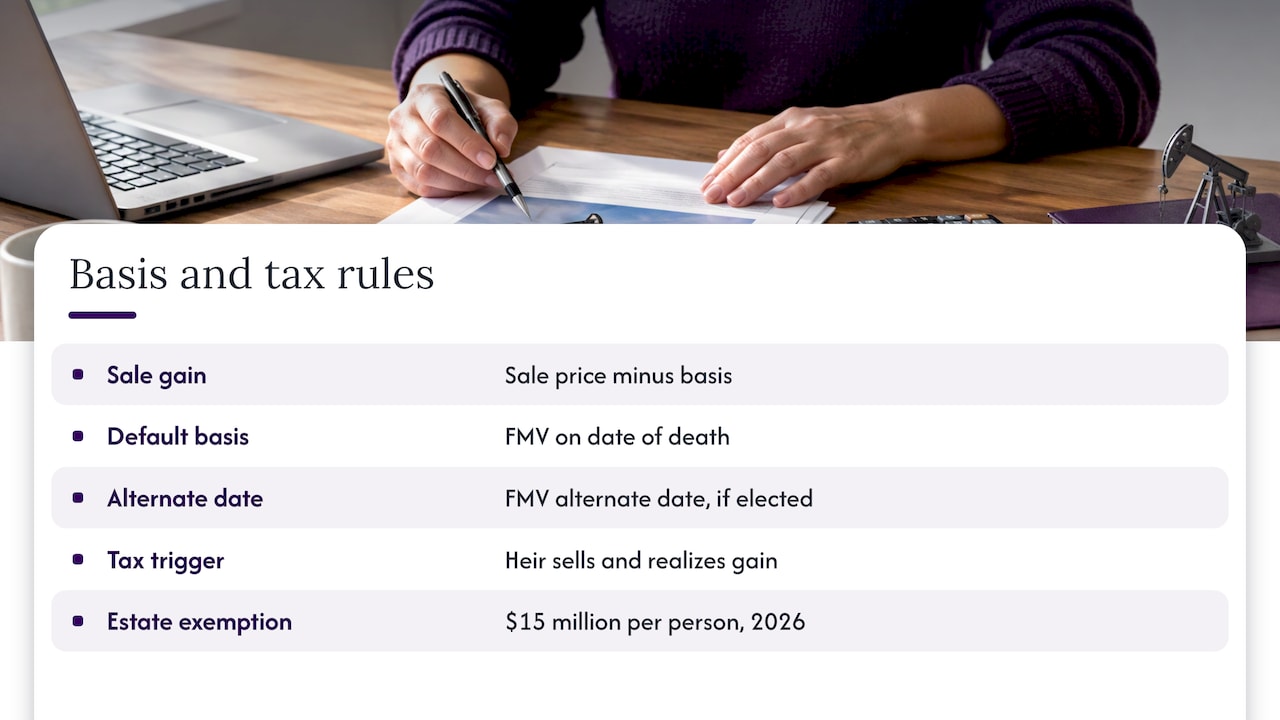
Basis is, roughly, what you have invested in an asset for tax purposes. When you sell, your taxable gain is the sale price minus basis. A low basis means a large gain.
For an inherited asset, the IRS says basis is generally the FMV on the date of death. If the executor files a federal estate tax return (Form 706) and elects the alternate valuation date, it is the FMV on that date instead, as IRS guidance on gifts and inheritances explains. The statute behind this is 26 U.S.C. § 1014.
The heir does not pay income tax simply for receiving the asset or holding it. Tax arises when the heir sells and realizes a gain. A Congressional Research Service report frames the step-up as a partial tradeoff for the estate tax. The estate tax reaches the unrealized appreciation in the gross estate, and the step-up keeps the heir from paying capital gains tax on that same appreciation again.
The step-up is also not tied to owing estate tax. Federal estate tax applies only above an exemption that one CPA guide puts at $15 million per person for 2026 after the One Big Beautiful Bill Act. Below it, the step-up still applies.
A simple example
This is a hypothetical, not a real investor. Suppose a parent’s oil and gas interest has an adjusted basis of $50,000 and is worth $400,000 when the parent dies. The heir’s basis becomes $400,000. If the heir sells for $420,000, the taxable gain is $20,000. Without the step-up, carrying over the parent’s $50,000 basis, the gain would be $370,000. The difference is a gain that never gets taxed.

How the step-up applies to oil and gas interests
Oil and gas ownership comes in several legal forms. The step-up works a little differently in each.
Mineral and royalty interests
A mineral interest is real property, so § 1014 applies to it directly. The practical problem is valuation. Mineral interests rarely have a quoted market price, so the date-of-death value normally comes from an appraisal. For estates that file Form 706, the value reported there also caps what the heir can use. Under § 1014(f), beneficiaries of those estates generally receive a Schedule A (Form 8971) showing the estate-tax value they must use as initial basis, as IRS Publication 551 describes.
Partnership and LLC interests
Many oil and gas investments are held through a partnership or an LLC taxed as one. There, basis has two layers:
- Outside basis is the heir’s basis in the interest itself. The IRS says the basis of an inherited partnership interest equals its FMV at the date of death (or the alternate valuation date). It is also generally increased by the heir’s share of partnership liabilities, per Tax Facts.
- Inside basis is the partnership’s basis in its own wells and leases. It does not change just because an owner died. A Section 754 election closes the gap by raising the partnership’s inside basis for the heir’s share. The partnership makes that election, not the estate, and it is permanent once made unless the IRS consents to revoke it.
This is why heirs of a partnership interest should ask early whether the election was made. It affects the depreciation and depletion the heir can claim against future income.
An LLC with a single owner that is not taxed as a partnership is simpler. The property itself steps up, with no election needed, according to the same professional guidance.
What does not step up
Three exceptions come up most often with energy interests.
Income in respect of a decedent
Income the decedent earned but never received is called income in respect of a decedent (IRD). Federal regulations say IRD keeps the character it had in the decedent’s hands and that the § 1014(a) basis rules do not apply to it. For an energy interest, think of oil already produced and sold before death whose payment arrives afterward. The recipient reports that income when it is received. The part of a partnership interest’s value that comes from IRD, such as uncollected receivables of a cash-basis business, does not step up either.
Gifts made shortly before death
Publication 551 carves out one trap. If an heir or the heir’s spouse gave appreciated property to the decedent within one year before death, and it comes back through the estate, the heir’s basis is the decedent’s adjusted basis immediately before death, not the date-of-death value. See Publication 551.
Lifetime gifts
The step-up happens at death. A parent who gives an appreciated interest to a child during life generally passes along the parent’s basis instead. That is why deals that look like simple family transfers deserve an estate attorney’s review before anything is signed.
From step-up to a later sale
Once the heir has a stepped-up basis, three things shape the tax result.
- Depletion reduces basis. Basis starts at date-of-death value and is then reduced by depletion allowed or allowable after that date. Depletion is the deduction for using up the resource. Our guide to percentage depletion rules walks through the two methods and why preparers run both.
- The sale compares price with basis. A sale above basis produces a taxable gain, and a sale at or below it does not. The step-up often leaves little or no gain in an inherited interest that is sold soon after death.
- Recapture can apply to working interests. Under § 1254, gain from the sale of oil and gas property is treated as ordinary income up to the amount of previously deducted intangible drilling and development costs, according to the Treasury regulation. We cover how that plays out in selling an oil working interest.
If you also face a state income tax, the same arithmetic runs with a state layer on top. A look at capital gains tax on a California sale shows how a high-tax state changes the net result of a gain, even though that guide deals with homes.
Worked example with depletion
This is again hypothetical. An heir inherits royalties valued at $200,000 on the date of death, so basis starts at $200,000. Over the next three years, $15,000 of depletion is allowed. Adjusted basis falls to $185,000. A sale at $220,000 then produces a $35,000 gain. A different heir who sold right away at $220,000 would report a $20,000 gain. Depletion helped reduce taxable income along the way, and it lowers basis along with it.
Why this matters before you invest
Most readers of this page are not heirs. They are earners with a large tax bill who want to know where an energy position goes over a long horizon. Three points follow from the rules above.
Structure drives the outcome. Whether you hold a direct interest or a partnership share changes how basis steps up and whether an election is needed. Knowing the structure before you commit is easier than untangling it later.
Deductions and basis are two halves of one plan. An energy interest can generate large first-year deductions while you own it, as we explain in how to lower your taxes with oil and gas investments. The basis rules at death govern what your heirs inherit. Our oil and gas depreciation methods guide covers the first half, and this article covers the second.
Records pay off. Heirs need your acquisition documents, your reserve and production reports and any statements showing depletion taken. Clean records make the appraisal and the Form 8971 reporting simpler.
If you want to size the deduction side, our free oil and gas tax deduction calculator gives you a starting figure. Your CPA should then confirm it against your return, and an estate attorney should review how the interest is titled for your heirs.
Fieldvest and the energy interests you can hold
Fieldvest is a platform where accredited investors invest directly in vetted U.S. energy projects. We list three kinds of opportunity: producing assets, development projects and energy infrastructure. Each offers direct real asset ownership alongside large first-year tax deductions and long-term energy income. We also provide portfolio management tools and ongoing investment support, so your records, project materials and positions sit in one place. You can browse the current opportunities on the Fieldvest platform.

Accredited investors who want to compare projects side by side can review key materials in a consistent format. That is useful when the question is not only what a deal returns this year but what it looks like to hold and pass on.
Perspective
Investors often ask us about the first-year deduction and stop there. We think the better question is what the whole life of the position looks like: what you deduct, what you collect, and what your family inherits.
The step-up in basis is the quiet end of that story. A real asset you own directly, held through a structure you understand, is something your heirs can value at the date of death and build on. That is part of why we focus on direct ownership of vetted projects instead of paper products.
Our approach is to put vetted operators and clear project materials in front of accredited investors, so you can compare deals on the numbers that matter to your tax picture. We then support you in managing the position over time. The rest of the plan belongs with your CPA and your estate attorney, and we are glad to work alongside them.
Sharif
Common mistakes to avoid
- Gifting appreciated interests to children while you are alive. You may give up the step-up. Talk to an estate attorney first.
- Ignoring the partnership layer. Heirs of a partnership interest should ask whether a Section 754 election was made for the year of death. The heir must notify the partnership in writing within one year of death, per the FTAS guidance.
- Skipping the appraisal. Without a date-of-death valuation, there is no solid basis number.
- Treating unpaid royalties as stepped-up. Income already earned before death is generally taxed to the recipient when received.
- Forgetting depletion in basis. Basis shrinks as depletion is allowed, so track it every year.
FAQ
Do oil and gas interests get a step-up in basis when inherited?
Yes, generally. Property acquired from a decedent takes a basis equal to its fair market value on the date of death, or on the alternate valuation date if the executor elects it. That covers mineral interests and, with extra mechanics, partnership and LLC interests. See 26 U.S.C. § 1014.
Does the step-up apply to royalties not yet paid at death?
No. Royalties earned before death but paid afterward are income in respect of a decedent. They keep the character they had for the decedent and are taxed to the recipient when received. The § 1014 basis rule does not apply to them, per the federal regulations.
Does my estate owe tax if the step-up applies?
Not necessarily. The step-up does not depend on owing estate tax. Federal estate tax applies only above the exemption, which one CPA guide lists as $15 million per person for 2026. State rules differ, so confirm with an estate attorney.
Is a step-up better than giving the interest away during my life?
For appreciated property, a lifetime gift generally carries over your basis, while an inheritance generally resets it to date-of-death value. Which is right for your family depends on your estate, your state and your goals. Take that decision to an estate attorney and your CPA.
Sources
- Gifts & inheritances, Internal Revenue Service
- Publication 551, Basis of Assets, Internal Revenue Service
- 26 U.S. Code § 1014, Cornell Legal Information Institute
- Step-Up vs. Carryover Basis for Capital Gains, Congressional Research Service
- Step Up in Basis at Death: 2026 Guide
- Partner’s Outside Basis, Internal Revenue Service
- Tax Facts, ThinkAdvisor
- Inherited Partnership & LLC Interests, FTAS
- 26 CFR Part 1, Income in Respect of Decedents, eCFR
- 26 CFR § 1.1254-1, Cornell Legal Information Institute
Recommended

Get the Fieldvest Energy Brief
and AI-driven demand shifts — curated for accredited investors. Smart. Strategic. Tax-advantaged.