


TL;DR:
- Schedule K-1 reports each partner’s share of income, losses, and deductions from pass-through entities. It significantly influences individual tax liability, deductions, and credits, especially for high-income taxpayers. Proper interpretation of the form and supplemental statements is essential for accurate filing and maximizing tax benefits.
Schedule K-1 is defined as the IRS form that reports each partner’s or shareholder’s distributive share of income, losses, deductions, and credits from a pass-through entity. The role of K-1 statements extends far beyond simple income reporting. These forms directly shape your personal tax liability, determine which deductions you can claim, and trigger rules like basis limitations and self-employment tax. Over 40 million U.S. taxpayers receive K-1s annually from partnerships, S corporations, trusts, and estates. That volume reflects how central pass-through taxation has become to American investment and business ownership.
What is the role of K-1 statements on your tax return?
K-1 data flows directly into Form 1040, affecting your taxable income, deductions, and credits. The entity itself pays no federal income tax. Instead, each partner or shareholder reports their allocated share on their personal return. This mechanism is called pass-through taxation, and the K-1 is the document that makes it work.

The IRS deadline for K-1 issuance is march 15, extendable to september 15 if the entity files an extension. That timing matters. If your partnership files an extension, you may need to extend your own Form 1040 to avoid filing with incomplete or estimated K-1 data. Filing before you receive a final K-1 is one of the most common and costly mistakes high-income taxpayers make.
How K-1 income affects your Form 1040
The type of entity issuing your K-1 determines how the income is taxed. Partnership K-1 income reported in Box 14 generally triggers self-employment tax at 15.3%. S corporation K-1 income typically does not, provided the shareholder receives a reasonable salary. That difference alone can shift thousands of dollars in tax liability for a high earner.
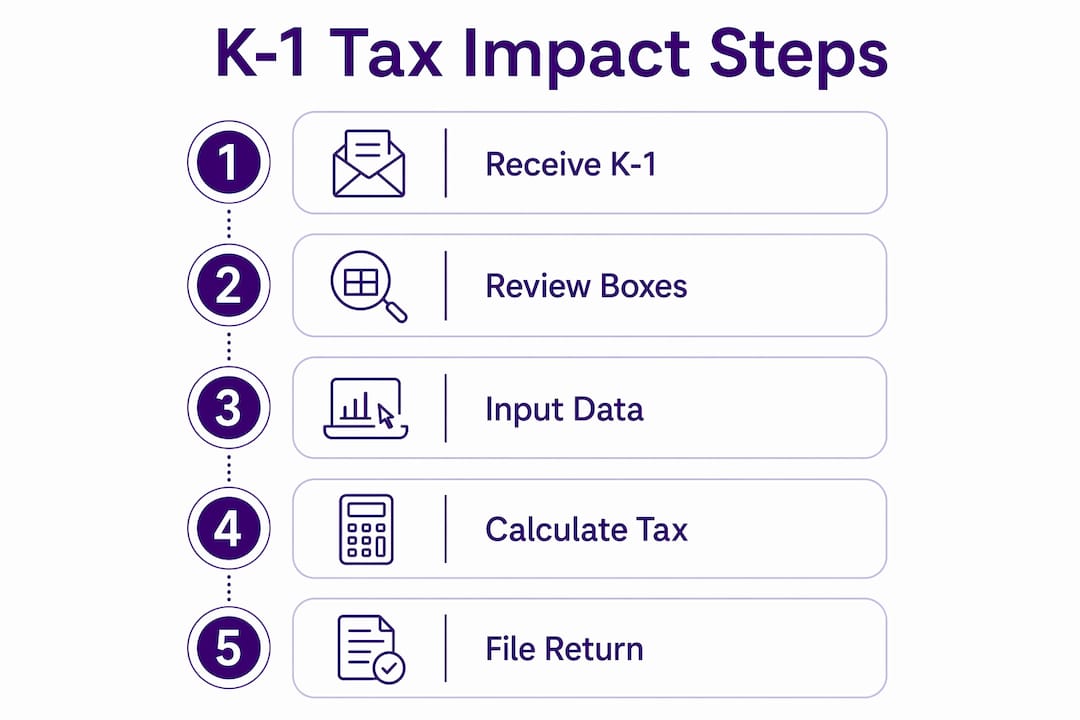
K-1s also report your share of the Qualified Business Income (QBI) deduction. The 2026 QBI deduction allows up to 20% of qualified business income for taxpayers below $201,750 (single) or $403,500 (married filing jointly). Amounts above those thresholds trigger wage and capital limitations that require careful calculation.
Key items that flow from your K-1 to Form 1040 include:
- Ordinary business income or loss (Box 1): reported on Schedule E
- Net rental real estate income or loss (Box 2): subject to passive activity rules
- Interest, dividends, and royalties (Boxes 5–7): reported on Schedule B or D
- Section 179 deductions and other deductions (Boxes 12–13): reduce taxable income subject to basis limits
- Self-employment earnings (Box 14): subject to self-employment tax for partners
- Credits (Box 15): applied directly against tax owed
Loss deductions on K-1s can be suspended by basis, at-risk, and passive activity loss rules. A suspended loss carries forward to future years rather than reducing your current tax bill. Many investors are surprised to learn their K-1 loss provides zero immediate benefit.
Pro Tip: If your partnership files an extension, file a personal extension immediately. Do not wait for the K-1 to arrive before deciding. Extensions eliminate late-filing penalties and give you time to report accurately.
How do you interpret the components of a Schedule K-1?
A K-1 form has three main sections: partner or shareholder identification, entity information, and the numbered income and deduction boxes. Reading it accurately requires understanding what each section reports and where that data lands on your personal return.
Key box groups and their tax implications
| Box group | What it reports | Tax implication |
|---|---|---|
| Box 1: Ordinary income/loss | Business operating income | Reported on Schedule E; subject to SE tax for partners |
| Boxes 5–7: Investment income | Interest, dividends, royalties | Reported on Schedule B or D; no SE tax |
| Box 9: Net long-term capital gain | Capital gains allocated to partner | Taxed at preferential capital gains rates |
| Boxes 12–13: Deductions | Section 179, other deductions | Reduce taxable income; limited by basis and at-risk rules |
| Box 15: Credits | Tax credits passed through | Applied dollar-for-dollar against tax owed |
| Boxes 17–20: Other information | AMT, foreign tax, QBI data | Affects AMT calculation, foreign tax credit, QBI deduction |
The supplemental statements attached to most K-1s carry equal weight to the numbered boxes. Attached supplemental statements contain code explanations, activity breakdowns, and liability details that the main form cannot capture in its numbered fields. Ignoring them leads to errors even when using tax software.
Foreign tax credits, multiple activity codes, and passive activity designations all appear in the footnotes. A K-1 from a fund with international holdings may carry a two-page supplemental statement. Each line in that statement corresponds to a specific IRS code that determines how the item is reported.
Pro Tip: Before entering any K-1 into your tax software, read the supplemental statements first. The codes in Boxes 17–20 are meaningless without the attached explanations. Missing one code can misclassify income or disallow a credit.
What are the biggest challenges with Schedule K-1 statements?
The core challenge with K-1 processing is the absence of a standardized format. K-1 forms lack a uniform structure and frequently include free-form text, footnotes, and unstructured supplemental data. That inconsistency makes manual review slow and error-prone, even for experienced tax professionals.
Tiered partnerships compound the problem. When a fund owns interests in multiple sub-partnerships, each sub-partnership issues its own K-1 to the fund, which then aggregates and re-allocates to its own partners. The final K-1 you receive may reflect three or four layers of entity activity. Tracing the original source of an income item through those layers requires detailed records.
Common challenges that increase audit risk include:
- Basis tracking errors: Failing to update outside basis annually causes incorrect loss deductions
- Passive activity misclassification: Treating passive losses as active reduces tax incorrectly
- Missed supplemental codes: Omitting items from Boxes 17–20 creates underreporting
- Capital account confusion: A negative capital account does not mean a tax loss is available
Taxpayers often confuse the K-1’s tax basis reporting with economic performance. Negative capital accounts occur despite positive cash flow because depreciation and interest deductibility reduce the tax basis below zero. The K-1 reports allocated income, not cash received. These are fundamentally different numbers, and treating them as equivalent is one of the most expensive mistakes an investor can make.
Tax authorities advise against attaching K-1s to Form 1040 unless specifically required. Unnecessary attachments can cause processing errors and delays. The K-1 data belongs on the appropriate schedules of your return, not as a physical attachment.
Accelerated depreciation and interest deductibility in oil and gas partnerships create another layer of complexity. These deductions reduce your tax basis, sometimes to zero or below. Once basis reaches zero, further losses are suspended until new basis is established through additional contributions or income allocations.
How can you optimize tax outcomes using Schedule K-1 data?
Understanding your K-1 deeply changes how you approach entity selection, investment timing, and deduction planning. The K-1 is not just a compliance form. It is a planning tool.
-
Choose your entity structure based on self-employment tax exposure. Partnership K-1 income triggers self-employment tax; S corporation distributions generally do not. High earners with active roles in a business should model both structures before committing. The self-employment tax difference between entity types is one of the most significant and underused planning levers available.
-
Maximize your QBI deduction using K-1 data. The QBI deduction requires accurate W-2 wage and qualified property data from the entity. Your K-1 supplemental statement should include these figures. If they are missing, contact the partnership directly before filing.
-
Review all supplemental codes before preparing your return. Box 20 codes in a partnership K-1 can include items like excess business interest expense, Section 743(b) adjustments, and unrecaptured Section 1250 gain. Each requires a separate calculation. A line-by-line review of your K-1 prevents these items from being missed.
-
Plan for late K-1s with a proactive extension strategy. Large partnerships and funds routinely issue K-1s in august or september after filing extensions. File your personal extension by april 15 every year if you hold partnership interests. This eliminates late-filing penalties and gives you accurate data.
-
Track your basis annually, not just at year-end. Basis changes with every contribution, distribution, income allocation, and loss. Maintaining a running basis schedule prevents suspended losses from being claimed incorrectly and protects you in an audit.
Pro Tip: If you invest in oil and gas partnerships, your K-1 will likely include intangible drilling cost deductions and depletion allowances. These are among the most favorable deductions in the tax code. Understanding how they appear on your K-1 lets you maximize first-year deductions from energy investments.
Key Takeaways
The role of K-1 statements is to allocate each partner’s share of income, deductions, and credits from pass-through entities directly to their personal tax return, making accurate interpretation a prerequisite for correct tax filing.
| Point | Details |
|---|---|
| K-1 drives personal tax liability | Every income, loss, and credit item on your K-1 flows to Form 1040 and affects your tax bill. |
| Entity type determines SE tax | Partnership K-1 income triggers 15.3% self-employment tax; S corporation distributions typically do not. |
| Supplemental statements are not optional | Ignoring attached codes and footnotes causes misreported income and missed credits. |
| Losses are often suspended | Basis, at-risk, and passive activity rules frequently disallow K-1 losses until future years. |
| Extensions protect accuracy | Filing a personal extension when your partnership extends prevents errors from incomplete K-1 data. |
K-1 statements: what most investors get wrong
The most persistent mistake I see is treating the K-1 as an economic performance report. It is not. The K-1 reports your allocated share of taxable income and deductions, which can look completely different from the cash you actually received. I have reviewed returns where an investor received a strong cash distribution but showed a tax loss on their K-1 because of depreciation. They assumed the loss was a mistake. It was not.
The supplemental footnotes are where the real complexity lives. Most investors glance at the numbered boxes and hand the form to their preparer. That works until it does not. A single missed code in Box 20 can mean an unclaimed foreign tax credit or an incorrectly deducted interest expense. I have seen both trigger IRS notices years after filing.
The lack of standardization across K-1 issuers is a structural problem that will not go away. Every fund, every partnership, and every estate formats its K-1 differently. The only defense is a disciplined review process and a tax preparer who specializes in pass-through entities. Proactive communication with your partnership’s tax team before the filing deadline is not optional for complex investors. It is the difference between a clean return and an amended one.
— Sharif
Fieldvest and the tax power of K-1 pass-through reporting
Oil and gas partnerships are among the most K-1-intensive investments available to accredited investors, and they carry some of the largest first-year deductions in the tax code. Fieldvest connects high-income professionals with vetted U.S. energy operators whose K-1s report intangible drilling cost deductions, depletion allowances, and pass-through income designed to reduce your tax bill significantly.

Fieldvest’s investment opportunities are structured to deliver both immediate tax reduction and long-term energy income. The K-1s issued through these partnerships report deductions that flow directly to your Form 1040. Use the oil and gas tax guide to see how these deductions work in practice, or run your numbers with the tax deduction calculator to estimate your potential savings before you invest.
FAQ
What is a Schedule K-1 statement?
A Schedule K-1 is an IRS form issued by partnerships, S corporations, trusts, and estates that reports each partner’s or shareholder’s share of income, losses, deductions, and credits. That data transfers directly to the recipient’s personal tax return.
When are K-1 statements due?
The standard IRS deadline for issuing K-1s is march 15. If the entity files a tax extension, the deadline moves to september 15, which often requires the recipient to extend their personal return as well.
Do I attach my K-1 to my Form 1040?
The IRS advises against attaching K-1s to Form 1040 unless specifically required. The K-1 data should be entered on the appropriate schedules of your return rather than submitted as a physical attachment.
Why might my K-1 loss not reduce my taxes?
K-1 losses are subject to basis, at-risk, and passive activity loss rules. If your outside basis is zero or the loss exceeds your at-risk amount, the deduction is suspended and carried forward to a future year when basis or income is available.
How does a K-1 from an oil and gas partnership differ?
Oil and gas partnership K-1s typically include intangible drilling cost deductions and depletion allowances, which are among the largest first-year deductions available in the tax code. These items appear in the supplemental statements and require specific treatment on your personal return.
Recommended
- K-1 Tax Reporting Explained for Investors in 2026 | Oil & Gas Investing
- The Role of Tax Shelter Strategies for High Earners | Oil & Gas Investing
- Why Tax-Efficient Investing Matters for High Earners | Oil & Gas Investing
- Maximize first-year tax deductions with energy investments | Oil & Gas Investing

Get the Fieldvest Energy Brief
and AI-driven demand shifts — curated for accredited investors. Smart. Strategic. Tax-advantaged.