


You can verify accredited investor status online in about one to two business days. Upload income or net-worth documents to a third-party reviewer, or have a licensed professional sign a confirmation letter. Whether you need to do it at all depends on how the offering is run. Under Rule 506©, the issuer must take reasonable steps to verify every purchaser. Self-certification alone is not enough.
This guide covers who qualifies, when verification is required, which documents the SEC recognizes, the online routes, typical cost and timing, and how to keep your financial data private. It is written for high earners who are looking at private deals, including energy projects.
TL;DR
- You qualify as an individual with income over $200,000 ($300,000 with a spouse or partner) in each of the last two years, with a net worth over $1 million excluding your home, or with a Series 7, 65 or 82 license.
- Verification is required when an offering uses Rule 506©. The issuer must take reasonable steps, and a checked box is not enough.
- The usual online routes are uploading tax forms or account statements, or getting a signed letter from a CPA, attorney, registered investment adviser or broker-dealer.
- Expect one to two business days for a review. Fees for a basic letter can be as low as a few dozen dollars.
- Share only what is needed, ask about redaction, and keep a copy of the letter for future offerings.
Table of Contents
- Who counts as an accredited investor
- When you actually have to verify
- What evidence the SEC recognizes
- The ways to verify online
- Step by step: verifying with your income
- Step by step: verifying with net worth
- A worked example
- Cost and turnaround
- What a verification letter does and does not say
- Protecting your information
- Do not confuse verification with due diligence
- Ready to look at energy projects?
- Common mistakes to avoid
- FAQ
- Sources
Who counts as an accredited investor
Before you verify anything, confirm which test you meet. The SEC’s accredited investor page sets out the main paths for individuals:
- Net worth: more than $1 million, alone or jointly with a spouse or partner, not counting your primary residence.
- Income: more than $200,000 individually, or $300,000 with a spouse or partner, in each of the two prior years, with the same level reasonably expected this year.
- Professional credentials: holding a Series 7, Series 65 or Series 82 license in good standing.
- Insider or knowledgeable-employee status: certain directors, executive officers or general partners of the issuer, and knowledgeable employees of certain private funds.
- Family-office clients: clients of a qualifying family office.
Entities have their own tests, such as investments over $5 million, assets over $5 million for listed entity types, or a structure where every equity owner is accredited.
Most of our readers are W-2 professionals, founders, physicians, attorneys and business owners, so the income test is the common route. Two details trip people up. First, the income test looks at each of the past two years, not an average. Second, a big one-time year, such as an equity sale, does not qualify you unless the current year is also expected to clear the bar.
For a broader walkthrough of the categories, see our guide to what accredited investors are.
When you actually have to verify
There are two broad ways a private offering can be sold, and they treat your status differently.
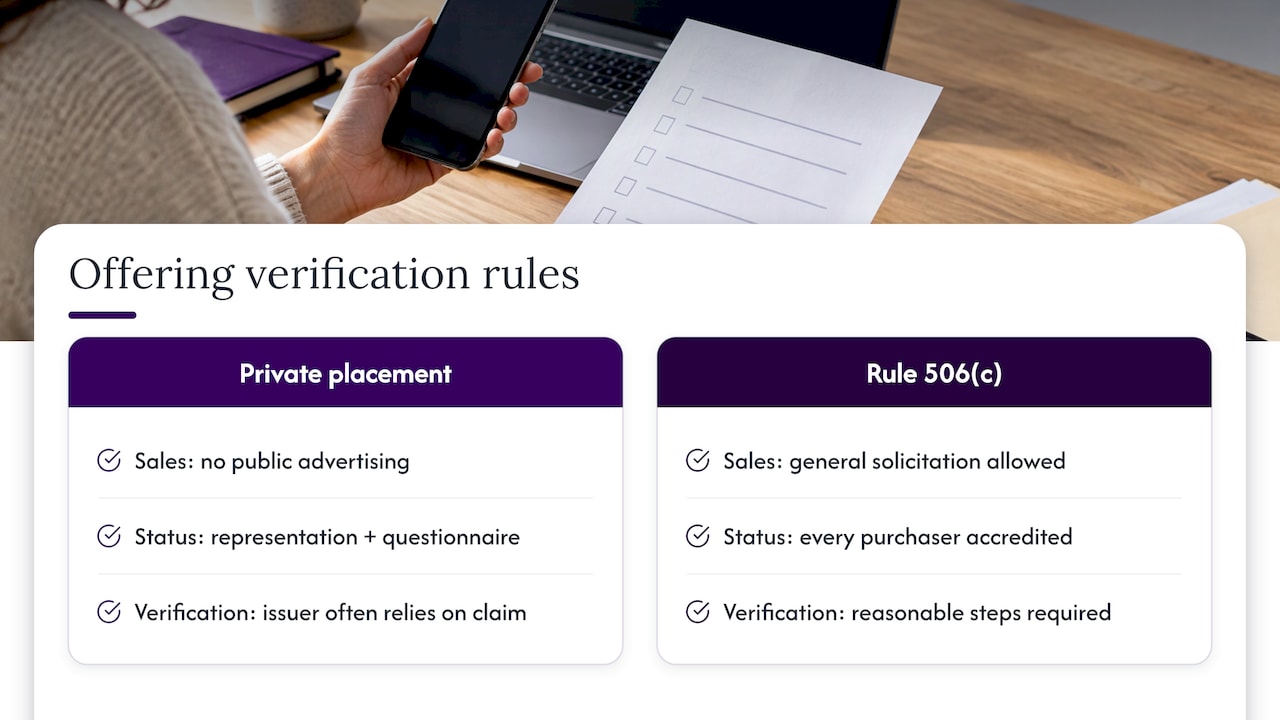
In a traditional private placement without public advertising, the issuer often relies on your representation that you are accredited, along with a questionnaire. In a Rule 506© offering, which allows general solicitation (advertising to the public), the rules are stricter. According to the SEC’s guidance on assessing accredited investors, every purchaser must be accredited and the issuer must take reasonable steps to verify that status. Self-certification alone is not enough.
The SEC describes this as a principles-based standard. The issuer has to assess objectively whether its steps are reasonable, given the investor, the information available, how the offering was solicited and its terms. The listed methods are non-exclusive safe harbors, not mandatory procedures. In practice, most sponsors use the safe harbors because they are clear and defensible.
This matters in energy investing because many oil and gas programs are marketed online. If you respond to an advertisement or find a deal through an online platform, expect a verification step before money moves. Our explainer on 506© energy offerings covers how that plays out on the deal side.
What evidence the SEC recognizes
The documents differ by the test you are using. The SEC’s guidance lists these safe harbors for natural persons.
| Test you meet | What the reviewer can look at | Recency |
|---|---|---|
| Income | IRS forms reporting income, such as W-2s, 1099s, Schedule K-1s or Form 1040, plus your written representation that you reasonably expect the required income this year | Two most recent years |
| Net worth | Bank and brokerage statements, certificates of deposit, tax assessments and similar asset records, a credit report from a nationwide consumer reporting agency, and your written representation about liabilities | Dated within the prior three months |
| Third-party confirmation | Written confirmation from a registered broker-dealer, SEC-registered investment adviser, licensed attorney or CPA that they took reasonable steps to verify you | Within the prior three months |
Source for the table: the SEC’s Regulation D assessment guidance.
Joint income or joint net worth
If you qualify together with a spouse or partner, both people are part of the check. The rule in 17 CFR 230.506 requires reviewing the relevant income or financial documents for both of you and getting representations from both. Gather your partner’s paperwork before you start, because a half-finished submission is the most common reason for delays.
The recency rules
The three-month window applies to net-worth documents and to professional confirmations. A separate rule helps repeat investors: if the same issuer already verified you and has no contrary information, a written representation that you remain accredited can cover a later purchase for up to five years, per the same eCFR rule text. That is useful if you plan to invest with one sponsor across several programs.
The ways to verify online
You do not have to mail paper to a law office. Most verification now happens through a secure web portal. There are four common routes.
1. Upload documents to a third-party verification service
Specialist services, some run by registered broker-dealers and some by law firms, let you create an account, state which test you meet and upload the supporting documents. A reviewer checks them and issues a letter or a status update to the issuer. One broker-dealer-run service describes its process as reviewing income, net worth, professional certifications and entity status, with issuers receiving status updates and timestamps rather than your raw financial documents.
2. Ask your CPA, attorney, adviser or broker-dealer for a letter
If you already work with a CPA, securities attorney, registered investment adviser or broker-dealer, ask for a written confirmation under the third-party safe harbor. The professional must have taken reasonable steps to verify you within the prior three months. This is often the fastest and most private route, because your records stay with someone who already holds them.
3. Submit documents through the issuer or portal
Some offering portals run the review inside the platform. You select your qualification and upload tax forms or statements for review. Portals commonly accept professional letters, W-2s, 1099s, K-1s, certificates of deposit, tax assessments, appraisals and proof of a Series 7, 65 or 82 license, with initial documents generally dated within 90 days. Check which options your particular portal lists before you gather files.
4. Reuse an existing approval
Some platforms reuse a prior approval. One system’s documentation describes reusing approved documents for 90 days across its offerings, or for five years with the same issuer. Reuse rules are set by each issuer or platform, so ask before you assume an old letter will transfer.
Step by step: verifying with your income
Here is the simplest path for a W-2 professional using the income test.
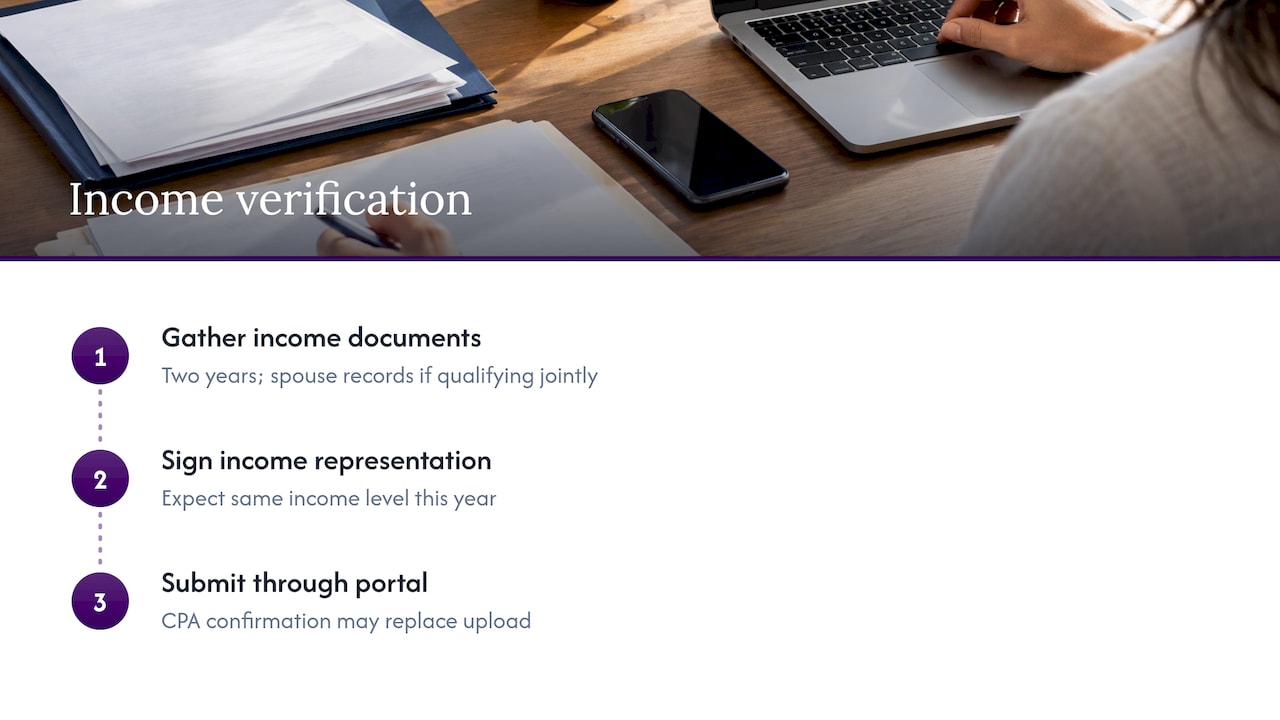
- Confirm the numbers. Pull your last two years of W-2s or Forms 1040. Check that your individual income, or joint income with a spouse or partner, cleared the threshold in both years.
- Write down your current-year expectation. You will be asked to represent that you reasonably expect to reach the same level this year. Bonus timing and equity vesting can affect this, so be honest about it.
- Choose your route. Use a professional letter if your CPA or attorney can issue one quickly. Otherwise, use the online portal the issuer points you to.
- Upload clean, complete files. Documents should show your full name and the date. Include every page.
- Redact what is not needed. If a service offers optional redaction of sensitive fields, such as account numbers or Social Security numbers, use it where allowed.
- Save the result. Keep the letter or confirmation, with its date, so you can reuse it where the issuer permits.
Step by step: verifying with net worth
The net-worth test needs more paperwork because it compares assets and liabilities.
- Add up assets: bank and brokerage statements, certificates of deposit, and other holdings, all dated within the last three months.
- Leave out your primary residence from the net-worth figure, as the SEC’s definition requires.
- Prepare a written statement of liabilities, and be ready for a credit report from a nationwide consumer reporting agency to be pulled.
- If you are applying jointly, collect the same material for your spouse or partner.
- Submit it all together through the portal, or hand it to your CPA or attorney to issue a confirmation.
Because statements go stale after three months, time this step close to when you plan to invest.
A worked example
Say you are a physician earning $240,000 and your spouse earns $90,000. Your combined income is $330,000 in each of the last two years, which clears the $300,000 joint threshold. That is only one scenario. Alone, your own income already clears the $200,000 individual bar.
You would pull two years of W-2s (or Form 1040s), sign a representation that you expect to reach the same level this year, and submit through the portal. Because you are qualifying on joint income, your spouse’s income documents and representation are part of the review. If your CPA is willing, a short confirmation letter can replace the document upload entirely.
This example is illustrative, not a promise that any particular reviewer will approve a given file. Reviewers apply their own checklists within the SEC’s framework.
Cost and turnaround
Costs and timing vary by provider, and they change, so confirm current figures on the provider’s page.
- Speed: one broker-dealer service reports typical processing of one business day, with bad-actor checks sometimes taking three to five business days. An attorney-reviewed service says most verifications take one or two business days when the information is complete.
- Fees: one third-party service advertises $35 per accreditation and $25 for each re-accreditation of the same account. Professional letters from your own CPA or attorney are typically billed at the professional’s rate, so ask up front.
- Who pays: in many offerings the issuer or platform covers verification. Ask the sponsor before you pay a third party yourself.
The biggest source of delay is incomplete paperwork, not the review itself. Name mismatches, missing pages and out-of-date statements account for most do-overs.
What a verification letter does and does not say
A verification letter typically identifies you and confirms that you were found to be accredited. It does not necessarily state your income or net worth. One service says its letter omits those figures, and recipients can authenticate it online.
That is useful for privacy: the sponsor learns your status, not your finances. Two limits apply. First, a letter is a snapshot. Issuers and platforms can set their own timeliness standards even when the provider sets no expiration date. Second, some certificates are limited to a single offering. One provider notes its certificates can generally cover multiple investments during their life unless restricted to one offering, and that SEC recency rules commonly lead to 90-day letter periods.
Protecting your information
Verification asks you to share some of the most sensitive documents you own. SIFMA’s guidance on Rule 506© acknowledges that the income and net-worth safe harbors require personal financial information and raise investor privacy concerns. It also notes that a qualifying third party can provide written confirmation instead.
A few practical habits help:
- Prefer a route where the sponsor receives only a status and a timestamp, not your raw documents.
- Look for encryption in transit and at rest, and ask whether you can redact fields you do not need to show. One attorney-reviewed service lists encryption, database encryption, firewalls, DDoS protection, vulnerability checks, optional redaction and attorney confidentiality duties.
- Upload through the official portal only. Never send tax returns by ordinary email to someone who contacted you unprompted.
- Ask who keeps your documents and for how long, and request deletion where you can.
Do not confuse verification with due diligence
A verified status says you are allowed to invest. It says nothing about whether a deal is a good one. Once you are cleared, the real work starts: reading the offering documents, understanding the operator’s track record and checking how the investment is structured. Our energy project evaluation guide and our article on how accredited investors vet private oil and gas deals walk through that process.
Tax questions deserve the same care. Energy programs can offer large first-year deductions, but how much applies to you depends on your own return. Talk to your CPA before you commit.
Our perspective
We talk with accredited investors every day, and the pattern is consistent: people expect verification to be the hard part, and it rarely is. The hard part is deciding which deal deserves your capital.
That is why we think about verification as the front door, not the product. A clean, fast, private check should take a day or two and then get out of your way, so your attention goes where it belongs: operator quality, project economics and how a deal fits your tax picture.
Fieldvest was built for high-earning professionals who want direct access to vetted U.S. energy projects, across producing assets, development projects and energy infrastructure. We aim to present key project materials in a streamlined way so you can compare deals side by side, and we focus on operators we have screened. Our view is simple: if you are going to share sensitive financial documents, you should get clarity, transparency and real access in return.
Gather your documents early, ask each sponsor exactly what they need, and use your CPA as a partner in both verification and tax planning.
Sharif
Ready to look at energy projects?
If you already meet the accredited test and want to see what private energy deals look like, Fieldvest brings together producing assets, development projects and energy infrastructure from vetted U.S. operators, built for accredited investors.

Want to size up the tax side first? Our free oil and gas tax deduction calculator gives you a starting estimate you can take to your CPA.
Common mistakes to avoid
- Using stale statements. Net-worth documents older than three months can be rejected.
- Counting your home. Your primary residence is excluded from the $1 million net-worth test.
- Forgetting the spouse’s paperwork. Joint qualification needs documents and representations from both people.
- Assuming one letter fits every deal. Reuse depends on the issuer or platform.
- Paying twice. Ask whether the sponsor already covers verification before buying a letter yourself.
If you are comparing deal types after you are verified, our overview of accredited investor opportunities and our piece on how private placements work for energy income and tax benefits are good next reads.
FAQ
Can I just check a box to say I’m accredited?
In some private placements without public advertising, a questionnaire and your representation may be enough. In a Rule 506© offering, the issuer must take reasonable steps to verify your status, and self-certification alone does not satisfy the rule. The offering documents will tell you which route applies.
How long does online verification take?
Providers commonly report one to two business days when your submission is complete. Extra checks can add a few days. Missing pages or out-of-date statements are the usual cause of delay.
How long is my verification good for?
That depends on the method and the issuer. Net-worth documents and professional confirmations must be dated within the prior three months. If the same issuer already verified you, a written representation can cover later purchases for up to five years, provided the issuer has no contrary information.
Will the sponsor see my tax returns?
Not necessarily. If a third party or your own professional issues the confirmation, the sponsor typically receives a letter or status confirming you qualify rather than your underlying documents. Ask each platform what it stores and shares before you upload.
Does my spouse need to submit documents too?
If you qualify using joint income or joint net worth, yes. The rule requires reviewing documents for both people and getting representations from both.
Sources
- SEC: Accredited Investors
- SEC: Assessing Accredited Investors under Regulation D
- eCFR: 17 CFR 230.506, exemption for limited offers and sales
- SIFMA: Guidance on Rule 506© Verification
- Broker-dealer verification service: process and turnaround
- Verification letter service: pricing and letter contents
- Attorney-reviewed verification service: FAQ and privacy measures
Recommended

Get the Fieldvest Energy Brief
and AI-driven demand shifts — curated for accredited investors. Smart. Strategic. Tax-advantaged.