


TL;DR:
- A 1031 exchange allows real estate investors to defer capital gains taxes by reinvesting sales proceeds into like-kind properties. Proper timing and the use of a qualified intermediary are essential to avoid disqualification and capitalize on tax deferral advantages. When held until death, the deferred gains can be erased through a stepped-up basis, making this strategy effective for long-term wealth growth.
A 1031 exchange is defined as a tax deferral mechanism under Internal Revenue Code Section 1031 that lets real estate investors sell an investment property and reinvest the proceeds into a like-kind property without triggering immediate capital gains taxes. Federal capital gains rates can reach 20%, plus an additional 3.8% Net Investment Income Tax (NIIT) for higher earners. That combined exposure makes deferral one of the most powerful tools in a real estate investor’s tax planning arsenal. The IRS does not eliminate the tax. It postpones it, which means your capital keeps compounding instead of shrinking at the point of sale.
What are 1031 exchanges and how do they work?
A 1031 exchange works by routing your sale proceeds through a Qualified Intermediary (QI) rather than into your hands directly. The QI holds the funds in escrow while you identify and close on a replacement property. This structure is what prevents “constructive receipt,” the IRS term for when a taxpayer takes control of funds and triggers immediate tax liability.
The process follows six defined steps:
- Engage a Qualified Intermediary before closing. You must hire a QI before the sale of your relinquished property closes. Engagement typically requires a minimum two-week lead time for paperwork and documentation.
- Close on the relinquished property. The sale proceeds transfer directly to the QI’s escrow account. You never touch the funds.
- Identify replacement properties within 45 days. The 45-day identification period begins the day you close on the relinquished property. Both the 45-day and 180-day clocks start simultaneously from that date.
- Follow the identification rules. The IRS allows three options: the 3-property rule (identify up to three properties regardless of value), the 200% rule (identify any number of properties as long as their combined value does not exceed 200% of the relinquished property’s value), or the 95% rule (identify any number of properties if you acquire at least 95% of their total value).
- Close on the replacement property within 180 days. The 180-day deadline is not additional time after the 45-day window. It runs concurrently from the same closing date.
- File IRS Form 8824. You attach Form 8824 to your federal tax return for the year of the exchange. This form reports the transaction and establishes your new cost basis in the replacement property.
Pro Tip: Never wait until a purchase contract is signed to call a QI. The IRS requires the QI agreement to be in place before the relinquished property closes. Missing this step by even one day disqualifies the entire exchange.
What qualifies for a 1031 exchange?
Like-kind property under IRC Section 1031 is defined broadly. Treasury Regulations, finalized in december 2020, clarify that “like-kind” refers to the nature of the property, not its grade or quality. Any real property held for investment or productive use in a trade or business qualifies.
Qualifying exchanges include:
- A residential rental property exchanged for a commercial office building
- Raw land exchanged for an apartment complex
- A retail strip center exchanged for a self-storage facility
- A single-family rental exchanged for a fractional interest in a larger asset
Properties that do not qualify are equally important to understand:
- Primary residences do not qualify. The property must be held for investment or business use, not personal use.
- Dealer property does not qualify. If you buy and sell properties as a business (flipping), the IRS treats those as inventory, not investment assets.
- Personal property such as equipment, vehicles, or collectibles no longer qualifies. The Tax Cuts and Jobs Act of 2017 restricted Section 1031 to real property only.
Eligible taxpayers include individuals, partnerships, LLCs, C-corporations, S-corporations, and qualified trusts. The key test is always investment intent. The property must be held for investment or business use at the time of the exchange, not for immediate resale or personal enjoyment.
What types of 1031 exchanges exist?
Four main exchange structures exist, each suited to different investor situations.
| Exchange Type | How It Works | Complexity | Key Requirement |
|---|---|---|---|
| Forward (delayed) | Sell first, then buy replacement | Low | QI engaged before closing |
| Reverse | Buy replacement before selling | High | Exchange Accommodation Titleholder (EAT) |
| Improvement | Build value into replacement property | High | Construction completed within 180 days |
| Delaware Statutory Trust (DST) | Fractional ownership in institutional property | Medium | Accredited investor status |
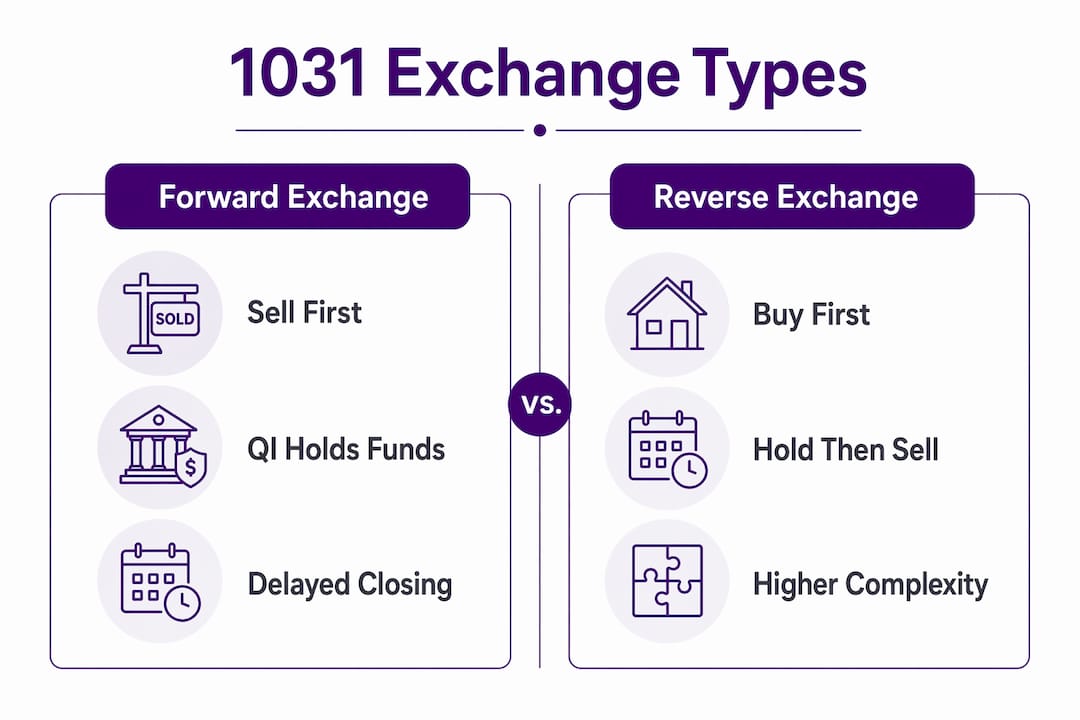
The forward exchange is the most common structure. You sell your property, the QI holds the proceeds, and you close on a replacement within the IRS deadlines.
The reverse exchange flips that sequence. You acquire the replacement property before selling the relinquished one. This requires an Exchange Accommodation Titleholder to hold title to one of the properties during the process. Reverse exchanges require 4–6 weeks of preparation and are significantly more complex than forward exchanges.
The improvement exchange, sometimes called a construction exchange, lets you use exchange proceeds to build improvements on the replacement property. The property must be received with the improvements substantially complete within the 180-day window.
The Delaware Statutory Trust (DST) structure allows investors to hold fractional interests in large institutional properties such as apartment complexes or medical office buildings. DSTs are popular with passive investors who want to exit active management while maintaining tax deferral.
Benefits, risks, and common pitfalls of 1031 exchanges
The primary benefit of a 1031 exchange is capital preservation. Instead of paying capital gains tax at the point of sale, you redeploy the full proceeds into a larger or better-performing asset. Over multiple exchanges, this compounding effect can significantly accelerate portfolio growth.

Tax deferral is not tax elimination. Deferred gains reduce the cost basis in the replacement property. When you eventually sell without another exchange, the accumulated deferred gain becomes taxable. One important exception: if you hold the replacement property until death, your heirs receive a stepped-up basis, which can erase deferred gains entirely. This makes 1031 exchanges a powerful multigenerational wealth transfer tool.
Common pitfalls include:
- Touching the funds. If the sale proceeds reach your bank account before the QI receives them, the exchange is disqualified. The full gain becomes taxable immediately.
- Missing the 45-day deadline. The IRS does not grant extensions for personal circumstances. Changing identified properties after the 45-day deadline is forbidden, regardless of the reason.
- Receiving boot. If you reinvest less than the full sale price, the difference is called “boot” and is taxed in the year of the exchange. To defer all taxes, you must reinvest all proceeds and acquire a property of equal or greater value.
- Engaging a QI too late. The most common failure in 1031 exchanges is engaging a Qualified Intermediary after the relinquished property has already closed.
Reviewing common legal mistakes with a real estate attorney before you list your property can prevent costly errors that no amount of planning can fix after the fact.
Pro Tip: Work with a tax advisor who specializes in 1031 exchanges, not a generalist. The identification rules alone have three separate compliance paths, and choosing the wrong one for your situation can disqualify the exchange.
How investors use 1031 exchanges to build wealth
The most effective use of a 1031 exchange is not a single transaction. It is a long-term portfolio strategy. Investors use sequential exchanges to trade up from smaller properties into larger, higher-yielding assets without losing capital to taxes at each step.
Practical applications include:
- Portfolio consolidation. An investor with five small rental properties sells them and exchanges into one larger commercial asset, reducing management complexity while deferring all gains.
- Geographic diversification. A California investor sells an appreciated rental and exchanges into properties in Texas or Florida, accessing different market dynamics without a tax penalty for moving capital.
- Asset class shifts. A residential landlord exchanges into a self-storage facility or industrial property to access different income profiles and depreciation schedules.
- Passive income transition. An active investor approaching retirement exchanges into a DST to eliminate property management responsibilities while maintaining tax deferral.
Pairing a 1031 exchange with other tax strategies amplifies the benefit. Investors who also hold oil and gas investments can use intangible drilling cost deductions to offset ordinary income in the same year they complete an exchange. The two strategies address different parts of the tax picture: the exchange defers capital gains, while energy investments reduce ordinary income. Understanding top tax deduction strategies across asset classes gives high-earning investors more levers to pull in any given tax year.
Key Takeaways
A 1031 exchange defers capital gains taxes indefinitely through sequential reinvestment, and when held until death, the deferred gain can be eliminated entirely through a stepped-up basis.
| Point | Details |
|---|---|
| Core definition | A 1031 exchange defers capital gains and depreciation recapture taxes by reinvesting in like-kind property. |
| Critical timelines | You have 45 days to identify and 180 days to close on a replacement property, both starting simultaneously. |
| QI requirement | A Qualified Intermediary must be engaged before the relinquished property closes or the exchange is disqualified. |
| Eligible property | All real property held for investment or business use qualifies; primary residences and dealer property do not. |
| Tax deferral vs. elimination | Deferred gains lower your cost basis and become taxable on a future non-exchange sale, unless a stepped-up basis applies at death. |
The procedural trap most investors don’t see coming
I’ve watched experienced investors lose their entire tax deferral not because they misunderstood the strategy, but because they underestimated the paperwork. A 1031 exchange looks simple on paper: sell, reinvest, defer. The reality is a sequence of hard deadlines with zero tolerance for error.
The QI engagement issue catches people most often. An investor gets a strong offer, accepts it, and calls a QI the day before closing. That is already too late in many cases. The QI agreement needs to be structured into the sale contract itself, not added as an afterthought. I always tell investors to treat the QI search as part of the listing process, not the closing process.
The identification rules are the second trap. Most investors default to the 3-property rule without realizing the 200% rule might give them more flexibility in a competitive market. Choosing the right identification path for your specific situation requires knowing your fallback options before the 45-day clock starts, not after.
My honest recommendation: consult a 1031-specialized tax attorney and a CPA before you list the property. The cost of that consultation is a fraction of the tax bill you’ll face if the exchange fails. The strategy is genuinely powerful, but only when executed with the same precision the IRS demands.
— Sharif
Tax-efficient investing beyond real estate
Real estate investors who use 1031 exchanges to defer capital gains often overlook a parallel strategy that addresses ordinary income taxes directly.

Fieldvest connects accredited investors with vetted U.S. oil and gas projects that generate large first-year tax deductions through intangible drilling costs. These deductions can offset W-2 income, business income, or other ordinary income in the same year you complete a 1031 exchange. The two strategies work on different parts of your tax bill and complement each other well. Use Fieldvest’s tax deduction calculator to estimate your potential deductions, or review how to lower your taxes with oil and gas investments alongside your real estate portfolio.
FAQ
What is the basic 1031 exchange definition?
A 1031 exchange is a transaction under Internal Revenue Code Section 1031 that allows investors to defer capital gains and depreciation recapture taxes by reinvesting sale proceeds from an investment property into a like-kind replacement property.
How long do you have to complete a 1031 exchange?
You have 45 days from the closing date of the relinquished property to identify replacement properties, and 180 days from that same closing date to complete the purchase. Both deadlines run simultaneously.
What property qualifies for a 1031 exchange?
Any real property held for investment or productive business use qualifies, including rental homes, commercial buildings, raw land, and fractional interests. Primary residences and properties held primarily for resale do not qualify.
Can you do a 1031 exchange on a rental property you also use personally?
Personal use complicates eligibility. The IRS requires the property to be held primarily for investment or business use. If personal use exceeds IRS thresholds, the property may not qualify as a relinquished or replacement property.
What happens to deferred taxes if you never sell?
If you hold the replacement property until death, your heirs receive a stepped-up basis equal to the property’s fair market value at that time. This can eliminate the accumulated deferred gain entirely, making 1031 exchanges one of the most effective multigenerational wealth transfer tools available.
Recommended

Get the Fieldvest Energy Brief
and AI-driven demand shifts — curated for accredited investors. Smart. Strategic. Tax-advantaged.