


TL;DR:
- Energy ETFs are structurally flawed due to concentration, management fees, and contango drag that erode long-term returns.
- Direct investments, royalties, and midstream assets offer better tax efficiency, income stability, and transparency for high earners.
Energy ETFs are exchange-traded funds that bundle exposure to oil, gas, and related energy companies or futures contracts into a single tradable security, and for many investors, that convenience comes at a steep structural cost. The case for why avoid energy ETFs is not simply about market timing. It is about persistent mechanical flaws, extreme concentration, and hidden drag that quietly erode returns over years. Accredited investors and high-earning professionals in particular often find that direct energy investments deliver better tax efficiency, more predictable income, and far greater transparency than any ETF wrapper can provide. This guide breaks down the core risks and shows you what better alternatives look like.
Why avoid energy ETFs: the core structural problem
Energy ETFs fall into two broad categories, and both carry distinct risks that most investors underestimate before they buy.
Equity-based energy ETFs hold shares in publicly traded energy companies. The Energy Select Sector SPDR Fund (XLE) is the most prominent example, tracking the S&P 500 energy sector. Futures-based energy ETFs hold rolling futures contracts on commodities like crude oil or natural gas. The United States Natural Gas Fund (UNG) and Invesco DB Energy Fund (DBE) are the most widely traded examples in this category.
Here is what makes the structure problematic:
- Equity ETFs concentrate holdings in a handful of integrated majors rather than delivering genuine sector diversification
- Futures ETFs must continuously roll expiring contracts forward, generating ongoing transaction costs
- Both types carry management fees that compound against returns over time
- Liquidity constraints during market stress cause tracking errors, meaning the ETF price diverges from the value of its underlying assets
- Passive exposure means investors absorb sector volatility without any active risk management
The structural design of these products suits short-term traders far better than long-term wealth builders. Understanding that distinction is the starting point for any serious energy investment decision.
What are the key risks and drawbacks of investing in energy ETFs?
Concentration risk is hiding in plain sight
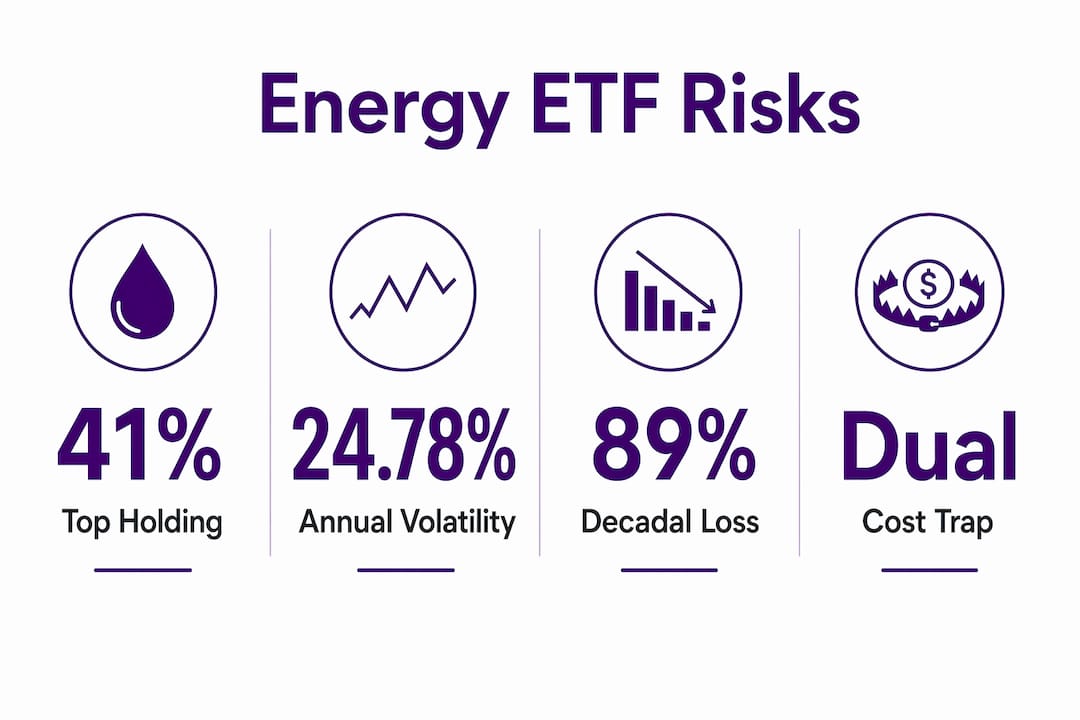
The most cited benefit of ETFs is diversification. In energy, that promise is largely false. XLE concentrates roughly 41% of its weight in just two companies: ExxonMobil and Chevron. That means buying XLE is less like buying the energy sector and more like making a leveraged bet on two integrated oil majors. When either company faces regulatory pressure, earnings misses, or geopolitical exposure, the entire fund moves with it.

This concentration also means that smaller, higher-growth energy producers, midstream operators, and royalty companies are either underweighted or absent entirely. You pay for diversification and receive something closer to a two-stock portfolio with extra steps.
Contango drag destroys long-term value in futures ETFs
Contango is the single most destructive force in commodity futures ETFs, and it operates invisibly. When futures markets are in contango, the price of a contract expiring next month is lower than the price of a contract expiring the month after. Every time a futures ETF rolls its position forward, it sells the cheaper near-term contract and buys the more expensive deferred contract. That monthly loss compounds relentlessly.
“Contango causes long-term losses in commodity futures-based ETFs by forcing the sale of cheaper contracts and the purchase of more expensive ones, with structural drag capable of eroding up to 90% of investment value over a decade.”
The data on UNG makes this concrete. UNG lost approximately 89% over ten years, trading near $11.33 today versus $106.24 a decade ago, despite no sustained decline in natural gas spot prices. The fund did not fail because natural gas became worthless. It failed because the roll mechanism bled investors dry. Annual roll costs on UNG run between 5% and 15%, compounding year after year.
Volatility is not a temporary condition
Energy futures ETFs average 24.78% annual volatility since inception, according to Invesco DB Energy Fund SEC filings. That figure is not a warning about bad years. It is the baseline. For investors building toward retirement income or tax-efficient wealth accumulation, absorbing that level of volatility passively is a costly choice.
Energy market volatility is also evolving from episodic to structural, driven by geopolitical disruption and the ongoing energy transition. Passive ETF exposure means you absorb that volatility as a cost rather than positioning to benefit from it. Active management, direct investments, or structured partnerships allow investors to respond to volatility rather than simply endure it.
The dual-cost trap compounds losses
Energy ETFs carry a dual-cost structure: management fees plus transaction and roll costs tied to futures contracts. During periods of market stress, liquidity constraints amplify these costs further, widening the gap between what the ETF should be worth and what it actually trades at. For investors who entered during a volatility spike, the exit can be equally punishing.
How do energy ETFs compare to alternative investment options?
| Investment type | Diversification | Tax efficiency | Income predictability | Structural costs |
|---|---|---|---|---|
| Equity energy ETF (e.g., XLE) | Low (concentrated) | Standard capital gains | Variable dividends | Management fees |
| Futures energy ETF (e.g., UNG) | Commodity-only | Standard capital gains | None | Fees plus roll costs |
| Midstream MLP | Moderate | Pass-through distributions | High, quarterly | Low |
| Direct oil & gas working interest | High (operator-specific) | Large first-year deductions | Long-term royalty income | Minimal ongoing |
| Renewable energy ETF | Moderate | Standard capital gains | Low to moderate | Management fees |
Direct equity investments in individual energy producers give you control over valuation, debt levels, and dividend history. You can screen for companies with strong free cash flow and manageable leverage, something a passive ETF never does on your behalf. Thematic energy ETFs encourage passive investing that bypasses fundamental analysis, leading retail investors to assume sector strength overrides individual company risks while ignoring debt and valuation metrics entirely.
Midstream investments, including master limited partnerships (MLPs) and pipeline operators, offer a different profile. They generate fee-based income largely independent of commodity prices, making them more predictable than upstream producers. Funds like the Alerian MLP ETF (AMLP) exist, but direct MLP investments or limited partnership interests often provide superior tax treatment through pass-through deductions.
For accredited investors, direct participation in oil and gas working interests or royalty programs offers the strongest combination of income and tax efficiency. These structures allow for tax-efficient energy income through intangible drilling cost deductions, depletion allowances, and long-term royalty streams that no ETF can replicate.
Pro Tip: Before comparing energy investment options, calculate your effective after-tax return on each vehicle. A direct oil and gas investment with a 70% first-year intangible drilling cost deduction will often outperform an ETF yielding 3% on a net basis, particularly for investors in the 37% federal bracket.
How should investors approach energy investing given these risks?
Size positions to match your actual risk tolerance
Commodity price declines simultaneously impact dividends and capital appreciation in energy investments, creating a dual risk that most sector allocations underestimate. Even energy ETFs that delivered 24% to 31% returns in 2026 remain fully exposed to the next commodity downturn. Position sizing in the energy sector should reflect that dual-sided risk, not just the upside potential from a strong year.
A reasonable starting point for most portfolios is limiting total energy sector exposure to 5% to 10% of investable assets, with the specific allocation depending on income needs, tax situation, and time horizon.
Go beyond the ETF composition
Passive ETF ownership removes the discipline of fundamental analysis. When you own XLE, you own ExxonMobil’s debt load, Chevron’s capital expenditure decisions, and every smaller holding’s balance sheet without ever reviewing any of them. Direct investment forces you to evaluate operator track records, well economics, reserve estimates, and cash flow projections. That discipline is not a burden. It is the mechanism that protects capital.
- Review operator history and production data before committing capital
- Analyze free cash flow yield rather than relying on dividend yield alone
- Assess debt-to-EBITDA ratios for any energy company you consider
- Understand the difference between proved developed producing reserves and speculative resource estimates
Prioritize income stability and tax structure
Long-term energy income from royalties, working interests, or midstream distributions provides a fundamentally different investor experience than ETF dividends. Royalty income does not require ongoing capital expenditure. Working interest income benefits from depletion deductions that reduce taxable income year after year. Exploring long-term energy income structures gives high-earning investors a path to cash flow that compounds on an after-tax basis rather than a pre-tax one.
Pro Tip: Ask any energy investment sponsor for a breakdown of intangible versus tangible drilling costs before committing. Intangible drilling costs, typically 60% to 80% of total well costs, are fully deductible in the year incurred, making the first-year tax impact dramatically different from any ETF investment.
Key takeaways
Energy ETFs carry structural flaws, including contango drag, extreme concentration, and compounding costs, that make them unsuitable for investors seeking reliable long-term income and tax efficiency.
| Point | Details |
|---|---|
| Contango destroys futures ETF value | UNG lost 89% over a decade from roll costs alone, not from falling gas prices. |
| Concentration risk is real | XLE puts 41% of its weight in just ExxonMobil and Chevron, limiting true diversification. |
| Volatility is structural, not temporary | Energy futures ETFs average 24.78% annual volatility, requiring active management to avoid absorbing it as pure cost. |
| Direct investments offer tax advantages | Oil and gas working interests provide first-year deductions and depletion allowances that no ETF can match. |
| Position sizing matters | Dual commodity price risk to both dividends and capital means energy allocations require careful sizing. |
Why I stopped recommending energy ETFs to serious investors
I have watched accredited investors buy XLE or UNG expecting sector exposure and walk away years later confused about why their returns lagged the energy market they thought they owned. The answer is almost always structural. The ETF wrapper creates a false sense of simplicity. You see one ticker, one price, one dividend yield. What you do not see is the roll cost bleeding your futures position, the two-stock concentration masquerading as diversification, or the management fee compounding against you in a flat market.
The more uncomfortable truth is that thematic ETF investing encourages intellectual laziness. When you buy a sector fund, you stop asking whether the underlying companies deserve your capital. You assume the index did that work for you. In energy, that assumption is particularly dangerous because the sector includes everything from highly profitable royalty companies to heavily indebted exploration-stage producers, and the index weights them by market cap, not by quality.
My view is that high-earning investors should treat energy as an income and tax strategy, not a sector bet. That means evaluating alternative energy investment options like direct working interests, royalty programs, and structured partnerships where the economics are transparent, the tax treatment is favorable, and the income is tied to actual production rather than a futures roll schedule.
The investors I have seen build real wealth in energy did not do it through ETFs. They did it by understanding the assets they owned.
— Sharif
Invest smarter in energy with Fieldvest

Fieldvest connects accredited investors with vetted U.S. oil and gas operators offering large first-year tax deductions and long-term production income. Unlike energy ETFs, every Fieldvest opportunity comes with full operator transparency, clear well economics, and a tax structure designed for high-earning professionals. Use the Oil & Gas Tax Deduction Calculator to see exactly how much a direct energy investment could reduce your federal tax bill this year. For investors ready to move beyond passive sector exposure, Fieldvest offers a direct path to tax-efficient energy income built on real assets, not rolling futures contracts.
FAQ
What makes energy ETFs risky for long-term investors?
Energy ETFs carry concentration risk, high volatility averaging 24.78% annually, and in the case of futures-based funds, contango drag that can erase most of an investment’s value over a decade without any decline in the underlying commodity price.
What is contango and why does it hurt futures ETFs?
Contango is a market condition where future-dated contracts cost more than near-term ones, forcing futures ETFs to sell low and buy high every month when rolling positions forward. UNG lost approximately 89% over ten years due to this structural drag alone.
Should you invest in energy ETFs if you want dividend income?
Equity energy ETFs do pay dividends, but commodity price drops reduce both the dividend and the share price simultaneously. Midstream MLPs or direct working interests typically offer more stable, tax-advantaged income for investors prioritizing cash flow.
How do direct oil and gas investments differ from energy ETFs?
Direct investments in oil and gas working interests provide intangible drilling cost deductions, depletion allowances, and royalty income tied to actual production. ETFs offer none of these tax benefits and add management fees on top of market risk.
What are the best alternatives to energy ETFs for accredited investors?
Accredited investors can access direct oil and gas working interests, royalty programs, midstream limited partnerships, and structured private placements through platforms like Fieldvest, all of which offer better tax treatment and more transparent economics than any ETF structure.
Recommended

Get the Fieldvest Energy Brief
and AI-driven demand shifts — curated for accredited investors. Smart. Strategic. Tax-advantaged.