


TL;DR:
- Energy projects attract tech founders because their complexity offers software solutions that reduce deal friction and improve long-term economics. AI-driven demand growth from data centers accelerates project timelines, making software tools highly valuable in the sector. Contractual governance layers create durable economic moats, positioning energy as a multi-decade infrastructure opportunity for innovative software platforms.
Energy projects attract tech founders because they combine software-solvable complexity with contract-anchored economics and one of the fastest-growing demand curves in modern markets. The sector’s fragmented data, multi-stakeholder governance, and AI-driven electricity surge create conditions where software delivers outsized returns. Founders like Victor Shao of Vor Systems and Raahul Hari Nair of CHI’GRIDS are not chasing hardware. They are building platforms that compress deal timelines, automate regulatory diligence, and lock in long-term economic value through governance layers that persist for decades. For tech founders exploring energy sector startup opportunities, the case is structural, not speculative.
Why energy projects attract tech founders: the software opportunity
The core reason tech founders enter energy is that the sector’s complexity is a software problem waiting to be solved. Energy project development involves thousands of fragmented documents spanning permits, interconnection studies, grid impact assessments, and power purchase agreements. Managing this manually is slow, expensive, and error-prone. That friction is exactly where software-driven founders see margin.

Vor Systems built an AI copilot and smart data room specifically for independent power producers (IPPs). The platform consolidates fragmented documentation, automates extraction of structured deal data, and reduces the manual effort that typically bogs down financing timelines. Victor Shao’s insight is direct: software reduces deal friction, saving time and cost while improving returns for energy investors. That is not a feature pitch. It is a structural advantage in a market where weeks of diligence delay can kill a project’s financing window.
REplace and similar project evaluation tools take a parallel approach. Rather than waiting for late-stage failures caused by grid or regulatory issues, these platforms consolidate documentation early so founders can identify viable projects faster. The payoff is measurable: 80% of renewable energy projects fail before construction, largely due to fragmented information and regulatory complexity. Every percentage point of that failure rate represents a software opportunity.
Key reasons tech founders cite for entering energy through software platforms:
- Reducing manual document review across permits, interconnection, and compliance filings
- Automating extraction of structured financial and regulatory data from unstructured sources
- Accelerating financing timelines by surfacing deal-critical information earlier
- Lowering per-project diligence costs, which improves returns at scale
- Building adaptable platforms that serve diverse IPP customer needs without costly rebuilds
Pro Tip: If you are evaluating energy sector startup opportunities, look for the document-heavy workflows first. That is where AI delivers the fastest, most defensible efficiency gains.
How AI-powered electricity demand fuels founder interest
The AI boom is not just a technology story. It is an energy story, and tech founders recognize this faster than most. Data centers powering large language models, inference workloads, and cloud infrastructure require enormous and growing amounts of electricity. This demand surge creates urgency to develop new power capacity at venture-scale speed, which is precisely the environment where software-driven founders thrive.
MIT Technology Review identifies the AI boom as a primary driver pushing power demand higher and influencing clean energy financing conditions. The connection is direct: more AI compute requires more electricity, which requires more energy projects, which requires faster development cycles. Founders who build tools that accelerate those cycles are positioned at the center of a compounding market.
“Companies like Solv Energy are growing capacity aligned with AI data center demand, cementing tech founders’ interest in energy projects as a durable, expanding market.” — MIT Technology Review, May 2026
Public market activity confirms this confidence. Climate tech IPOs are accelerating, reflecting investor confidence in energy innovations linked to AI-driven demand. This is not a niche trend. It is a structural realignment of where capital flows in the technology and energy sectors simultaneously. For tech founders in renewable energy, aligning project development tools with AI-driven power demand is not just smart positioning. It is the market telling you where to build.
The AI and data center demand dynamic also shortens the acceptable development timeline for new capacity. Utilities and hyperscalers need power on predictable schedules. Founders who can compress project timelines through better software earn a premium, both in fees and in equity value.
Why contracts, corridors, and compliance define long-term value
Most tech founders entering energy quickly learn that the real value is not in the hardware or the edge devices. It is in the governance layer. Energy projects are bound by contracts, corridor rights, and compliance frameworks that lock in economics and risk profiles for years, sometimes decades. Software that governs these layers creates a durable competitive advantage that hardware alone cannot replicate.
Raahul Hari Nair, founder of CHI’GRIDS, articulates this clearly. His focus is on tools connecting sourcing, cost, regulatory, and carbon positioning across the full asset life. The insight is that contractual governance creates sustainable advantage beyond edge device innovation. A project’s interconnection agreement, power purchase contract, and regulatory compliance record are not administrative details. They are the economic foundation of the asset.
Here is how tech founders approach the governance layer in practice:
- Map the contract stack early. Identify all binding agreements, corridor rights, and regulatory filings before committing capital or development resources.
- Build or adopt software that tracks compliance obligations. Regulatory deadlines in energy are hard stops. Missing them can void permits or trigger penalties that restructure the entire project economics.
- Treat carbon positioning as a financial variable. Carbon credits, renewable energy certificates, and emissions compliance are increasingly priced into project valuations and offtake agreements.
- Automate governance reporting. The hardest-to-automate layer in energy development is the fragmented document and risk-accounting system. AI platforms that handle this deliver the greatest efficiencies.
- Align contract terms with financing windows. Long-term power purchase agreements that match debt service schedules are the difference between bankable and non-bankable projects.
Pro Tip: When evaluating an energy project as a tech founder, ask for the interconnection queue position and the PPA term sheet before reviewing any financial model. Those two documents tell you more about project viability than any spreadsheet.
The long decision lock-in periods via contracts and corridors make governance software critical to securing durable investment returns. This is why founders who understand software architecture and regulatory compliance simultaneously have a structural edge in energy markets.
How energy projects compare to other sectors for tech founders
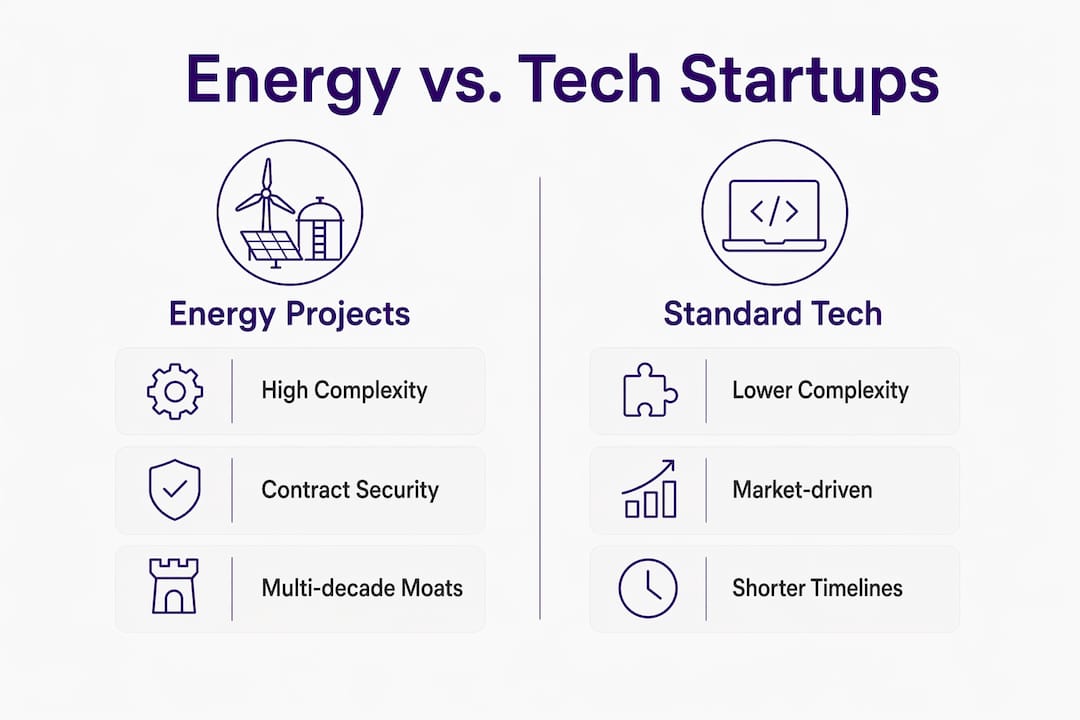
Tech founders evaluate opportunities across many sectors. Energy stands apart in ways that are not immediately obvious from the outside. The comparison matters because it explains why energy startups are attracting entrepreneurs who could build in fintech, healthtech, or consumer software instead.
| Factor | Energy projects | Standard tech startup |
|---|---|---|
| Deal complexity | High: multi-stakeholder, regulatory, grid-dependent | Low to medium: primarily commercial and technical |
| Contract duration | 10 to 30 years, locked economics | 1 to 3 year SaaS contracts, high churn risk |
| Market size driver | AI demand, climate policy, infrastructure spend | Consumer adoption, platform network effects |
| Competitive moat | Governance software, corridor rights, compliance systems | Product features, brand, distribution |
| Failure mode | Late-stage regulatory or grid rejection | Customer acquisition cost, market timing |
| Return timeline | Long cycle, but contract-secured cash flows | Faster exits possible, but higher binary risk |
The table makes the tradeoff clear. Energy projects carry more upfront complexity, but that complexity is the moat. Once a project clears interconnection, secures a PPA, and achieves commercial operation, the cash flows are contractually protected in ways that SaaS revenue simply is not.
Energy investment also aligns with two megatrends simultaneously: the AI-driven electricity demand surge and the global climate transition. Founders who build in this space are not betting on a single product cycle. They are positioning within a multi-decade infrastructure buildout backed by both private capital and policy support.
The benefits of energy innovation for tech founders extend beyond returns. The sector offers a chance to build software that has genuine infrastructure-level impact, which attracts a specific type of founder who wants both financial returns and durable market relevance.
Key takeaways
Tech founders enter energy because the sector’s complexity is a software opportunity, its contracts create durable economic moats, and AI-driven demand growth makes the market timing structurally favorable.
| Point | Details |
|---|---|
| Software solves energy friction | AI platforms like Vor Systems reduce diligence time and deal costs, improving project returns. |
| AI demand creates urgency | Data center electricity growth forces faster project development cycles, rewarding efficient founders. |
| Governance layers lock value | Contracts, corridor rights, and compliance frameworks secure economics for decades, not quarters. |
| Failure rate signals opportunity | 80% of renewable projects fail pre-construction, creating clear demand for better evaluation tools. |
| Ecosystem support matters | Organizations like Greentown Labs help founders cross the gap from prototype to commercial pilot. |
What I’ve learned watching tech founders enter energy
I have watched a lot of founders make the move from software into energy over the past several years, and the ones who succeed share one trait: they stop thinking about energy as a hardware problem and start treating it as a data and governance problem. The founders who struggle are usually the ones who arrive with a consumer-tech mindset, expecting fast feedback loops and short sales cycles. Energy does not work that way, and that is actually the point.
The cultural shift I find most interesting is how AI has changed the conversation. Three years ago, energy project developers were skeptical of software-first founders. Today, the urgency created by AI data center demand has made those same developers eager to adopt tools that compress timelines. The market has moved toward the founders, not the other way around.
I also think the ecosystem dimension is underrated. Greentown Labs and MIT Energy Initiative programs exist specifically to help founders cross the prototype-to-pilot gap, which is where most energy startups die. Founders who plug into those networks move faster and make fewer expensive regulatory mistakes.
My honest advice: if you are a tech founder considering energy, do not start with the technology. Start with one specific workflow that is visibly broken, whether that is interconnection queue management, permit tracking, or PPA negotiation. Build something narrow and defensible there first. The broader platform opportunity will become clear once you understand the governance layer from the inside.
— Sharif
How Fieldvest helps tech founders invest in energy projects
Tech founders who understand energy’s structural advantages often want direct exposure to vetted projects, not just the software layer. Fieldvest connects accredited investors with trusted U.S. oil and gas operators offering large first-year tax deductions and long-term energy income. The platform is built for high-earning professionals who want to reduce taxes and generate cash flow from energy assets without managing operations themselves.
Fieldvest provides a free tax deduction calculator so you can model your first-year savings before committing capital. For founders already generating significant income, the combination of intangible drilling cost deductions and long-term production income creates a tax-efficient cash flow profile that few other asset classes match. If you want to see how energy investments fit your financial picture, the wealth projection tool models after-tax compound growth specific to your income level.
FAQ
Why do tech founders choose energy over other investment sectors?
Energy projects offer contract-secured cash flows, multi-decade governance moats, and alignment with AI-driven electricity demand growth. These characteristics are structurally different from consumer tech or fintech, where revenue is more volatile and competitive moats erode faster.
What software problems do tech founders solve in energy projects?
The primary targets are fragmented document management, interconnection queue tracking, and regulatory compliance automation. Platforms like Vor Systems use AI to consolidate thousands of permit and contract documents, reducing diligence time and improving deal economics.
How does AI demand growth affect energy project investment?
AI data centers require significant and growing electricity capacity, creating urgency to develop new power projects faster. This demand surge rewards founders who build tools that compress development timelines and improves the financing environment for clean energy projects.
What is the biggest risk for tech founders entering energy?
Late-stage project failure due to grid or regulatory issues is the primary risk. 80% of renewable projects fail before construction, most due to fragmented information and regulatory complexity that better software tools are designed to address.
How do contracts create long-term value in energy projects?
Power purchase agreements and interconnection contracts lock in revenue and risk profiles for 10 to 30 years. This contractual stability makes energy assets more predictable than most technology investments and creates durable economic moats that software governance tools help protect.
Recommended

Get the Fieldvest Energy Brief
and AI-driven demand shifts — curated for accredited investors. Smart. Strategic. Tax-advantaged.