


Wind projects earn their tax benefits through two federal credits (a per-kilowatt-hour production credit or a percentage-of-cost investment credit) plus accelerated depreciation. Those benefits flow mostly to corporate “tax equity” investors, and for an individual they are usually passive, so they rarely reduce tax on wages or capital gains from securities. If you earn $200,000 or more and want deductions that work against active income, you need to understand that gap before you commit capital.
This guide explains how the wind incentives work, what the 2025 law changed, and how to test whether any energy deal can actually lower your own tax bill.
TL;DR
- A wind project can claim the production tax credit (PTC) or the investment tax credit (ITC), never both, and depreciation comes on top.
- Under the One Big Beautiful Bill Act, wind facilities generally had to begin construction by July 4, 2026, or be placed in service before 2028, to keep the credit.
- Individuals who buy into wind credits generally get passive credits. They offset tax on passive income, not on your salary or portfolio gains.
- Before you invest in any energy project for tax reasons, check the type of income the benefit can offset, your basis, and the timing, ideally with your CPA.
- Fieldvest connects accredited investors with vetted U.S. energy projects that offer large first-year tax deductions.
Table of Contents
- The three wind tax levers: PTC, ITC and depreciation
- What the 2025 law changed
- How an individual investor actually receives wind tax benefits
- Can wind credits offset your W-2 income or capital gains?
- Do wind projects pay without the subsidies?
- Five checks before you invest in any energy project for tax reasons
- Where Fieldvest fits
- Our perspective
- FAQ
- Sources
The three wind tax levers: PTC, ITC and depreciation
A wind developer can choose between two credits. The Congressional Budget Office explains that the ITC is a percentage of the project’s cost (30 percent for a typical wind or solar project), while the PTC is based on the electricity the project produces and can be claimed during its first 10 years of operation. A business can claim one or the other for a single project, and IRS Publication 6045 says the same.
The choice depends on the project. The IRS lists financing and estimated electricity generation among the factors. A windy site that will generate a lot of power tends to favor the PTC, because the credit grows with every kilowatt-hour. A project with a high build cost and modest output may favor the ITC.
Depreciation is the third lever. Qualifying wind components have generally been depreciated over five years under the MACRS schedule (the IRS system for writing off business property), and Stoel Rives’ tax guide notes bonus depreciation of 40% in 2025 and 20% in 2026, which lets a project deduct a larger share of cost up front.
| Benefit | How it is measured | Duration | Key interaction |
|---|---|---|---|
| Production tax credit (PTC) | Cents per kWh produced and sold | 10 years from placed in service | Cannot be combined with the ITC on the same facility |
| Investment tax credit (ITC) | Percentage of qualifying cost (basis) | Claimed once, when placed in service | Reduces depreciable basis by half the credit |
| Accelerated depreciation | Five-year MACRS plus bonus depreciation | Front-loaded | Larger when no ITC is taken |
The basis rule matters. The CBO gives a worked example: on a $350 million investment with a $140 million ITC, the owner can depreciate $280 million, because the depreciable amount falls by 50 percent of the credit. With 40 percent bonus depreciation in 2025, that is $112 million deducted immediately, and the remaining $168 million follows the MACRS schedule.
What the 2025 law changed
The credits that wind relied on for years are now being phased out. The NASEO summary of the One Big Beautiful Bill Act (OBBBA, enacted July 4, 2025) says wind and solar facilities had to begin construction within one year of enactment, or be placed in service by December 31, 2027, to receive the full credit under Sections 45Y and 48E.
The IRS instructions for Form 7211 put the same rule in filing terms: an applicable wind facility must begin construction on or before July 4, 2026, or be placed in service before 2028. They add that the Physical Work Test is generally the only way to establish a construction start date. That test asks whether real physical work of a significant nature began, not whether money was spent or contracts were signed.
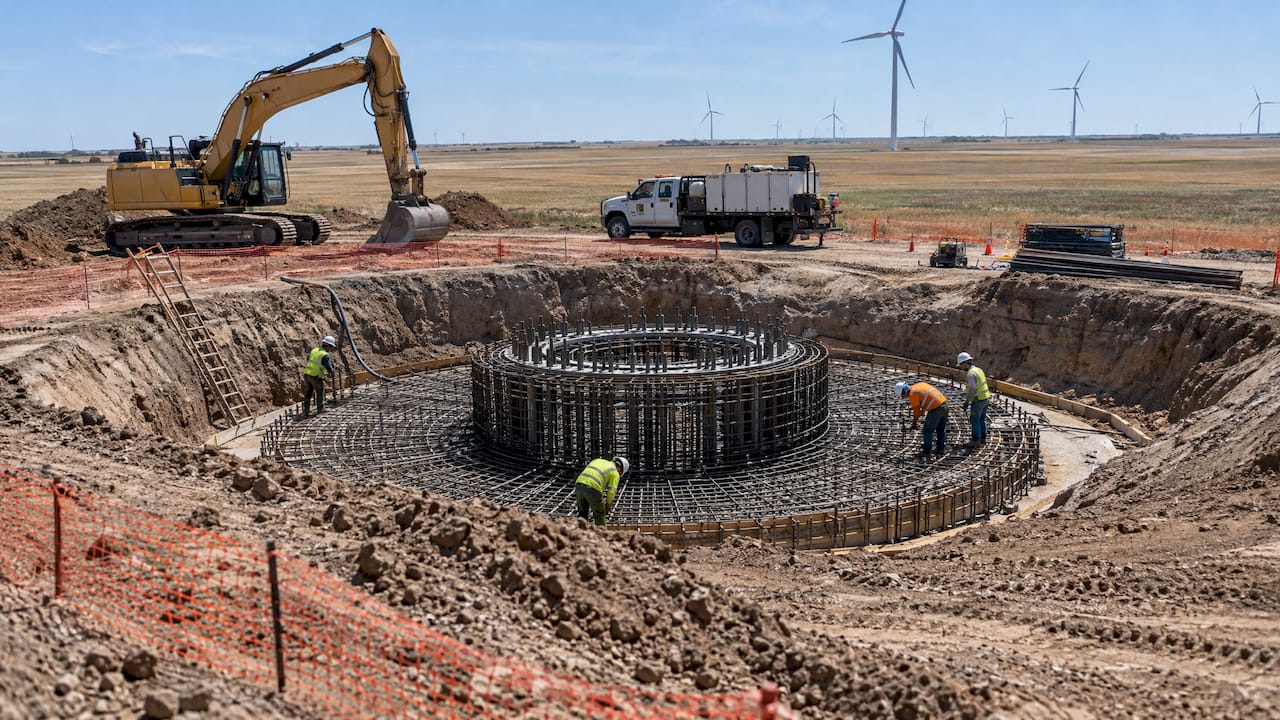
Since that July 4, 2026 date has passed, a project that did not start construction by then generally has to be in service before 2028 to qualify. Anyone offered a wind deal today should ask which of the two paths the project is on, and how the sponsor documents it.
The credit amounts also depend on labor standards:
- PTC: the base rate is 0.3 cents per kWh. The alternative amount is 1.5 cents per kWh for facilities under 1 MW, facilities whose construction began before January 29, 2023, or facilities that meet prevailing wage and apprenticeship requirements (the Form 7211 instructions).
- ITC: for projects of 1 MW or more that began construction on or after January 29, 2023, the base credit is 6% of basis, rising to 30% when prevailing wage and registered apprenticeship rules are met. Smaller projects or those started earlier get 30% directly (Publication 6045).
- Bonus credits: the Energy Communities (2 or 10 percentage points), Domestic Content (2 or 10) and Low-Income Communities (10 or 20) bonuses can raise the ITC (Publication 6045).
There is also a foreign-sourcing layer. Jones Day reports that no credit is allowed for specified foreign entities or foreign-influenced entities, that a “material assistance” restriction applies to facilities starting construction after December 31, 2025, and that from 2028 a violating payment in the first 10 years can trigger recapture of previously generated Section 48E credits. For an investor, recapture means credits you used can be clawed back.
How an individual investor actually receives wind tax benefits
You cannot simply buy a wind turbine’s tax credit the way you buy a stock. Large projects are financed through layered structures, and the most common one for tax benefits is the partnership flip.
In a partnership flip, a tax equity investor puts up part of the project’s capital and is allocated nearly all the tax benefits. A Federal Reserve risk profile of renewable tax equity describes the typical terms:
- The tax equity investor provides one-third to two-thirds of total capital.
- It receives about 99% of the tax attributes and 5% to 30% of the cash.
- The expected flip comes after 9 to 10 years for PTC projects and 6 to 8 years for ITC projects.
- Tax benefits generally represent over 80% of the investor’s total return.
After the investor reaches an agreed return (or a set date), the tax allocation “flips” down to about 5%. White & Case explains that the investor’s return comes from three sources: the credits, the tax value of accelerated depreciation, and cash distributions.
The same Federal Reserve document points out who plays this game: tax equity is commonly provided by corporations, and passive activity and other legal limits restrict individuals’ ability to invest. The 2022 Inflation Reduction Act also introduced credit transferability, which lets developers sell credits for cash. According to the Legal 500 U.S. renewable energy guide, this broadened the buyer base mainly to large corporations running big tax-credit programs.
The practical takeaway for a physician, founder or executive: the wind tax market was built around corporate balance sheets and long-horizon structures, not around an individual with a W-2.
Can wind credits offset your W-2 income or capital gains?
This is the question that decides whether a wind tax benefit helps you. For most individuals, the answer is no, or only partly.
Credits that individuals and closely held corporations receive from passive activities are subject to passive activity credit limits. As a tax law firm’s guide to renewable equipment puts it, such credits generally offset only tax attributable to passive income, not wages or active business income, and unused credits carry forward. S corporation shareholders also face stock and debt basis limits that can shrink current-year benefits.
In plain terms:
- Your salary: passive wind credits generally do not reduce tax on it.
- Capital gains from stock or crypto: these are portfolio income, which passive credits generally cannot offset either.
- Passive income: rental profit or income from a passive business interest is what passive credits can reduce.
- Unused credits: they carry forward, but a credit you cannot use for years has limited present value.
Here is a simple, hypothetical example. A surgeon earns $650,000 in wages and has no passive income. She buys into a wind structure that generates $100,000 of passive credits in year one. Because she has no passive income to absorb them, the credits carry forward instead of reducing her tax bill. A real estate investor with $150,000 of net passive rental income could use more of the same credits, up to the tax attributable to that income.
The lesson, which the Cummings & Cummings article also stresses, is to model whether you can actually use a credit, year by year, before judging how big it is. A stranded credit is the most common way a tax-driven investment disappoints.
To see how passive loss rules interact with energy investing, our guide on passive losses and the energy tax twist walks through the carryforward mechanics.
Do wind projects pay without the subsidies?
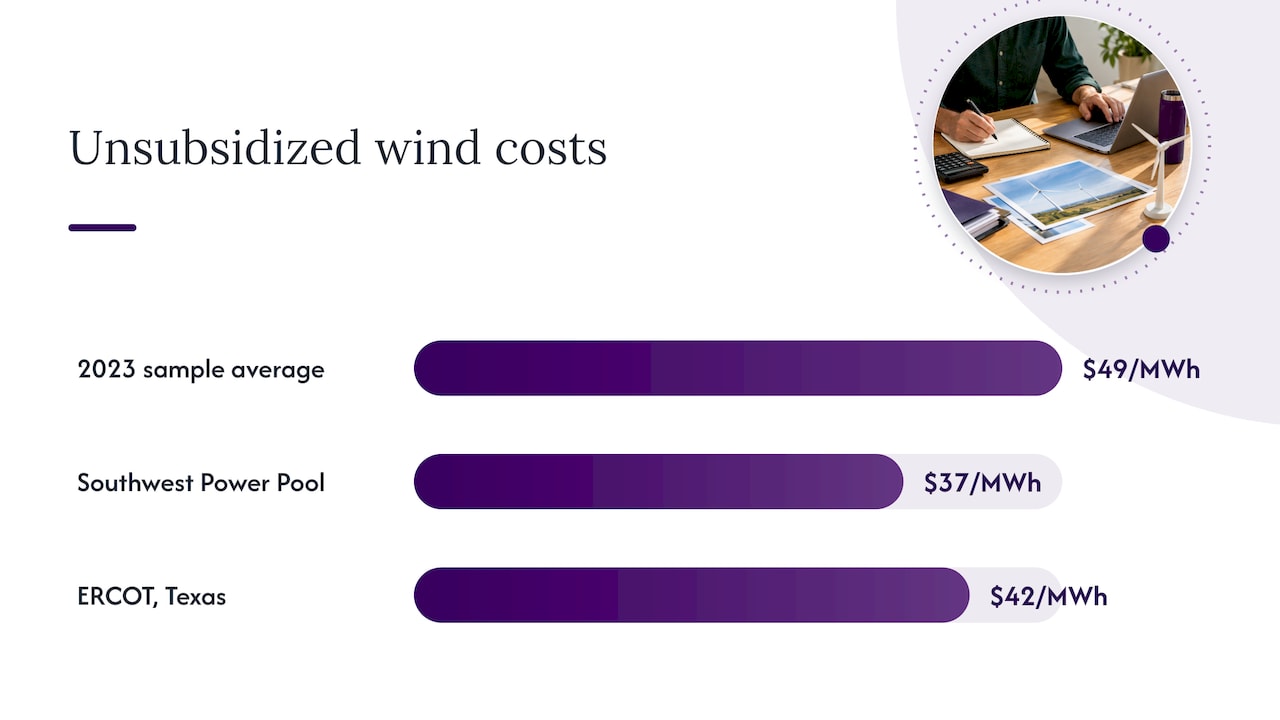
The economics of the underlying asset matter alongside the tax. The Berkeley Lab Land-Based Wind Market Report (2024 edition) estimates that the unsubsidized average levelized cost of wind energy for a sample of projects built in 2023 was $49/MWh. The lowest averages for projects built in 2022 and 2023 were in the Southwest Power Pool ($37/MWh) and ERCOT in Texas ($42/MWh).
Strong sites can therefore compete on cost, but the investor-level return still depends on how the structure shares cash and tax benefits. Remember the Federal Reserve figure: when more than 80% of a tax equity investor’s return is tax benefit, the return is only as good as your ability to use that benefit.
Five checks before you invest in any energy project for tax reasons
Whether the project is wind, solar or oil and gas, the same questions separate a deal that lowers your bill from one that only looks like it does.
- What kind of income does the benefit offset? Ask your CPA whether it is active, passive or portfolio for you. This single answer drives everything.
- Is it a credit or a deduction? A credit cuts tax dollar for dollar. A deduction cuts taxable income, so its value depends on your bracket.
- What is your basis and risk exposure? Basis limits and at-risk rules cap the losses you can claim in a year.
- What is the timing? Look at construction-start and placed-in-service requirements, and whether a benefit arrives in year one or over a decade.
- Who is the operator? Credits and deductions depend on the project being built and run as described, so the sponsor’s track record and documentation matter.
Our guides on how to qualify for energy tax incentives and essential energy tax breaks for investors go through these questions for individual investors, and the depreciation guide covers the write-off side in detail.
Where Fieldvest fits
If your goal is to reduce a large tax bill on active income and build cash flow, Fieldvest is built for that reader. We connect accredited investors with vetted U.S. energy operators, offering large first-year tax deductions and long-term energy income. Projects come in three categories: producing assets, development projects and energy infrastructure, and investors own real assets directly.

Our platform presents key project materials in one place so you can compare deals, and gives you portfolio management tools and ongoing investment support after you commit. You can start by estimating your own numbers with the free oil and gas tax deduction calculator, or browse the available energy projects. Confirm how any deal applies to your situation with your CPA.
Our perspective
Most high earners come to us after reading about wind and solar credits and asking why the numbers never seem to touch their W-2 tax bill. The reason is structural: those programs were designed for corporate tax equity and for investors with passive income to absorb the credits.
We built Fieldvest around a different question: what does an accredited professional with a large taxable income actually need? A project they can own directly, a tax benefit that arrives in the first year rather than in a decade-long schedule, and clear materials to compare deals side by side.
That is why we focus on vetted operators and deals designed for accredited investors seeking tax-advantaged income. Our approach emphasizes deep due diligence on operators, transparent project documents, and tools that keep the portfolio organized as it grows.
Whatever you choose, start with the income your tax benefit has to offset and work backward. If you want to see how energy investments can fit that plan, we are glad to walk through it with you.
Sharif
FAQ
Can I claim both the PTC and the ITC on a wind project?
No. A taxpayer cannot claim both credits for the same facility, according to IRS Publication 6045. The project owner chooses one, based on factors such as financing and expected electricity generation. Claiming the ITC also lowers the depreciable basis by half the credit amount.
Are wind tax credits still available in 2026 and beyond?
Yes, but on a limited timeline. Under the OBBBA, a wind facility generally had to begin construction on or before July 4, 2026, or be placed in service before 2028, to be eligible for the Section 45Y credit, per the IRS Form 7211 instructions. Projects that miss both tests generally lose the credit, so ask for the construction-start documentation.
How much is the wind production tax credit worth?
The base PTC is 0.3 cents per kWh. The alternative amount is 1.5 cents per kWh, adjusted for inflation, for facilities that meet prevailing wage and apprenticeship rules, are under 1 MW, or began construction before January 29, 2023. It is paid on electricity produced and sold during the first 10 years of operation.
Can wind tax credits offset my salary or crypto gains?
Generally no. Credits an individual receives through a passive investment typically offset only tax on passive income, and unused credits carry forward. Wages and capital gains from securities or crypto are not passive income, so confirm with your CPA how your own mix of income would work.
Why do individual investors rarely use wind tax benefits directly?
The structures that capture them, such as partnership flips, are mostly financed by corporations, and the Federal Reserve notes that passive activity and other legal limits restrict individuals. Credit transferability has mostly attracted large corporate buyers as well.
Sources
- Business Tax Credits for Wind and Solar Power, Congressional Budget Office
- Publication 6045, Internal Revenue Service
- Instructions for Form 7211, Internal Revenue Service
- Tax Considerations for Wind Energy Projects, Stoel Rives
- Energy-Related Tax Incentives, NASEO
- One Big Beautiful Bill Act: Impact on Energy Tax Credits, Jones Day
- The Risk Profile of Renewable Energy Tax Equity Investments, Federal Reserve
- Clean Energy Tax Credits: Transferability and Deal Structure Alternatives, White & Case
- Country Comparative Guides 2026: United States Renewable Energy, Legal 500
- Tax Considerations for Installing Renewable Energy Equipment, Cummings & Cummings Law
- Land-Based Wind Market Report, 2024 Edition, Berkeley Lab
Recommended

Get the Fieldvest Energy Brief
and AI-driven demand shifts — curated for accredited investors. Smart. Strategic. Tax-advantaged.