


A division order is the payor’s written statement of your decimal interest in production revenue and the payment instructions tied to it. Before you sign, verify the decimal and the underlying title work: signing generally confirms the payor’s math and triggers payment, so request calculation workpapers or a title opinion first if anything looks off.
TL;DR:
- Verify that your decimal interest on the division order matches the final title work, pooling orders, and revenue statements to prevent misallocations.
- Request calculation workpapers and division order title opinion pages to support your interest and resolve discrepancies before signing.
- Understand that signing a division order does not amend the lease; it only states your share and payment instructions, which are controlled by law and document wording.
- Disputes over decimals can be corrected through written notices and supporting documentation, often allowing retroactive adjustments if properly documented.
- Keep detailed records of all division orders, correspondence, and supporting documents to protect your interests over the lifespan of a well.
Table of Contents
- What a division order is and why it exists
- Who issues division orders, timing, and payment effects
- Core elements and clauses to check on every division order
- Types of division orders and when each applies
- The division order analyst role and NADOA CDOA certification
- Common calculation pitfalls and how to verify your decimal
- State statute context and the NADOA Model Form
- Practical review checklist before you sign
- Impact of division orders on tax reporting and liabilities
- Correcting errors in a signed division order
- Division orders and overriding royalty interests
- Record-keeping and document retention for division orders
- Why disciplined ownership administration matters
- Fieldvest: diligence resources for accredited investors
- FAQ
- Sources
What a division order is and why it exists
A division order exists to protect the purchaser or operator paying revenue from paying the wrong owner twice, often called double liability. It states your decimal share of production and tells the payor where and how to send funds. Division orders sit downstream of the lease: the purchaser or operator issues the document after title work establishes who owns what, then payment flows from purchaser to operator (or directly to owners) based on the signed decimals.
A division order generally does not replace or amend the oil and gas lease beneath it. The NADOA Model Form Division Order booklet makes this explicit, and state law and the document’s own wording ultimately control what it can and cannot do.
- States a decimal interest and payment instructions, not lease terms.
- Protects payors from paying a disputed interest to the wrong party.
- Reflects title work completed before issuance, not an independent grant of rights.
Who issues division orders, timing, and payment effects
Purchasers issue division orders when they pay royalty owners directly; operators or lessees issue them when they collect revenue from the purchaser and distribute it themselves. Timing varies: owners typically see a division order weeks to months after first production, once title review and decimal calculations are complete.
- Purchaser-issued division orders put the purchaser in direct contact with the owner.
- Operator or lessee-issued division orders route payment through the operator’s revenue accounting.
- Delays often trace to title curative work, probate, or pooling amendments still in progress.
Refusing to sign, or disputes over decimals, can trigger escrow or payment suspension, though the legal basis for suspension varies by state, a point covered in more detail below.
Core elements and clauses to check on every division order
Every division order should carry a specific set of fields, and missing or vague entries are a signal to pause before signing.
- Effective date and a legal property description matching your lease or title records.
- Your decimal interest, expressed to enough decimal places to avoid rounding disputes.
- Payee name, taxpayer identification number, and current mailing or payment contact.
- A certification or warranty clause describing what you are affirming about your title.
- Language confirming the division order does not amend the underlying lease.
- Indemnity provisions describing who bears risk if the decimal later proves wrong.
- Suspension or escrow terms describing what happens during a title dispute.
- A change-of-ownership notice clause describing how transfers must be reported.
Each clause shifts exposure. A broad certification clause can bind you to the stated decimal even if it is later found incorrect, while a narrow one leaves room to contest errors without re-signing.
Pro Tip: Read the certification clause before the decimal line. It determines how much the signed decimal can later be challenged.
Types of division orders and when each applies
Three structures cover most division orders in circulation, and the type affects both who pays you and what title evidence you should expect to see.
- Third-party purchaser division order: the purchaser pays owners directly and typically expects clean title evidence or a division order title opinion before issuing payment.
- Indemnity division order: the purchaser pays the lessee or operator, who then distributes funds and carries the indemnity burden if ownership later changes.
- Lessee or purchaser division order: common in gas marketing arrangements, with revocability and payment timing often negotiated between the two parties rather than fixed by a single form.
The division order analyst role and NADOA CDOA certification
Division order analysts handle the operational work behind every decimal on the page: setting up ownership records, implementing title opinions, building the revenue distribution deck, coordinating joint interest billing, and resolving suspended funds when ownership is unclear.
- Translate title opinions into ownership decimals in the accounting system.
- Coordinate with title attorneys on curative requirements before releasing payment.
- Track and resolve suspense accounts tied to unresolved ownership questions.
- Communicate directly with royalty owners about decimal changes or disputes.
NADOA’s voluntary certification program requires a minimum of five years of relevant experience, with possible credit for a bachelor’s degree, plus a passing score on a test covering title analysis and division order duties. The Certified Division Order Analyst, or CDOA, credential functions as the industry’s primary professional standard, and analysts who hold it typically serve as the point of contact between title attorneys and royalty owners on complex curative matters.
Common calculation pitfalls and how to verify your decimal
Most decimal disputes trace back to a handful of recurring errors, and knowing where to look saves time for owners and analysts alike.
- Confirm whether your interest is a royalty interest or a net revenue interest, since NRI accounts for post-production cost deductions that a simple royalty description may not.
- Check pooling or unitization documents for the fractional interest actually assigned to your tract, since unit participation factors are a common source of miscalculation.
- Look for rounding or transcription errors, especially where fractional interests were converted from legal descriptions written in older deed language.
- Verify the division order against the title opinion, division order title opinion excerpt, and revenue distribution deck rather than accepting the decimal at face value.
According to the Oil and Gas Lawyer Blog, experienced analysts warn that confusion between NRI and royalty interest frequently causes misallocated payments, and a practical check involves reconciling the division order decimal against the title opinion, pooling schedules, and revenue deck, since discrepancies often trace to omitted fractional owners or incorrect fractional conversions.
Pro Tip: Ask for the pooling or unitization order by name and date rather than accepting a summary decimal with no supporting schedule.
State statute context and the NADOA Model Form
The NADOA Model Form Division Order booklet standardizes language that confirms a division order does not amend the lease, includes a certification of title, and requires change-of-ownership notice before payment terms change. NADOA built the form partly in response to inconsistent state statutes and case law, aiming to reduce disputes through consistent wording.
Texas offers a useful statutory example. According to the Oil and Gas Lawyer Blog, Texas statutes and court decisions limit how a division order can be used to alter lease terms and affect suspension practices, and using an approved statutory form can give payors stronger suspension rights in some states while court rulings in others limit suspension absent unmarketable title. The Texas Railroad Commission’s Oil & Gas Division provides the regulatory backdrop for production and correlative rights oversight that shapes how these disputes play out in practice.
- A division order’s power to limit payment is defined by its own wording and your state’s statute, not by industry custom alone.
- Owners generally have more leverage where courts require unmarketable title before suspension is lawful.
Practical review checklist before you sign
Work through these steps in order before signing any division order.
- Confirm the legal description and lease terms match your existing records.
- Verify the decimal interest against pooling orders, the title opinion, and the revenue deck.
- Request calculation workpapers showing how the payor arrived at your decimal.
- Ask for the relevant page of the division order title opinion supporting your entitlement.
- Check your taxpayer identification number and payee contact information for accuracy.
- Review suspension and escrow language to understand what happens if a dispute arises.
- Keep copies of every communication, including emails and the signed or disputed document.
A useful script: “Please provide the calculation workpapers that produced this decimal and the division order title opinion page supporting my entitlement.” Our guide to handling oil investment documents walks through organizing these records once you receive them.
Pro Tip: Document disputes in writing and request escrow of disputed funds rather than refusing to sign outright, since an unconditional refusal can delay payment longer than a documented, narrow objection.
Impact of division orders on tax reporting and liabilities
The decimal interest stated on your division order determines the revenue reported to you on an annual information return, which in turn shapes your taxable royalty or working interest income for the year. An incorrect decimal does not just delay payment, it can misstate the income you report, creating a mismatch between what you receive and what you owe tax on if the error surfaces after filing.
Royalty income is generally reported as ordinary income, while working interest owners face different reporting treatment tied to their operating expenses and depletion calculations. Because division orders govern the split between owners, an uncorrected decimal error can persist across multiple tax years before anyone notices, especially when payments are small relative to an owner’s overall portfolio.
Post-production cost deductions, which reduce a net revenue interest relative to a gross royalty, also affect the net income figure that flows into your tax reporting. Reviewing how your division order defines your interest, and reconciling it against prior-year statements, helps catch a misallocation before it compounds. Our tax deduction calculator can help investors model how royalty income and first-year deductions interact once ownership figures are confirmed. Keeping division order documentation alongside tax records makes it easier to substantiate your reported income if a payor later issues a correction or an amended statement.
Correcting errors in a signed division order
Signing a division order does not permanently lock in an incorrect decimal. Most payors will accept a correction once an owner or analyst documents the error, typically through a letter in lieu of a new division order or a formal amended division order referencing the original document.
The process generally starts with written notice to the payor identifying the specific error, whether a miscalculated decimal, an outdated pooling fraction, or an ownership change that was never reflected. Supporting documentation, such as a corrected title opinion, a probate order, or an amended pooling agreement, strengthens the request and speeds resolution. Analysts typically update the ownership records and revenue deck once the correction is verified, then adjust future payments going forward.
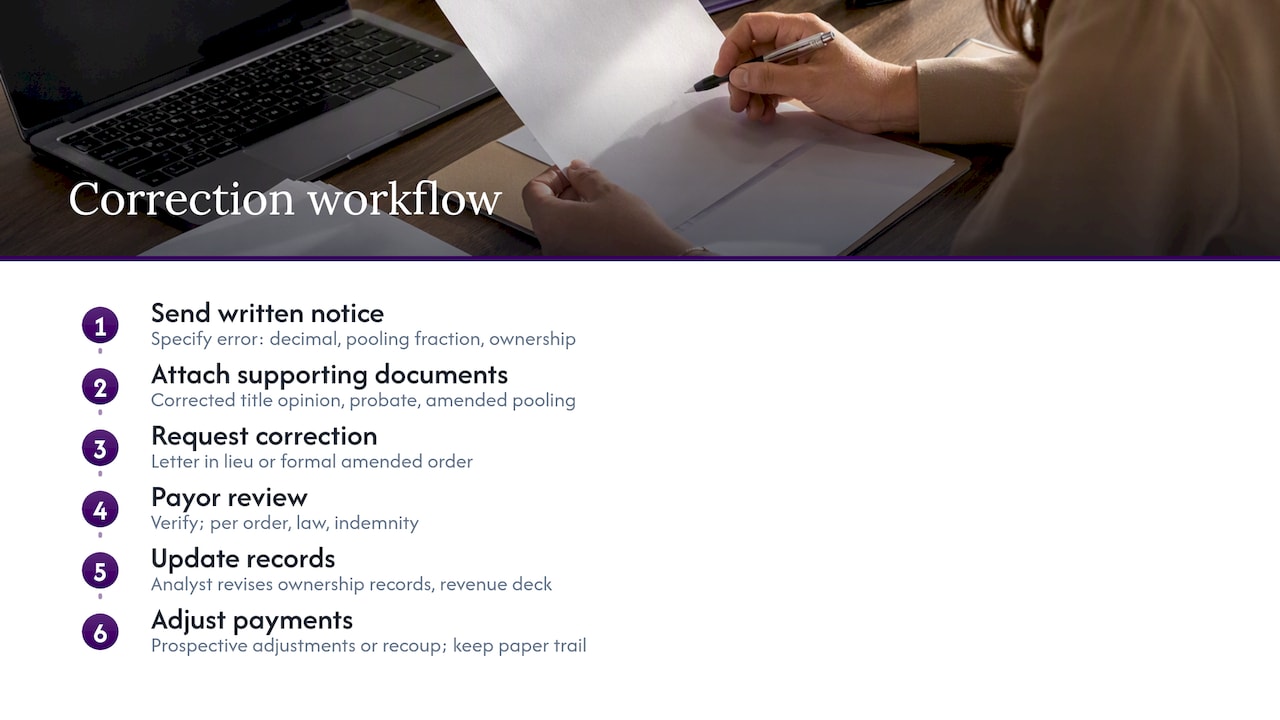
Retroactive correction is where disputes tend to concentrate. Payors may adjust only prospective payments, or they may recoup prior overpayments from future revenue, depending on the division order’s own language and applicable state law. An indemnity clause in the original document often determines who bears the cost of past misallocation, which is why reviewing that clause before signing matters as much as checking the decimal itself. Keeping a paper trail of the original error notice and the payor’s written response protects your position if the correction is contested later.
Division orders and overriding royalty interests
Overriding royalty interests, along with other non-working interests like net profits interests, generally receive their own separate division order rather than being folded into the working interest or royalty owner’s document. The decimal stated reflects the overriding interest’s specific fraction, which is carved out of the working interest rather than the mineral estate itself, and it typically terminates when the underlying lease terminates.
Because an overriding royalty interest is created by assignment rather than by the original lease or mineral deed, the division order analyst has to trace the assignment language carefully to confirm the correct decimal and effective date. A common error involves applying an overriding royalty fraction against the wrong base, either gross production instead of the working interest’s share, which inflates or deflates the decimal relative to what the assignment actually grants.
Non-working interest owners should expect the same core fields on their division order as working or royalty interest owners: decimal interest, property description, and certification language. Where overriding royalty interests complicate review is in change-of-ownership notices, since these interests are often sold or assigned separately from the underlying lease, and a payor may not learn of a transfer until the new owner submits documentation. Owners holding an overriding royalty interest should request the original assignment alongside any division order to confirm the decimal reflects the correct fractional carve-out.

Record-keeping and document retention for division orders
Retaining every division order you sign, along with the correspondence and workpapers behind it, is the single most useful habit for protecting your interest over the life of a well. Production can continue for decades, and ownership records that seem obvious today can become difficult to reconstruct after a transfer, an estate settlement, or a payor’s system migration.
At minimum, keep the signed division order itself, any calculation workpapers or title opinion excerpts you received, written correspondence about disputes or corrections, and your annual revenue statements showing the decimal actually applied. Organizing these by property and by effective date makes it far easier to spot a decimal that drifted after a pooling amendment or a partial assignment.
Our guide to handling oil investment documents outlines a practical filing structure for investors managing documents across multiple properties. Digital storage with clear naming conventions, backed up outside a single payor’s portal, protects against the common scenario where an operator changes revenue accounting systems and historical statements become harder to retrieve. Retention becomes especially important if you ever sell a non-working interest or transfer ownership, since a buyer’s title review will ask for exactly this documentation.
Why disciplined ownership administration matters
Administrative errors in ownership setup are not a paperwork footnote, they are real revenue leakage that erodes investor trust when a decimal sits wrong for years before anyone catches it. Standardized forms like the NADOA Model Form and certified analysts holding the CDOA credential reduce disputes and speed payment precisely because they remove ambiguity from language that owners often read only once.
— Sharif
Fieldvest: diligence resources for accredited investors
We provide access to offering documents, title materials, and payment terms relevant before committing capital to producing assets, development projects, or energy infrastructure deals.

Beyond document access, we offer a tax deduction calculator and investor guides that help you model first-year deductions and ongoing royalty income before you sign anything. For production-handling questions in specific basins, partner resources like Eco-Lift Energy Services cover mobile compression and virtual pipeline support in Texas and Oklahoma. If you are ready to review active opportunities, visit our producing asset listings to request a diligence packet.
FAQ
What are division orders in oil and gas?
A division order is the payor’s written statement of your decimal interest in production revenue and the payment instructions tied to it. It generally does not amend the underlying lease, and state law along with the document’s own wording controls how binding it is, according to the NADOA Model Form booklet.
What is a division order analyst?
A division order analyst sets up ownership records, implements title opinions into the accounting system, builds the revenue distribution deck, and resolves suspended funds tied to unclear ownership. Many analysts pursue the voluntary NADOA CDOA certification, which requires at least five years of relevant experience and a passing score on a title and division order test.
Who regulates oil and gas companies?
Oversight varies by state, and in Texas the Railroad Commission’s Oil & Gas Division handles permitting, production oversight, and correlative rights protection that shapes how payment and division order disputes are managed. Other producing states maintain their own regulatory bodies with similar authority over production and ownership matters.
Can a payor suspend my payment if I refuse to sign?
Legal scholarship notes that refusing to sign does not always justify suspension, since courts in some states have ruled that unmarketable title is required before a payor can lawfully suspend funds, according to Tulsa Law Review. Requesting escrow of disputed funds rather than refusing outright often resolves the standoff faster while preserving your position.
How do I check if my decimal interest is correct?
Request the calculation workpapers and the relevant page of the division order title opinion supporting your entitlement, then reconcile them against pooling orders and your revenue statements. Discrepancies most often trace to omitted fractional owners, misapplied pooling fractions, or confusion between royalty interest and net revenue interest, according to the Oil and Gas Lawyer Blog.
Sources
- NADOA Model Form Division Order booklet
- Division orders: what you need — Oil and Gas Lawyer Blog
- Royalty owner rights under division orders — Tulsa Law Review (article)
- Texas Railroad Commission — Oil & Gas Division overview
Recommended

Get the Fieldvest Energy Brief
and AI-driven demand shifts — curated for accredited investors. Smart. Strategic. Tax-advantaged.