


If you hold an economic interest in oil, gas, or mineral property, you can likely claim percentage depletion, a deduction equal to a statutory percentage of gross income from the property. The deduction generally caps at 50% of taxable income from the property, but oil and gas properties get a more favorable 100% limit under certain section 613A exceptions. Always compute cost depletion too, since you must use whichever method produces the larger deduction.
TL;DR:
- Eligibility requires capital at risk and income tied to extraction; fixed price purchase rights and processing fees alone fail the economic interest test.
- Exclude lease bonuses and unearned advance royalties from property gross income; calculate each mineral separately at its statutory rate, with domestic oil and gas at 15%.
- Apply the 50% cap or qualifying oil and gas 100% cap per property; disallowed amounts carry forward, and multiple owners apportion shares before applying limits.
- Cost depletion depends on adjusted basis and recoverable units, so working interest owners with high development costs may benefit early, before basis declines.
- Keep leases, production logs, revenue statements, basis records, and annual calculations of both methods; mismatched production or unclear ownership can invite IRS scrutiny.
Table of Contents
- Who Qualifies: Economic Interest, Excluded Parties, and Lease Impacts
- Percentage Rates: Statutory Percentages by Mineral Type and Special Rules for Oil, Gas, and Geothermal
- Limits and Interactions: Taxable-Income Caps, Section 613A, and Carryovers
- How to Calculate Percentage Depletion: Step-by-Step Procedure
- Cost Depletion vs Percentage Depletion: Why You Must Run Both
- Apportionment, Recordkeeping, and Reporting: Allocating Depletion and Required Documentation
- Common Pitfalls, Audit Triggers, and Practical Tips for Preparers
- Sharif and Fieldvest Perspective: Practitioner Notes and Resource Links
- A Preparer’s Honest Take on Percentage Depletion
- Fieldvest: Vetted Producing Assets and Tools to Estimate Tax Impact
- FAQ
- Sources
Who Qualifies: Economic Interest, Excluded Parties, and Lease Impacts
Percentage depletion hinges on one concept: economic interest. The IRS defines this as a capital investment in mineral property that gets its return specifically from extraction, meaning your income depends on the mineral actually coming out of the ground. A working interest owner who pays drilling costs and shares in production qualifies. So does a royalty owner who leased mineral rights to an operator in exchange for a share of revenue. An overriding royalty interest, carved out of a working interest, also counts because it still depends on production volume and value.
What does not count is a contractual right to buy minerals at a fixed price or a fee for processing someone else’s output. The IRS is explicit that contract rights alone, without capital at risk in the minerals in place, fail the economic interest test. This distinction trips up more taxpayers than almost any other part of the depletion rules.
Certain parties are excluded from percentage depletion altogether regardless of their interest:
- Retailers of oil and gas products generally cannot claim percentage depletion on those sales.
- Most refiners lose eligibility once their refining capacity crosses statutory thresholds.
- Contract processors who handle minerals without an ownership stake in the deposit are excluded.
Lease language matters more than most preparers expect. A lease that characterizes a payment as a bonus, rather than production income, removes that payment from the gross income base used to calculate percentage depletion. Production payment arrangements can also shift who the IRS treats as the economic owner for depletion purposes, so the actual contract terms, not just who physically operates the well, determine eligibility.
Percentage Rates: Statutory Percentages by Mineral Type and Special Rules for Oil, Gas, and Geothermal
The percentage rates themselves come from 26 U.S.C. §613(b), which lists a separate rate for each mineral category. Rates vary considerably depending on the resource:
- Sulfur, uranium, and several other listed minerals carry a 22% rate.
- Gold, silver, copper, and iron ore mined in the United States typically carry a 15% rate.
- Coal and lignite carry a 10% rate.
- Clay and shale used in specific industrial applications fall in the 5% to 7.5% range.
- Most other minerals not separately listed default to a 14% rate.
Statistic callout: The most common rate oil, gas, and mineral owners will apply is 15%, which covers domestic crude oil and natural gas production as well as several hard-rock minerals, according to Ohio State University Extension guidance. That single rate governs the majority of percentage depletion claims filed by independent producers and royalty owners.
Oil and gas carry their own layer of rules beyond the base 15% rate. Domestic production qualifies, but the percentage applies only to gross income from the property, which excludes lease bonuses and advance royalties that are not tied to actual extraction volume. Geothermal deposits also qualify for percentage depletion, and the regulatory framework in 26 CFR §1.613-1 treats geothermal steam and related byproducts similarly to other qualifying minerals for rate purposes.
When a single property produces more than one mineral with different statutory rates, you cannot blend them into one average. The regulations require computing percentage depletion separately for each mineral at its own rate, summing the results, and then applying the overall taxable-income limitation to that combined figure. Skipping this step is a common source of underclaimed or overclaimed deductions.

Limits and Interactions: Taxable-Income Caps, Section 613A, and Carryovers
Percentage depletion is never unlimited. The baseline rule in 26 CFR §1.613-1 caps the deduction at 50% of taxable income from the property, computed without subtracting depletion itself. That means you calculate all your revenue and deductible expenses related to the property first, arrive at a taxable-income figure before depletion, and only then apply the cap.
Oil and gas properties get a meaningfully better deal. Under section 613A, qualifying oil and gas production is limited to 100% of taxable income from the property rather than 50%, which lets many independent producers and royalty owners claim the full percentage depletion amount in years with strong income from the property.
Three practical points shape how these limits play out:
- The 50% and 100% caps apply separately to each property, not to your overall tax return, so a loss on one well does not offset a strong deduction on another.
- Carryforward treatment lets disallowed depletion from the taxable-income limitation roll into the following year’s calculation, rather than disappearing entirely.
- Apportionment between multiple owners of the same property must happen before the limitation is applied to each owner’s share.
Statistic callout: The general cap sits at 50% of property-level taxable income, while oil and gas properties get a 100% limit under the applicable section 613A exceptions, nearly doubling the ceiling for most independent producers and royalty owners compared to other mineral categories.
Carryover mechanics work similarly to other suspended deductions. When the taxable-income limitation disallows part of your percentage depletion for the current year, that disallowed amount is not lost. It carries forward and gets added to the depletion calculation for the following tax year, where it is subject to that year’s own limitation test.
Percentage depletion also brushes against two other tax calculations worth flagging. It can affect alternative minimum tax computations for certain integrated oil and gas producers, since AMT rules treat some depletion preferences differently than regular tax. It can also interact with qualified business income calculations for pass-through entities reporting mineral income. Both intersections get technical quickly, and anyone with a complex ownership structure, multiple properties, or AMT exposure should work through the specifics with a CPA rather than rely on general guidance.
How to Calculate Percentage Depletion: Step-by-Step Procedure
Running the actual numbers follows a consistent four-step sequence every time, regardless of which mineral you are working with.
- Determine gross income from the property. Include revenue from the sale of extracted oil, gas, or minerals, but exclude lease bonuses, advance royalties not yet earned by production, and payments that are not tied to actual extraction volume.
- Apply the statutory percentage. Multiply gross income from the property by the applicable rate, 15% for most domestic oil, gas, and many hard-rock minerals under 26 U.S.C. §613(b).
- Apply the taxable-income limitation. Compare the result against 50% of taxable income from the property (or 100% for qualifying oil and gas under section 613A), and cap the deduction at the lower figure.
- Compute cost depletion and compare. Divide your adjusted basis in the property by estimated recoverable units, multiply by units sold during the year, and compare that result against your percentage depletion figure. IRS guidance requires you to use whichever method produces the larger deduction for the tax year.
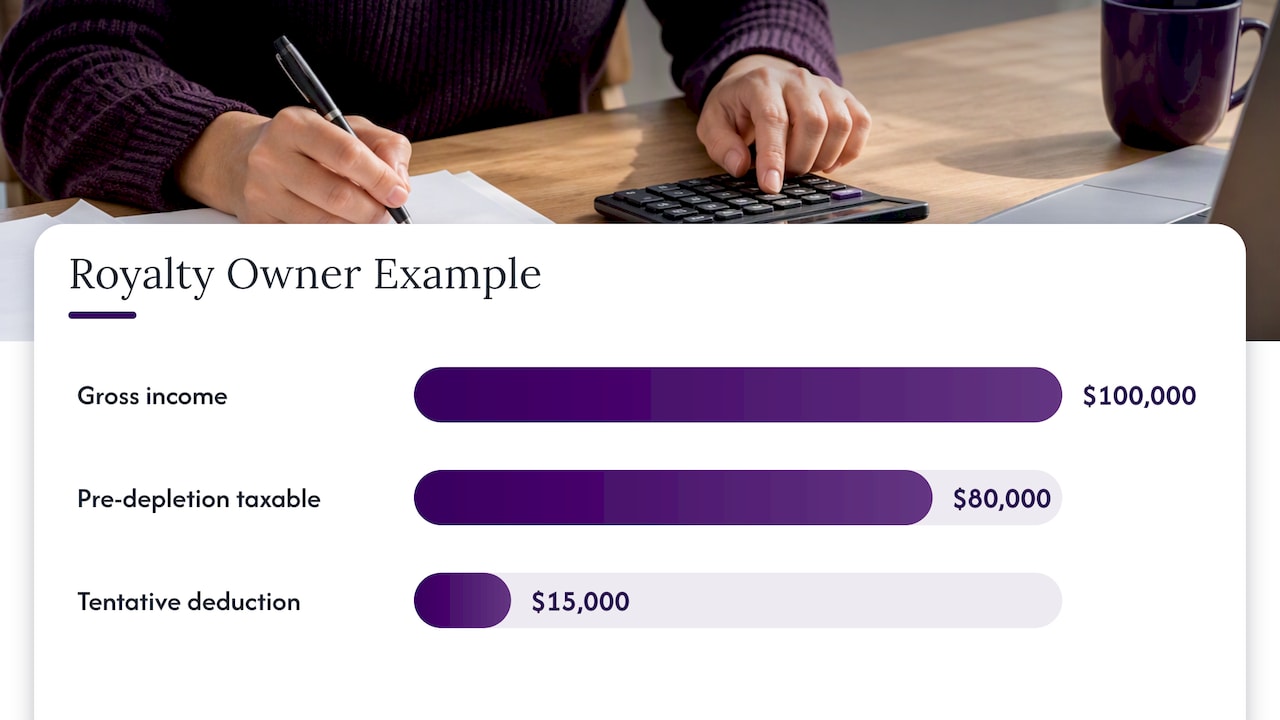
Here is an example with sample numbers for a royalty owner. Say a royalty interest generates $100,000 in gross income from the property during the year, with no lease bonus included. If taxable income from the property before depletion is $80,000, the 100% oil and gas limitation allows up to $80,000, far above the $15,000 tentative figure, so the full $15,000 is deductible with no reduction. If this same royalty owner has little or no basis in the mineral rights, cost depletion would likely produce a far smaller number, often close to zero, making percentage depletion the clear choice.
Statistic callout: Applying a 15% rate to gross income from the property yields a tentative percentage depletion deduction, illustrating the importance of gross income rather than net profit in this calculation.
For reporting, royalty owners typically enter depletion on Schedule E alongside other royalty income and expenses, while partnerships and S corporations usually pass depletion information through on Schedule K-1 for each partner or shareholder to apply at the individual level. The 2025 Schedule E instructions walk through exact line placement for these entries.
Cost Depletion vs Percentage Depletion: Why You Must Run Both
Cost depletion works on a completely different logic than percentage depletion. You take your adjusted basis in the mineral property, divide it by the total estimated recoverable units, and multiply that per-unit figure by the units actually sold during the year. Unlike percentage depletion, cost depletion cannot exceed your remaining basis in the property, and it shrinks every year as basis gets used up.
The statute does not let you pick your favorite method and stick with it. IRS guidance requires comparing both calculations every year and claiming whichever one produces the larger allowance for that tax year.
In practice, this plays out predictably:
- Royalty owners with little or no basis in the mineral rights almost always come out ahead with percentage depletion, since cost depletion depends entirely on basis.
- Working interest owners with substantial drilling and development costs sometimes find cost depletion more favorable in early years before basis is depleted.
- Properties with declining production but rising prices can shift the advantage toward percentage depletion even for owners who previously favored cost depletion.
Pro Tip: Build a simple side-by-side worksheet each year comparing both methods for every property you hold, since the better method can shift from year to year as basis declines and production or prices change.
Apportionment, Recordkeeping, and Reporting: Allocating Depletion and Required Documentation
When multiple parties hold interests in the same mineral property, 26 CFR §1.611-1 requires the depletion deduction to be apportioned among them according to their respective economic interests. A lessor retaining a royalty interest and a lessee holding the working interest each compute and claim depletion separately on their own share of gross income from the property, not on the combined total. Trusts holding mineral interests face similar apportionment requirements between the trust and its beneficiaries.
Solid recordkeeping is what separates a defensible depletion claim from one that collapses under IRS review. Keep these records for every property where you claim depletion:
- Production logs showing volume extracted and sold each period, matched against revenue received.
- Lease agreements and any amendments, since they determine what counts as a bonus versus production income.
- Basis documentation for the property, needed to run the cost depletion comparison every year.
- Royalty statements or operator-provided revenue reports showing gross income from the property.
- A year-by-year worksheet showing both percentage and cost depletion calculations and which one you claimed.
For reporting, individual royalty owners generally report depletion on Schedule E alongside rental and royalty income. Working interest owners operating as sole proprietors may report on Schedule C instead. Partnerships and S corporations compute depletion-related items at the entity level in many cases, then pass the necessary figures through on Schedule K-1 for each owner to finish the calculation individually. The Schedule E instructions specify exact line placement for these entries each filing season, so confirm current line numbers before filing rather than relying on a prior year’s form.
Common Pitfalls, Audit Triggers, and Practical Tips for Preparers
A handful of mistakes account for most percentage depletion problems preparers encounter. Misclassifying a lease bonus as production income inflates the gross income base improperly. Failing to document economic interest, particularly for complex ownership structures like overriding royalties or carried interests, leaves a claim vulnerable to challenge. Skipping the cost depletion comparison entirely, rather than running both methods every year, can mean leaving money on the table or, worse, overclaiming. Errors in the taxable-income-from-the-property calculation, especially when expenses are allocated incorrectly across multiple properties, also show up frequently.
Certain patterns tend to draw IRS attention:
- Large percentage depletion claims paired with thin or missing supporting documentation.
- Production records that do not reconcile with reported revenue figures.
- Depletion claimed by a party whose economic interest in the property is unclear from the lease or contract.
A few practical checks go a long way toward avoiding these issues. Reconcile reported production volumes against revenue received every year rather than assuming consistency. Preserve the original lease language and any amendments in an accessible file, since depletion eligibility often traces back to specific contract terms. Maintain a standing depletion worksheet for each property that shows both calculation methods side by side for every tax year.
Pro Tip: Treat your depletion worksheet as a permanent file that follows the property, not just the tax year, since IRS review can reach back several years and ownership or lease terms rarely change in isolation.
Sharif and Fieldvest Perspective: Practitioner Notes and Resource Links
Accredited investors who buy into producing oil and gas assets often structure those investments specifically to capture the year-one tax benefits that come with direct ownership, including percentage depletion alongside intangible drilling cost deductions. Because percentage depletion depends on holding an actual economic interest, the structure of the investment, direct working interest versus a passive fund wrapper, determines whether depletion flows through to the investor at all.
For readers evaluating oil and gas depreciation methods alongside depletion, it helps to see how the two cost-recovery tools work together rather than compete. Readers specifically focused on the common 15% royalty rate may also find our breakdown of claiming 15% depletion useful for working through royalty-specific scenarios in more depth.
A Preparer’s Honest Take on Percentage Depletion
Percentage depletion rewards documentation more than it rewards aggressive assumptions. The taxpayers who get the most value from it are the ones who treat the economic interest requirement and the dual-method comparison as a yearly discipline, not a one-time setup.
If you take one thing from this, model both depletion methods every year, keep your lease and production records organized, and loop in a CPA the moment your ownership structure gets more complicated than a straightforward royalty or working interest.
— Sharif
Fieldvest: Vetted Producing Assets and Tools to Estimate Tax Impact
We provide a platform for investors to access vetted U.S. energy projects, including producing assets, development projects, and energy infrastructure, designed to offer depletion and other first-year tax benefits as part of the investment case. Deal materials are presented to facilitate side-by-side comparison of opportunities before committing capital.

If you want to see how percentage depletion and other deductions might apply to a specific investment size, our Free Oil & Gas Tax Deduction Calculator lets you model the numbers before you commit. For a broader look at how direct energy investments reduce tax liability, our guide to lowering your taxes with oil and gas investments walks through the mechanics in plain terms.
- Operators are vetted before their projects are listed, aiming to provide fewer but stronger opportunities.
- The platform presents deal materials consistently, simplifying comparison of producing assets, development projects, and infrastructure deals.
- Ongoing support is offered after capital commitment to a project.
Readers who do not yet meet accredited investor criteria, or who want a broader financial modeling view before committing to energy assets specifically, may also find value in Aerowealth’s planning tools for Australian investors, though that resource applies to the Australian market rather than U.S. rules. If you are ready to see what fits your situation, visit our home page to browse current opportunities.
This article is general information, not a substitute for advice from a qualified financial advisor. Consult a qualified financial professional about your own circumstances before acting on anything here.
FAQ
How Is Depletion Calculated?
You calculate percentage depletion by multiplying gross income from the property by the statutory rate for that mineral, often 15% for domestic oil and gas, then capping the result at 50% of taxable income from the property, or 100% for qualifying oil and gas under section 613A. You must also calculate cost depletion separately and claim whichever method yields the larger deduction.
What Is the Depletion Method of Cost Recovery and How Does It Work?
Cost depletion recovers your basis in a mineral property by dividing that basis by total estimated recoverable units and multiplying by units sold each year, shrinking as basis is used up. Percentage depletion instead applies a fixed statutory rate to gross income from the property and does not depend on basis, which is why IRS rules require comparing both every year.
Who Qualifies for Percentage Depletion on Oil and Gas Properties?
Taxpayers with an economic interest in the mineral property, meaning a capital stake whose return depends on actual extraction, generally qualify, including working interest owners and royalty owners. Retailers, most refiners, and contract processors without an ownership stake in the minerals are typically excluded from this deduction.
What Is the Taxable-Income Limit on Percentage Depletion?
Oil and gas properties often qualify for a more favorable 100% limitation under section 613A, and amounts disallowed by this limit can carry forward to the following tax year.
Sources
- IRS FS-13-06: Facts about Depletion and Oil & Gas Interests
- 26 U.S.C. §613A — Disallowance or modification of percentage depletion for oil and gas wells
- Ohioline factsheet: Using the Depletion Deduction to Minimize Oil and Gas Tax Liability
- 26 CFR § 1.613-1 — Percentage depletion; general rule
Recommended

Get the Fieldvest Energy Brief
and AI-driven demand shifts — curated for accredited investors. Smart. Strategic. Tax-advantaged.