


An oil and gas subscription agreement is the contract that turns your interest in a private energy deal into a binding purchase. You sign it to buy a stake in a well, a partnership or a project. In it you confirm you are an accredited investor, you accept that the investment is illiquid, and you agree to the offering’s terms. Read it as carefully as the pitch deck, because it is the document you will be held to.
This guide covers what the agreement does, how it fits with the other documents in the package, the clauses that matter most in oil and gas, and the questions to settle with your tax adviser before you wire money.
TL;DR
- The subscription agreement is a binding contract. It is separate from the private placement memorandum (PPM), which is the disclosure document.
- You make legal representations in it: accredited status, understanding of the risks, and that you are buying for yourself.
- In oil and gas, read it together with the operating agreement or Joint Operating Agreement, because overhead and cost terms often live there.
- Tax treatment depends on how you hold the interest. Direct working interest and limited-liability structures can be treated very differently.
- Have your CPA and an attorney review the full package before you sign, not after you fund.
Table of Contents
- What a subscription agreement actually does
- How it fits with the rest of the package
- Your accredited investor representation
- Clauses to read line by line
- Oil and gas specifics that generic guides miss
- A review process that works
- Our perspective
- Where Fieldvest fits
- FAQ
- Sources
What a subscription agreement actually does
In nearly any private placement, the PPM is the core disclosure document, but it is not itself a contract. The subscription agreement is the contract. It is where you, the investor, make binding representations and warranties and where the issuer records that you agreed to the terms.
In practice it does four jobs:
- It states the purchase. How much you are committing, what you receive (units, a percentage of a working interest, a partnership interest) and when funds are due.
- It documents your eligibility. You confirm you are accredited, which the issuer needs to stay inside its securities exemption.
- It records your acknowledgments. The securities are unregistered, illiquid and can lose all their value. Law firm guidance on private placements describes these disclaimers as core to the document.
- It limits transfer. The SEC’s investor bulletin notes you may sign agreements that restrict or prevent free transfer of the securities.
The practical consequence: once you sign, statements you made in it can be relied on by the sponsor. If you say you meet the income test and you do not, that is your problem, not just a paperwork slip.
How it fits with the rest of the package
A typical oil and gas offering arrives as a stack of documents. Knowing what each one does keeps you from skimming the wrong one.
| Document | What it is | What to look for |
|---|---|---|
| Private placement memorandum | Disclosure of the project, operator, risks and fees | Operator track record, use of proceeds, conflicts of interest |
| Subscription agreement | Your binding purchase contract | Representations, funding mechanics, remedies, governing law |
| Operating or partnership agreement | Rules for running the entity or well | Management powers, distributions, capital calls, liability |
| Joint Operating Agreement (JOA) | Terms between working interest owners and the operator | Overhead rates, cost sharing, consent rights |
| Investor questionnaire | Your eligibility information | Accuracy: you will be relying on it later |
The subscription agreement often refers to the others by name and says you have received and read them. That sentence matters. If you did not receive the JOA, say so before signing, not after.
Your accredited investor representation
Private placements that rely on Regulation D Rule 506(b) or 506© are exempt from SEC registration, but the issuer must be sure of who it is selling to. Under the SEC’s definition, as summarized by Investor.gov, an individual qualifies with income above $200,000 (or $300,000 with a spouse or spousal equivalent) in each of the prior two years with a reasonable expectation of the same this year, or net worth above $1 million excluding the primary residence. Holders of certain licenses, including the Series 7, 65 and 82, also qualify.
How the issuer checks differs by rule:
- Rule 506(b): the issuer cannot use general solicitation and needs a reasonable belief that you are accredited, built on its relationship with you and the information you provide.
- Rule 506©: general solicitation is allowed, but the issuer must take reasonable steps to verify. That can mean reviewing tax forms or bank and brokerage statements, or getting written confirmation from a CPA, attorney or registered investment adviser. Per the SEC’s guidance, a professional’s written verification is valid for up to three months, and self-certification alone is not enough.
If you saw the deal advertised online, expect the 506© route and a request for documents. That is not a red flag. It is the sponsor doing what the rule requires. For a deeper look at who qualifies, see our guide to what accredited investors are.
Clauses to read line by line
Most subscription agreements share a template. The details that differ are where the risk sits.
Representations and warranties
These are your statements: that you are accredited, that you can bear the loss of your entire investment, that you are buying for your own account and not for resale, and that you had the chance to ask questions. Check each one is true for you today. If your income dipped last year, talk to your CPA before you confirm the two-year test.
Acknowledgment of illiquidity and total loss
Expect language that the securities are unregistered, can’t easily be sold and could be lost entirely. Take it at face value. There is no public market for these interests, and FINRA’s guidance on private oil and gas and real estate products says firms must weigh whether tax benefits are outweighed by up-front fees and the lack of a secondary market. That is a fair test for you to apply as well.
Funding mechanics and capital calls
Find out whether the commitment is paid in full at closing or in tranches, and whether the sponsor can call for additional capital. In a drilling program, ask what happens if costs exceed the budget. Some structures cap your exposure at what you paid in. Others, especially general partner or direct working interests, can carry ongoing cost obligations. The agreement or operating documents should say which applies.
Acceptance, closing conditions and refunds
The issuer usually has the right to accept or reject your subscription. Look for what happens to your funds if the offering does not reach its minimum or the deal never closes: held in escrow, returned promptly, or something else.
Governing law, venue and arbitration
Many agreements require arbitration or a specific state’s courts. For a deal in Texas or Oklahoma with an investor in California, that affects your practical remedies. Know it before you sign.
Indemnification
Some agreements make you indemnify the issuer if your representations prove false. This is the clause that turns a careless accreditation checkbox into a financial liability.
Oil and gas specifics that generic guides miss
Subscription agreements for stock in a startup and for an energy project look alike on the surface. The differences lie in the structure underneath.
Working interest or limited-liability entity
The IRS explains in Publication 925 that a working interest in an oil or gas well held directly, or through an entity that does not limit your liability such as a general partner interest, is not treated as a passive activity, regardless of whether you materially participate. If liability is limited, income and losses may be treated as passive. The subscription agreement tells you which kind of interest you are buying, so this is a clause with tax consequences. We cover the related rules in our piece on passive losses and the energy tax twist.
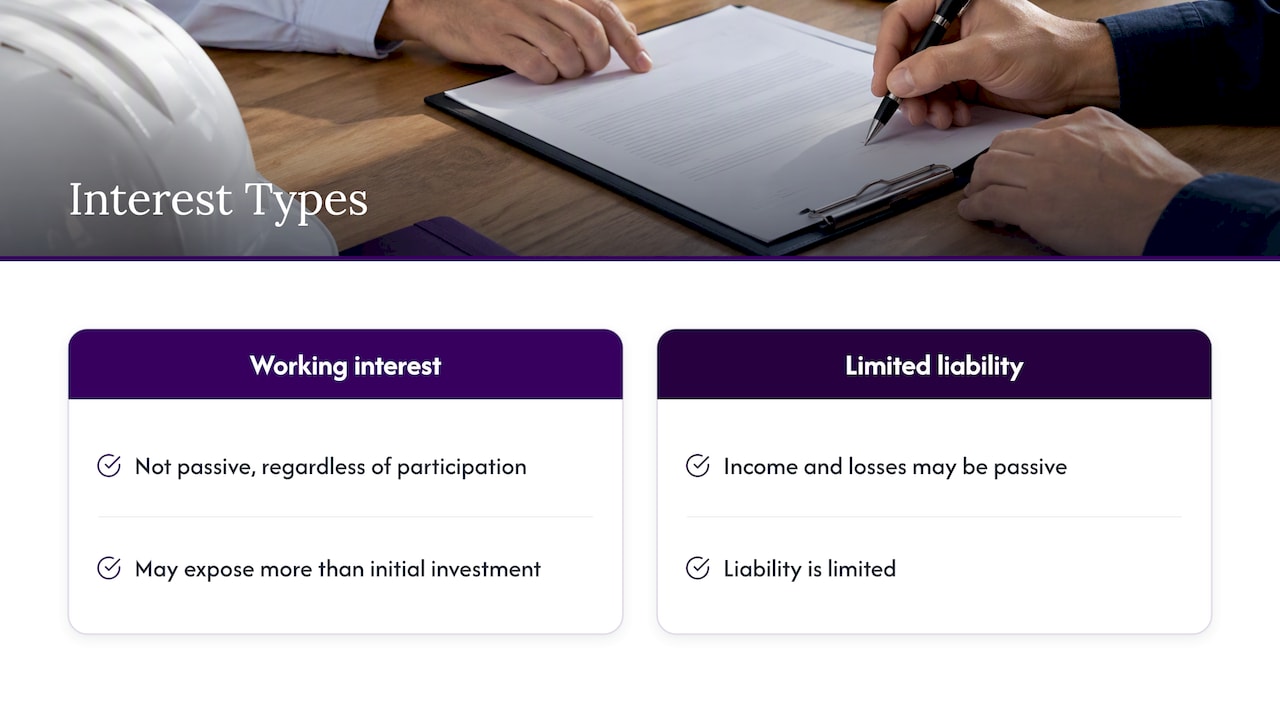
The trade-off is real: an interest without liability protection can expose you to more than your initial investment. Ask counsel what protection, if any, sits between you and the operating risks, and whether insurance is carried.
Intangible drilling costs and the JOA
Much of the tax interest in these deals comes from intangible drilling costs (IDC). The IRS’s Oil & Gas Audit Technique Guide shows examiners look closely at whether costs classified as IDC are truly incident to and necessary for drilling. The same guide is a reason to read the JOA referenced in your subscription documents: overhead charges applied to IDC can vary by operator, and the treatment of costs can affect Alternative Minimum Tax. Bring that question to your tax adviser.
When the package makes a tax claim, ask for the legal opinion behind it. FINRA’s notice advises looking for clean opinions on tax-advantaged structures and treating a “more likely than not” opinion as a signal of higher tax risk that should be disclosed openly.

Tax character of the income
Deductions are only half of the picture. Production income, depletion and the eventual sale of an interest can each be taxed differently, and it helps to understand how capital gains treatments work before modeling returns on a direct working interest.
Operator terms
The subscription agreement tells you what you bought. It rarely tells you who runs it well. Look in the PPM and JOA for the operator’s drilling history, how it is paid (management fees, overhead, carried interests) and where its interests diverge from yours. Our guide on how to navigate oil deal terms walks through the fee and payout terms most worth comparing.
A review process that works
- Collect the full package. PPM, subscription agreement, operating or partnership agreement, JOA, and any tax opinion. If one is missing, ask for it in writing.
- Read the representations against your own situation. Check income, net worth and any entity you are investing through.
- Map the money. Total commitment, fees at entry, ongoing operator charges, capital call rights, and distribution priority.
- Send the package to your CPA. Ask specifically about passive versus non-passive treatment, IDC, AMT and how it fits your return this year.
- Have an attorney review the legal terms. Indemnification, arbitration, transfer limits and what the sponsor can change after you sign.
- Sit with concentration. FINRA notes that illiquid private oil and gas products raise over-concentration risk. Decide what share of your net worth you can lock up.
- Sign only when every blank is filled and every question has a written answer.
Our perspective
We built Fieldvest because the paperwork around private energy deals is where many high earners get stuck, or worse, skip the reading. A strong tax number on a one-page summary means little if the subscription agreement and operating documents say something different.
Our approach is to treat the documents as the product. We work with vetted and screened operators, and we present the key project materials in a consistent way so you can compare deals side by side rather than decode a different format each time. Whether the opportunity is a producing asset, a development project or energy infrastructure, we want you to see the terms, the fees and the structure before you commit.
We also say plainly what we are not: we are not your tax adviser or your attorney. The best outcomes come when your CPA has the full package early. Deductions are a reason to look at an energy investment. They should never be the only reason to sign one.
— Sharif
Where Fieldvest fits
If you are an accredited investor weighing a private energy deal, Fieldvest gives you access to vetted U.S. projects across producing assets, development projects and energy infrastructure, with the project materials laid out for comparison. To estimate what a deduction could mean for your own bracket before you read any documents, try our free oil and gas tax deduction calculator, then take the result to your CPA.
For background reading, our guides cover how accredited investors vet private oil and gas deals and oil and gas investments for accredited investors.
FAQ
Is a subscription agreement the same as a PPM?
No. The PPM discloses information about the offering, while the subscription agreement is the contract you sign to buy. Legal commentary describes the PPM as not itself a contract. You will usually confirm in the subscription agreement that you received and reviewed the PPM.
Can I invest in a private oil and gas deal if I am not accredited?
Under Rule 506©, participation is limited to accredited investors. Rule 506(b) allows up to 35 non-accredited investors if they are sophisticated, according to Investor.gov, but many sponsors accept accredited investors only. On Fieldvest, investing is open to accredited investors.
Do I need to prove I am accredited?
Often, yes. In a 506© offering the issuer must take reasonable steps to verify, and the SEC says self-certification alone is not enough. Expect to provide tax forms, account statements or a letter from your CPA, attorney or registered investment adviser.
Are oil and gas losses always deductible against my salary?
No. A direct working interest, or one held through an entity that does not limit liability, is generally not a passive activity under IRS Publication 925. If your liability is limited, the income and losses may be treated as passive. At-risk rules also apply, so confirm your specific structure with a CPA.
Sources
- Private Placement Subscription Agreements: Basics & Summary, Riveles Wahab LLP
- Private Placements under Regulation D, Investor.gov
- Assessing Accredited Investors under Regulation D, SEC
- Publication 925, Passive Activity and At-Risk Rules, IRS
- Oil & Gas Audit Technique Guide, IRS Publication 5652
- Notice to Members 05-18, FINRA
Recommended

Get the Fieldvest Energy Brief
and AI-driven demand shifts — curated for accredited investors. Smart. Strategic. Tax-advantaged.