


An oil and gas data room is the controlled collection of records a seller opens so a prospective investor can verify an asset before committing capital. For you as an accredited investor, it is where a pitch deck turns into evidence: title, wells, reserves, production, financials, permits and legal terms. This guide covers what a good data room contains, how to read it, which gaps matter, and what to expect from the security around it.
TL;DR
- A data room is the investor’s main chance to test a deal’s claims against documents. Thin or disorganized rooms are a signal in themselves.
- A sound index covers asset and technical records, legal and title files, financials, and environmental and regulatory records.
- Land and title work is usually the broadest part of diligence, so start there and reconcile what you find against field results.
- Keep a written request log. Unanswered requests are evidence you can act on.
- Ask how access is controlled: who sees what, for how long, and whether every login traces to one person.
Table of Contents
- What an oil and gas data room is, and why it matters to investors
- Our perspective on data rooms
- The data room checklist: what should be inside
- How to review the room, step by step
- Environmental and regulatory records
- Offering, ownership, tax and legal documents
- Spotting missing or inconsistent information
- Security and access controls to expect
- How Fieldvest fits into your diligence
- FAQ
- Sources
What an oil and gas data room is, and why it matters to investors
In oil and gas, data rooms have long been used when a company sells assets or acreage, or brings in partners by diluting its equity. Buyers inspect, copy and interpret the seller’s data to decide whether to pursue the opportunity, as a peer-reviewed review of the practice describes. Physical rooms have largely given way to virtual ones, but the logic is the same: the seller discloses, the buyer verifies.
For a private investor in a project, the room may be smaller than in a corporate acquisition. You may be looking at a folder of operator materials rather than a full-scale auction process. The discipline still applies. The same review notes that a data-room visit is effectively a one-off opportunity that demands meticulous planning, and that poor preparation can delay a deal or stop it. Treat your review the same way: decide what you need to see before you log in.
There is also a signal in the room’s quality. A well-organized room, with a clear index and consistent naming, tells you the operator keeps good records. Disorganized files often mean disorganized operations, though that is a judgment, not a rule.
Our perspective on data rooms
We built Fieldvest around a simple observation: accredited investors are rarely short of pitches. They are short of comparable, verifiable information. Two operators can describe similar projects in very different formats, and an investor ends up comparing presentation skill instead of substance.
So we care less about how polished a room looks and more about three things. First, whether the key project materials can be laid side by side. Second, whether the operator has been screened before the deal reaches you. Third, whether the documents answer the questions a skeptical reader would ask: who owns the minerals, who operates, what has the well actually produced, what liabilities come with it.
Our advice is to read the room backward. Start with what could go wrong (title defects, plugging obligations, environmental history, the terms you cannot exit), then read the upside. A deal that survives that order of reading is one you can own with confidence. We also suggest you never rely on the data room alone. Pair it with the operator’s track record and with independent professionals, as we outline in our guide on how accredited investors vet private deals.
— Sharif
The data room checklist: what should be inside
The index is the backbone of the room. One industry whitepaper on virtual data rooms in oil and gas calls it the heart of the diligence process and says it should be tailored to the transaction, usually with asset, legal, financial, environmental and engineering categories. Its sample index adds licenses, drilling and well reports, geology and reserves, entity documents, the joint operating agreement, past costs and lease acquisition, plus asset-retirement and regulatory records.
Translated into a checklist an investor can use:
| Category | What to look for | Why it matters |
|---|---|---|
| Asset and technical | Lease and license list, well files, drilling and completion reports, geology, reserve reports, production history | Shows what exists, what it has produced and what is estimated |
| Legal and title | Entity documents, title opinions, division-order data, joint operating agreement, assignments | Confirms who owns what and who gets paid |
| Financial | Financial statements, capital budgets, hedging agreements, lease acquisition and past operating costs | Tests the economics behind the projected return |
| Environmental and regulatory | Permits, spill history, plugging and abandonment liabilities, impact assessments | Reveals obligations that sit outside the revenue line |
| Offering and tax | Subscription documents, risk factors, fee terms, tax assumptions | Defines what you are actually buying and how it is taxed |
Two cautions apply. A checklist found online is a starting point; adjust it to whether you are looking at a producing asset, a development project or infrastructure, because the emphasis differs. And a complete index does not equal complete content. Open the files.
How to review the room, step by step

1. Assemble the right reviewers
A study of acquisition diligence published by a U.S. law school institute recommends a multidisciplinary team: engineers, geologists, landmen, lawyers and accountants. You do not need to hire all of them for a minority investment, but you should know which questions belong to which expert. Your CPA reads the tax assumptions. An attorney reads the offering and operating agreements. An independent petroleum engineer can sanity-check reserves if the size of your commitment justifies it.
2. Start with land and title
The same source says land diligence is usually the broadest and most time-consuming part of the process, covering title opinions, division-order data and title defects. It also advises prioritizing land review by value, so the largest assets get checked first, and comparing title reports against field results. Our explainers on the five types of title opinions and on division orders will help you read what you find.
3. Test the production and reserves story
Compare reserve estimates with actual production decline. A projection that assumes much better performance than the historical curve deserves a direct question to the operator. Check the date and author of each reserve report, and note which reserve category each volume falls into.
4. Rebuild the financial picture
Financial documentation should include statements, capital budgets and hedging agreements, along with the tax or fiscal assumptions behind them, according to a data room guide for oil and gas raises. Check whether the operating costs in the model match the historical costs in the files. Check whether hedges cover production you actually expect to have.
5. Read the offering and risk documents
Before you sign, read the risk factors closely. Even a large public issuer’s SEC filing lists exposures such as volatile commodity prices, legislative and regulatory change and geopolitical conditions, as a 2026 prospectus supplement shows. A private offering carries those same exposures, and its documents should describe them just as plainly. If they do not, ask why.
Environmental and regulatory records
Liabilities that do not appear in revenue figures often sit here. Environmental diligence should document petroleum and hazardous-substance storage, past or planned cleanup and its status, and regulatory standing including permits, as the U.S. EPA’s reuse assessment guidance describes for property assessment generally.
For an oil and gas project, translate that into specific requests:
- Current permits for each well and facility, and their expiry or renewal status
- Any history of spills, notices of violation or enforcement correspondence
- The count of inactive or shut-in wells and the plan and cost to plug them
- Surface-use or landowner agreements that carry restoration duties
Requirements differ by state, because wells are regulated mostly by state agencies, so ask the operator which agency holds each permit and request the public record number. You can then confirm filings independently rather than trusting a scanned PDF alone.
Offering, ownership, tax and legal documents
This is the part of the room most investors skim, and the part that defines your rights. Look for:
- The ownership structure. What exactly do you hold: a working interest, a partnership or LLC interest, or something else? Who is the legal counterparty?
- Fees and promote. What does the sponsor, operator and platform earn, and when?
- Capital calls and liability. Can you be asked for more money? What happens if you decline?
- Tax assumptions. Deduction estimates depend on how the interest is structured and on your own situation. Our piece on nonrecourse debt and oil investors explains one area where assumptions can go wrong, and our deduction calculator gives a first-pass estimate to take to your CPA.
- Operator role and removal rights. What can the operator decide alone, and under what conditions can it be replaced? See our overview of operator roles in U.S. oil and gas projects.
For a broader walk through paperwork, our guide to handling oil investment documents covers how to store and organize what you receive.
Spotting missing or inconsistent information
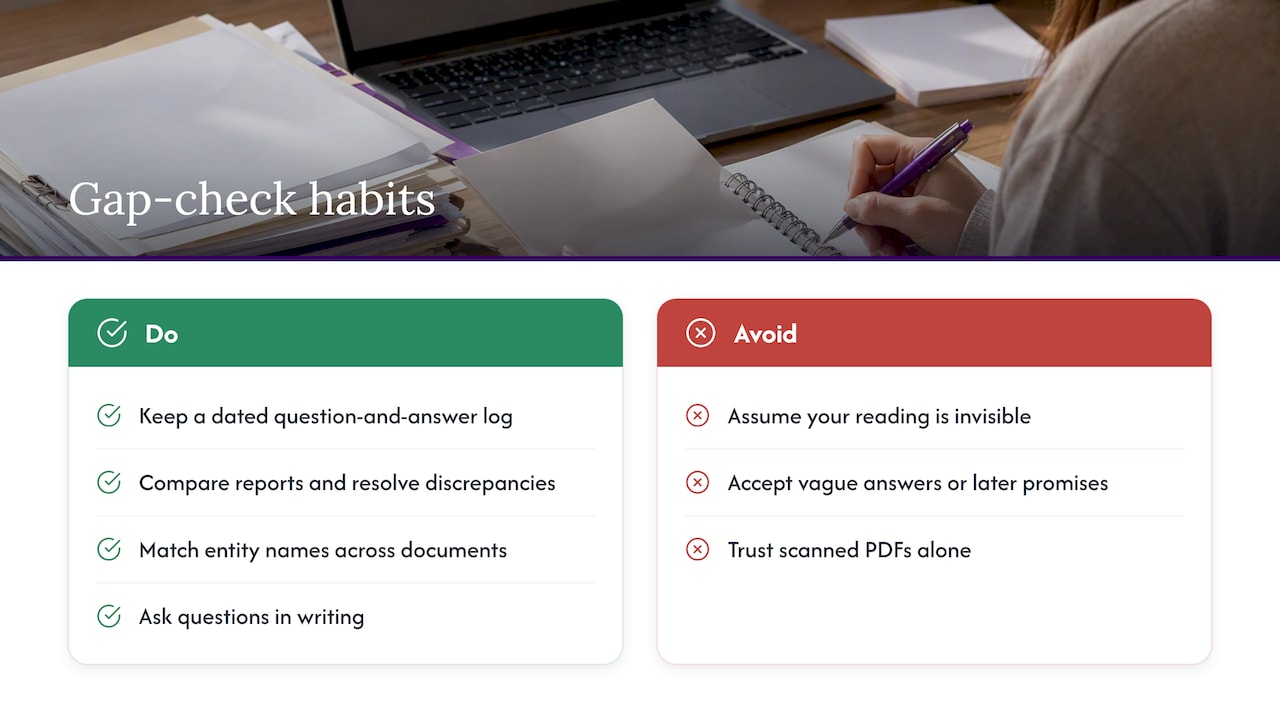
Gaps are normal in a first pass. Patterns of gaps are not. Three habits help.
Keep a data log. The law school study recommends a tailored checklist and a log of requests and responses. It also suggests that buyer and seller each appoint a gatekeeper to handle them, so that the log can serve as evidence if the seller turns unresponsive. For an individual investor, that means one email thread or one spreadsheet, dated, with every question and every answer.
Reconcile across documents. The same source advises comparing internal title reports with field-review results and resolving discrepancies. Apply the idea broadly. Does the well count in the reserve report match the permit list? Do production volumes in the financials match the operator’s reported figures? Do the entity names match across the title, the operating agreement and the offering?
Watch how answers arrive. A prompt, specific answer with a document attached is a good sign. A vague answer, a promise to send it later, or a shift to talking about upside is not. Write down what you asked and how it was handled. That record is also useful if you later decide to walk away.
When a sponsor controls what goes into the room, remember it also gets feedback on how you read it. Virtual rooms can show a seller which documents each bidder opened, which a vendor whitepaper on oil and gas data rooms says can inform negotiations. It is a reason to ask your questions in writing rather than assume your reading is invisible.
Security and access controls to expect
A data room holds sensitive financial, personal and technical information. Reasonable practices come from general U.S. business guidance rather than a rule written for energy deals, and they are worth asking about.
- Least access. The FTC advises limiting remote access to a user’s business need and to the scope and duration of the task, and ending contractor access when the task ends, in its guidance on secure remote access. Ask whether your login sees only your deal.
- Attributable accounts. The same guidance says vendor account use should be traceable to an individual. Shared logins are a red flag.
- Tested cloud settings. The FTC also says companies should actively test cloud repositories for misconfigurations rather than take cloud security on faith, because exposed data is a frequent cause of breach headlines.
You can ask the operator or platform plain questions: Who has access? How are accounts disabled when a person leaves? Are files watermarked or logged? Does the room keep an access record? If the answers are evasive, treat that the way you would treat an evasive answer about title.
How Fieldvest fits into your diligence
We connect accredited investors with vetted U.S. energy projects across three categories: producing assets, development projects and energy infrastructure. Our aim is to present key project materials in a form you can compare, from operators we have screened, so more of your time goes to analysis instead of chasing documents. You can browse the current opportunities on the Fieldvest platform.

If you are still weighing whether energy belongs in your portfolio at all, start with our guide to oil and gas investments for accredited investors, and read how to lower your taxes with oil and gas investments. Our notes on risk mitigation steps for oil projects pair well with the checklist above.
FAQ
What is a data room in oil and gas?
It is a controlled repository of documents a seller or sponsor shares so that a potential buyer or investor can verify an asset. In oil and gas, it typically holds land, well, reserves, financial, legal and environmental records. Today most are virtual, with permissioned access.
What should an oil investment data room checklist include?
At minimum: asset and well records, reserve and production data, title and legal files, financial statements and budgets, environmental permits and plugging liabilities, and the offering and tax documents. Tailor the list to the type of project, since a development project needs different evidence than a producing asset.
How long does data room review take?
It depends on the size of the asset and the number of reviewers. The law school study cited above describes land and title work as usually the most time-consuming piece, so budget the most time there. A small private investment moves faster than a corporate acquisition, but a rushed review is the usual way problems get missed.
What are red flags in a data room?
Watch for missing title documentation, reserve estimates far above historical production, unexplained plugging or environmental liabilities, entity names that do not match across files, and slow or vague answers to specific requests. One gap may be an oversight. A pattern deserves a pause.
Do I need professionals to review it?
For any meaningful commitment, yes. An attorney should read the legal documents, a CPA should review the tax assumptions, and an engineer can test reserves. Their fees are small next to the size of the decision.
Sources
- The data room (peer-reviewed article, PMC)
- Key Points for Sellers during Virtual Data Room Processes (oil and gas whitepaper)
- Due Diligence in Oil and Gas Acquisitions (LSU Mineral Law Institute)
- Oil and Gas Raise Data Room guide
- SEC prospectus supplement, 424B5 (2026)
- EPA Revitalization-Ready Guide, Chapter 3
- FTC: Secure remote access to your network
- FTC: Six steps toward more secure cloud computing
Recommended

Get the Fieldvest Energy Brief
and AI-driven demand shifts — curated for accredited investors. Smart. Strategic. Tax-advantaged.