


A 506© energy offering is a private oil, gas or energy investment sold under Rule 506© of Regulation D. The sponsor may advertise it publicly, but every buyer must be an accredited investor, and the sponsor must take reasonable steps to verify that status. If you earn $200,000 or more a year, or hold $1 million or more in net worth outside your home, you may qualify to see these deals. This guide covers what the rule allows, how verification works, where the tax deductions come from, and what to check in the paperwork before you wire money.
TL;DR
- Rule 506© lets an energy sponsor advertise a private deal openly, but only accredited investors can buy, and the sponsor must verify them.
- Individuals qualify on income above $200,000 ($300,000 with a spouse or spousal equivalent) or on net worth above $1 million excluding a primary residence.
- Oil and gas programs can offer first-year deductions for intangible drilling costs and, on producing wells, percentage depletion. Eligibility and timing depend on your own tax situation.
- These offerings are illiquid and can lose the entire investment. Read the offering documents, fees and the sponsor’s history first.
- Talk to a CPA or tax attorney who knows oil and gas before you rely on any projected deduction.
Table of Contents
- What a 506© energy offering is
- Who can invest
- How accredited status gets verified
- Why energy offerings attract high earners
- How these offerings produce cash flow
- Risks to weigh before you commit
- Our perspective
- Where Fieldvest fits
- A practical path from interest to investment
- Rules to recheck
- FAQ
- Sources
What a 506© energy offering is
Companies that sell securities must either register them with the SEC or use an exemption. Regulation D holds several of those exemptions, and they exist for offerings aimed at investors the law presumes can judge the risks of a private deal without the protections of a fully registered one. The SEC’s investor bulletin on Regulation D private placements explains that design.
In energy, the underlying deal can take several forms:
- Producing assets: working or royalty interests in wells that already generate revenue.
- Development projects: capital to drill new wells, where the early deductions are usually largest.
- Energy infrastructure: pipelines, processing and similar assets that earn fees.
The investment vehicle is often a limited partnership or LLC. You buy a unit, the operator runs the wells, and income, deductions and risk pass through to you in proportion to your stake.
506(b) versus 506©
The two common Rule 506 paths differ mainly in how the sponsor finds you. Under 506(b), the sponsor generally cannot advertise and usually relies on an existing relationship with the investor. Under 506©, the sponsor can use websites, social media, webinars and ads. In exchange, the sponsor cannot simply take your word that you are accredited.

The SEC’s page on general solicitation under Rule 506© states the trade: issuers may broadly solicit and advertise, but all purchasers must be accredited, the issuer must take reasonable steps to verify, and the other Regulation D conditions must still be met. It also requires a Form D notice filed with the SEC within 15 days after the first sale.
For you, the practical difference is simple. If you saw a deal advertised and you are being asked for documents, that is probably a 506© process, and it is normal.
Who can invest
Every purchaser in a 506© offering must be accredited. The text of 17 CFR 230.506 sets that requirement. The SEC’s exempt offerings FAQ gives the individual tests:
| Test | Threshold |
|---|---|
| Net worth | At least $1 million, not counting your primary residence |
| Individual income | Over $200,000 in each of the prior two years, with the same expected this year |
| Joint income | Over $300,000 with a spouse or spousal equivalent, same two-year test |
The income test is why the audience for these deals skews toward W2 professionals, physicians, attorneys, tech executives and business owners. A founder who just sold shares or a crypto investor with a large realized gain may also clear the net worth test even if income varied year to year.
Meeting the threshold means you may be eligible. It does not mean the deal suits you. Accreditation is a legal category, not a suitability review.
How accredited status gets verified
With 506©, the sponsor has to do more than offer a checkbox. The rule requires reasonable steps to verify, and the SEC describes that as an objective determination based on the facts and circumstances of each investor and transaction.
The regulation lists methods that qualify. In practice you will see one of these:
- Tax documents. IRS forms such as W-2s, 1099s or K-1s, or a return, for the two most recent years, plus a statement that you expect the same income this year.
- Financial statements. Bank, brokerage and similar statements for assets, and a credit report for liabilities, for the net worth test.
- A third-party letter. Written confirmation from a registered broker-dealer, an SEC-registered investment adviser, a licensed attorney or a CPA that they took reasonable steps to verify you within the prior three months.
The third-party letter is often the least intrusive route, and many investors ask their CPA for one before they start looking at deals, so the process takes days instead of weeks.
The 2025 no-action letter
In March 2025 the SEC’s Division of Corporation Finance published a no-action letter that eased verification for offerings with minimum investment amounts. As King & Spalding summarized it, an issuer can meet the verification requirement without collecting invasive documents if it requires purchasers to agree to certain minimum investment amounts and obtains specific written representations, among other conditions. Latham & Watkins’ client alert on the letter describes the amounts as generally $200,000 for natural persons and $1 million for legal entities.
Two cautions follow. First, this is staff guidance on one route to verification, and not every sponsor uses it. Second, a high minimum is not a reason to invest more than you intended. Check the SEC’s exempt offerings pages for the current state of the rules, since staff positions can change.
Why energy offerings attract high earners
The pitch for oil and gas programs rests on two features: tax treatment and cash flow. Both are real, and both come with conditions.
First-year deductions for drilling costs
In many oil and gas programs, investors may take first-year deductions for intangible drilling and development costs, the costs of drilling that have no salvage value, such as labor, fuel, site preparation and chemicals. The deduction is an election. An IRS legal memorandum notes that a taxpayer who does not deduct these costs on the return for the first year they are paid or incurred is deemed to have elected to recover them through depletion or depreciation. If you want the first-year deduction, your return has to take it.
If you want the mechanics in more detail, our guide to intangible drilling costs for investors walks through them, and the one on oil and gas depreciation methods covers what happens to the rest of the cost.
Depletion on producing wells
Once wells produce, most investors are permitted to take percentage depletion deductions, which shelter otherwise taxable income to the extent of the deduction. This is why producing assets and development projects serve different goals. Development projects tend to front-load deductions. Producing assets tend to emphasize ongoing income.
What can limit the benefit
A deduction is not a refund. Several things decide whether you can use it:
- How your interest is structured. How you hold the interest, and whether you are treated as having liability, affects how losses are treated. Our piece on nonrecourse debt and oil investors explains one piece of that.
- Your income. A deduction helps most when you have large taxable income to offset. The same deduction is worth less to someone in a lower bracket.
- Phantom income. A partnership prospectus filed with the SEC warns that investors may owe tax on their share of partnership income even when they receive no cash distributions.
- Tax classification. The same prospectus notes that if the IRS treated the partnership as a corporation, cash available for distribution would be substantially reduced.
To see how deductions might scale against your own bracket, try our oil and gas tax deduction calculator, then take the numbers to your CPA. For a broader walkthrough, see how to lower your taxes with oil and gas investments.
How these offerings produce cash flow
Producing wells sell oil and gas, and after operating costs, the net revenue is distributed to investors under the partnership terms. Three things shape what reaches you:
- Production and prices. Wells decline over time, and commodity prices move. Distributions are not fixed.
- Fee layers. Sponsors, general partners and dealer managers can earn management and incentive fees. The prospectus noted above says the dealer manager may receive incentive fees on distributions after unit holders receive specified amounts. Read the waterfall.
- Structure. A limited partner’s liability is generally limited to capital contributed, including amounts agreed to be contributed in the future, according to Tax Facts. That is worth confirming for any future capital calls.
A projected yield in a pitch deck is a forecast. Ask what assumptions it uses for price, decline rate and operating cost, and who prepared the reserve estimate.
Risks to weigh before you commit
The SEC’s investor alert on private oil and gas offerings says these deals carry unique risks, including the potential loss of the entire investment and typically less liquidity. Plan on holding for years and assume you cannot sell early.
Other risks come from the structure:
- Blind pools. A blind-pool offering has not yet identified its properties. The prospectus cited above also lists management’s limited operating experience as a risk in that case. Know whether you are buying specific wells or a promise to find them.
- Limited fiduciary duty. The partnership agreement in that prospectus limits the general partner’s fiduciary duty. Read what protections you actually have.
- Concentration. One operator, one basin and one commodity can all move against you at once.
Checklist from the SEC
The same SEC alert tells investors to review the following. Use it as your due diligence list:
- The written offering materials.
- Use of proceeds and sales fees.
- Related-party relationships between the sponsor, operator and affiliates.
- The promoter’s history.
- Third-party reports.
- Well history.
- Reserve estimates.
Our article on how accredited investors vet private oil and gas deals applies this kind of checklist in practice.
Check who is selling it
Because 506© deals are advertised, you will meet them through ads, social posts and cold messages, and that is also where fraud shows up. Before you share any financial documents, confirm the person and the company are who they say they are, look up registration and disciplinary history, and never send money or documents to an unverified contact. A quick two-minute scam self-check can catch obvious red flags in a website or message before you go further. Legitimate sponsors expect you to ask these questions.
Our perspective
We built Fieldvest for people who earn well, pay a lot of tax and want to understand what they are buying. Most of the confusion we see is not about the rule. It is about the order of operations. Investors fall in love with a deduction figure, and only later ask who the operator is, what the fees are and how they get out.
Our view is that the tax benefit should be the second question. The first is whether you would want to own the asset without the deduction: a well, a royalty stream or an infrastructure position run by an operator you have looked at closely. The deduction is a feature of the asset, not a reason for it.
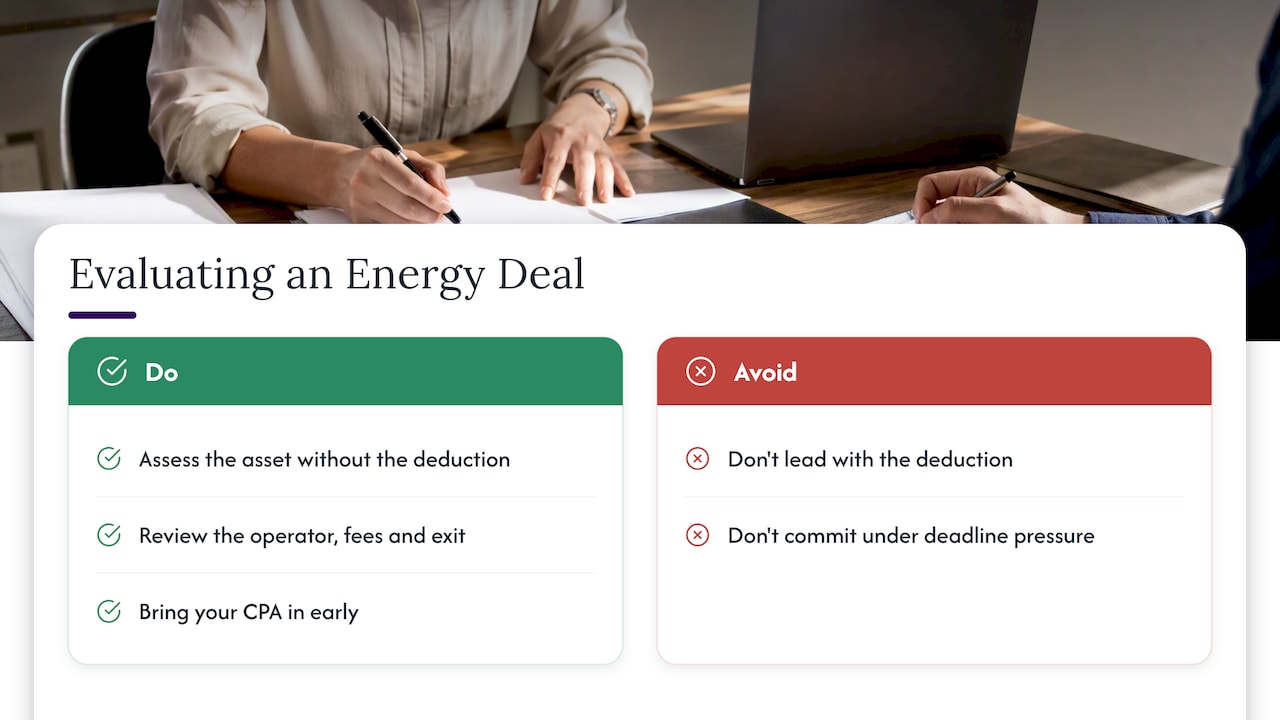
That is why we focus on vetted and screened operators, lay out key project materials in a consistent way so you can compare deals side by side, and give access to off-market energy deals designed for accredited investors. Verification is not a hurdle to resent. It is the rule doing its job, and a sponsor that handles it carefully is usually one that handles the rest carefully too.
We would also rather you walk away from a deal you do not understand than commit to one because a deadline was pushed on you. Bring your CPA in early. A good one will tell you quickly whether the deductions fit your return.
— Sharif
Where Fieldvest fits
Fieldvest is a marketplace where accredited investors can invest directly in vetted U.S. energy projects. You can browse three kinds of opportunity: producing assets, development projects and energy infrastructure. Each is presented with the key materials you need to compare, so you can judge the operator, the structure and the terms in one place.

If you are accredited and want to see what is available, start at Fieldvest and review the current deals. Our guide to oil and gas investments for accredited investors is a good primer first.
A practical path from interest to investment
Here is a sequence that keeps you in control:
- Confirm your status. Check your last two years of income and your net worth excluding your home against the thresholds above.
- Line up verification. Ask your CPA or attorney whether they can provide a verification letter, or gather tax forms and statements.
- Define your goal. Is it first-year deductions, ongoing income, or both? That points you toward development, producing or infrastructure.
- Read the documents. Work through the SEC checklist. Pay particular attention to fees, related parties and capital calls.
- Model the tax effect. Run your numbers with your CPA, including how the deduction interacts with the rest of your return.
- Size the position. Treat it as illiquid money you can afford to lock up and could in a bad case lose.
- Confirm the filings. Ask whether the sponsor filed its Form D, and check it on the SEC’s EDGAR database.
A worked example makes the point. Say a physician with high W2 income is considering a development project. The goal is a large deduction in the first year. The questions that matter are not only how large the deduction might be, but whether her income is enough to use it, how the interest is held, what happens if the wells underperform, and what the fees take from distributions. Those questions apply to every deal, and the good sponsors answer them in writing.
Other investors will approach this differently. A tech executive after a liquidity event may care more about spreading a one-time gain across several years of planning. A real estate investor may compare the depletion and depreciation profile with what they already own. A crypto investor with realized gains may want to know how quickly deals close. In each case, the first step is the same: understand the asset.
If you are exploring other categories before choosing, our overview of accredited investor opportunities compares several types, and our article on mineral rights investing covers one route in detail. Doctors in particular may find why physicians invest in oil and gas relevant.
Rules to recheck
The rules covered here can change. The SEC’s verification guidance shifted in 2025, and tax law on drilling deductions is set by Congress and the IRS. Before you invest, confirm the following on official pages:
- The current Rule 506© text and any new staff guidance on the SEC’s exempt offerings pages.
- The current accredited investor definition.
- IRS guidance on intangible drilling costs and depletion for the year you plan to claim them.
Your CPA or tax attorney should confirm how each applies to your return. Nothing here is tax, legal or investment advice.
FAQ
Can anyone invest in a 506© energy offering?
No. Every purchaser must be an accredited investor, and the sponsor must take reasonable steps to verify it. Individuals generally qualify with income above $200,000 ($300,000 with a spouse or spousal equivalent) or net worth above $1 million excluding their primary residence.
Why am I asked for tax returns or a letter from my CPA?
Because 506© sponsors may advertise publicly, they cannot rely on a self-certification alone. Reviewing tax forms or financial statements, or getting written confirmation from a registered broker-dealer, SEC-registered adviser, attorney or CPA, are accepted methods. Some sponsors may use the 2025 minimum-investment approach instead.
Are the tax deductions guaranteed?
No. Many oil and gas programs offer first-year deductions for intangible drilling costs, but you must elect them on your return, and your ability to use them depends on your income and how you hold the interest. You may also owe tax on partnership income without receiving cash. Review the projections with your CPA.
What is the biggest risk in a private energy offering?
The SEC warns that you can lose your entire investment and that these deals are typically less liquid than public securities. Fees, related-party arrangements and blind-pool structures add further risk. Read the offering documents and the sponsor’s history before you commit.
Sources
- Private Placements under Regulation D: Investor Bulletin (SEC Investor.gov)
- General solicitation, Rule 506© (SEC)
- 17 CFR 230.506
- Frequently Asked Questions About Exempt Offerings (SEC)
- Assessing Accredited Investors under Regulation D (SEC)
- SEC Staff No-Action Letter Eases Rule 506© Accredited Investor Verification (King & Spalding)
- Latham & Watkins client alert on the 506© letter
- Why Are Oil and Gas Limited Partnerships Attractive to Individual Investors (Tax Facts)
- IRS legal memorandum on intangible drilling costs
- Partnership prospectus filed with the SEC (2017)
- Private Oil and Gas Offerings (SEC investor alert)
Recommended

Get the Fieldvest Energy Brief
and AI-driven demand shifts — curated for accredited investors. Smart. Strategic. Tax-advantaged.