


A pooling clause lets the operator combine your leased acreage with neighboring tracts to form one drilling unit. Production from a well on that unit is then shared among everyone in it, usually in proportion to the acreage each owner contributed. It is one of the most consequential paragraphs in a lease. It decides where your royalty comes from, how long your lease survives, and how much control you keep.
This guide explains what the clause says, what forced pooling is, how pooling differs from unitization, and which terms deserve a second look. It is written for mineral owners and for accredited investors who evaluate projects built on leases like these.
TL;DR
- A pooling clause gives the operator the right to merge your tract with others into a drilling unit. Your share becomes a slice of the unit’s production, not the output of one well on your land.
- Forced (compulsory) pooling is a state process for owners who will not lease or participate. It is a regulatory tool, not a penalty, and the rules differ sharply by state.
- Pooling joins tracts for a well or spacing unit. Unitization manages a whole reservoir or field as one engineering unit, usually for secondary recovery.
- Check unit size limits, how your share is calculated, and whether the lease has a Pugh clause or anti-dilution language.
Table of Contents
- What a pooling clause actually does
- How your share is calculated
- Forced pooling: when a state steps in
- Pooling vs. unitization
- What to check in a pooling clause
- What pooling means if you invest in energy projects
- Our perspective
- Looking at projects built on well-documented leases
- FAQ
- Sources
What a pooling clause actually does
An oil and gas lease normally covers a specific tract. Without special language, the operator cannot treat that tract as part of anything larger. A lessee has no power to pool unless the lessor expressly authorizes it, and that authorization is what the pooling clause provides.
The practical reason is well spacing. States set rules about how much acreage a single well needs, so many small or irregular tracts cannot support a permit on their own. Pooling is the joining of small tracts sufficient for the granting of a drilling permit under the applicable spacing rule. The clause is how an operator assembles that acreage by contract.
A Texas law review article on horizontal drilling summarizes what the clause in most leases does. It lets production and operations be shared across lease lines, and it lets operations on one tract count as operations on any pooled tract. It also decides how much of the production belongs to each lease.
The clause as an option held by the operator
Legal scholarship describes the pooling clause as an option the lessor grants to the operator. Once the operator exercises it, the “leased premises” are redefined from your tract to the whole unit.
That cuts both ways:
- For the operator: work anywhere on the unit keeps the entire lease alive, including the lands where nothing has been drilled. That is why pooling is a main tool for holding acreage without drilling every tract.
- For the mineral owner: your royalty no longer depends on a well landing on your specific acres. It depends on your acreage being inside a productive unit.
The trade-off is dilution. If your 40 acres sit inside a 640-acre unit, you share in the unit’s output at roughly your fraction of that acreage, not at the rate of a well drilled on your land alone.
How your share is calculated
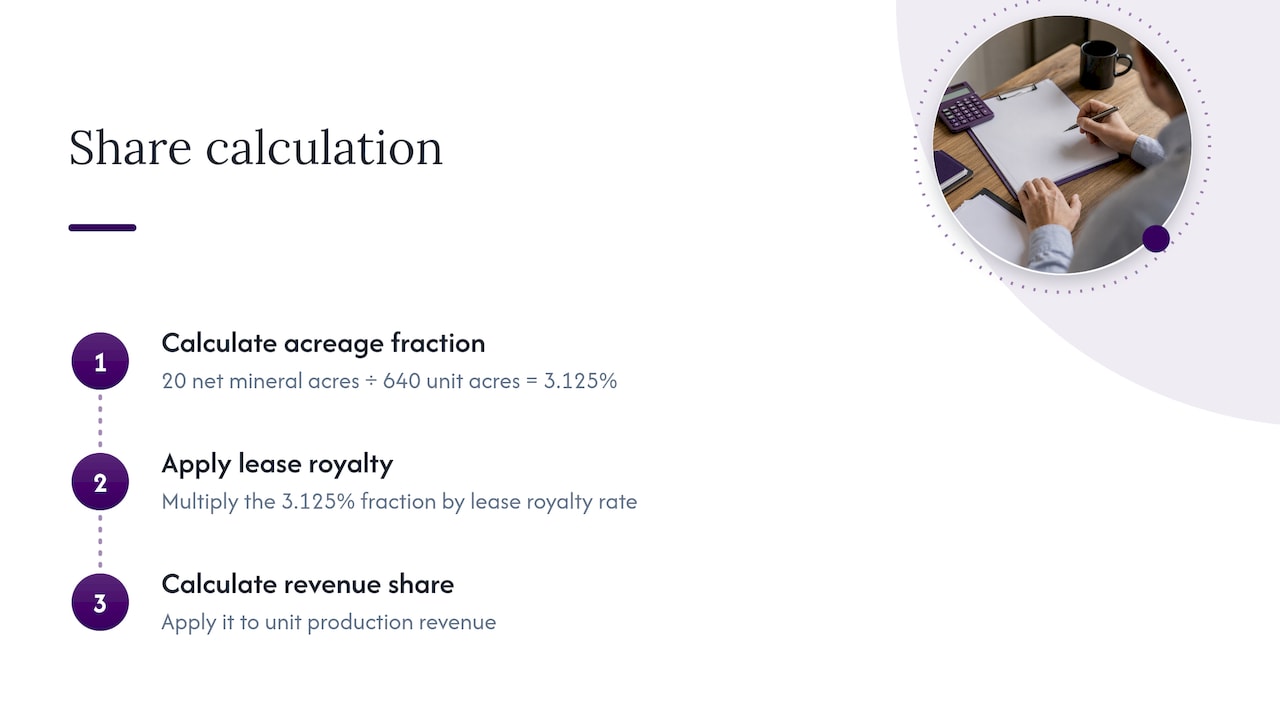
In most pooling arrangements, each owner’s share is the net mineral acres they contribute divided by the total acres in the unit. Say you own 20 net mineral acres in a 640-acre unit. Your fraction is 20/640, or 3.125%. Your royalty is then that fraction multiplied by your lease royalty rate, applied to the unit’s production revenue.
That is a simplified illustration. Actual payments depend on the lease terms, deductions, and the division order. Before you sign one, read our checklist of division order terms, because that document is where the unit fraction is written down.
Unit sizes vary. Kentucky guidance and industry summaries describe pooling units that typically range from 40 to 640 acres, and horizontal drilling has pushed typical unit sizes up in many states. A Pennsylvania law firm notes that horizontal drilling there calls for much larger units than vertical wells did, which sharpens the dilution question for landowners with scattered holdings.
Forced pooling: when a state steps in
What happens if an owner within a spacing unit will not lease or join the well? Many oil-producing states have a process for that. Forced pooling, also called compulsory or involuntary pooling, is a process in which a state authority issues a pooling order requiring owners within a unit to share in development.
It is easy to read this as a taking. The regulators describe it differently. Oklahoma’s Corporation Commission explains that pooling is a means of forcing interest owners in a spacing unit to come to a decision. The aim is to stop one holdout from blocking development that benefits the rest of the unit.
How the process works in Oklahoma
Oklahoma is a useful example because the agency publishes its process. Oklahoma law permits only one initial well in a drilling and spacing unit. An owner who wants to propose a well must secure the commitment of the other owners. Those owners must share in the cost or lease their interest.
In outline:
- The operator makes a good-faith effort to reach a voluntary agreement with every interest owner.
- If that fails, the operator files a pooling application with the Commission.
- After notice and a hearing, the Commission issues a pooling order.
- Each unleased owner then has a set window, typically 20 to 30 days, to elect. The choices are to pay a proportionate share of drilling costs or to accept a lease-type alternative, usually a cash bonus plus a royalty.
- An owner who does not elect is often treated as having leased on the terms the Commission set.
Administrative law judges are responsible for confirming that all respondents were notified. They also check that the terms offered to an unleased owner are comparable to fair market lease terms nearby.
Non-consent and risk penalties
When an owner chooses to participate but not to front the cost, many states let the operator carry that share. The owner pays nothing up front, and the operator recovers its costs from that owner’s share of production, often with a penalty for the capital risk. Kentucky’s statute is the example researchers cite, with a 200% figure for the recovery. Other states use different multiples, so read the statute for the state your well sits in.
States do not agree
Forced pooling is not universal. In Pennsylvania, no compulsory pooling can be ordered by state agencies, so pooling is purely a matter of the contract and has to be written into the lease. Texas has a narrower statutory route. A recent Texas Supreme Court decision, described by a Texas energy law firm, upheld the Railroad Commission’s rejection of applications under the Mineral Interest Pooling Act because the applicant had not made a fair and reasonable offer to pool voluntarily. Louisiana sets its own terms for pooling interests in units the state creates.
The lesson: the same operator, the same lease form and the same well design can land very differently depending on the state.
Pooling vs. unitization
The two words are used interchangeably in casual conversation, and the lawyers say so themselves. Still, each has a specific meaning.
| Pooling | Unitization | |
|---|---|---|
| Scope | Tracts joined for one well or spacing unit | Much or all of a reservoir or field |
| Typical stage | Primary recovery | Mature fields, secondary recovery, pressure maintenance |
| How shares are set | Usually surface acreage ratio | Participation factors, which can weigh reservoir factors such as recoverable hydrocarbons or thickness |
| Origin | Lease clause, or a state order in forced pooling | Voluntary agreement among owners, or a regulatory order in states that allow it |
Both change how your share is calculated, which is why they get confused. The purpose is also shared. Practitioners describe both as replacing artificial property lines with an engineering approach, since without them the rule of capture can encourage competitive, inefficient drilling that strands oil and gas in the reservoir.
The difference matters when you read a document. A pooling clause in a lease usually governs a unit built around a well. A unit agreement for secondary recovery is a separate, more complex contract with its own formula. In voluntary agreements the formula can be negotiated. In compulsory scenarios it is set by order.
What to check in a pooling clause
You do not need to be a lawyer to spot the terms that matter. Have an oil and gas attorney in the relevant state review anything you sign. These are the questions to bring.
1. How big can the unit be? Look for a stated acreage cap or a tolerance above the state’s spacing rule. A clause with no limit lets the operator dilute you across a very large unit.
2. Is there an anti-dilution provision? Some leases require a minimum share of the unit to consist of your land. The Pennsylvania example language set that floor at 75% of the unit. That helps mostly owners with large holdings.
3. Does a Pugh clause release unused acreage? A Pugh clause releases land that is not in a producing unit once the primary term ends. Without one, a single pooled well can hold everything. Our Pugh clause checklist covers the vertical and horizontal versions.
4. How is production allocated? Acreage-weighted allocation is the common default. Confirm that the lease says so, rather than leaving the method to the operator.
5. How and when must you be notified? The clause should require a recorded designation of the unit. You want to know when you have been pooled.
6. Can you audit the numbers? Once your royalty depends on a unit allocation, you need the right to verify it. See the audit clauses investors should check.
What pooling means if you invest in energy projects
If you buy into a producing asset or a development project, you are often relying on leases that contain pooling clauses you never negotiated. Three things follow.
First, lease maintenance. Because operations anywhere in a pooled unit can keep every tract in it alive, the pooling language affects how long the operator can hold acreage. That bears on the life of the asset.
Second, revenue. Your return flows from the unit fraction and the unit’s production, not from any single parcel. Ask for the unit map, the unit acreage and the net acres attributed to the project.
Third, jurisdiction. Whether a holdout can be forced in, and at what cost, depends on the state. A project in Oklahoma has different options available to the operator than one in Pennsylvania.
Taxes are a separate layer. Royalty income from a pooled unit is taxed like other royalty income, and the way you hold it changes the picture. Our guides on the oil royalty tax rate and depletion and on net investment income tax on oil royalties go through the rules, and a CPA who knows energy should confirm how they apply to you.

Our perspective
We talk with accredited investors who understand taxes far better than they understand leases. The pooling clause is where that gap shows up. It rarely makes a headline, yet it shapes how the asset behaves for years.
When we look at an operator and a project, we want the lease structure on the table early. That means the unit size, how the allocation works, what happens at the end of the primary term, and which state’s pooling rules apply. A deal can look strong on a deduction schedule and still depend on acreage that is diluted or exposed to release. Presenting those project materials side by side is a large part of why we built Fieldvest the way we did: you should be able to compare projects on the terms that govern the cash flow, not only on the headline.
Our advice is simple. Treat the pooling clause as a financial term. Ask for the unit documents. Have counsel read them. And do not assume that two projects with similar returns share the same legal footing.
— Sharif
Looking at projects built on well-documented leases
Fieldvest connects accredited investors with vetted U.S. energy operators across producing assets, development projects and energy infrastructure. If you want to see how deals are presented, you can browse the offerings on Fieldvest. If you are weighing the tax side first, use the free oil and gas tax deduction calculator, or read how mineral rights investing can capture year-one deductions. Investments are available to accredited investors only.
FAQ
Is a pooling clause good or bad for a mineral owner?
Neither, by itself. It can make your royalty more stable, because you share in a unit rather than depending on one well on your land. It can also dilute your share and let an operator hold your lease by drilling elsewhere. The terms around it, such as unit size limits and a Pugh clause, decide which effect dominates.
Can an operator pool my land without my permission?
Under a lease, only if the lease grants pooling authority. Without that authorization, a lessee has no power to pool. If you have not leased, some states allow forced pooling through a regulatory order, while others, such as Pennsylvania, do not.
What are my options if I am force pooled?
The options depend on the state. In Oklahoma, an unleased owner typically has 20 to 30 days to elect between paying a share of drilling costs or taking a lease-type alternative such as a bonus and royalty. Missing the deadline can mean being treated as leased on the Commission’s terms. Contact the state agency and an oil and gas attorney as soon as you receive notice.
What is the difference between pooling and unitization?
Pooling joins tracts into a drilling or spacing unit for a well, usually in primary recovery. Unitization operates a whole reservoir or field as one unit, often for secondary recovery, and uses participation factors rather than a simple acreage ratio. Both change how your share of production is calculated.
Sources
- Pooling Order Information, Oklahoma Corporation Commission
- Forced Pooling in Oklahoma, Oklahoma Corporation Commission
- KRS 353.640 Pooling order, Kentucky Legislature
- Louisiana Laws, Louisiana State Legislature
- Forced Pooling (US), Practical Law
- What’s in a Name? Is Texas House Bill 100 Really Forced Pooling?, Energy & the Law
- Unitization, FindLaw
- Pooling Clauses and Statutes, Texas A&M Law Scholarship
- Modifying Oil & Gas Documents for Horizontal Drilling
- The Texas Supreme Court and Oil and Gas Jurisprudence, St. Mary’s University
- Not Your Father’s Oil and Gas Lease, Hanna & Hanna Law
- Texas Supreme Court Rejects Forced Pooling of Riverbed Minerals
- Pooling, Unitization, and Joint Leases, USLegal
Recommended

Get the Fieldvest Energy Brief
and AI-driven demand shifts — curated for accredited investors. Smart. Strategic. Tax-advantaged.